
Edible
Finger Millet
Eleusine coracana
Also known as Ragi, African millet, Nachni, Kodo
How to grow finger millet, Eleusine coracana. The clenched fist of seed heads, more calcium than any other cereal, and a grain that keeps for a decade.
At a glance
- Difficulty
- Moderate
- Water
- Water at establishment, then sparingly
- Light
- Full sun
- Temperature
- 20-30 deg C, and it tolerates cooler nights than most millets
- Hardiness
- USDA 9-11, RHS H2, hardy to 10 C
- Type
- Tender annual grass
- Height
- 40-100 cm
- Native to
- the Ethiopian and Ugandan highlands
- Best month
- May and September in the Northern Hemisphere, November and March in the Southern Hemisphere
It grows at higher altitudes and in cooler conditions than pearl millet, which is why it is the staple of the east African and Indian highlands rather than the lowlands, and it still wants three to four months of warmth. The grain stores for years without insect damage because the seed coat is so hard, which made it the traditional famine reserve. It is the highest-calcium cereal by a wide margin.
Hardiness zones describe winter cold alone. Summer heat, humidity, rainfall and the length of the growing season decide as much, so treat the range as the outer limit rather than as a recommendation.
Every month named in this guide is for the temperate Northern Hemisphere. If you garden in the Southern Hemisphere, shift each one by six months, so May becomes November. Closer to the equator the wet and dry seasons matter more than the calendar, and the shift stops being a useful guide.
Not known to be toxic
- Safe to eat
- The whole grain, milled with the bran in
Finger millet contains no gluten and no toxic compound worth naming. It is a staple across the Indian Deccan and the east African highlands, eaten as ragi mudde, porridge and flatbread, and it is traditionally one of the first solid foods given to infants in southern India. The grain is unusually high in calcium, at roughly ten times the level in rice or wheat, which is a real nutritional distinction rather than a marketing one, and it is milled whole because the calcium sits in the seed coat. Nothing about the plant requires a safety warning, and the crop is notable in the opposite direction for storing for years without insect damage, which is why it served as a famine reserve.
About
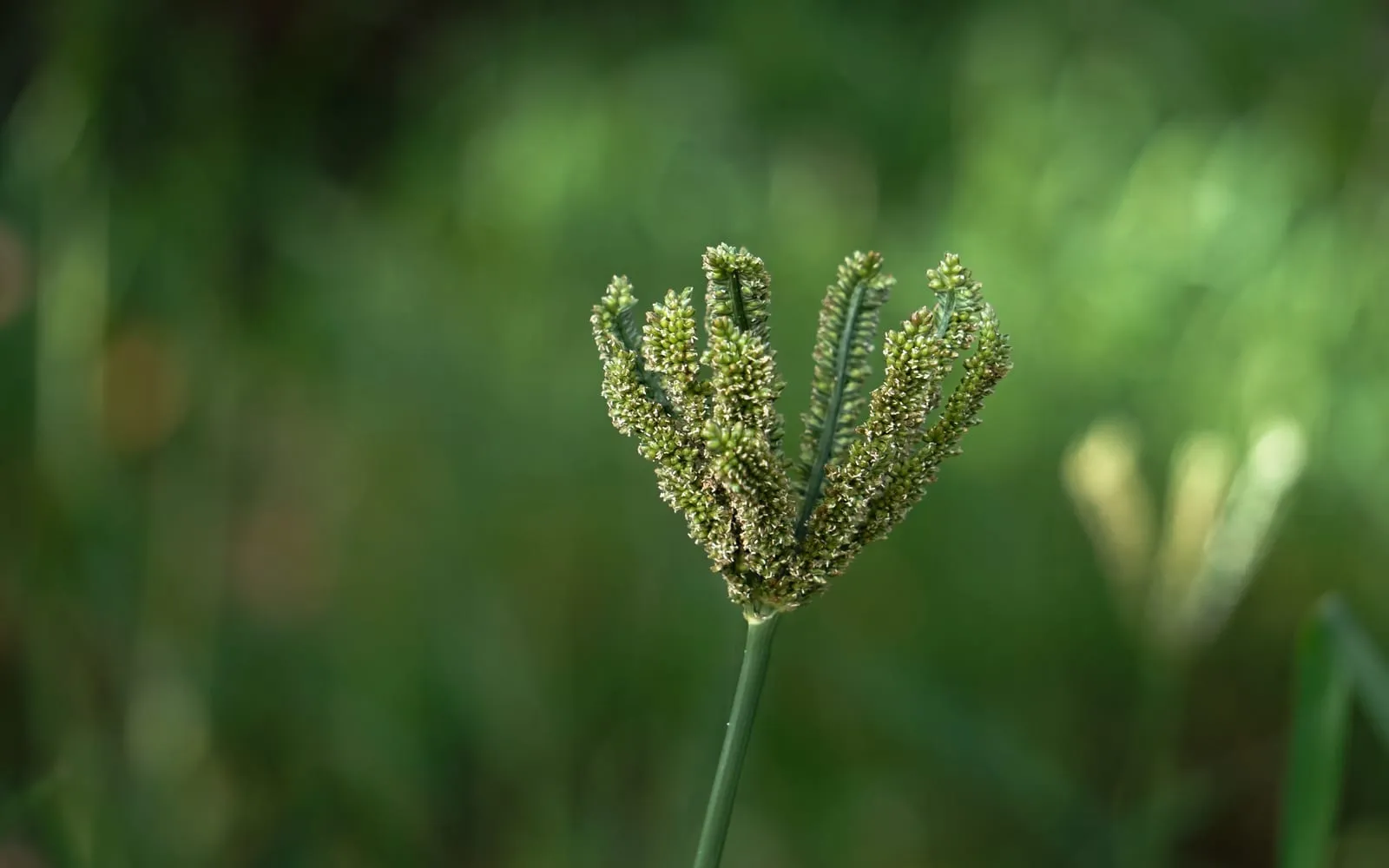
Finger millet is named for its head, which carries four to six short thick spikes radiating from a single point at the top of the stem and curving inward like the fingers of a loose fist. Nothing else in a field looks like it.
The crop was domesticated in the highlands of Ethiopia and Uganda and carried to India around 1800 BC, and India now grows more of it than Africa does. As ragi it is a staple across Karnataka, Tamil Nadu and Andhra Pradesh, eaten as a stiff porridge, as flatbread and as the first solid food many children are given.
Two properties make it more than another small millet. Its calcium content is roughly ten times that of rice or wheat, which matters in diets built on cereals. And the grain stores for years without insect attack, which is why villages kept it as the reserve against a failed season.
Appearance and character
The head decides it. Several stiff spikes, each 5 to 15 cm long and about as thick as a pencil, all emerging from one point at the stem tip and curling inward. As they ripen they darken and the curl tightens, which is where the comparison to a fist comes from. Some varieties carry one extra spike set a little lower down the stem.
The plant is a compact tufted grass with narrow folded leaves and a distinctly flattened stem base. It tillers heavily, so a single seedling produces a clump.
The seed is tiny, about 1.5 mm across, round and hard, and it ranges from pale brown through red to almost black. Unlike most millets it threshes free of any hull, so the grain that comes off the head is ready to mill. That absence of a hull is a considerable practical advantage over every other millet grown.
Where it is from
Finger millet was domesticated in the highlands of Ethiopia and Uganda from the wild Eleusine coracana subspecies africana, which still grows across east Africa. The archaeological record is thin, and the genetic evidence points to a domestication some three to five thousand years ago.
It reached India early, with archaeobotanical finds from around 1800 BC in Karnataka, and became more important there than in its homeland. Indian production now exceeds African production several times over.
The crop belongs to the highlands rather than the plains, growing at altitudes from 1,000 to 2,400 m in both Africa and India. That preference for cooler conditions is why it tolerates a cool summer better than pearl millet does, though it still needs three to four months of warmth.
How it grows
Finger millet has minute seed and correspondingly tiny seedlings, which are slow and vulnerable for the first three weeks. Traditional practice raises it in a nursery bed and transplants it, for exactly that reason.
Once established it tillers heavily and grows steadily rather than fast, taking three to four months from sowing to harvest, which is longer than proso or foxtail millet.
The head emerges from the top of the stem, the spikes spread and then curl, and grain fill takes about four weeks. The plant is self-pollinating. Ripe seed is held firmly and does not shatter, which makes harvest less urgent than with the other millets here.
Through the seasons
Sow indoors in April in modules, or outdoors from late May once the soil has reached 15 deg C. The seed is tiny, so sow it shallowly and firm it rather than burying it.
Transplant or thin to 20 cm apart. Growth is slow through June and picks up in July, and heads appear in August on a plant that has been tillering all summer.
Harvest in late September or early October when the spikes have darkened and the seed is hard. The crop holds its grain, so a week either way does no harm. Cut the heads, dry them, and rub the seed out. No hulling is needed.
Care difficulty
The growing is straightforward and the season is the problem. Finger millet takes three to four months of warmth from a cool summer that supplies perhaps three, so raising it under cover in April and planting it out in late May is the difference between a crop and a green clump.
The seedlings are the vulnerable stage. They are minute, slow, and easy for a slug to remove entirely, which is why transplanting from modules works better than direct sowing here.
Everything after that is easy. The plant tillers into a solid clump, holds its seed, threshes free of any hull, and mills without further processing. Among the millets, this is the one to grow if you want to eat the result.
Watering
Water through establishment and while the plants are small, since the shallow root system of a seedling dries out quickly.
Once the clump has formed, water sparingly. The crop is drought tolerant and does its best work on ground that is not kept wet, though it responds to a soak during head fill in a dry August.
Waterlogging is poorly tolerated. Finger millet grows on free-draining upland soils in both its homelands, and a wet heavy bed produces yellow stunted plants.
Warning signs, diseases and pests
Blast is the disease of finger millet worldwide, caused by the same fungal genus that causes rice blast. It produces spindle-shaped grey-centred lesions on the leaves and, more seriously, rots the neck below the head so the whole thing dies while still green. Humid crowded conditions bring it on.
Birds take ripening heads, though less enthusiastically than they take the loose-seeded millets, since finger millet holds its grain tightly.
Slugs are the significant early pest because the seedlings are so small. Raise the plants in modules and put them out at 10 cm tall rather than direct sowing into a slug-populated bed.
Lodging follows feeding, as with every millet. Aphids appear on the growing tips in hot dry weather and are a nuisance rather than a threat.
Fall armyworm feeds hidden in the whorl and can kill a seedling outright, and this crop is grown across much of Africa, where the pest has become a major threat since first arriving in 2016. Check the whorl for frass from the seedling stage. It has not established in Europe or New Zealand.
Desert locust swarms can strip a field to bare stems within hours during an upsurge, across an invasion area spanning North and West Africa, the Middle East and south-west Asia that overlaps much of this crop’s own range. It is the most destructive migratory pest on earth, and a hopper band or swarm should be reported to the national locust control authority immediately.
Growing environment
Full sun and shelter. The plant is a highland crop and tolerates cooler nights than pearl millet or sorghum, but it still needs sustained warmth through a long season.
Soil should drain freely and can be poor and acid. Finger millet grows well from pH 5 to 7.5 and tolerates the aluminium toxicity that acid soils bring, which is part of why it succeeds on weathered tropical uplands.
Where summers are short the practical answer is a raised bed in the sunniest position available, or a polytunnel. A cool wet August will produce heads that never fill.
Feeding
Feed lightly. Finger millet was farmed for millennia on unfertilised upland soil and responds to generosity by growing tall and falling over.
One dressing of a balanced granular feed at around six weeks is enough on tired ground, and nothing at all is right on a bed that grew a fed crop last year.
The crop’s tolerance of poor soil is part of its role in the systems that grow it, where it goes into ground at the end of a rotation and still produces something worth storing.
Troubleshooting
Why is it called finger millet? The head carries four to six thick spikes radiating from one point and curling inward, which looks like the fingers of a loosely closed hand.
Is ragi the same thing? Yes. Ragi is the Indian name, and ragi flour, ragi mudde and ragi malt are all made from this species.
Does it need hulling? No, and that is its great advantage over every other millet. The grain threshes free and is milled whole, seed coat included, which is where the calcium sits.
Is the calcium claim real? Yes. Finger millet carries roughly ten times the calcium of rice or wheat, at around 300 mg per 100 g, and that is a genuine nutritional distinction in diets built on cereals.
Will it fill a head where I am? It needs three to four months of warmth, which USDA zone 9 and warmer supplies outdoors. In a cool summer it needs a start under cover and a polytunnel or a sunny sheltered bed.
Why did my seedlings disappear? Slugs. Finger millet seedlings are minute and slow for their first three weeks. Raise them in modules and plant them out at 10 cm tall.
How long will the grain keep? Years. Finger millet is famous for storing without insect damage, which is why farming communities kept it as the reserve against a failed harvest.
Finger Millet problem guides
Not sure what is wrong? See the common vegetable pests guide.
- Birds on the ripening heads
- Slugs on seedlings, which are very small
- Aphids on the growing tips
- Blast, the main disease of the crop, which kills the neck of the head
- Frost, which ends the season at both ends
- Fall armyworm, established across Africa, Asia and Australia since 2016
- Desert locust, capable of stripping a whole crop in a swarm year