
Pest
Leek moth
Acrolepiopsis assectella
Also called Onion leaf miner, Leek moth caterpillar
Pale windows mined through the leaves, a caterpillar in the heart of the leek and a net-like cocoon on the surface. A pest that has spread across most of Britain since 2000, and the mesh that stops it.
At a glance
- Type
- Pest
- Cause
- Insect
- Severity
- Destroys the crop or display
- Affects
- Herbs and edibles
- Active
- May to October
- Established in
- Europe, Asia and North America
What you are seeing
- Elongated whitish or translucent windows mined through the leaf, visible when held to the light
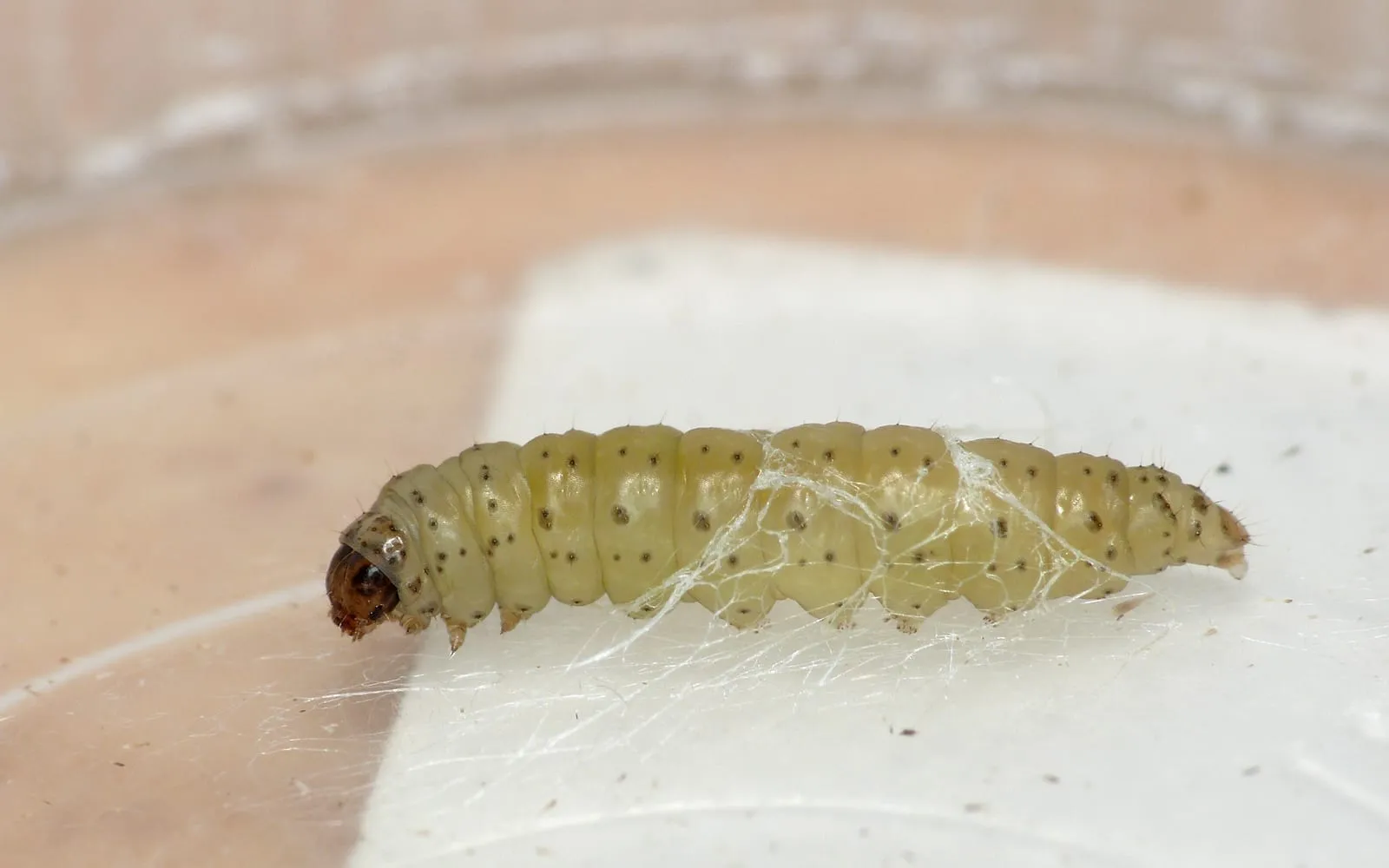
- A pale green caterpillar up to 13 mm long, with a brown head and faint dark spots
- Tunnels running down into the heart of a leek, or into the neck of an onion
- A loose white cocoon like a piece of netting, spun on the outside of a leaf
- Leaves yellowing and dying back from the tip
- Soft rots following the tunnels down and spoiling the whole plant
- Damage arriving in two waves, one in late spring and a heavier one in late summer
Before you treat anything
Tunnelled tissue often carries a secondary soft rot. Cut it away and use the sound part of the leek, and discard any that smells bad or has gone slimy.
What you are looking at
Hold a leek leaf up to the light. Leek moth caterpillars feed inside the leaf, grazing away the tissue between the two surfaces, so what is left is a pale elongated window with the outer skin still stretched over it. Several mines run down the same leaf and the blade dies back from the tip.
Peel the outer leaves off and the caterpillar is in the heart. It is pale green, up to about 13 mm long, with a brown head and faint darker spots along its body. Behind it are tunnels running down towards the base of the plant, packed with frass, and those tunnels are the route the soft rots take afterwards.
On the outside of a leaf you may find the pupa, and it is unmistakable. A loose, open white cocoon, spun like a piece of coarse netting with the brown pupa visible inside it. Nothing else on an allium in a British garden makes one.
Onions and shallots show the same mines and then tunnelling into the neck and the bulb. Garlic and chives get it too, and on chives the damage often reads as the clump failing for no visible reason.
A pest that has arrived recently
Leek moth was for a long time a local insect of the south coast and the Channel Islands. From the late 1990s it moved inland and northwards, and it is now found through most of England and Wales with records well into Scotland.
Gardeners who grew leeks for thirty years without meeting it are meeting it now, and older gardening books either do not mention it or describe it as a curiosity of Kent and Cornwall. Anyone searching for what is wrong with their leeks will find plenty of advice written before this became a mainstream problem.
Two generations, and which crops sit in the way
Adults are small brown moths about 15 mm across the wings, with a white triangle on the trailing edge of each forewing. They fly at dusk and are almost never seen.
The first flight runs from around April into June, from moths that spent the winter as adults in sheds, hedge bottoms and among standing alliums. Eggs go on the leaves, the caterpillars mine and then tunnel, and they pupate in those netted cocoons.
The second flight, in August and September, is the larger one and does most of the damage, because it lands on maincrop leeks that are sizing up and on onions approaching harvest. Those caterpillars feed into the autumn.
Salad onions and autumn-planted garlic often miss the worst of it by timing. Maincrop leeks stand through both flights and cannot dodge either, which is why they are the crop worth covering.
Mesh, and why it has to be done properly
An insect-proof mesh over hoops, on from planting and off at lifting, stops this pest. Three details decide whether it works.
The mesh has to be fine enough. Around 1.3 mm is the usual specification, and ordinary fleece or bird netting will not exclude a moth this size.
It has to be held clear of the leaves. Where the fabric rests on the foliage, a moth standing on top can lay through it onto the leaf beneath.
And the edges have to be sealed to the soil the whole way round, buried in a slit or weighted with a continuous line rather than pegged at intervals. This moth walks under a lifted edge as happily as it flies over a low one.
The fourth condition is rotation. Covering a bed that grew leeks last year seals the emerging moths in with the new crop and shuts out the wasps that would otherwise parasitise them.
What to do about it
Cover leeks and onions with 1.3 mm insect mesh over hoops from planting, sealed at the edges.
Rotate so that new alliums never follow old ones, and clear the last of the overwintering row before the new plants go out.
Lift and bin every leek stump, onion top and volunteer at the end of the season rather than composting them.
Cut mined leeks back to about 5 cm above the neck in midsummer and let them regrow.
Crush the caterpillars and the netted cocoons on any plant you handle.
Grow salad onions and autumn garlic where the flight periods allow, and save the mesh for the maincrop leeks that cannot avoid it.
What it gets mistaken for
Allium leaf miner punches a distinctive line of white dots down the leaf where the adult fly has fed, and it pupates as orange-brown grains inside the plant rather than in a cocoon outside it. It also flies in different months, roughly March to April and October to November, so a plant damaged in high summer is usually leek moth.
Onion white rot rots the base and the roots, coating them in white fluff dotted with hard black specks, and the leaves yellow from the tip because the plant has lost its roots.
Onion thrips silver the leaf surface all over without tunnelling.
Downy mildew on onions makes pale oval patches with a fine grey-violet furry growth on them in damp weather, and the patches have no caterpillar behind them.
Rust puts raised orange pustules on leeks and chives that leave powder on a finger.
Not established in Australia and New Zealand
Do not prune, spray or otherwise treat a suspected case. Doing so risks spreading an organism the country has kept out, and it disturbs the evidence needed to identify it. Photograph what you can see, leave the plant alone, and contact your national or state plant health authority. The control advice further down this page is written for regions where this problem is already established.
Acrolepiopsis assectella is European and reaches into Algeria and central Asia. It was first found in Canada in 1993, and EPPO now records it from New Brunswick, Ontario, Prince Edward Island and Quebec, with only New York and Vermont on the American side, so it is still working south. In Britain it sat on the south coast for decades and has moved north since the 1990s, which is why older books describe it as a local problem and newer ones do not. Australia and New Zealand hold no records of it.
What to do, in order
The steps below apply where this problem is already established.
Start here
Prevention, and the changes that stop the problem returning. Most of these pages should end at this tier.
- Rotate alliums and keep the new crop away from the old
- Overwintering leeks standing in the ground in March are where the first generation of moths comes from. Plant the new crop as far from them as the plot allows, and clear the last of the old row before the young plants go out.
- Clear and destroy every allium remnant at the end of the season
- Leek stumps left in the ground, onion tops on the compost heap and volunteer garlic all carry caterpillars and pupae through to spring. Lift, bag and bin them. Composting infested material keeps the problem on the plot.
- Grow through the gaps in the flight periods
- Moths fly in two main waves, roughly April to June and again in August and September. Autumn-planted garlic and overwintering onions are mostly clear by the time the second wave arrives, and early salad onions escape the second wave entirely. Maincrop leeks, which stand from summer through autumn, sit in the worst of it and are the crop that needs the mesh.
- Pull and destroy badly tunnelled plants rather than nursing them
- A leek with tunnels running into its heart will rot from the inside whatever else is done, and while it stands it is producing the next generation. Take it out, take it off the plot and close the gap in the row.
Then reach for a barrier
Netting, hand removal and water. Nothing here harms anything except the target.
- Cover the crop with insect-proof mesh from planting
- This is the control that works. Use a mesh of about 1.3 mm or finer, laid over hoops rather than resting on the foliage, with the edges buried or weighted down all round. Put it on when the plants go out and leave it on until they are lifted. A gap anywhere along the base makes the whole thing pointless, because the moth is small and walks as readily as it flies.
- Check the mesh has no alliums already under it
- Covering ground that grew alliums last year, or covering plants that are already mined, traps the pest inside with the crop and protects it from its own parasites. Rotate first, cover second.
- Squash the caterpillars and cocoons you find
- On a few plants, peeling back the outer leaves and crushing what is inside is quick and effective. The white netted cocoons on the leaf surface are easy to spot and each one is a moth that will not fly.
- Cut damaged leeks back hard in midsummer
- A leek mined in the first generation but not yet rotting can be cut down to about 5 cm above the neck. It regrows from the centre, the damaged tissue and much of the pest goes in the barrow, and the plant usually makes a usable, smaller leek by autumn.
Then bring in the predators
Encourage what already lives in the garden, and buy predators in where the problem is under glass and nothing will arrive on its own.
- Leave the parasitic wasps that are catching up with it alone
- Several small parasitoid wasps attack leek moth caterpillars and pupae, and their numbers have been building as the moth has spread. Nothing can be bought. What helps is not spraying the crop and leaving flowering plants nearby for the adult wasps to feed at.
Biological controls are live organisms and their sale and release are regulated country by country. An agent sold freely in one place may be unapproved in another, so buy from a licensed supplier where you live and never import or move one yourself.
Plants affected
Guides that name it among the problems to watch for. The list is the plants it is characteristic of rather than everything it will feed on.
Common on UK allotments
This is one of the pests and diseases allotment growers meet most often. See it alongside the other common problems on the allotment guide.
Common allotment pests and diseases