
Edible
Watercress
Nasturtium officinale
Also known as Wild watercress, Green watercress
How to grow watercress, Nasturtium officinale. Growing it safely in a bucket or a pot, why picking it from the wild risks liver fluke, and the deadly plant that shares its ditches.
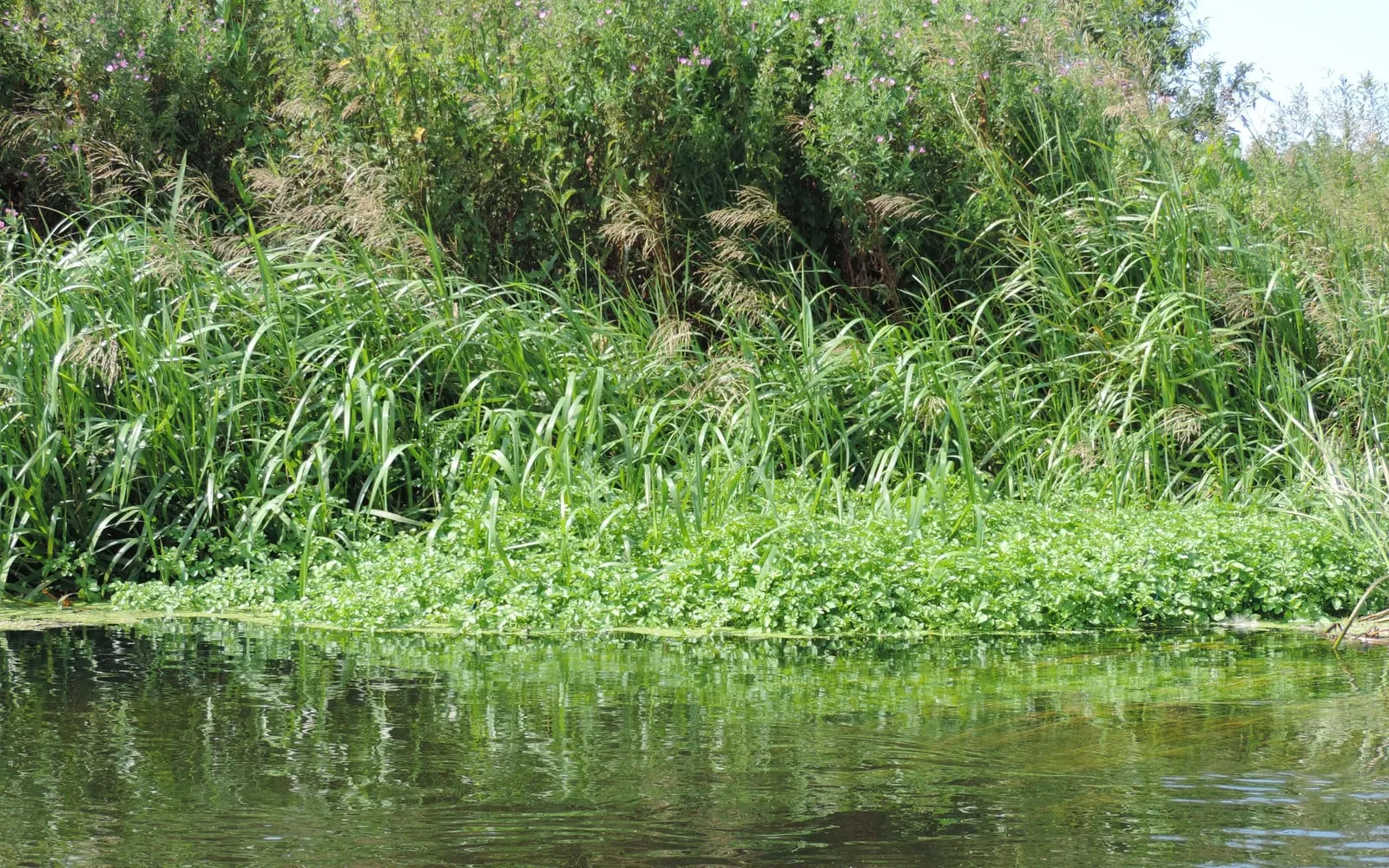
At a glance
- Difficulty
- Moderate
- Water
- Constantly, since the roots must stay wet
- Light
- Full sun to partial shade
- Temperature
- Hardy, and it grows on through mild winters in running water
- Hardiness
- USDA 4-11, RHS H5, hardy to -10 C
- Type
- Hardy aquatic perennial, rooting at every leaf joint
- Height
- 10-60 cm, mostly spreading rather than upright
- Native to
- Europe and western Asia, in clean flowing water, and native to Britain
- Best month
- June in the Northern Hemisphere, December in the Southern Hemisphere
Running water between about 10 and 18 deg C is the requirement, which is why the commercial crop sits on chalk springs where the temperature barely moves through the year. It grows in a bucket and tastes of little. Never gather it from still water or from a stream below livestock, because liver fluke is carried on the leaves.
Hardiness zones describe winter cold alone. Summer heat, humidity, rainfall and the length of the growing season decide as much, so treat the range as the outer limit rather than as a recommendation.
Every month named in this guide is for the temperate Northern Hemisphere. If you garden in the Southern Hemisphere, shift each one by six months, so June becomes December. Closer to the equator the wet and dry seasons matter more than the calendar, and the shift stops being a useful guide.
Not known to be toxic
- Safe to eat
- The leaves and young stems
Watercress is a salad vegetable and is not toxic. It is not listed by the RHS as harmful and is not recorded by the ASPCA as toxic to cats or dogs. The hazards attached to it are entirely about where it is picked rather than what it is. Wild watercress growing in water that drains grazing land can carry the larval stage of the sheep liver fluke, Fasciola hepatica, which encysts on the leaves and infects people who eat them raw. That is the reason the standing advice in Britain is not to eat wild watercress raw, particularly from ditches and streams below sheep or cattle pasture. Cooking destroys the parasite. Water contaminated by livestock or sewage can also carry bacterial contamination. The far more serious risk is a plant rather than a parasite. Hemlock water-dropwort, one of the most poisonous plants in Europe, grows in the same ditches and streams, and people have died after gathering it with or instead of watercress. Fool's watercress is a harmless lookalike that adds to the confusion. Cress grown at home in clean tap water in a container carries none of these risks, which is the argument for growing your own.
Sources: RHS potentially harmful garden plants, ASPCA toxic and non-toxic plants
About
Watercress is one of the few crops that grows better in a bucket of water than in soil, and one of the very few that can be cropped through winter in a cool climate. Because it grows with its roots in water, it is also one of the easiest crops to try in hydroponics.
The peppery flavour comes from mustard oils, the same family of compounds that make rocket and horseradish sharp, and a home-grown leaf is hotter than anything sold in a bag.
Growing your own also solves the problem this plant is known for. Wild watercress carries two genuine risks, and both disappear when the plant is grown in clean water in a container.
The first is liver fluke, a parasite from sheep and cattle that encysts on leaves in water draining grazed land.
The second is far more serious and is a case of mistaken identity. Hemlock water-dropwort grows in the same ditches, is one of the most poisonous plants in Europe, and has killed people who gathered it while picking watercress. That guide is cross-referenced here, and the identification checks are set out below.
Appearance and character
A hardy aquatic perennial with hollow, fleshy, brittle stems that creep and float, rooting from every leaf joint they touch.
Leaves are pinnate, divided into three to nine rounded or oval leaflets in opposite pairs along a stalk, with a larger rounded terminal leaflet at the end. They are smooth, glossy and dark green.
Flowers appear from May to October in small clusters at the shoot tips, white with four petals in a cross, which places the plant in the cabbage family rather than anywhere near the carrot family.
Seed pods are slender, curved and up to 2 cm long, held out from the stem.
The taste is the confirmation once identification is settled. Watercress is distinctly peppery. Nothing dangerous that resembles it tastes like that, though tasting is not a safe identification method with this group of plants.
Growth is prostrate and spreading rather than upright, forming dense mats in shallow water.
Where it is from
Europe and western Asia, and native throughout Britain in clean flowing water.
Its natural habitat is chalk streams, spring heads and shallow flowing ditches, and it is most abundant on chalk and limestone where the water is alkaline and cool.
Commercial watercress in Britain is grown in gravel beds fed by chalk springs in Hampshire, Dorset and Wiltshire, where the water emerges at a constant temperature year round and keeps the crop growing through winter.
That constant cool clean flow is what the plant wants, and it is what a home grower approximates with a bucket and regular water changes.
The plant is in the genus Nasturtium, which has nothing to do with the garden nasturtium people grow for orange flowers, that being Tropaeolum.
How it grows
The container method is the practical one for a garden and the safe one for eating.
Take a pot with drainage holes, fill it with a soil-based compost, and stand it in a saucer, tray or bucket holding 5 to 10 cm of water. The pot wicks water up and the compost stays saturated.
Sow seed thinly on the surface in spring and barely cover it, or root a bunch of supermarket watercress by standing the stems in water on a windowsill until roots appear, then potting them up.
Change the standing water two or three times a week. Stagnant water sours the roots, smells and grows algae, and this is the commonest reason a home crop fails.
Site in partial shade in summer. Full sun heats a shallow tray of water quickly and watercress runs to flower in heat.
Pinch out the growing tips regularly. This keeps the plant bushy and delays flowering, after which the leaves turn bitter.
Harvest by cutting the top few centimetres of each shoot rather than pulling, and the plant regrows repeatedly.
Divide and restart the container each spring, since old plants become woody and flower-prone.
Where a garden has a genuine stream or spring, watercress can be planted at the margin, and the same caution about upstream grazing applies to anything harvested from it.
Through the seasons
Winter keeps a sheltered container cropping slowly in a mild spell. A cold frame or an unheated greenhouse extends it usefully.
Spring is sowing and dividing. Growth accelerates from March.
Summer is the fastest growth and the point at which plants bolt in heat. Move containers into shade and keep pinching out tips.
Autumn gives a second good flush as temperatures fall, and this is often the best crop of the year.
Care difficulty
Moderate, and the difficulty is unusual for a leafy crop.
The plant is easy to grow and hard to keep in good condition, because it wants constantly renewed water rather than merely wet compost. A bucket left alone for two weeks goes stagnant.
Bolting in summer heat is the other recurring problem, and shade plus regular pinching are the answers.
Nothing about the plant is fragile. It roots from any node and recovers from most setbacks quickly.
Watering
Watercress cannot be allowed to dry out at any stage. This is the whole of its cultivation.
Stand the pot in 5 to 10 cm of water permanently and top it up daily in hot weather.
Refresh the standing water two or three times a week rather than topping it up indefinitely. Moving water is what the plant is adapted to, and stagnant water is what kills it.
Rainwater or tap water both work. Water from a butt that has stood a long time is worse than fresh tap water for this crop.
In winter, reduce the depth slightly so the crown is not sitting in ice.
Warning signs, diseases and pests
Yellowing lower leaves with a sour smell from the tray means stagnant water. Change it and change it more often.
Green algae on the water surface and the pot sides is normal in warm weather and becomes a problem when it mats over the compost. Refresh the water and move the container into shade.
Bolting shows as elongated stems and white flowers, and the leaves turn bitter. Pinch out tips regularly, keep the plant cool, and start a fresh batch.
Flea beetle peppers the leaves with small round holes, mostly on plants grown at the drier end of the range. Keeping the compost properly saturated reduces it, and fine mesh excludes the beetles.
Aphids and whitefly appear under cover and wash off.
The warning signs that matter most concern wild plants rather than cultivated ones. Never gather watercress from water below sheep or cattle pasture, and never gather it at all from a ditch where hemlock water-dropwort grows.
Growing environment
Shallow standing or flowing water, or permanently saturated soil.
Partial shade in summer and full sun in spring and autumn. Heat is the enemy of a container crop.
Cool water is what produces good leaves. A shaded position keeps a shallow tray several degrees cooler than an open one.
A large flat container holds temperature better than a small one and needs less attention.
An unheated greenhouse or a cold frame extends the season at both ends and is the easiest way to have watercress in February.
It suits a corner of a pond margin, a bog garden or a permanently wet patch, with the same caution about what else grows there and what drains into it.
Feeding
Watercress in fresh water needs almost no feeding, since it takes minerals from the water.
A weak balanced liquid feed once a month suits a container crop, applied to the compost rather than tipped into the standing water where it will feed algae.
Avoid rich feeding. Soft overfed growth is more prone to aphids and less peppery.
Plants in a genuine spring-fed stream need nothing at all.
Troubleshooting
Is it safe to pick wild watercress? Not raw, as a general rule. Water draining grazed land can carry sheep liver fluke, which encysts on the leaves. Cooking kills it. The greater risk is picking hemlock water-dropwort by mistake, which is fatal.
How do I tell it from hemlock water-dropwort? Watercress is low and sprawling with rounded leaflets in pairs and small four-petalled white flowers held in a small cluster. Water-dropwort stands 1 to 1.5 m with a thick grooved stem, celery-like leaves, flat umbels of five-petalled flowers and a cluster of parsnip-shaped root tubers. If the plant is taller than your knee and has an umbrella-shaped flower head, leave it alone.
What about fool’s watercress? Apium nodiflorum grows in the same places and has toothed leaflets rather than smooth-edged rounded ones, and umbels rather than crosses of four petals. It is harmless, and its main significance is that it adds a third plant to the confusion.
The water smells and the leaves are yellowing. Stagnation. Change the standing water two or three times a week rather than topping it up.
It has flowered and gone bitter. Bolting from heat. Move it into shade, pinch out tips regularly, and start a fresh batch from cuttings.
Can I grow it from a supermarket bag? Yes, and it is the easiest start. Stand the stems in water until roots form, then pot them up and stand the pot in a tray of water.
Do I need running water? No. A pot standing in a tray of water that you refresh two or three times a week is enough.
Small round holes in the leaves. Flea beetle. Keep the compost saturated and cover with fine mesh.
Watercress problem guides
Not sure what is wrong? See the common vegetable pests guide.