
Edible
Mizuna
Brassica rapa var. nipposinica
Also known as Japanese mustard, Kyona, Mibuna
How to grow mizuna, Brassica rapa var. nipposinica. Cut-and-come-again sowing, why it beats lettuce for winter salad, and keeping flea beetle off the leaves.
At a glance
- Difficulty
- Easy
- Water
- Every few days in dry weather
- Light
- Full sun in autumn and winter, light shade in summer
- Temperature
- 10-20 deg C, and hardy to about -10 deg C under a cloche
- Hardiness
- USDA 4-10, RHS H5, hardy to -10 C
- Type
- Annual, or a biennial run as an annual
- Height
- 20-40 cm
- Native to
- Eastern Asia
- Best month
- August in the Northern Hemisphere, February in the Southern Hemisphere
Cold-tolerant enough to crop under a cloche through winter, and it regrows repeatedly from cut-and-come-again picking. Long days push it into flower, so the reliable sowings are late summer and autumn. It bolts less readily than pak choi under the same conditions.
Hardiness zones describe winter cold alone. Summer heat, humidity, rainfall and the length of the growing season decide as much, so treat the range as the outer limit rather than as a recommendation.
Every month named in this guide is for the temperate Northern Hemisphere. If you garden in the Southern Hemisphere, shift each one by six months, so August becomes February. Closer to the equator the wet and dry seasons matter more than the calendar, and the shift stops being a useful guide.
Not known to be toxic
- Safe to eat
- The leaves and stalks, raw in salad or cooked
Mizuna is a food crop and carries no toxicity concern for people. The RHS does not list it as a potentially harmful garden plant and the ASPCA does not list Brassica rapa as toxic to cats and dogs, though a dog eating a quantity of raw brassica leaf is likely to get wind and a loose stomach from the glucosinolates. Those glucosinolates are what give mizuna its mild peppery bite, and they sit well below the level found in mustard greens or rocket. Mizuna carries the vitamin K content common to leafy brassicas, which matters for anybody taking warfarin, where a steady intake matters more than avoidance. The plant flowers readily when it bolts and the flowers are edible.
Sources: RHS potentially harmful garden plants, ASPCA toxic and non-toxic plants
About
Mizuna is the most useful winter salad leaf a cool temperate garden can grow. It germinates in cold soil, stands to about -10 deg C under a cloche, regrows after cutting three or four times, and tastes mild enough to make up the bulk of a salad rather than accenting one.
Lettuce cannot do any of that. A row of mizuna sown in late August and covered in October will still be giving leaves in February, which is the point in the year when a kitchen garden usually has nothing.
The plant grows fast enough to be worth sowing in spring as well, though a spring sowing bolts by June. Treat it as an autumn and winter crop and it earns its bed.
Appearance and character
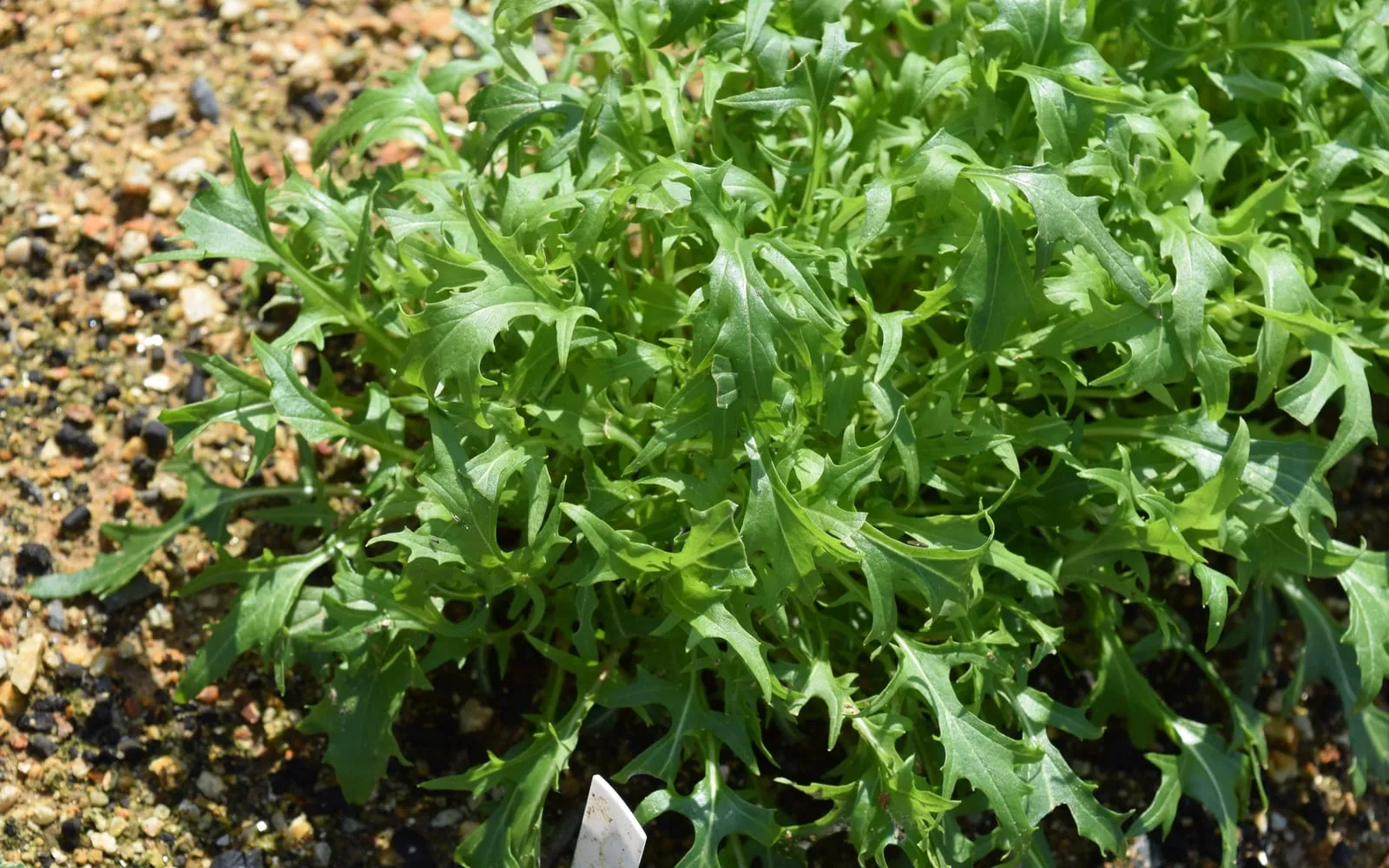
A spreading rosette of many thin white stalks, each carrying a deeply divided, feathery leaf with toothed and pointed lobes. A mature plant looks like a green firework and can spread 40 cm across.
Leaf colour is a clean mid-green, and purple-leaved forms such as ‘Red Knight’ are sold as well.
The flavour is mild and peppery, closer to a young rocket than to mustard, and it sharpens with age and with heat. Winter leaves are noticeably milder than summer ones.
Mibuna is the sister form of the same plant, with long, strap-shaped, undivided leaves instead of feathery ones and a slightly stronger flavour. It is grown identically.
A bolting plant sends up a branched stem to 60 cm with small yellow four-petalled flowers. The leaves coarsen but the flowering shoots are good eating, tasting of sprouting broccoli.
Where it is from
Mizuna is Brassica rapa, the same species as the turnip, pak choi, tatsoi and Chinese cabbage. Japanese growers selected it, and the name means water vegetable, from the practice of growing it in flooded beds between rice crops.
Kyoto is the traditional centre. Kyona, one of its other names, means Kyoto vegetable, and the Mibu district of the city gives mibuna its name.
Cultivation records go back to at least the sixteenth century in Japan, where it is used in hotpots and pickles far more than in salads.
Britain got it in the 1970s and 1980s along with the rest of the oriental greens, and salad growers took to it because it does the one thing the salad trade wanted, which is to produce cuttable leaf in cold weather.
How it grows
Sow direct, either in rows for full-sized plants or broadcast thickly as a cutting patch.
For cut-and-come-again leaves, scatter seed thinly over a prepared bed and rake in, or sow in shallow drills 15 cm apart. Cut at 10 to 15 cm tall with scissors, 2 cm above the crown, and the plant regrows in ten to fourteen days.
For full plants, sow at 1 cm deep in rows 30 cm apart and thin to 25 cm. A full-sized plant gives a large rosette to pick leaf by leaf over months.
Germination takes four to seven days and happens readily at soil temperatures down to 7 deg C, which is what makes autumn sowing work.
Expect three or four cuts from a cutting patch before the plants tire. Feed after each cut.
Sow every three weeks from July to September for the main season, and in March and April for a spring crop that will bolt by June.
Through the seasons
Spring takes sowings from March under fleece and in April outdoors, cut young. Expect them to bolt as the days lengthen in June, and use the flowering shoots rather than mourning the leaves.
Summer is the difficult season. Long days and heat push the plant into flower. A sowing in light shade, kept damp and cut small, works after a fashion.
Late summer is the main sowing window, from late July through September. This is the sowing that carries the winter.
Autumn and winter are the harvest. Cover with a cloche or fleece from October, which keeps the leaves clean, extends picking into February and stops the worst of the wind damage. Growth almost stops in December and resumes in late January.
Care difficulty
One of the easiest crops in this collection, and the easiest of the oriental greens.
Flea beetle is the main nuisance, peppering the leaves with small holes in spring and early summer. The damage is cosmetic on a mature plant and serious on seedlings, and fine mesh from the day of sowing prevents it.
Bolting is a spring and summer problem and a non-problem in autumn. Sow in the right season rather than fighting it.
Slugs take seedlings and shelter in the crown of a mature rosette in a wet autumn.
Nothing else troubles it much. Mizuna is quick enough to outrun clubroot in most gardens and shallow-rooted enough to grow in a container or a windowbox.
Watering
Water every few days in dry weather to keep the leaves tender. A plant short of water gets tough and much hotter in flavour.
Aim for the top 15 cm to stay damp. The roots are shallow and there is no reserve lower down.
Water at the base rather than over the leaves, particularly in autumn, when wet foliage overnight brings downy mildew and slugs.
Water immediately after each cut on a cut-and-come-again patch. Regrowth depends on it.
Mulch lightly with compost between rows of full-sized plants.
Containers suit this crop. A 20 cm pot or a windowbox on a cool sill gives winter salad, and it needs watering every day or two.
Warning signs, diseases and pests
Flea beetle shot-holes the leaves from April to July. Cover with fine insect mesh from the day of sowing and keep the soil surface damp, since the beetles favour dry ground. An August sowing largely misses them.
Slugs and snails graze seedlings off and hide in the crowns of mature plants through a wet autumn. Water in the morning, keep the surrounding ground clear, and patrol on damp evenings.
Downy mildew shows as yellow blotches on the upper leaf with grey growth underneath, and it arrives in a still, wet autumn. Space the plants, water at the base, remove affected leaves, and improve airflow under a cloche by ventilating on dry days.
Cabbage white caterpillars strip leaves in late summer. Net with 7 mm mesh.
Bolting coarsens the leaves and is a season problem rather than a pest. Eat the flowering shoots.
Clubroot applies in principle and rarely in practice, given how briefly this crop occupies its ground. Rotate anyway on infected soil.
Growing environment
Full sun from September to March, and light shade in high summer, which delays bolting.
Fertile, moisture-retentive soil grows the tenderest leaves. Work garden compost in before sowing.
Lime to pH 6.5 or 7, as for every brassica.
A cloche, low tunnel or cold frame transforms the winter crop. It keeps rain off the leaves, lifts the temperature a few degrees, and stops wind tearing the foliage.
Shelter from strong wind. The leaves are thin and shred easily.
Rotate on four years with the other brassicas where clubroot is present.
Feeding
Work garden compost into the bed before sowing. A leaf crop growing this fast needs its nutrients available from the start.
Feed with a balanced or nitrogen-rich liquid feed after every cut on a cut-and-come-again patch. Regrowth is what you are paying for and it depends on nitrogen.
Feed full-sized plants monthly through autumn and stop in December when growth stalls.
Avoid fresh manure, which softens the growth and invites slugs.
Winter plants under cover need less feed than the growth rate suggests, since low light rather than nutrients is what limits them.
Troubleshooting
Small round holes all over the leaves. Flea beetle. Cover with fine mesh from the day of sowing and keep the surface damp. An August sowing misses the worst of it.
The plants have flowered. Bolting, from a spring or summer sowing meeting long days. Sow from late July for the main crop, and eat the flowering shoots from the ones that have gone.
Tough, unpleasantly hot leaves. Grown too dry or picked too old. Water every few days and cut at 10 to 15 cm.
Seedlings disappeared overnight. Slugs. Water in the morning and patrol on damp evenings.
Yellow blotches with grey growth underneath. Downy mildew. Space wider, water at the base, and ventilate the cloche on dry days.
It stopped regrowing after three cuts. Normal. Feed after each cut, and expect to resow after three or four.
Is mibuna the same plant? Effectively yes, and it is grown identically. The leaves are long straps rather than feathery, and the flavour is a little stronger.
Will it survive the winter outside? Usually, down to about -10 deg C, and much more reliably under a cloche. The leaves stop growing in December and start again in late January.
Mizuna problem guides
Not sure what is wrong? See the common vegetable pests guide.