
Outdoor plant
Perennial ryegrass
Lolium perenne
Also known as English ryegrass, Ray grass
How to grow perennial ryegrass, Lolium perenne. The grass in almost every cool-climate lawn, choosing a hard-wearing cultivar, and overseeding worn patches.
At a glance
- Difficulty
- Easy
- Water
- In prolonged drought only, and an established lawn recovers without it
- Light
- Full sun to light shade, and it thins badly in real shade
- Temperature
- Fully hardy, and it grows whenever the soil is above about 5 deg C
- Hardiness
- USDA 4-8, RHS H7, hardy to -25 C
- Type
- Perennial grass, forming a dense tuft and spreading by tillers
- Height
- 5 cm mown, and 30-60 cm in flower
- Native to
- Europe, temperate Asia and north Africa, and native throughout Britain
- Best month
- May in the Northern Hemisphere, November in the Southern Hemisphere
It wants cool moist conditions and goes dormant and brown in summer heat and drought, so it is the standard lawn and pasture grass through cool temperate climates and a poor choice through hot summers, where warm-season grasses take over. The point that matters beyond the lawn is the fungal endophyte living inside it. Wild endophytes produce alkaloids that cause ryegrass staggers in sheep and cattle across New Zealand and Australia, and the modern answer is a novel endophyte bred to deter insects without poisoning stock.
Hardiness zones describe winter cold alone. Summer heat, humidity, rainfall and the length of the growing season decide as much, so treat the range as the outer limit rather than as a recommendation.
Every month named in this guide is for the temperate Northern Hemisphere. If you garden in the Southern Hemisphere, shift each one by six months, so May becomes November. Closer to the equator the wet and dry seasons matter more than the calendar, and the shift stops being a useful guide.
Not known to be toxic
Perennial ryegrass is not listed by the RHS as a potentially harmful garden plant and is not recorded by the ASPCA as toxic to cats, dogs or horses. It is the principal grazing grass of temperate agriculture and is eaten in enormous quantity by livestock every day. The pollen is a significant hay fever allergen and grass pollen is the commonest cause of seasonal allergic rhinitis worldwide, which is a reason to mow before the flower spikes develop rather than a toxicity issue. Two agricultural points are worth recording. Many commercial forage cultivars contain endophytic fungi bred in for pest resistance, and some endophyte strains produce alkaloids that cause ryegrass staggers in sheep and cattle, so endophyte-free cultivars are used where livestock health matters. Separately, ryegrass is high in water-soluble carbohydrate, which contributes to laminitis in horses and ponies on rich spring pasture, and horse paddocks are usually sown with lower-sugar mixtures rather than pure ryegrass. Neither applies to a garden lawn.
Sources: RHS potentially harmful garden plants, ASPCA toxic and non-toxic plants
About
Perennial ryegrass is what almost every cool-climate lawn is mostly made of, and it is there because nothing else takes the wear.
It germinates in a week, establishes faster than any other lawn grass, recovers from being walked on, and repairs itself where the surface is damaged. A family lawn with children, a dog and a football on it stays green because of ryegrass and would not otherwise.
The trade-off is texture. Ryegrass leaves are broader and coarser than the bents and fescues used in fine ornamental turf, so a bowling green or a formal lawn uses very little of it. Modern turf-type cultivars have narrowed that gap considerably and a good one now makes a lawn that looks respectable as well as surviving use. How you then mow, water and feed it is covered in the lawn care guide.
It is also the backbone of temperate livestock farming. Most of the improved grassland in Britain, Ireland and New Zealand is ryegrass, bred for yield and palatability, and the difference between an agricultural cultivar and a turf cultivar is substantial.
That difference matters when buying seed. A cheap general-purpose mixture may contain agricultural ryegrass, which is coarse, grows fast and needs mowing twice a week.
Appearance and character
A perennial grass forming a dense tuft, reaching 5 cm under regular mowing and 30 to 60 cm if left to flower.
Leaves are narrow, 3 to 6 mm wide, with a distinctly glossy underside and a matt upper surface, and prominent parallel ribs.
The glossy leaf back is the reliable identification, and it separates ryegrass from the duller fescues and meadow grasses at a glance.
Young leaves are folded in the shoot rather than rolled, which is the other identification character used in the seed trade.
The leaf base is often flushed reddish-purple.
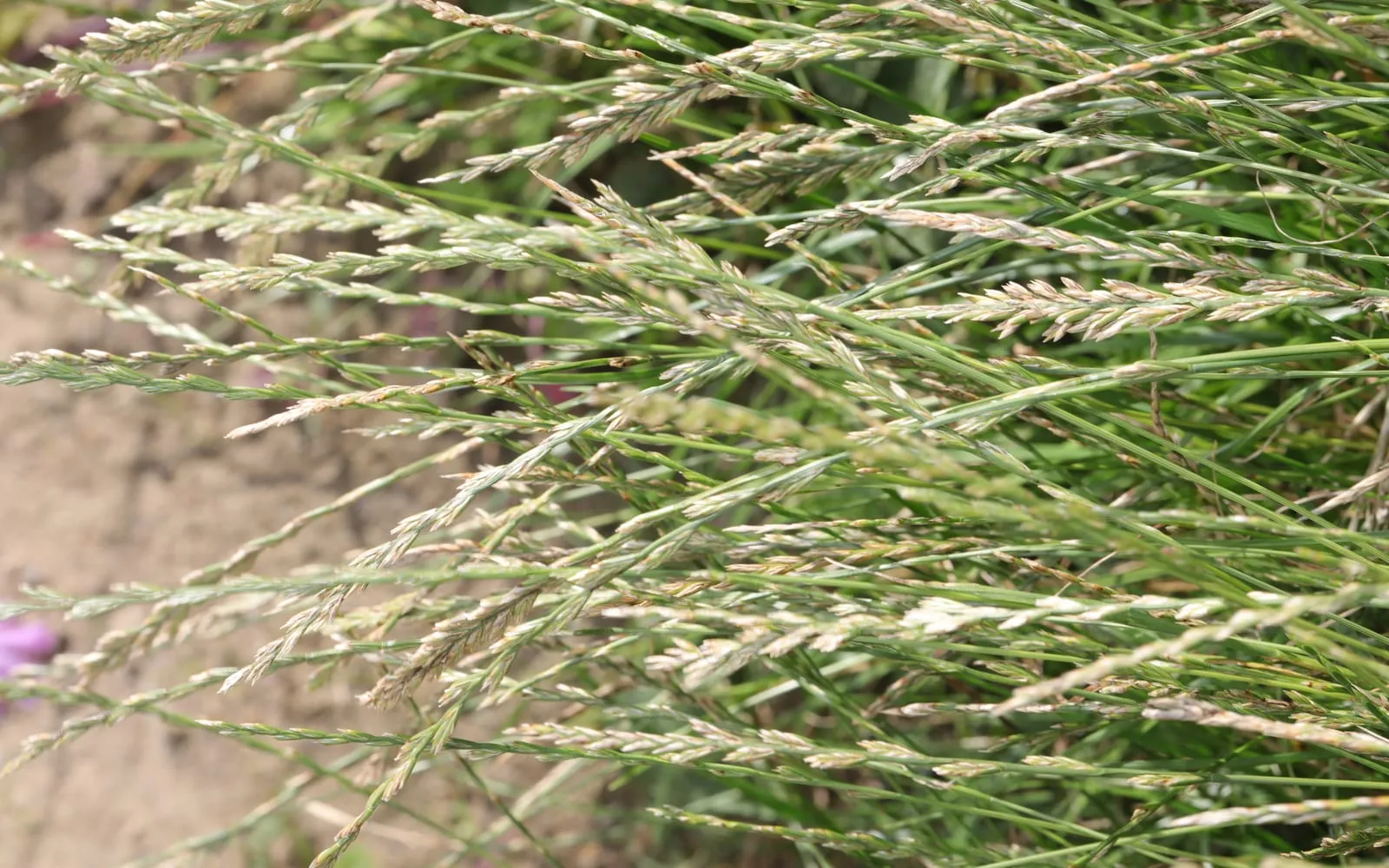
Flower spikes appear from May to August, flattened, 10 to 30 cm long, with the spikelets set alternately edge-on directly against the stem in two ranks, giving a zigzag ladder appearance.
It spreads by tillering, producing new shoots from the base of the plant, rather than by runners or rhizomes, so it thickens in place and does not creep sideways.
Turf-type cultivars are finer, darker and slower growing than agricultural cultivars, and they are worth paying for.
Where it is from
Europe, temperate Asia and north Africa, and native throughout Britain and Ireland.
It grows on grassland, roadsides, waysides, waste ground and any reasonably fertile moist soil, and it is one of the commonest grasses in Europe.
It was the first grass to be deliberately cultivated as a crop in Europe, with records of it being sown as a hay and grazing grass in Britain from the seventeenth century.
Ryegrass breeding has been central to British agriculture since the twentieth century, and the Aberystwyth breeding programme produced many of the cultivars still in use.
Turf-type ryegrass breeding is much more recent, largely from the 1970s onwards and largely American, driven by sports pitches and golf.
Italian ryegrass, Lolium multiflorum, is the fast-growing short-lived relative used as a short-term forage crop and sometimes found in cheap seed mixtures, where it is unwelcome because it dies out after a couple of years.
Darnel, Lolium temulentum, is the annual relative of biblical notoriety, which carries a toxic fungal endophyte and was a serious contaminant of grain crops historically. It is now rare as a contaminant, since modern seed cleaning removes it.
How it grows
Sow between mid-March and mid-May or between late August and mid-October, when the soil is warm and moist. Early autumn is the best time of year for a new lawn, when the soil is still warm and weeds compete less.
Prepare the ground thoroughly. Dig or rotavate, remove perennial weeds, level, firm by treading, and rake to a fine tilth. The preparation determines the lawn far more than the seed does.
Sow at 25 to 35 g per square metre for a new lawn, and 15 to 25 g for overseeding.
Rake the seed in lightly and firm it. Do not bury it deeply.
Water in dry weather until it germinates, which takes seven to ten days for ryegrass and longer for the fescues in the mixture.
Keep off it until the first cut, and take that when the grass reaches 5 to 8 cm, cutting back to about 4 cm with sharp blades.
Buy a mixture rather than pure ryegrass for a lawn. A good hard-wearing mixture is around half turf-type ryegrass with strong creeping red fescue and slender creeping red fescue making up the rest, which combines the wear tolerance of one with the fineness and shade tolerance of the other.
Check the cultivar names on the bag. Turf-type ryegrass cultivars are named on any decent product, and a bag that lists only “perennial ryegrass” may contain an agricultural cultivar.
Mow regularly through the growing season, at 2.5 to 4 cm for a family lawn, never removing more than a third of the height at once.
Overseed worn areas in September. Scarify or scratch the surface, sow at 25 g per square metre, rake in and keep moist. Ryegrass establishes fast enough that a worn path across a lawn repairs within six weeks.
Feed twice a year, with a high-nitrogen spring feed in April and a high-potash autumn feed in September.
Scarify and aerate in autumn to remove thatch and relieve compaction.
Through the seasons
Winter ryegrass keeps some colour and grows whenever the soil is above about 5 deg C, which in a mild winter means the occasional cut.
Spring growth accelerates from March, and this is feeding, sowing and the start of regular mowing.
Summer is peak growth and peak wear, with flowering from May if it is left uncut.
Autumn is the best season for sowing, overseeding, scarifying, aerating and the potash feed.
Care difficulty
Easy. Ryegrass is the most forgiving lawn grass available in a cool climate.
It germinates fast, establishes quickly, tolerates being walked on, cut short, cut irregularly and neglected, and recovers from damage that kills finer grasses.
The two limitations are shade, where it thins badly, and texture, where it is coarser than a fine ornamental lawn wants.
Diseases are secondary and mostly follow from management. Red thread follows a shortage of nitrogen, and fusarium follows a soft over-fed sward in damp autumn weather.
Watering
Water a new sowing in dry weather until it has germinated and established.
An established lawn needs no watering in a temperate climate in most years. Ryegrass browns off in a drought and recovers completely when the rain returns, which is what it is meant to do.
Soak thoroughly and infrequently if you do water, rather than sprinkling daily, which encourages shallow rooting.
Avoid watering in the evening in autumn, which leaves the sward damp overnight and encourages fusarium.
Aerate compacted ground rather than watering it, since compaction is the commoner reason a lawn struggles in summer.
Warning signs, diseases and pests
Pink or red thread-like growth binding the grass blades together, with patches of bleached straw-coloured turf, is red thread. It follows a shortage of nitrogen and is worst in late summer. Feed the lawn and it grows out.
Small circular patches of yellow-brown turf, sometimes with a white or pinkish fungal growth at the edge in damp weather, is fusarium patch or snow mould. It follows soft over-fed growth in autumn. Avoid nitrogen after August, improve air movement and brush off dew.
Yellow patches that lift like a carpet with no roots underneath, often with birds or badgers tearing at the turf, is leatherjackets or chafer grubs eating the roots. Water the area and cover it overnight with black polythene to bring leatherjackets to the surface, or apply a biological nematode treatment in late summer.
Thin sparse growth under trees or beside a north wall is shade. Ryegrass has poor shade tolerance. Overseed with a shade mixture based on fescues, or accept that grass is the wrong answer there.
A spongy surface that holds water is thatch. Scarify in autumn.
Compacted worn tracks are physical damage. Aerate, overseed in September, and consider a path where people walk.
Coarse fast-growing patches in a fine lawn is agricultural ryegrass from a cheap seed mixture. Dig it out and overseed with a turf-type cultivar.
Moss is a symptom rather than a cause, and it follows shade, compaction, poor drainage or mowing too short.
Growing environment
Full sun to light shade. It thins badly in real shade, where fescues do better.
Any reasonable soil, and it prefers moist fertile ground. It tolerates clay well and dries out on thin sand.
Fully hardy to about -25 deg C, and it grows through mild winters.
Sow at 25 to 35 g per square metre for a new lawn and 15 to 25 g for overseeding.
It suits a family lawn, a play area, a dog run, a sports pitch, a path across grass, a verge or any area that gets walked on.
It does not suit a fine ornamental lawn, deep shade or a wildflower meadow, where its vigour outcompetes the flowers.
Use a mixture rather than pure ryegrass for a garden lawn, combining turf-type ryegrass for wear with creeping red fescue for fineness and shade tolerance.
Its wildlife value in a mown lawn is low, which is a fair criticism of a ryegrass lawn. Leaving an area unmown, or overseeding a rough area with a meadow mixture, does far more for insects than anything else you can do to a lawn.
Feeding
Feed twice a year for a lawn in ordinary use.
Apply a high-nitrogen spring and summer feed in April, which drives the growth and colour.
Apply a high-potash autumn feed in September, which hardens the sward for winter and reduces disease.
Do not apply nitrogen after August. Soft growth going into a damp autumn is what fusarium patch feeds on.
Leave the clippings on with a mulching mower in dry weather, which returns nitrogen and reduces the need to feed.
Red thread appearing in late summer is a sign the lawn is short of nitrogen rather than diseased in any serious sense.
Troubleshooting
When should I sow a new lawn? Early autumn is best in a cool climate, with mid-spring as the alternative. Warm moist soil and less competition from weeds are what make autumn better.
How do I repair a worn patch? Overseed in September. Scratch or scarify the surface, sow at 25 g per square metre, rake in and keep it moist. Ryegrass germinates in a week and a worn path repairs within six weeks.
Which seed mixture should I buy? For a family lawn, one based on turf-type perennial ryegrass with creeping red fescue. Check that the cultivars are named on the bag, since a product listing only “perennial ryegrass” may contain a coarse agricultural cultivar.
Why is my lawn thin under the tree? Ryegrass has poor shade tolerance. Overseed with a fescue-based shade mixture, or accept that grass is the wrong plant for that spot and use ground cover instead.
There are pink threads in the grass and pale patches. Red thread, which follows a shortage of nitrogen. Feed the lawn and it grows out.
The turf lifts up like a carpet with no roots. Leatherjackets or chafer grubs eating the roots. Apply a biological nematode treatment in late summer, and expect birds and badgers to make the damage worse while looking for them.
How short should I mow it? Two and a half to four centimetres for a family lawn, and never remove more than a third of the height in one cut. Mowing shorter than that encourages moss and weakens the grass.
Why does it go brown every summer? Drought dormancy, which is normal and reversible. Ryegrass browns off and recovers completely when the rain returns. Watering a lawn through a cool summer is rarely necessary.
Can I use it in a wildflower meadow? No. Ryegrass is too vigorous and outcompetes the flowers. Meadow mixtures use fine slow grasses such as crested dogstail and sheep’s fescue.
Perennial ryegrass problem guides
- Leatherjackets and chafer grubs eating the roots
- Red thread and fusarium patch in the wrong conditions
- Moss in lawns wherever the grass is thin, shaded or compacted
- Fairy rings marking dark green arcs and killing the grass inside them
- Moles, which throw heaps of soil up through the sward
- Dog urine patches, yellow in the middle with a greener ring around them
- Fertiliser scorch from an uneven spread or a feed onto dry grass