
Pest
Galls and gall mites
Eriophyid mites, cynipid wasps and cecidomyiid midges
Also called Gall mite, Big bud, Blister mite, Nail gall, Robin's pincushion, Knopper gall
Pimples on lime leaves, pincushions on wild roses, blisters on pears and fat round buds on blackcurrants. Most galls can be left alone. Blackcurrant big bud mite is the main exception because it can spread reversion virus.
At a glance
- Type
- Pest
- Cause
- Mite
- Severity
- Weakens the plant
- Affects
- Garden plants, Herbs and edibles
- Active
- February to September
- Established in
- Worldwide
What you are seeing
- Blackcurrant buds swollen into fat round balls over winter, which fail to open in spring
- Red or yellow pimples standing up from the upper surface of lime leaves
- Raised yellow-green blisters on pear leaves, turning pink then black through summer
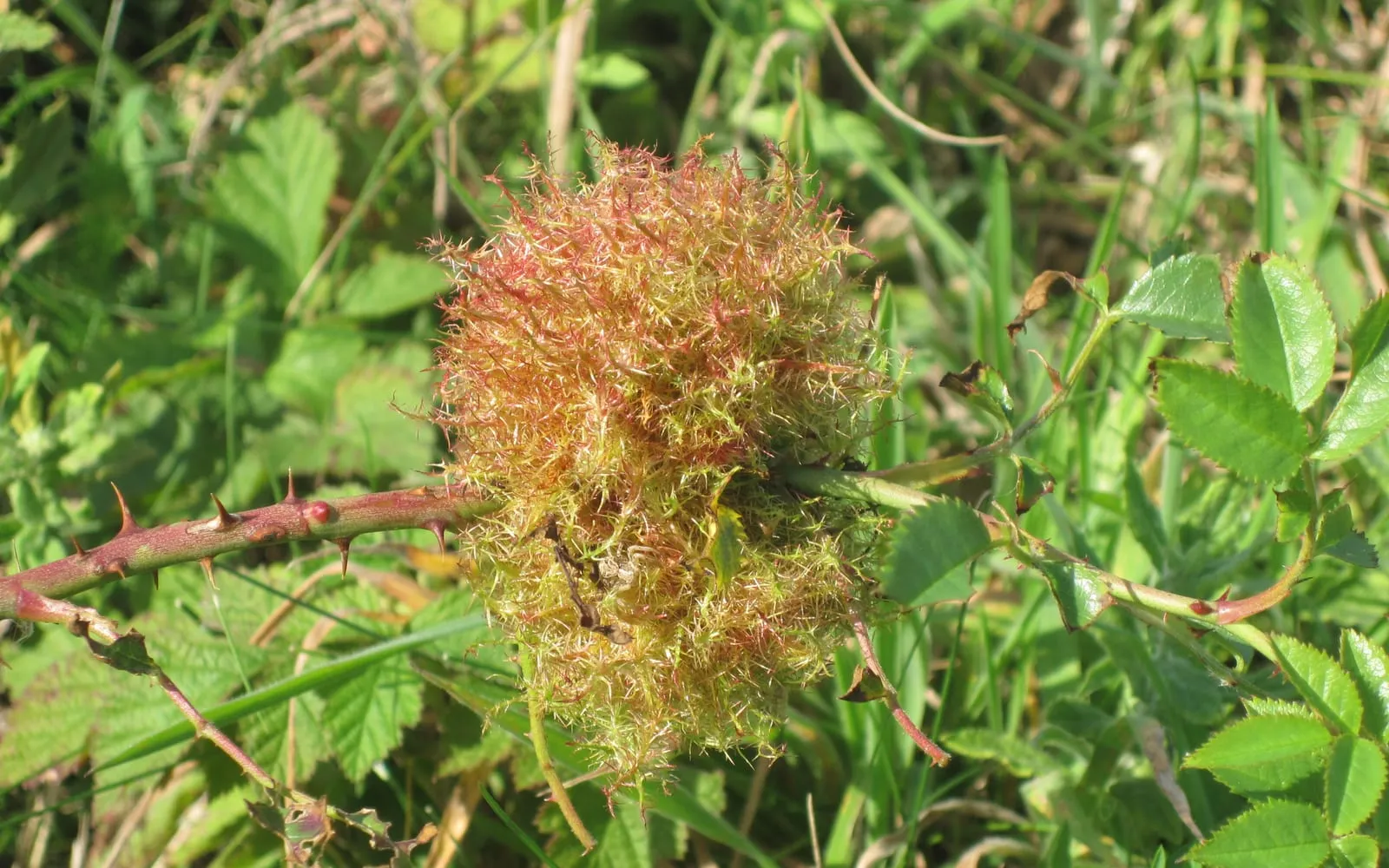
- A ball of red-green moss on a wild rose stem, softer than it looks
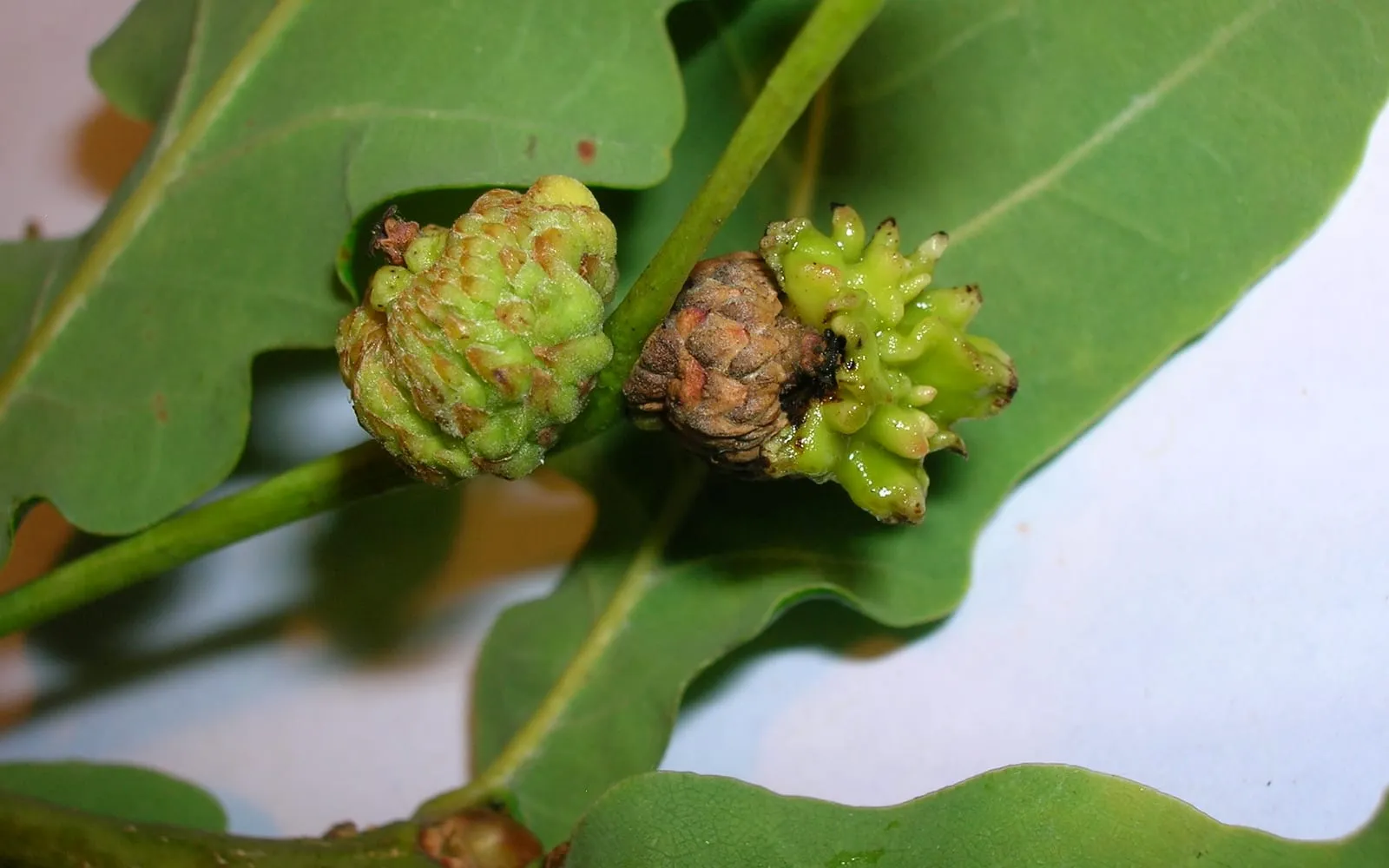
- Woody spheres on oak twigs, or ridged distorted acorns
- Pineapple-shaped swellings at the base of spruce shoots
- Pale, thickened, fleshy swellings on camellia and azalea leaves, turning chalky white
- Rounded warty swellings on stems and roots at soil level
Before you treat anything
Galls are harmless to handle. Oak marble and knopper galls are sometimes collected by children, and there is nothing in them to worry about.
What you are looking at
A gall is plant tissue, grown by the plant. Something small has settled on a bud, a leaf or a stem and released a chemical that hijacks the plant’s own growth signals, and the plant obediently builds a structure around it. The animal or fungus inside gets shelter and food; the plant spends a little energy and carries on.
That is why galls are so precise. A red pimple standing on a lime leaf, a woody sphere on an oak twig and a pineapple at the base of a spruce shoot are all repeated to the same pattern, because the pattern is written into the instructions the causer sends. Damage from chewing or sucking is ragged and irregular; galls are architecture.
The causers are a mixed lot. Microscopic eriophyid mites, tiny gall wasps, gall midges, aphids and adelgids, and in a few cases fungi and bacteria. What they have in common is the method rather than any relationship to one another.
Most galls can be left alone
Most galls look stranger than they are. An abnormal lump on a leaf, bud or stem does not automatically need treatment.
Nail galls on lime leaves, spangle galls on the underside of oak leaves, oak marble galls, robin’s pincushion on wild roses, adelgid pineapples on spruce, maple bead galls and the blisters that pear leaf blister mite raises all take a trivial amount from the plant. A lime tree can carry tens of thousands of nail galls and put on a normal year’s growth. The leaf works around them.
Removing them costs more than leaving them. Picking off galled leaves takes away functioning foliage in the middle of the growing season, and spraying a tree for a mite living inside plant tissue would fail even if there were a product for it.
Knopper gall is the one people ask about most. It deforms English oak acorns into sticky ridged lumps and in a heavy year takes most of the crop. It arrived in Britain in the 1960s, it needs Turkey oak nearby to complete its cycle, and it does nothing at all to the tree. The loss falls on the jays and squirrels that would have eaten the acorns.
The exception on blackcurrants
Blackcurrant big bud mite causes damage in a different way from most gall mites.
Through winter the mites live inside blackcurrant buds and feed there, and the bud responds by swelling into a fat round ball two or three times the size of a healthy one. Those buds never open. On its own that is a nuisance, costing a proportion of next year’s fruiting wood.
What makes it serious is that the mite carries blackcurrant reversion virus. Once a bush is infected the virus is in it permanently, and there is no treatment. The bush gradually stops setting fruit, and the tell is in the flowers, which turn bright pink and lose their fine hairs where a healthy blackcurrant flower is dull grey and downy. The leaves change too, with fewer main veins and a narrower outline.
Treat the bush according to the flowers. A bush with a few big buds and normal flowers can be picked over in winter and kept. A bush with pink, hairless flowers and a poor set is finished. Remove it before it infects the next one.
Hazel gets its own big bud mite, which swells the buds the same way and carries nothing. It is a nuisance on a nut crop and nothing more.
Crown gall, which is neither a mite nor a worry
Rough woody warts at the base of a stem, on a root, or along a graft union, are usually crown gall, caused by a soil bacterium that inserts a piece of its own DNA into the plant’s cells and makes them multiply. Roses, fruit trees, willows and many others get it.
On an established plant it does very little. The galls look alarming, they can be large and knobbly, and the plant usually grows away perfectly well with them. Avoid damaging the base when strimming or hoeing, because the bacterium enters through wounds. Reject a new plant that arrives with a gall on it. Cutting galls off an established plant achieves nothing.
What to do about it
Look at what plant it is on before doing anything at all.
On a blackcurrant, go over the bush between December and March, pick off every swollen round bud, and burn them. Check the flowers in spring for the pink, hairless look that means reversion, and grub out any bush that shows it.
Buy certified blackcurrant stock, choose a resistant cultivar such as ‘Ben Hope’ where the problem is about, and never take cuttings from an affected bush.
On a young or wall-trained pear, pick off the worst blistered leaves in early summer and rake up the leaf fall in autumn.
On a small camellia or azalea, pick the thick pale galls off before they turn chalky white.
On limes, oaks, maples, spruces and wild roses, leave them entirely alone.
What it gets mistaken for
Woolly aphid is white fluff sitting on the outside of the bark, which smears when rubbed and hides the insects rather than being made by the plant.
Peach leaf curl thickens and reddens whole leaves into puckered blistered masses, on peaches, nectarines and almonds.
Capsid bug damage is ragged and irregular, with small brown-edged holes in puckered young leaves.
Root-knot nematodes bead the roots underground with many small swellings.
Clubroot fuses brassica roots into a single distorted mass that rots and smells.
Leafy outgrowths on a conifer where the growth has gone soft and bunched are usually a witches’ broom, which is caused by a rust fungus or a mutation and is harmless enough that some are propagated deliberately as dwarf conifers.
What to do, in order
Start here
Prevention, and the changes that stop the problem returning. Most of these pages should end at this tier.
- Leave almost all of them alone
- Nail galls on lime, spangle and marble galls on oak, pincushions on wild roses, pimples on maple and pineapple galls on spruce do no measurable harm to a healthy plant. The tree makes the tissue itself in response to a chemical signal, it costs very little to make, and the leaf goes on photosynthesising around it. Removing them means removing foliage, which does more damage than the gall did.
- Treat blackcurrant big bud mite differently
- Blackcurrant big bud mite is different from everything else on this page because it carries blackcurrant reversion virus. The mite itself only destroys buds; the virus stops the bush fruiting and cannot be treated. A blackcurrant with fat round buds in February needs acting on, and a lime tree covered in red pimples does not.
- Buy certified blackcurrant stock and resistant cultivars
- New bushes from a reputable supplier are certified free of the mite and the virus. 'Ben Hope' carries resistance to the gall mite and is the obvious choice where the problem is established nearby. Never take cuttings from a bush that has shown big bud.
- Grub out a reverted blackcurrant rather than nursing it
- Reversion shows in the flowers, which go bright pink and hairless instead of dull grey and downy, and in leaves with fewer main veins and fewer lobes than they should have. A bush at that stage will never crop again. Dig it out, burn it, and plant its replacement well away from where it stood.
- Accept knopper galls on acorns
- The ridged sticky distortions on English oak acorns are a gall wasp that arrived in Britain in the 1960s. In a heavy year most of the acorn crop is lost, which matters to jays and squirrels rather than to the tree, and the oak itself is unaffected. There is nothing to do and nothing to buy.
- Ignore camellia and azalea gall on a large shrub
- The thick pale fleshy leaves are caused by a fungus rather than a mite. On an established shrub a handful of them each spring is a curiosity. On a small or young plant, pick them off before they turn chalky white, which is the stage at which they release spores.
Then reach for a barrier
Netting, hand removal and water. Nothing here harms anything except the target.
- Pick off blackcurrant big buds in winter and burn them
- Between December and March the affected buds are obvious against the normal ones, fat and round rather than slim and pointed. Go over the bush and take every one off, and burn them rather than composting. Where more than a few branches are affected it is quicker to cut those branches out entirely. This holds a lightly affected bush and it will not save one that has already reverted.
- Pick off pear blister mite leaves on a young tree
- On a small or wall-trained pear, removing the worst-blistered leaves in early summer keeps the numbers down and costs the tree little. On a standard tree it is not worth the ladder, and the damage is cosmetic anyway.
- Clear fallen leaves under an affected pear
- Blister mites spend the winter under the bud scales, and a share of them are in the leaf litter. Raking it up in autumn takes some out of circulation and is worth doing on a tree that is badly marked each year.
In pictures
Plants affected
Guides that name it among the problems to watch for. The list is the plants it is characteristic of rather than everything it will feed on.