
Edible
Oat
Avena sativa
Also known as Common oat, Groats, Porridge oats
How to grow oats, Avena sativa. The weed that became a crop, the panicle that sets it apart from every other cereal, and where oats stand on gluten.
At a glance
- Difficulty
- Easy
- Water
- Rain-fed. Oats want moisture more than the other cereals
- Light
- Full sun, though oats tolerate more shade than wheat
- Temperature
- Cool and damp suits them. They dislike hot dry ripening
- Hardiness
- USDA 3-9, RHS H5, hardy to -15 C
- Type
- Annual grass, usually spring sown
- Height
- 80-150 cm
- Native to
- the Near East as a weed of wheat and barley, domesticated in Europe
- Best month
- March and August in the Northern Hemisphere, September and February in the Southern Hemisphere
Oats want cool moist summers and are the least winter-hardy of the small grains, so they are mostly spring sown and they thrive in maritime climates that suit wheat less well. Heat and drought during grain fill shrivel the kernel faster than in any other cereal. They tolerate acid soil better than wheat or barley, which is why they became the staple grain of wet upland regions from Scotland to Scandinavia.
Hardiness zones describe winter cold alone. Summer heat, humidity, rainfall and the length of the growing season decide as much, so treat the range as the outer limit rather than as a recommendation.
Every month named in this guide is for the temperate Northern Hemisphere. If you garden in the Southern Hemisphere, shift each one by six months, so March becomes September. Closer to the equator the wet and dry seasons matter more than the calendar, and the shift stops being a useful guide.
Edible, with limits
- Safe to eat
- The groat, rolled, cut or milled
- Do not eat
- Ergot bodies in the panicle
- Harm from
- Eating it
- Affects
- People and horses
Oats contain avenin rather than the gluten proteins of wheat, barley and rye, and most people with coeliac disease tolerate pure oats. The practical problem is contamination, since oats are grown, harvested, stored and milled alongside wheat, so ordinary porridge oats routinely carry enough wheat to cause a reaction. Oats sold as gluten-free are grown and handled on a segregated supply chain and are the ones to use. A minority of people with coeliac disease react to avenin itself, so Coeliac UK advises introducing even gluten-free oats carefully and with clinical advice. Oats are safe for dogs and cats in ordinary quantities. For horses they are a traditional feed and a familiar cause of over-excitement and, in quantity, of laminitis, so the amount is a matter for a vet rather than a scoop.
Sources: Coeliac UK on the gluten-free diet, Food Standards Agency on the 14 named allergens
About
Oats came late and came sideways. Wheat and barley were domesticated deliberately around 8500 BC, and wild oats travelled with them as a weed of those fields for several thousand years. As farming spread north and west into cooler, wetter country, the weed did better than the crop, and somewhere in Bronze Age Europe farmers stopped pulling it out and started sowing it.
Oats thrive in cool damp summers, tolerate acid peaty soil, and produce where wheat gives a thin sample, all of which follows from where they were domesticated. Northern and western Britain, Ireland and Scandinavia built diets around it for exactly that reason, and the Scottish reputation for oats is a fact of climate rather than of taste.
The grain has an unusual composition among cereals. Oats carry more fat and more soluble fibre than wheat or barley, and the beta-glucan in that fibre is the component behind the cholesterol claims. Its high oil content is also why oatmeal goes rancid faster than wheat flour.
Appearance and character
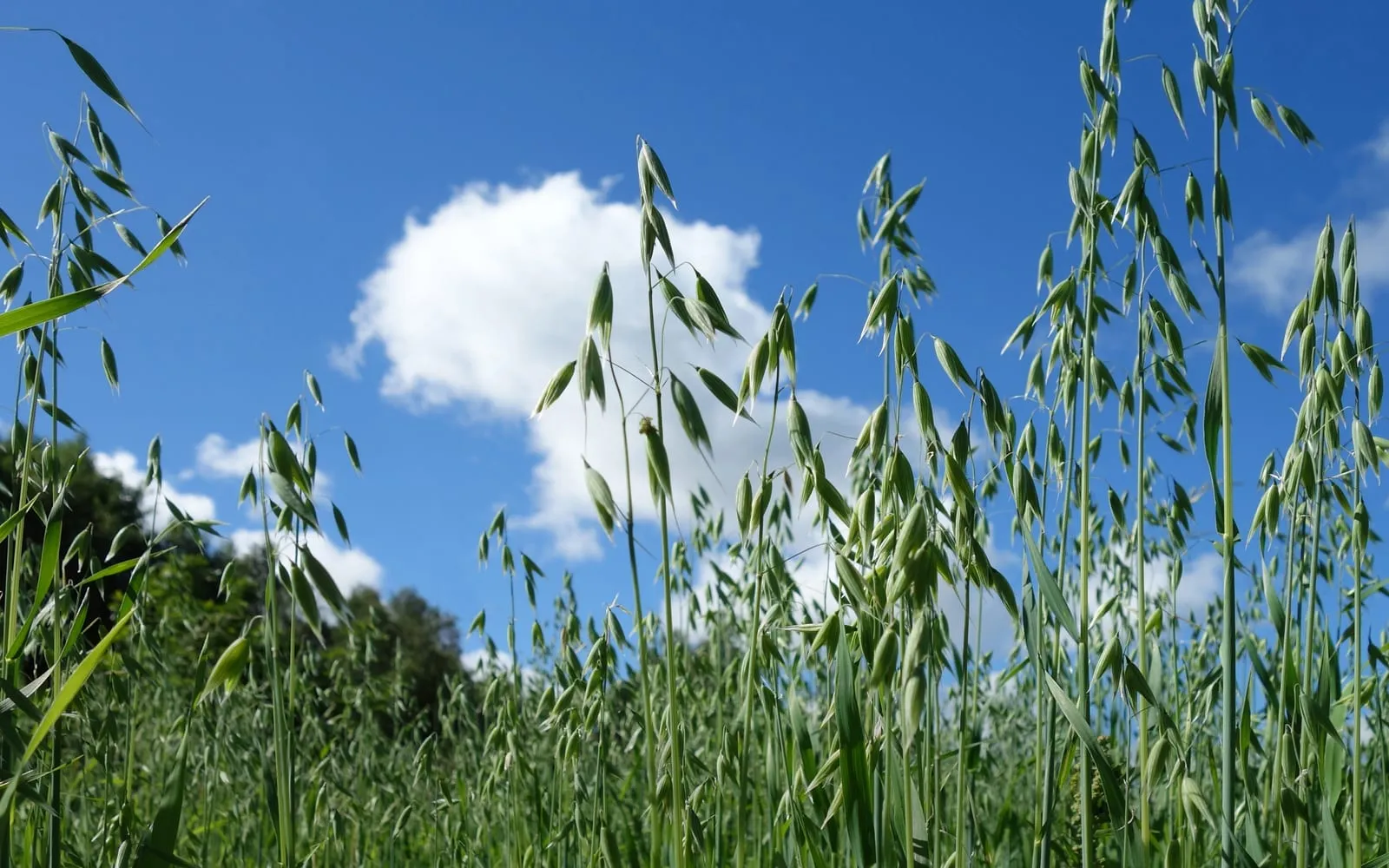
Oats are the one cereal you can identify from a moving car. Where wheat, barley and rye carry their grain in a spike, oats carry theirs in a panicle: an open branching structure where each grain hangs at the end of its own fine stalk. A ripe oat crop looks like a loose spray rather than a head.
The grains hang in pairs or threes inside pale papery lemmas, and the whole panicle moves in the slightest breeze. Some varieties carry a single bent awn per grain, twisted at the base, which straightens as it takes up moisture.
The plant is tall, with broad soft leaves and a lax habit. At the leaf base there are no auricles at all, which is a quick negative identification against wheat, barley and rye, all of which have them. The leaf edges are finely hairy.
Where it is from
The wild ancestor is Avena sterilis, which grows around the Mediterranean and across the Near East. It was never deliberately taken into cultivation there. Instead it followed wheat and barley into their fields as a weed, and its seeds travelled in every sack of sown grain.
Domestication happened in Europe, probably in the Bronze Age and probably more than once, as agriculture moved into climates the founder crops disliked. Oat grains appear in central European sites from around 2000 BC and become common in northern Europe afterwards.
Britain and Ireland took to it thoroughly. Oats were the staple grain of much of Scotland, Wales, Ireland and northern England through the medieval period and well beyond, because they yield in a cool wet summer where wheat does not. The crop declined through the twentieth century as horses left farms and rose again with the market for porridge and oat milk.
How it grows
Oats germinate readily in cold soil and grow away quickly, which suits an early spring sowing. They tiller moderately and then put their energy into height.
The panicle emerges from the flag leaf and opens over several days, with the branches spreading as it dries. Flowering runs from the top of the panicle downward over about a week, and the plant is self-pollinating.
Grain fill takes around six weeks, and ripening is uneven because the panicle flowered unevenly. The top grains are ready first, and a crop left standing too long starts shedding them. Cut it when most of the panicle has gone pale.
Through the seasons
Most oats are spring sown, from February to April, as soon as the ground is workable, because they are the least winter-hardy of the small grains. Winter oats exist and go in during September and October, and they yield more but are less hardy than winter wheat or rye.
The plant grows fast through April and May and comes into panicle in June. Flowering and grain fill run through July.
Harvest is August. Cut when the top grains are hard and the panicle has gone pale, and expect some shedding. Threshing is easy, since oats free themselves from the panicle with a rub, though the grain stays inside its papery hull and needs a further step to make groats.
Care difficulty
Oats are the most forgiving cereal a temperate gardener can sow. They germinate in cold soil, tolerate acid and peaty ground that would defeat barley, cope with a wet summer, and need no fungicide on a garden scale.
Two things go wrong. They lodge, because the plant is tall and its straw is soft, so a fed crop in an exposed spot ends up flat. And the birds find them first, since oats seem to be preferred over wheat and barley by pigeons and finches alike, so net a patch from the moment the panicle appears.
Processing is the middle case among the cereals. Oats are hulled, so the grain does not thresh free, but the hull is loose and papery rather than tight, and rubbing dried grain between the hands and winnowing removes most of it. Making rolled oats from the groats needs a roller, though a coarse mill gives you oatmeal.
Watering
Oats want more water than wheat, barley or rye, which is why they succeed in maritime climates and struggle in a dry continental summer. Rain usually supplies it in a temperate climate.
Water a garden patch through May and June if the spring is dry, because that is when the plant is building the structure that will carry the crop. Drought at that stage produces a short thin stand.
They tolerate wet ground better than wheat or barley, including soils that lie damp and slightly acid. What they will not tolerate is standing water, which rots the roots as it does in any cereal.
Warning signs, diseases and pests
Crown rust is the main oat disease and it has an unusual life cycle. The fungus alternates between oats and buckthorn, and it needs the shrub nearby to complete its sexual stage, so a plot with buckthorn in the hedge gets it worse. It shows as bright orange pustules scattered on the leaves.
Barley yellow dwarf virus hits oats harder than it hits the crop it is named after. Aphids bring it in, and infected plants are stunted with leaves that turn yellow then a distinctive red or purple from the tip. Scattered patches of short reddened plants in a spring crop are the sign.
Frit fly larvae tunnel into the growing point of young oat plants, which kills the central shoot and leaves a yellowing dead heart that pulls out cleanly. Late sowings into warm soil suffer most.
Lodging is the routine failure. Tall soft straw plus a summer storm equals a flat crop, and once down the panicles sit wet and start sprouting. Feed lightly, and choose a shorter variety if you have the choice.
Growing environment
Full sun is best, though oats tolerate more shade than the other cereals and will give something in a partly shaded strip where wheat would not.
Soil tolerance is broad and includes the ground the other cereals refuse. Oats grow on acid soils down to pH 5, on peat, and on cold heavy land that the other cereals refuse. That tolerance is why they became the staple where they did.
The climate preference is cool and moist. Oats ripen poorly in a hot dry summer, producing thin grain, and they do their best work in a season that a wheat grower would call disappointing.
Feeding
Feed oats lightly or not at all. The plant is tall, its straw is soft, and extra nitrogen goes into height and then into lodging.
One modest dressing of a balanced granular feed in early spring is enough for a garden patch on tired ground. On a bed that grew a fed crop the previous year, apply nothing.
Oats scavenge phosphate well and grow on soils where other cereals show deficiency, which is part of why they were the crop of choice on unimproved upland ground. Manganese deficiency on light alkaline soil is the one to watch for, showing as grey flecking along the leaves.
Troubleshooting
Are oats gluten-free? Oats contain avenin rather than wheat gluten, and most people with coeliac disease tolerate pure oats. Ordinary porridge oats are contaminated with wheat during growing, storage and milling, so a coeliac diet needs oats specifically labelled gluten-free. A minority react to avenin itself, so introduce them with clinical advice.
How do I tell oats from other cereals? The head. Oats carry an open branching panicle with each grain on its own stalk, while wheat, barley and rye all carry a compact spike. At the leaf base, oats have no auricles, and all three of the others do.
How do I turn my crop into porridge? Thresh the panicles, rub the grain between your palms to loosen the papery hulls, and winnow. What is left is groats. Kiln them gently in a low oven to develop flavour and stop them going rancid, then either roll them or mill them coarsely for oatmeal.
Why are my oats flat on the ground? Lodging, and it is the plant’s habit. Tall soft straw plus a storm does it, and feeding makes it certain. Cut a flattened crop rather than leaving it, because the panicles sprout once they are lying wet.
What is the orange dust on my oat leaves? Crown rust. It alternates between oats and buckthorn, so it is worse where that shrub grows nearby. On a garden patch it rarely justifies more than accepting a smaller crop.
Can I sow porridge oats from the supermarket? No. Rolled oats have been steamed and flattened, and even pinhead oatmeal has been cut. Both are dead. Buy seed oats or whole groats that have not been heat treated.
Are oats good for horses? They are a traditional feed and a familiar cause of over-excitement, and in quantity they contribute to laminitis. How much to feed is a question for a vet rather than a scoop.
My young oats have a dead central shoot. Frit fly. The larva tunnels into the growing point and the middle leaf yellows and pulls out cleanly. Early sowing avoids it, since the flies are active later in the spring.
Oat problem guides
Not sure what is wrong? See the common vegetable pests guide.
- Crown rust, the main oat disease, which needs buckthorn nearby to complete its cycle
- Powdery mildew on crowded stands
- Aphids carrying barley yellow dwarf virus, to which oats are very susceptible
- Frit fly, whose larvae tunnel into the growing point of young plants
- Slugs in a wet seedbed
- Birds, which take oats ahead of any other cereal on a plot