
Edible
Barley
Hordeum vulgare
Also known as Bere, Pearl barley
How to grow barley, Hordeum vulgare. The cereal behind beer and whisky, two-row against six-row, and how to tell it from wheat at fifty paces.
At a glance
- Difficulty
- Easy
- Water
- Rain-fed. Water a garden patch only through a dry grain fill
- Light
- Full sun
- Temperature
- Grows from 3 deg C, ripens quickly in a warm July
- Hardiness
- USDA 3-9, RHS H6, hardy to -20 C
- Type
- Annual grass, autumn or spring sown
- Height
- 60-100 cm
- Native to
- the Fertile Crescent, Ethiopia and Tibet as secondary centres
- Best month
- March and August in the Northern Hemisphere, September and February in the Southern Hemisphere
Barley is the most widely adapted cereal on earth, ripening further north than wheat, higher up than any other grain on the Tibetan plateau, and on saline and alkaline ground that stops most crops. It has the shortest season of the small grains, which is what lets it succeed where summers are brief. Winter and spring types split as they do in wheat, and malting barley is usually spring sown because a slower fill gives lower protein, which is what a maltster wants.
Hardiness zones describe winter cold alone. Summer heat, humidity, rainfall and the length of the growing season decide as much, so treat the range as the outer limit rather than as a recommendation.
Every month named in this guide is for the temperate Northern Hemisphere. If you garden in the Southern Hemisphere, shift each one by six months, so March becomes September. Closer to the equator the wet and dry seasons matter more than the calendar, and the shift stops being a useful guide.
Edible, with limits
- Safe to eat
- The grain, pearled, flaked, malted or milled
- Do not eat
- Ergot bodies in the ear, and the awns, which are an irritant
- Harm from
- Eating it
- Affects
- People
Barley contains hordein, a gluten protein, so it appears under cereals containing gluten in the 14 named allergens and is unsafe for anyone with coeliac disease. Malt extract, malt vinegar and beer all derive from it, which is why those turn up on gluten-free avoidance lists. The awns deserve a mention of their own. Barley awns carry backward-facing barbs, they work their way into skin, and in dogs they are a common veterinary problem, lodging between toes, in ears and in eyes after a walk through a ripe crop or a field margin. Check a dog's feet and ears after a summer walk near barley. Ergot applies as it does across the cereals.
Sources: Coeliac UK on the gluten-free diet, Food Standards Agency on the 14 named allergens, PDSA on grass seeds and dogs
About
Barley is the cereal that goes furthest. It ripens faster than wheat, grows closer to the Arctic than any other grain, tolerates salt and drought better, and gives a crop at altitudes in Tibet where nothing else does. Britain grows around 1.1 million hectares of it, second only to wheat.
Most of that goes to two places. Feed barley becomes animal rations. Malting barley is steeped, germinated and kilned to convert its starch into fermentable sugar, and that malt becomes beer and whisky. Scotch whisky is a barley product by law, and the distinction between a malting sample and a feed sample is worth a substantial price difference on a farm.
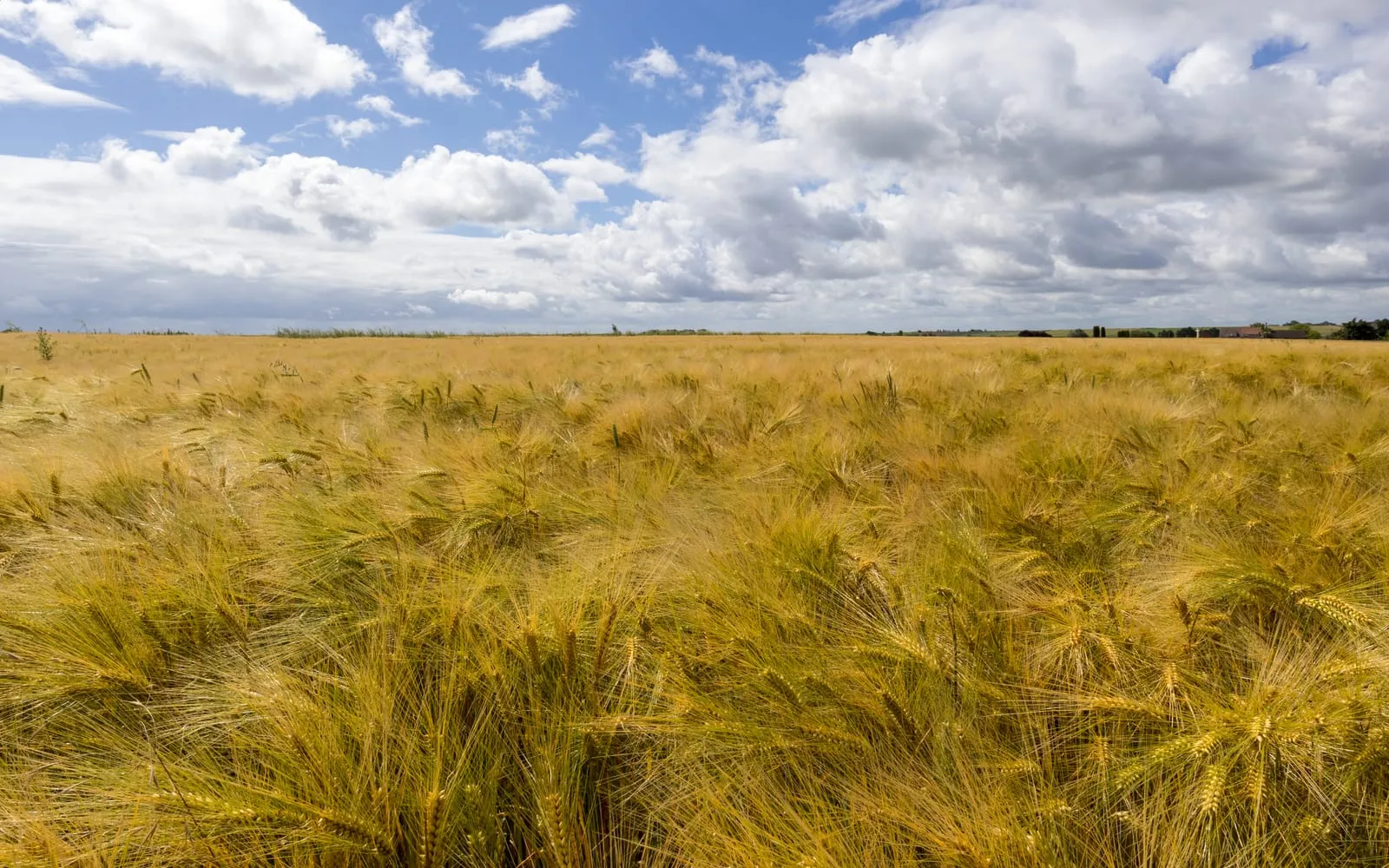
A ripening barley field in July has a texture no other cereal has. The long awns catch the light and move as one when the wind crosses them, which is worth standing beside a field to watch.
Appearance and character
The awns are the identification. Barley carries awns as long as the ear itself, sometimes longer, and no other cereal comes close. As the grain fills, the whole ear bends over on its neck and hangs, so a ripe field looks combed in one direction.
The ear structure divides the crop in two. Barley bears three spikelets at each joint of the axis. In two-row barley only the central one is fertile, so the ear is flat and carries two ranks of large even grains. In six-row barley all three set seed, giving a thicker ear with six ranks of smaller and less even grains. Two-row goes to malting, six-row largely to feed.
At the base of the leaf, barley has large smooth auricles that wrap right around the stem and overlap, which distinguishes it from wheat’s small hairy ones long before the ear appears. The leaves themselves are broader than wheat’s and a paler green.
Where it is from
Barley was domesticated in the Fertile Crescent around 8500 BC from wild barley, Hordeum vulgare subspecies spontaneum, which still grows across the Near East and central Asia. It is one of the eight founder crops, and it may have been in cultivation slightly before wheat.
Secondary centres complicate the picture. Distinct barley lineages in Ethiopia and on the Tibetan plateau suggest either independent domestication or very early divergence, and Tibetan agriculture is built on naked barley to this day, where the grain threshes free of its hull.
Britain has grown barley since the Neolithic, and in northern Scotland the old six-row landrace called bere is still cultivated in Orkney. It ripens in around 90 days, which is what a growing season that far north demands.
How it grows
Barley germinates fast and grows fast. A spring crop sown in March can be in ear by early June and harvested in August, which is roughly a month quicker than spring wheat. Winter barley is quicker still and is usually the first cereal cut anywhere it is grown.
The plant tillers heavily at the start, produces its ear on the strongest of those tillers, and pollinates itself inside the closed flower before the ear has fully emerged. That closed pollination is why barley suffers less ergot than rye does.
Grain fill takes four to six weeks, and the ear bends over as it becomes heavy. Ripening runs from the top of the plant down, and the crop is ready when the grain is hard and the straw has gone from green to pale gold.
Through the seasons
Winter barley goes in from late September, earlier than wheat, and is harvested in July. Spring barley is sown from February to April as soon as the ground is workable and dry, and most malting barley in Britain is spring sown.
The crop moves quickly through May and June. Ear emergence, flowering and the start of grain fill can all happen within three weeks in a warm season.
Harvest is late July to August, and barley is usually the first cereal off the field. Cut it when the grain is hard, since a ripe crop is prone to brackling, where the neck below the ear snaps and drops the head on the ground.
Care difficulty
Barley is the most straightforward cereal for a garden patch. It is quick, it threshes free of its hull with a good rub in most varieties, and it is untroubled by a cold spring. Sow in March, net against birds, cut in August.
The one thing to get right is soil pH, since barley is more sensitive to acidity than wheat, rye or oats. On an acid plot it comes up pale and stunted and never recovers, and liming the autumn before is the fix.
Two-row and six-row types both grow the same way. If you want to try malting, choose a named two-row malting variety, because the enzyme content and the uniformity of the grain are what the process depends on.
Watering
Rain-fed as a field crop and largely so in a garden. Barley is more drought tolerant than wheat and roots quickly, which is what lets it produce in dry continental climates.
The period that repays watering is grain fill, in late June and July. Drought then produces small pinched grains, which for a malting crop is a failure since the grains have to be even.
Waterlogged ground kills barley faster than it kills wheat. It has less tolerance of standing water, so choose a free-draining spot and lift the bed on heavy soil.
Warning signs, diseases and pests
Rhynchosporium leaf blotch is the barley disease, showing as pale grey-green oval blotches with a dark brown margin, usually on the lower leaves first. It runs in cool wet springs and can strip a crop.
Powdery mildew shows as white fluffy pustules on leaves and stems and troubles barley more than any other cereal. Brown rust scatters small orange pustules, and net blotch produces a distinctive fine dark netting pattern within a brown blotch, which is one of the more nameable cereal symptoms.
Barley yellow dwarf virus is named for this crop. Aphids bring it in during the autumn, and the following spring shows scattered stunted plants with bright yellow leaf tips that redden. Once a plant has it, nothing can be done.
Brackling is a physical failure rather than a disease. The neck below the ear weakens as the crop over-ripens and snaps, dropping the head. Watch a ripe crop daily and cut it rather than leaving it a further week.
Desert locust swarms can strip a barley field to bare stems within hours during an upsurge, across an invasion area spanning North and West Africa, the Middle East and south-west Asia. It is the most destructive migratory pest on earth and not a risk for barley grown outside that range, but a hopper band or swarm within it should be reported to the national locust control authority immediately.
Growing environment
Full sun, an open site, and free-draining ground. Barley is happiest on light loams and sands where wheat would run short of water, and it makes better use of a thin soil than wheat does.
The pH requirement is the strictest of the cereals here. Barley wants 6.5 to 7.5 and suffers below 6, showing pale stunted growth and poor tillering. Lime an acid plot the autumn before sowing.
Salt tolerance is unusually good, which is why barley grows on coastal machair and in irrigated dryland where salts accumulate. It is also why it was the staple in ancient Mesopotamia as the irrigated soils there salted up and wheat failed.
Feeding
Feed barley modestly. A feed crop takes nitrogen and turns it into yield, but a malting crop fed too well produces grain with too much protein, which maltsters reject because high-protein grain gives less extract and can haze the beer.
For a garden patch, a single light spring dressing of a balanced granular feed is enough, and on a plot that grew a fed crop last year, nothing at all.
Barley responds well to residual fertility and follows a manured crop happily. It also picks up manganese deficiency on light alkaline soils, which shows as pale leaves with brown flecks and floppy growth, and a foliar manganese feed corrects it within a fortnight.
Troubleshooting
How do I tell barley from wheat? By the awns. Barley’s are as long as the ear and the head hangs over as it ripens. Wheat’s are short or absent and the ear stays upright. Before heading, look at the auricles at the leaf base. Barley’s are large, smooth and overlapping, and wheat’s are small and hairy.
What is the difference between two-row and six-row? How many of the three spikelets at each joint set grain. Two-row gives large even grains and goes to malting. Six-row gives more grains that are smaller and less even, and goes mostly to feed.
Can I malt barley at home? Yes, and people do. Steep the grain in water for two days with air breaks, drain it and let it germinate for four or five days, turning it, then dry it slowly with warm air. Use a named two-row malting variety, since the process depends on the enzymes and evenness those varieties were bred for.
What is pearl barley? Whole barley with its hull and most of its bran abraded away. Pot barley is the same process taken less far. Neither will germinate, so neither is worth sowing.
Why has my barley dropped its heads on the ground? Brackling. The neck below the ear weakens as the crop over-ripens and snaps. Cut a ripe crop promptly rather than leaving it standing.
Are the awns dangerous to dogs? They cause real veterinary problems. Barley awns carry backward-facing barbs, so once one starts into a paw or an ear canal it keeps going. Check a dog’s feet, ears and eyes after a walk past a ripe crop.
Is barley gluten-free? No. Barley contains hordein, a gluten protein, so barley, malt extract and malt vinegar are all off a coeliac diet.
My barley is pale and stunted. Check the soil pH first, since barley is the most acid-sensitive cereal in common cultivation and struggles below pH 6. If the pH is fine, consider manganese deficiency, which is common on light alkaline soils.
Barley problem guides
Not sure what is wrong? See the common vegetable pests guide.
- Rhynchosporium leaf blotch, the classic barley disease in a wet spring
- Brown rust and yellow rust
- Powdery mildew, which barley suffers from more than wheat
- Aphids carrying barley yellow dwarf virus, which is named for this crop
- Slugs in an autumn seedbed
- Pigeons and finches on a garden patch
- Desert locust, capable of stripping a whole crop across Africa and south-west Asia