
Edible
Filbert
Corylus maxima
Also known as Kentish Cob, Lambert's filbert, Purple filbert, Giant filbert
How to grow filbert, Corylus maxima. The long-husked hazel behind Kentish Cob, why you need two of them, and the squirrels that will take the crop first.
At a glance
- Difficulty
- Easy
- Water
- First two summers, then only in drought
- Light
- Full sun to part shade
- Temperature
- Fully hardy to -25 deg C
- Hardiness
- USDA 4-8, RHS H6, hardy to -30 C
- Type
- Deciduous shrub or small tree, long-lived, suckering
- Height
- 4-6 m, and as wide
- Native to
- South-east Europe, Western Asia
- Best month
- September and October in the Northern Hemisphere, March and April in the Southern Hemisphere
Pollination happens in midwinter, with wind carrying pollen from catkins to tiny red female flowers in January or February, so a wet or frozen spell at the wrong moment costs the whole crop. Eastern filbert blight limits growing across eastern North America, where only resistant cultivars are worth planting. Two different cultivars are needed.
Hardiness zones describe winter cold alone. Summer heat, humidity, rainfall and the length of the growing season decide as much, so treat the range as the outer limit rather than as a recommendation.
Every month named in this guide is for the temperate Northern Hemisphere. If you garden in the Southern Hemisphere, shift each one by six months, so September becomes March. Closer to the equator the wet and dry seasons matter more than the calendar, and the shift stops being a useful guide.
Not known to be toxic
- Safe to eat
- The kernels
The kernels are food. Nut allergy is the point that matters most here, and tree nuts are among the most significant food allergens, capable of causing anaphylaxis in sensitised people. Neither the RHS nor the ASPCA lists Corylus as a poisonous plant, and the ASPCA does not record hazelnuts as toxic to cats or dogs, though a dog that eats whole nuts in quantity risks a blockage and the shells are hard enough to break a tooth. Mouldy nuts left on the ground are a separate hazard, since moulds growing on fallen nuts can produce tremorgenic toxins that cause seizures in dogs. Clear windfalls rather than leaving them to rot where a dog forages.
Sources: RHS potentially harmful garden plants, ASPCA toxic and non-toxic plants
About
The naming here has been muddled for two hundred years. A cob has a short husk that the nut sits proud of, and a filbert has a long husk that wraps the nut and closes beyond it. Kentish Cob, the variety that dominates British nut growing, is a filbert by that test, and has been sold under the wrong name since 1830.
The plant is a large multi-stemmed shrub rather than a tree, suckering from the base and spreading wide, and it grows on chalk where many fruits struggle.
Pollination needs thought. Hazels carry male catkins and tiny female flowers on the same plant but reject their own pollen, so a second variety is needed and it must shed catkins while the other’s red female flowers are open.
Squirrels are the reason many gardeners give up. They take nuts while still green, weeks before you would pick.
Appearance and character
A vigorous multi-stemmed shrub, suckering freely from the base into a broad clump.
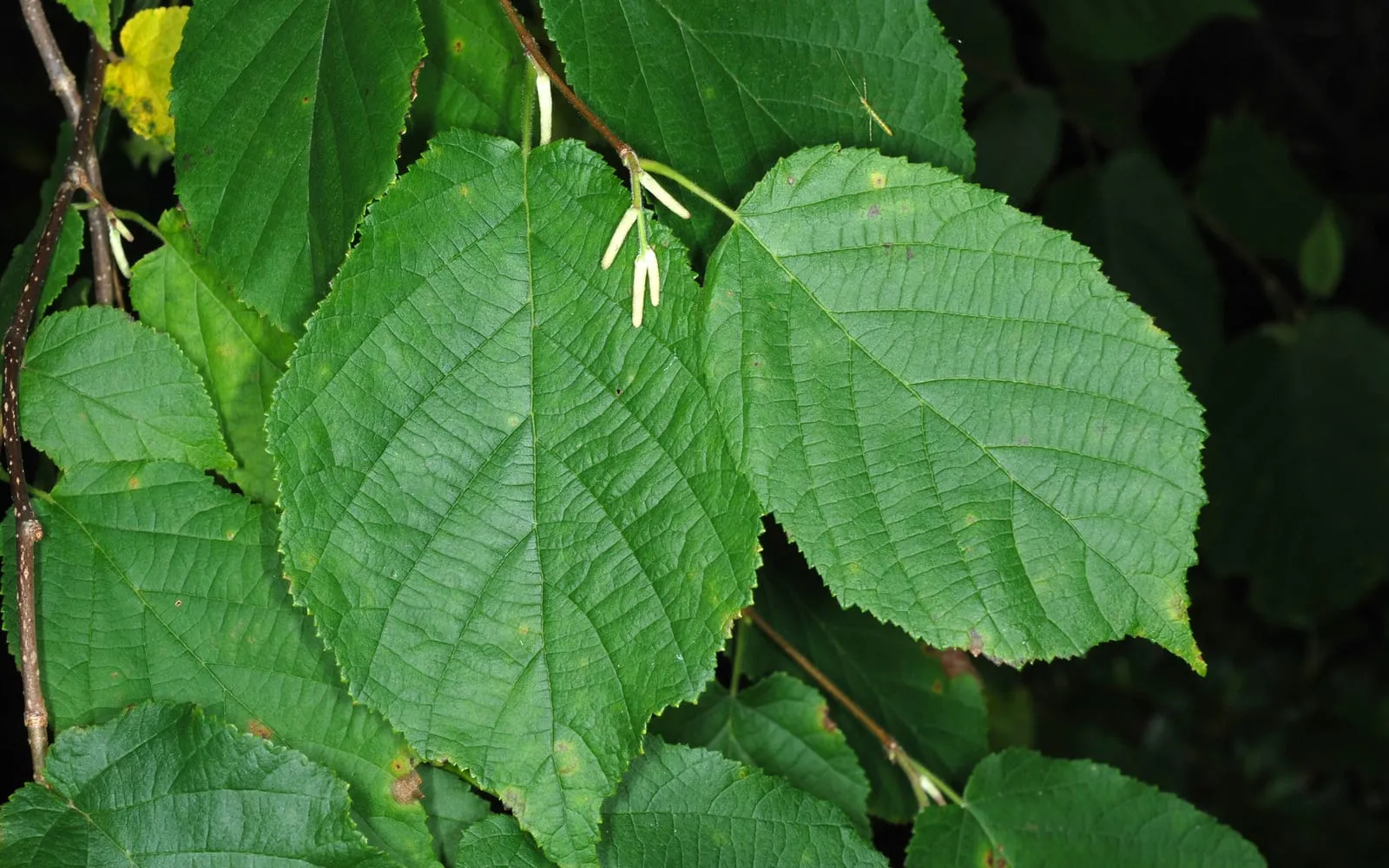
Leaves are rounded to heart-shaped, 6 to 12 cm, with a doubly toothed edge, softly hairy, and mid-green in the type or deep purple in ‘Purpurea’.
Male catkins form in autumn and hang through winter, expanding and shedding yellow pollen in January and February.
Female flowers are minute, appearing on the same stems in midwinter as tiny bright red tufts of styles protruding from a bud, easily missed and worth looking for.
Nuts ripen in clusters of two to four, each enclosed in a long tubular green husk that extends well beyond the nut and is often fringed at the mouth.
Where it is from
Corylus maxima is native to south-east Europe and western Asia, around the Balkans, Turkey and the Caucasus.
It grows in woodland and scrub, and it has been cultivated for nuts since classical times.
Turkey produces the majority of the world’s hazelnuts today, and the Black Sea coast is the centre of that industry.
British commercial growing centred on Kent, where the plum orchards and nut plats of the Weald included substantial areas of Kentish Cob from the mid-nineteenth century.
The name filbert is generally traced to St Philibert, whose feast day on 20 August falls around the time the nuts begin to fill.
How it grows
Buy two different named varieties. ‘Kentish Cob’ with ‘Gunslebert’ or ‘Butler’ is a reliable pairing, and any nursery selling nut trees will advise on overlap.
Plant bare-root in winter, 4 to 5 m apart, in well-drained soil. Chalk is acceptable and rich soil is not ideal.
Site in sun for the heaviest crop, though the plant tolerates part shade.
Prune in late winter after the catkins have shed, or in August using the traditional brutting method, where side shoots are broken and left hanging to check growth and encourage flower buds.
Remove suckers annually unless you want a widening thicket.
Expect a first crop in the fourth year, building substantially by year eight.
Through the seasons
Winter is when the plant flowers. Catkins lengthen and shed pollen in January and February, and the tiny red female flowers open at the same time.
That midwinter timing means cold still weather can reduce pollination, since the pollen travels on wind rather than by insect.
Leaves follow in April, and the nuts develop through summer inside their husks.
August is when the kernels fill, and it is also when squirrels start taking them green.
Harvest in September and October. Nuts are ready when the husk turns from green to brown and the nut falls free when the cluster is shaken.
Dry the crop for a fortnight in a single layer somewhere airy, then store in a cool dry place in mesh rather than plastic.
Care difficulty
Easy as a plant and difficult as a crop, and squirrels account for the gap.
The shrub itself is hardy, tolerant of chalk and shade, and free of any serious disease.
Pruning is optional in a garden setting, and suckering is the only habit that needs annual attention.
Pollination requires two varieties with overlapping flowering, which is a decision made once at planting.
Protecting the nuts from squirrels is close to impossible in a garden with a squirrel population, and picking early and ripening indoors is the usual compromise.
Watering
Water weekly through the first two summers, 20 litres at a time.
An established plant needs water only in prolonged drought.
Moisture in July and August helps the kernels fill, so a soaking during a dry spell improves the crop.
Mulch in spring with compost, kept clear of the stems, which suppresses suckers somewhat and holds moisture.
The plant dislikes waterlogging and grows best on ground that drains freely.
Warning signs, diseases and pests
Nuts disappearing in August while still green. Squirrels. Pick early and ripen the nuts indoors, since waiting for perfect ripeness usually means losing the lot.
Small round hole in the shell, kernel eaten out. Nut weevil. Collect and destroy fallen nuts, and cultivate the soil beneath the plants in winter.
White powdery coating on leaves in late summer. Powdery mildew, cosmetic at that stage in the season.
Buds swollen and rounded rather than pointed, failing to open. Big bud mite. Pick off and destroy affected buds in winter.
Curled sticky shoot tips. Aphids, which the plant outgrows.
Stems dying back with white sheets under the bark. Honey fungus, which is fatal.
Kernels shrivelled or discoloured with no visible entry hole. Brown marmorated stink bug feeding through the husk, established across North America and a growing list of European countries.
Growing environment
Full sun gives the best crop, and the plant tolerates part shade with a lighter one.
Well-drained soil of moderate fertility, and it grows well on chalk, which few nut crops do.
Rich soil produces growth rather than nuts, so avoid feeding heavily.
Shelter helps at flowering time, since pollen moves on light air rather than in a gale.
Allow 4 to 5 m per plant and remember two are needed. A pair at the edge of a lawn, or a row as an informal boundary, both work.
Feeding
Feed little. Sulphate of potash in late winter supports flowering and nut fill.
Avoid nitrogen, which produces long leafy growth, more suckers and fewer nuts.
Mulch with compost in spring on poor soil, kept off the stems.
An established plant on reasonable ground needs nothing at all.
Leave fallen leaves to break down beneath the plant, which returns more than any bagged fertiliser.
Troubleshooting
Plenty of catkins, no nuts. Only one variety, or two whose flowering does not overlap. Hazels reject their own pollen.
Nuts empty when cracked. Poor pollination, or nut weevil. Check for the exit hole to tell which.
All the nuts gone by September. Squirrels. Pick in late August while the husks are still greenish and dry them indoors.
Plant spreading into a thicket. Suckering, which is normal. Cut suckers out at ground level each winter.
Lots of growth, few nuts. Too much nitrogen or too much shade. Stop feeding and thin what overhangs.
Sold as Kentish Cob but described as a filbert. Both are correct. The variety is a filbert carrying a cob’s name.
Filbert problem guides
Not sure what is wrong? See the common vegetable pests guide.