
Edible
Salak
Salacca zalacca
Also known as Snake fruit, Sala, Zalacca
How to grow salak, Salacca zalacca. The snake fruit with a reptile skin and an apple crunch, the spines that make harvesting a dangerous job, and the male and female plants you need for a crop.
At a glance
- Difficulty
- Difficult
- Water
- Two or three times a week year round
- Light
- Part shade. It grows under a canopy in the wild
- Temperature
- Minimum 15 deg C. Damaged below 12 deg C
- Humidity
- Very high
- Hardiness
- USDA 11-12, RHS H1b, hardy to 15 C
- Type
- Tender evergreen clumping palm, dioecious
- Height
- 4-6 m of leaf, on a trunk that stays near the ground
- Native to
- Java, Sumatra
- Best month
- June and July in the Northern Hemisphere, December and January in the Southern Hemisphere
Wet lowland Indonesia, growing as a spiny stemless palm in shade. Plants are male or female, so a crop needs both and is usually hand pollinated. No dry season and no cool nights.
Hardiness zones describe winter cold alone. Summer heat, humidity, rainfall and the length of the growing season decide as much, so treat the range as the outer limit rather than as a recommendation.
Every month named in this guide is for the temperate Northern Hemisphere. If you garden in the Southern Hemisphere, shift each one by six months, so June becomes December. Closer to the equator the wet and dry seasons matter more than the calendar, and the shift stops being a useful guide.
Not known to be toxic
- Safe to eat
- The flesh of the ripe fruit
- Do not eat
- The seed, which is hard and inedible
Salak is not toxic and nothing in the plant is listed as harmful to people or to cats and dogs. Unripe fruit is strongly astringent and drying in the mouth, which is unpleasant rather than dangerous, and the tannin content is high enough that a large quantity is constipating. The seed is hard, brown and inedible and is discarded. The genuine hazard is mechanical. Every leaf stalk is armed along its whole length with slender black spines several centimetres long, harvesting is done with long tongs and thick gloves, and a puncture from one is painful and prone to infection. This is a plant to site where nobody walks past it.
Sources: ASPCA toxic and non-toxic plants, RHS potentially harmful garden plants
About
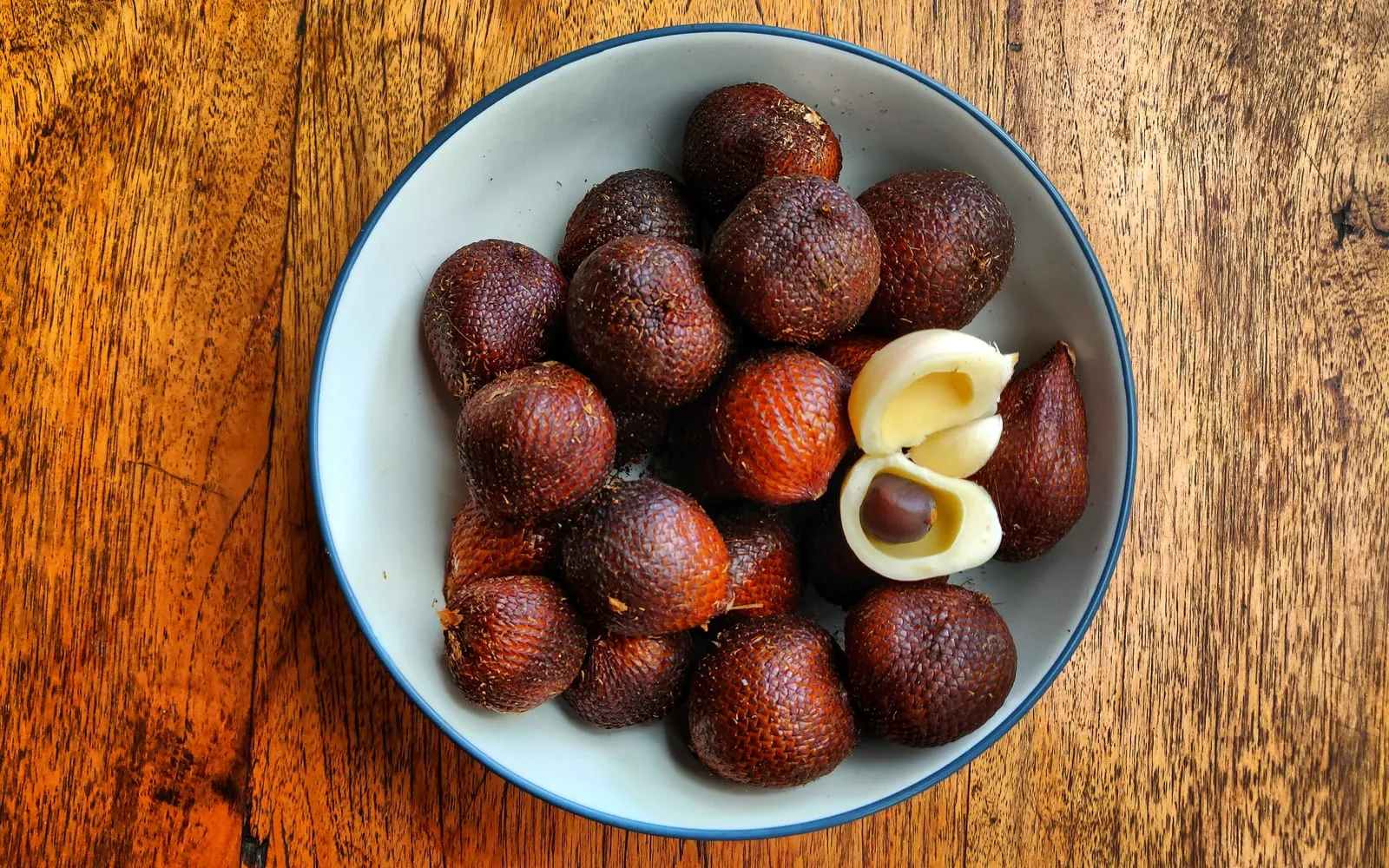
Salak is called snake fruit for the skin, and the resemblance is exact. Each fruit is covered in overlapping red-brown scales that look and feel like a reptile, and the skin flakes off in the fingers to leave three creamy segments inside.
The flesh is crisp and dry, more like an apple than anything tropical, with a flavour that runs sweet and acid at once with an astringent edge. Balinese salak is the sweet one, Javanese pondoh is the aromatic one, and the two are treated as different fruits in Indonesia.
The palm itself is armed like almost nothing else in cultivation. Every leaf stalk carries long black spines along its entire length, and harvesting is done with tongs at arm’s length.
Appearance and character
A clumping stemless palm, with a very short trunk that stays at or near ground level and a dense rosette of leaves rising from it.
Leaves are pinnate, 3 to 7 m long, arching, with leaflets ranged along a stout midrib, dark green above and whitish beneath.
The leaf stalks and midribs are covered along their whole length in slender black spines 2 to 10 cm long, and this is the first thing anyone notices.
Suckers form around the base, so a mature plant is a thicket rather than a single palm.
Flowers are borne in short spikes among the leaf bases, close to the ground and hidden. The species is dioecious, with male and female flowers on separate plants.
Fruit grows in tight clusters at the base of the clump, each 5 to 8 cm, teardrop-shaped, covered in overlapping shiny red-brown scales that point backwards.
Peeling is done by pinching the pointed tip and pulling the skin away in flakes.
Inside are two or three creamy white to pale yellow segments, crisp and dry, each with a hard brown seed.
Where it is from
Salak is native to Java and Sumatra, where it grows in the understorey of humid lowland forest.
Indonesia has cultivated it for centuries and it remains overwhelmingly an Indonesian crop.
Two cultivar groups dominate. Salak Bali comes from Bali, is sweeter and less astringent, and is the one most often exported. Salak pondoh comes from the Yogyakarta region of Java, is aromatic and can be eaten when still slightly under-ripe, and is the domestic favourite.
Cultivation spread to Malaysia, Thailand and the Philippines, and small plantings exist in Queensland and Papua New Guinea.
Commercial growers plant female clumps and keep a small number of males for pollen, and hand pollination is normal practice because the flowers are hidden among the spiny leaf bases.
Temperate markets see salak occasionally in South East Asian groceries and it does not keep long.
How it grows
Sow seed from a ripe fruit within a week. Salak seed loses viability quickly.
Clean the flesh off and sow at 25 to 30 deg C in rich free-draining compost. Germination takes four to eight weeks.
Grow in part shade. This is an understorey palm and full sun scorches it.
Keep the temperature above 15 deg C and the humidity very high, year round.
Water two or three times a week and never let it dry out.
Feed monthly from April to September with a palm feed containing magnesium and potassium.
Handle it with thick gloves and long sleeves. Every operation, including watering a plant in a crowded greenhouse, is a hazard.
Grow several if fruit is the aim, since the palm is dioecious and about half will be male.
Expect fruit in four to five years in the tropics, and hand pollination will be needed because the flowers sit hidden among the spines.
Through the seasons
Winter is the season that tests it. Hold above 15 deg C with high humidity and reduced watering, and feed nothing.
Spring brings new leaves as light returns. Start feeding.
Early summer is the main growing period.
Midsummer is peak growth, and a mature clump flowers among the leaf bases.
Late summer is fruit development, which takes about six months from pollination.
Autumn is when to stop feeding and hold the humidity as the heating comes on.
Care difficulty
Difficult, and the difficulties are unusual.
The spines are the first. They cover every leaf stalk, they are long and sharp, and a puncture is painful and prone to infection. This is not a plant for a crowded greenhouse or a household with children.
Constant warmth and very high humidity are the second, with no cool rest.
Part shade is a requirement rather than a preference.
Sex is the third. The palm is dioecious, half of seedlings are male, and there is no way to tell until flowering.
Hand pollination is needed even with both sexes present, because the flowers are hidden among the leaf bases.
Space is the fourth, since a clump spreads by suckers into a thicket.
Watering
Water two or three times a week year round, keeping the compost evenly damp.
Never let it dry out. This is a rainforest understorey palm with no drought tolerance.
Drain fully, since cold wet compost still rots the roots.
Keep humidity very high with misting, damp gravel and grouping.
Use rainwater where the supply is hard.
Reduce watering slightly in winter without allowing the compost to dry.
Water carefully, given the spines, and use a long-spouted can.
Warning signs, diseases and pests
Brown scorched leaflets mean direct sun on a plant that wants shade.
Brown leaf tips mean dry air.
Leaf drop or collapse after a cold spell is chill damage below 12 deg C.
Fine webbing on the leaflets is spider mite, which arrives when humidity falls.
Brown limpets on the leaf stalks are scale, hard to reach among the spines.
White fluff at the leaf bases is mealybug.
Wilting in damp compost is root rot.
A clump that flowers and never fruits is male, or is female with no pollen and no hand pollination.
Astringent fruit means it was picked early.
Growing environment
A heated humid greenhouse with room to keep it away from paths.
Minimum 15 deg C, with 25 to 32 deg C for growth.
Very high humidity year round.
Part shade.
Rich moisture-retentive free-draining compost, slightly acid.
pH from 5.0 to 6.5.
A wide pot, since the clump spreads by suckers.
Thick gloves, long sleeves and long-handled tools kept nearby.
Feeding
Feed monthly from April to September with a palm feed.
Choose one containing magnesium and potassium, which palms run short of in pots.
Stop feeding at the end of September.
Give nothing through winter.
Top-dress each spring rather than wrestling a spiny clump out of its pot.
Correct yellow mottling on older leaves promptly, since a palm cannot repair a formed leaf.
Keep feeding moderate.
Troubleshooting
Why is it called snake fruit? The skin is covered in overlapping shiny red-brown scales that look and feel like reptile skin. It flakes off in the fingers.
How do I peel one? Pinch the pointed tip and pull the skin away in flakes. No knife is needed.
What does it taste like? Crisp and dry, closer to an apple than to anything tropical, sweet and acid at once with an astringent edge.
What is the difference between salak Bali and pondoh? Bali salak is sweeter and less astringent and is the one usually exported. Pondoh comes from Java, is aromatic, and can be eaten slightly under-ripe.
Do I need two plants? Yes. The palm is dioecious and only females fruit. Grow several seedlings and expect about half to be male.
Why do the flowers need hand pollination? They sit hidden among the spiny leaf bases close to the ground, where few pollinators reach, so growers do it by hand as standard practice.
How dangerous are the spines? Enough that harvesting is done with long tongs and thick gloves. They are several centimetres long, cover every leaf stalk, and puncture wounds from them are prone to infection.
My fruit was mouth-drying. It was picked early. Unripe salak is heavily astringent.
Salak problem guides
Not sure what is wrong? See the common vegetable pests guide.