
Edible
Horseradish
Armoracia rusticana
Also known as Red cole, Mountain radish
How to grow horseradish, Armoracia rusticana. Why it must be contained, growing it in a bin or a tube, lifting in autumn, and the heat that only appears when you grate it.
At a glance
- Difficulty
- Easy
- Water
- Weekly in a dry summer, otherwise it fends for itself
- Light
- Full sun to partial shade
- Temperature
- Fully hardy to about -20 deg C, dying back to the root each winter
- Hardiness
- USDA 2-9, RHS H7, hardy to -30 C
- Type
- Hardy herbaceous perennial
- Height
- 60-120 cm
- Native to
- South-eastern Europe, Western Asia
- Best month
- October in the Northern Hemisphere, April in the Southern Hemisphere
Any fragment of root left in the ground regrows, so a planting is effectively permanent and is best confined to a sunken bucket or a corner nothing else wants. It is listed as an invasive species in parts of North America for that reason. Cold does not trouble it at all, and the heat in the root is strongest after a cool autumn.
Hardiness zones describe winter cold alone. Summer heat, humidity, rainfall and the length of the growing season decide as much, so treat the range as the outer limit rather than as a recommendation.
Every month named in this guide is for the temperate Northern Hemisphere. If you garden in the Southern Hemisphere, shift each one by six months, so October becomes April. Closer to the equator the wet and dry seasons matter more than the calendar, and the shift stops being a useful guide.
Skin irritant
- Safe to eat
- The root, grated as a condiment, and the young leaves in salad
- Harm from
- Eating it, handling it and sap in the eyes
- Affects
- People, cats, dogs and horses
Horseradish is a food crop and the grated root is eaten in small quantities as a condiment, which is the key to understanding its position. The root contains sinigrin, which is odourless and inert until the cells are broken. Grating releases the enzyme myrosinase, which converts sinigrin to allyl isothiocyanate, the same volatile compound that gives mustard gas-like pungency to wasabi and mustard. That compound is a genuine irritant. The vapour stings eyes and airways during grating, and prolonged skin contact with fresh grated root causes redness and blistering. Grate it in a ventilated room or outdoors, and wear gloves for a large quantity. Eating a quantity of the raw root, rather than a spoonful of sauce, causes vomiting, abdominal pain and diarrhoea. The ASPCA lists horseradish as toxic to cats, dogs and horses for exactly this reason, with the same signs, and the RHS lists Armoracia rusticana among plants that irritate skin and are harmful if eaten in quantity. A dog that digs up and chews a root needs a vet's advice. Anybody with a thyroid condition should know that the glucosinolates interfere with iodine uptake at high intakes, which no normal use reaches.
Sources: RHS potentially harmful garden plants, ASPCA (Horseradish, Armoracia rusticana)
About
Plant horseradish once and you have it for life, whether or not that is what you wanted. Every fragment of root left in the ground grows a new plant, and the roots go down a metre, which puts complete removal beyond most gardeners. This is the reason almost every guide to it opens with a warning rather than a planting instruction.
Grow it in a container, a bottomless bin sunk in the ground or a length of drainpipe, and it becomes a well-behaved and useful plant. Grow it in an open border and it becomes a permanent feature of your garden and your neighbour’s.
The heat explains how to handle the root. An intact horseradish root smells of almost nothing. The pungency is manufactured on the spot when you break the cells by grating, and it starts to fade within half an hour unless vinegar is added to stop the reaction.
Appearance and character
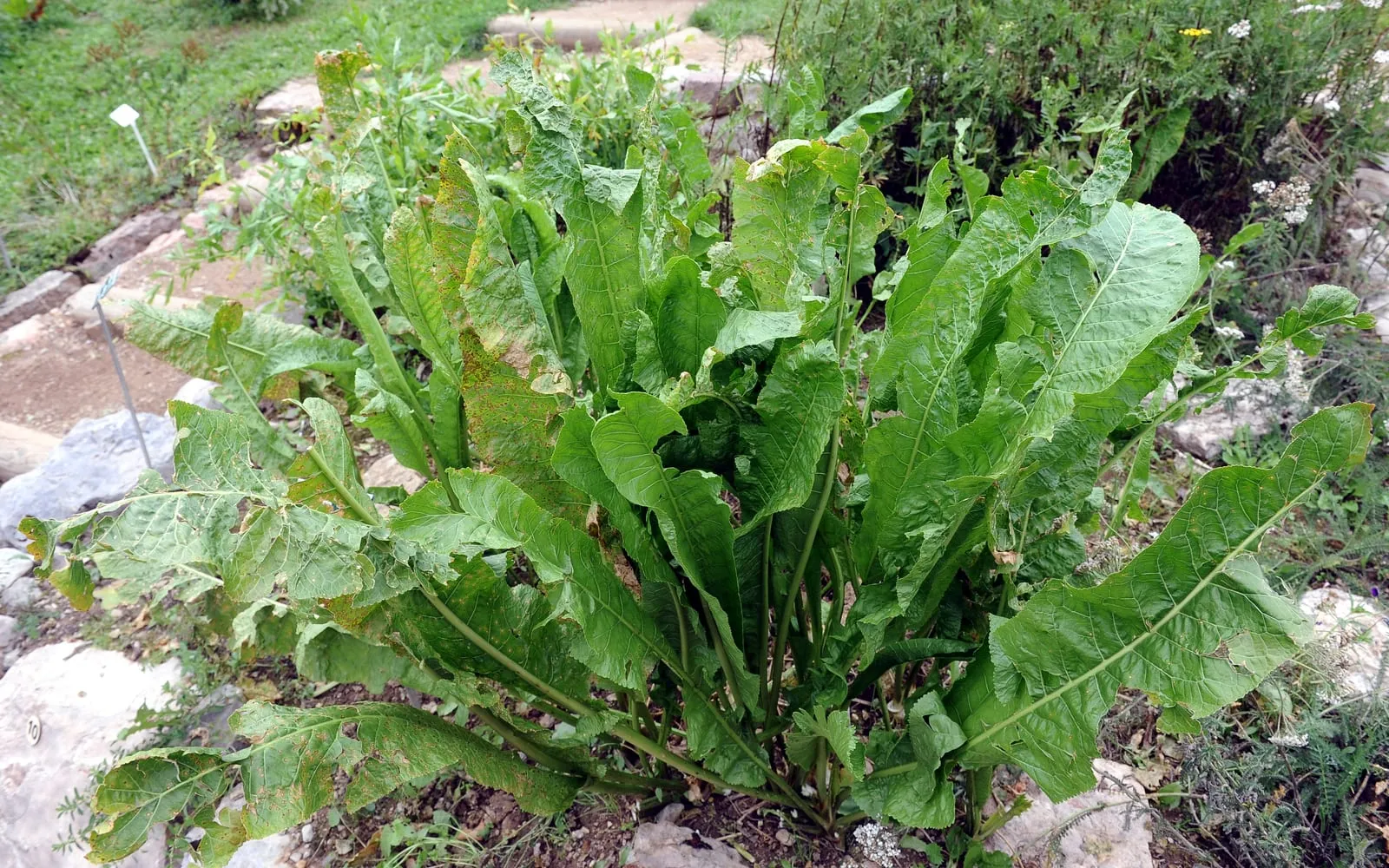
A coarse clump of large leaves, each 30 to 60 cm long, oblong with wavy and toothed margins, in a glossy mid-green. They look like a well-grown dock and are often mistaken for one.
The root is a thick, branching, buff-skinned taproot with white flesh, running straight down and sending out side roots that each become a new plant.
Flesh is dense, fibrous and white, with no smell until it is cut or grated.
Flowers appear in early summer on branched stems to a metre, small and white in the manner of every brassica, and most garden plants set little viable seed. The plant spreads by root rather than by seed.
Variegated forms with cream-splashed leaves are sold as ornamentals and have the same root and the same habits.
Where it is from
Horseradish is native to south-eastern Europe and western Asia, probably around the Caspian and the Volga basin, and it has naturalised across Europe, Britain and North America.
It has been used as a medicine and a condiment since antiquity. Documented culinary use in central and eastern Europe runs back to the Middle Ages, and it is one of the bitter herbs of the Passover seder.
Britain took to it in the sixteenth century, first as a medicine and then as the sauce that goes with roast beef. Gerard’s Herball of 1597 records both uses, and notes with some disapproval that Germans ate it as a relish.
Wild plants along British roadsides and railway banks are garden escapes rather than natives, and there are a great many of them, which tells you most of what you need to know about containing it.
How it grows
Plant root cuttings, called thongs, in early spring or autumn. A thong is a pencil-thick side root 20 to 30 cm long, cut square at the top and slanted at the bottom so you know which way up it goes.
Plant at an angle of about 45 degrees with the top 5 cm below the surface.
Contain it. Sink a bottomless dustbin, a large pot or a 30 cm length of drainpipe filled with soil, and plant into that. A pot of 40 litres or more standing on a hard surface works well and is easily emptied.
Rub off the side shoots along the developing root in midsummer if you want one thick straight root rather than several branched ones. This is what commercial growers do.
Lift in autumn after the leaves have died back, from October, which is when the root is at its most pungent.
Keep the thickest root for the kitchen and a few thongs for replanting, and remove every fragment from the soil unless you intend to have it there again.
Through the seasons
Early spring is one of the two planting windows. Plant thongs into a contained bed or container and let them go.
Late spring brings the leaves up fast. Slugs and flea beetle both take an interest and neither does lasting harm.
Summer needs watering in a dry spell and little else. Rub off the side shoots in July if you want a single thick root. Remove flowering stems, which take energy from the root.
Autumn is the harvest. Lift from October after the foliage dies back. This is also the second planting window.
Winter is when the roots keep best. Store lifted roots in damp sand in a cool shed, or leave them in the ground and lift as needed, since they are fully hardy.
Care difficulty
Easy to the point of being difficult to stop.
Containment is the only real decision, and it has to be made before planting rather than after. A sunk bin, a large pot or a drainpipe all work. An open border does not.
Lifting cleanly is the other skill. Dig wide and deep, and get every fragment, because a piece the size of a fingernail regrows.
The plant asks for almost nothing else. It survives drought, shade, poor soil and neglect, and the pests that attack the leaves do not reach the root.
Handling the grated root is where care is needed. Grate outdoors or by an open window, keep your face away from it, and add vinegar as soon as you have the heat you want.
Watering
Water weekly in a dry summer to keep the leaves from wilting, and otherwise leave it alone. An established plant in the ground finds its own water.
Container-grown plants need real attention, since the whole point of the container is to restrict the roots. Water two or three times a week in summer and never let the compost dry out completely.
A dry summer gives a smaller, hotter, more fibrous root, which some people prefer.
Mulch a container or a contained bed in spring with compost.
Waterlogged ground rots the crown over winter, which is the one condition horseradish does not tolerate.
Warning signs, diseases and pests
Flea beetle shot-holes the leaves through the summer. The damage looks worse than it is and the root is unaffected.
Cabbage white caterpillars strip the leaves in late summer. Again the root continues, and netting is only worth it if you want the leaves for salad.
White blister brings chalky pustules and distorted leaves. Remove affected foliage.
Slugs graze the young leaves in spring.
Spreading is the real problem, and it is not a pest. Any root fragment left in the ground grows. Lift carefully and completely, and never rotavate a bed that has held horseradish, which chops the roots into hundreds of cuttings.
Rot at the crown follows waterlogging over winter on heavy ground. Plant on a slight mound or in a container.
Growing environment
Full sun to partial shade. Horseradish crops in far more shade than most vegetables.
Deep, fertile, moisture-retentive soil gives the thickest roots, and the plant tolerates almost any soil that is not waterlogged.
A container, sunk bin or drainpipe is the recommended growing environment rather than open ground. Use a 40 litre pot or larger.
Free drainage over winter matters more than fertility.
Site it where you can dig it up completely, which means away from paths, walls, fences and shrubs whose roots you cannot disturb.
Never plant it in a mixed border or anywhere it can reach a neighbour’s ground.
Feeding
Horseradish needs very little. Work compost into the container or bed when planting a new set of thongs and leave it at that.
Avoid nitrogen, which gives enormous leaves and a thin root.
A container refreshed with new compost each spring needs no other feeding.
Ground that has grown horseradish for several years benefits from lifting the whole crop, adding compost and replanting fresh thongs, which is better than feeding an old congested clump.
Troubleshooting
It has spread all over the bed. Every root fragment grows. Lift what you can reach, keep cutting off any leaves that appear to starve the remaining roots, and accept that this takes two or three seasons. Never rotavate.
Thin, branched roots. Overfeeding with nitrogen, a crowded old clump, or side shoots left on. Lift and replant fresh thongs, and rub off the side shoots in July.
The grated root has no heat. Either the root was lifted in spring rather than autumn, or it was grated too long ago. The pungency forms on grating and fades within half an hour. Add vinegar to fix it at the strength you want.
Holes all over the leaves. Flea beetle or cabbage white caterpillars. Neither affects the root.
My eyes streamed while grating it. Allyl isothiocyanate vapour. Grate outdoors or by an open window and keep your face clear.
The crown rotted over winter. Waterlogging. Plant on a mound or in a container with free drainage.
Can I grow it in a pot? Yes, and it is the recommended way. Use 40 litres or more, stand it on a hard surface, and empty it out each autumn.
Is wasabi the same thing? No, though most wasabi sold outside Japan is horseradish with green colouring. True wasabi is Eutrema japonicum and is a different plant with different growing requirements.
Horseradish problem guides
Not sure what is wrong? See the common vegetable pests guide.