
Edible
Asian pear
Pyrus pyrifolia
Also known as Nashi, Japanese pear, Sand pear, Apple pear
How to grow Asian pear, Pyrus pyrifolia. Why you pick it crisp instead of ripening it soft, the pollination partner it needs, and thinning the fruit for size.
At a glance
- Difficulty
- Moderate
- Water
- Weekly through the first two summers, then only in drought
- Light
- Full sun, and it needs the warmest wall or corner you have
- Temperature
- Wood hardy to about -20 deg C, blossom lost at -2 deg C
- Hardiness
- USDA 5-9, RHS H6, hardy to -20 C
- Type
- Deciduous tree, cropping for forty years or more
- Height
- 3-4 m on quince rootstock, 8 m or more on seedling roots
- Native to
- China, Japan, Korea
- Best month
- September and October in the Northern Hemisphere, March and April in the Southern Hemisphere
The chill requirement runs 400 to 600 hours, low enough that it crops in winters too mild for a European pear. What it wants instead is a long warm autumn, because the fruit ripens on the tree rather than in store and needs the heat to finish. Plant two cultivars.
Hardiness zones describe winter cold alone. Summer heat, humidity, rainfall and the length of the growing season decide as much, so treat the range as the outer limit rather than as a recommendation.
Every month named in this guide is for the temperate Northern Hemisphere. If you garden in the Southern Hemisphere, shift each one by six months, so September becomes March. Closer to the equator the wet and dry seasons matter more than the calendar, and the shift stops being a useful guide.
Not known to be toxic
- Safe to eat
- The fruit, skin and all
- Do not eat
- The pips, in large chewed quantity
The flesh is food. The pips contain amygdalin, which releases hydrogen cyanide when the seed coat is broken by chewing, and the same compound occurs in apple and pear seed. Swallowing a few pips whole does nothing, because an intact seed passes through undigested. The quantity needed to cause harm runs to a large cupful of thoroughly chewed seed, so treat this as a reason not to feed cores to a dog rather than as a hazard to the person eating the fruit. Discard the core when juicing in quantity, since a juicer breaks every seed at once. Leaves and wood carry the same compound at low levels and no part of the tree is a grazing risk in a garden.
Sources: RHS potentially harmful garden plants, ASPCA toxic and non-toxic plants
About
An Asian pear is round, russeted like a potato, and crunches like an apple. People who expect the buttery softness of a Conference pear put the first one down disappointed, having judged it against the wrong fruit. This is a pear that stays crisp, and the texture is the point.
The other reversal is picking. A European pear is cut from the tree hard and ripened indoors, because left hanging it goes to mush from the core outwards. An Asian pear ripens on the tree and is picked ready to eat. Take it when the ground colour shifts from green to gold and the fruit parts from the spur with a gentle lift.
It is a better garden tree in a cool climate than its reputation suggests. The wood is hardy well past anything a temperate winter produces. What limits it is the early blossom, which opens in April and is vulnerable to a late frost.
Fruit thinning does more for an Asian pear than for almost any other tree. Left alone it sets in clusters of six and gives you six small ones.
Appearance and character
A medium tree with a naturally upright frame that spreads as the branches take weight.
Leaves are oval with finely toothed edges, 7 to 12 cm long, glossy dark green above and turning a good bronze-red in autumn. The autumn colour is better than most European pears manage.
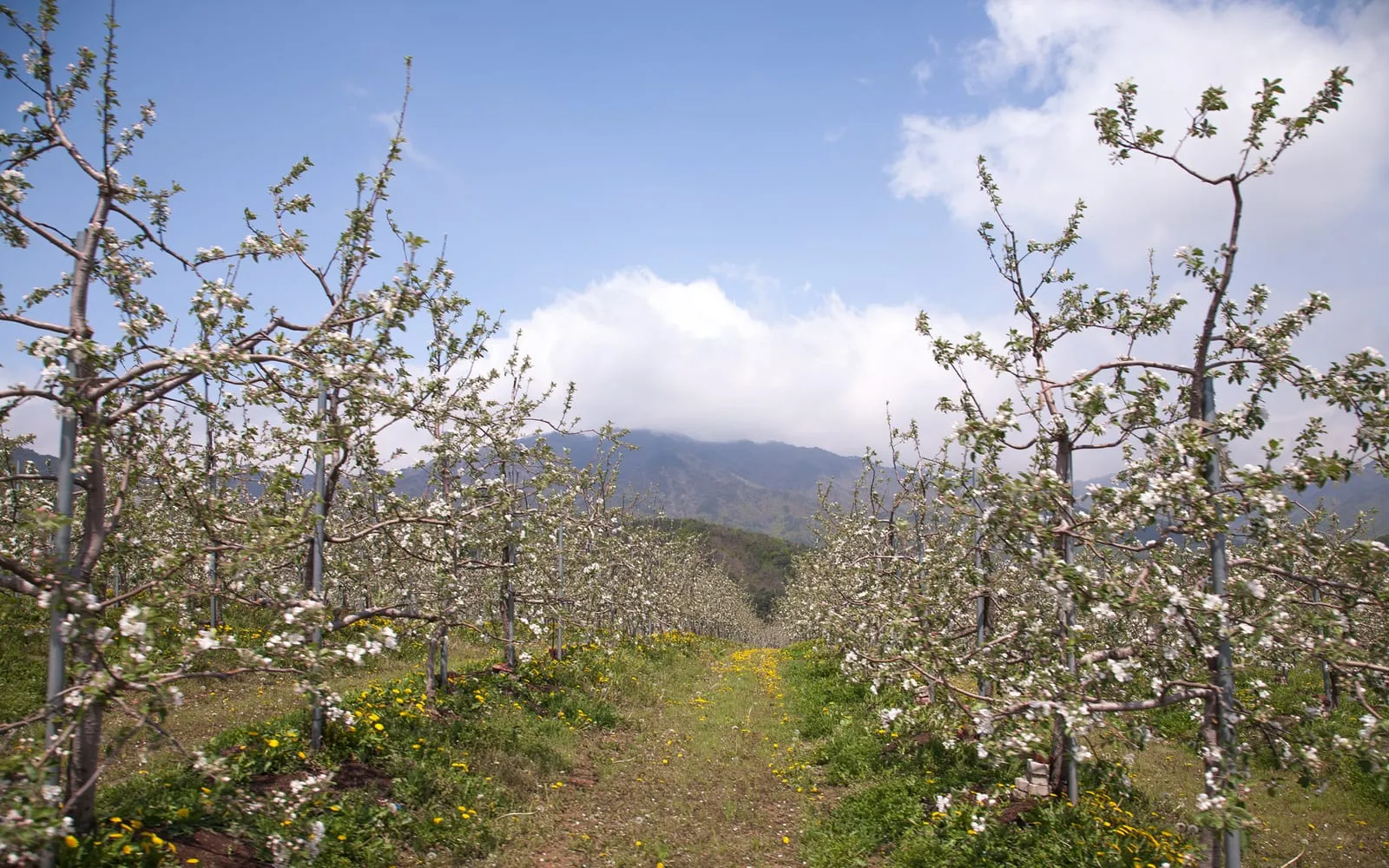
Blossom comes in April, white with five petals in flat clusters, opening before or alongside the leaves. Purple-black anthers give the flower a smudged centre that tells it apart from apple blossom at a glance.
Fruit is round to slightly flattened rather than the waisted pear shape, 6 to 10 cm across. Skin ranges from smooth green-yellow in varieties such as ‘Nijisseiki’ to a heavy bronze russet in ‘Hosui’ and ‘Shinseiki’.
The flesh is white, very juicy, and full of the gritty stone cells that give the sand pear its name. Those cells are what keep it crisp.
Where it is from
Pyrus pyrifolia is native to central and southern China, and it has been under cultivation there for well over two thousand years.
It travelled to Japan and Korea early, and Japanese breeders did the work that produced the varieties sold today. ‘Nijisseiki’ was found as a chance seedling on a rubbish heap in 1888 and named the twentieth-century pear.
Wild trees grow in warm temperate forest with hot wet summers and cold dry winters, which explains the tree’s appetite for summer heat and its indifference to winter cold.
Chinese and Japanese growers treat the fruit as a gift item, bagging each pear on the tree to keep the skin unmarked, and a single perfect specimen can sell for a remarkable sum.
Commercial planting in the West began in California and later Australia and New Zealand, where the fruit is usually sold as nashi.
How it grows
Buy a two-year-old grafted tree in winter. Quince A rootstock keeps it to about 4 m and brings fruiting forward to the third or fourth year.
Choose the warmest spot you have. A south or west wall suits it, and fan-training against one solves the heat problem and the frost problem together.
Plant in winter into soil improved with compost, with the graft union well clear of the ground. Stake for the first three years.
Plant a partner. Most Asian pears set a poor crop alone. Another Asian pear flowering at the same time is ideal, and a European pear such as ‘Conference’ will also do the job since the two cross freely.
Thin ruthlessly in June. Reduce each cluster to one fruit and space those 15 cm apart along the branch. A tree carrying forty good pears beats one carrying two hundred small hard ones.
Prune in winter to an open goblet or a fan. Fruit forms on spurs that stay productive for years, so avoid cutting back into old spur systems without reason.
Through the seasons
Winter is the planting and pruning window. Take out crossing wood and anything diseased while the tree is bare and the structure is visible.
April brings blossom, and with it the year’s main risk. Fleece a small tree or a trained fan on a clear night when frost is forecast, and take the cover off by morning so pollinators can reach the flowers.
June is thinning month. Do it once the natural drop has finished, so you are not removing fruit the tree was going to shed anyway.
Through July and August the fruit sizes up and this is when water matters. A dry spell now gives you small pears however well you watered in spring.
September and October bring the harvest. Test by lifting a fruit horizontally rather than pulling down. If it releases, the crop is ready, and the rest of that cluster will follow within a week.
The fruit keeps for two to three months in a cold shed, longer than a European pear and without the narrow window of perfect ripeness.
Care difficulty
Moderate. The tree itself is undemanding and hardy, and the difficulty sits in two places.
The first is frost at blossom time, which is a matter of site rather than skill. Pick a sheltered spot away from a frost pocket and the problem mostly disappears.
The second is fireblight. Pears are more susceptible than apples, and there is no cure once it takes hold, only cutting well back into clean wood.
Everything else is ordinary orchard work. It needs less spraying than a European pear because pear midge and pear leaf blister mite trouble it far less.
A tree in a warm sheltered garden with a pollination partner nearby will crop reliably with an hour of attention a year.
Watering
Water weekly through the first two summers while the root system establishes. After that an open-ground tree finds its own water except in drought.
The exception is a tree against a wall, where the soil at the foot stays dry in rain shadow. Water those all summer regardless of the weather.
August is the month that decides fruit size. Drought then produces small pears with tough skins, and no amount of watering in September corrects it.
Water at the drip line rather than the trunk, since the feeding roots sit out at the edge of the canopy.
Mulch in spring with compost or bark, keeping it clear of the bark itself, and the tree will need far less watering through the season.
Warning signs, diseases and pests
Shoot tips blackened and hooked over, leaves dead but still attached. This is fireblight. Cut 60 cm back into clean wood, burn the prunings and disinfect the saw between cuts. Act the day you see it.
Olive-brown blotches on leaves, cracked corky patches on fruit. Pear scab. Rake up and remove fallen leaves in autumn, prune for airflow, and the pressure drops sharply the following year.
Brown patches on fruit spreading in rings of buff pustules. Brown rot, which enters through wasp holes and bird pecks. Pick off and dispose of every affected fruit, including the shrivelled mummies that hang on through winter, since those carry the fungus into next season.
Fruit with a hole and a tunnel to the core, often with frass. Codling moth. Hang a pheromone trap in May to catch the males and time any treatment.
Blossom brown and limp after a clear night in April. Frost damage. Nothing to do afterwards, so the work is in fleecing before it happens.
Curled sticky shoot tips in early summer. Aphids. Squash them or leave them for the ladybirds, since an established tree shrugs off the damage.
Growing environment
Full sun, and more of it than a European pear needs. Fruit quality tracks the amount of summer heat the tree gets.
Shelter from wind matters at blossom time, both to protect the flowers and to let pollinating insects work.
Avoid a frost pocket. Cold air runs downhill and pools at the bottom of a slope or against a solid fence, and blossom in that pool will be lost in a year when blossom 20 m uphill survives.
Soil should be deep and well-drained, ideally a loam, at pH 6 to 7. The tree tolerates clay if it does not sit wet in winter.
A container works for a tree on quince rootstock, in a pot of at least 50 cm, but the plant will need feeding and watering all season and will never carry the crop a ground-planted tree does.
Feeding
One feed a year in late winter is enough. Use a balanced granular fertiliser spread over the root area and hoed in lightly.
Where the tree is making long leafy growth but setting little fruit, switch to sulphate of potash. Excess nitrogen produces soft growth that fireblight finds easy to enter.
Mulch with compost or well-rotted manure in spring, laid on damp soil in a ring that stops short of the trunk.
A container tree needs a liquid tomato feed fortnightly from May to August, since its roots cannot go looking for what is missing.
Do not feed after midsummer. Late growth stays soft into autumn and gets damaged by the first hard frost.
Troubleshooting
Heavy blossom, no fruit. Almost always a pollination problem. Plant a second variety flowering at the same time, or check whether a frost took the flowers before the bees reached them.
Fruit small and hard. Too many on the tree. Thin to one per cluster in June and the difference the following year is dramatic.
Fruit gritty and flavourless. Picked too early. An Asian pear ripens on the tree, so leave it until the green ground colour turns gold and it lifts free easily.
Tree growing strongly but never fruiting. Too much nitrogen, or too young. Stop feeding nitrogen, apply sulphate of potash, and give a tree on seedling rootstock the six or seven years it needs.
Leaves yellowing between the veins. Usually iron shortage on limy soil. Apply chelated iron and mulch with compost to bring the pH down slowly.
Split fruit after rain. Irregular watering through summer, where a dry spell is followed by a soaking. Mulch and water steadily rather than heavily.
Asian pear problem guides
Not sure what is wrong? See the common vegetable pests guide.