
Edible
Muscadine
Vitis rotundifolia
Also known as Scuppernong, Southern fox grape, Bullace grape, Muscadine grape
How to grow muscadine, Vitis rotundifolia. The thick-skinned grape of the American South, which needs more summer heat than a cool climate can offer outdoors.
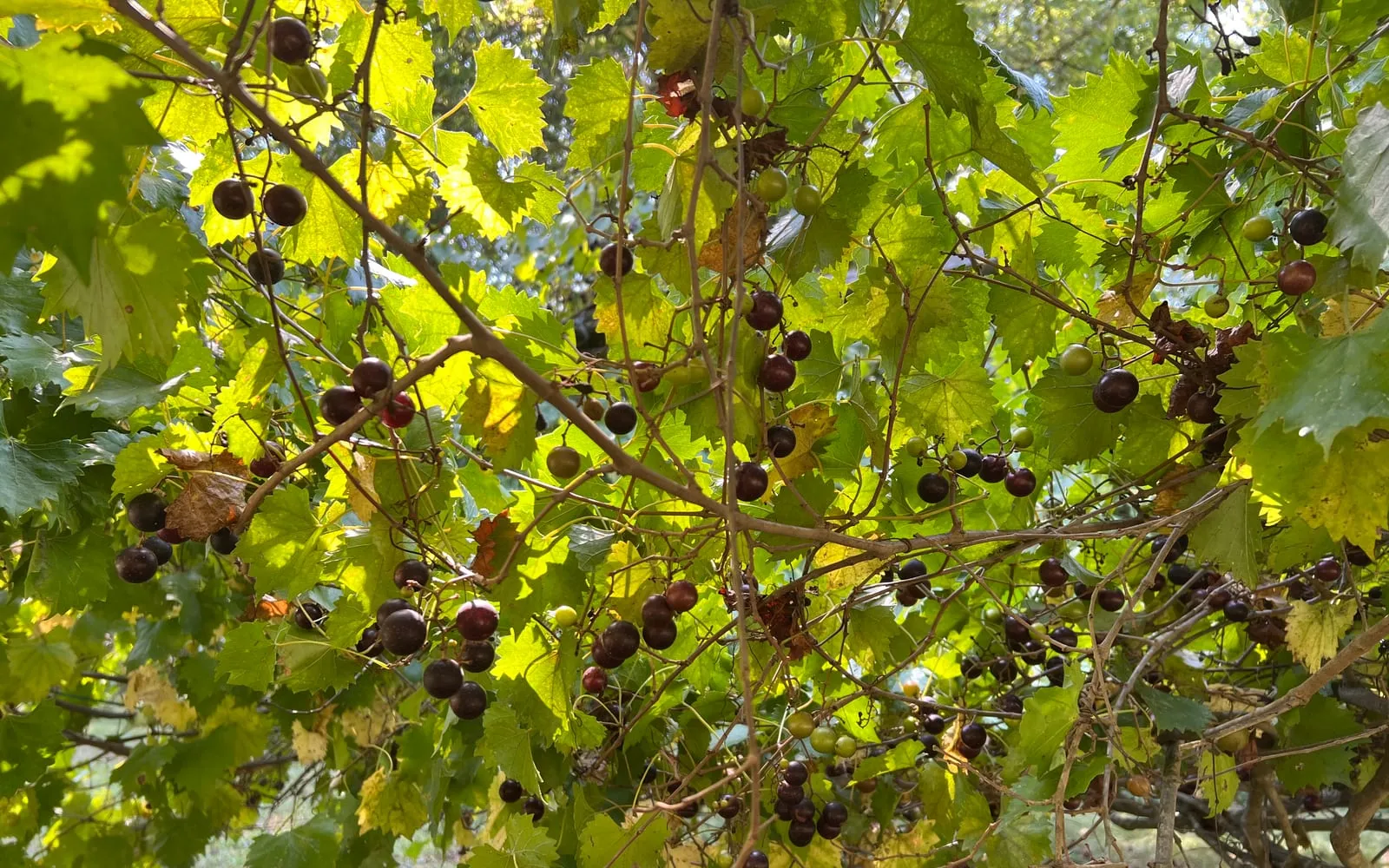
At a glance
- Difficulty
- Difficult
- Water
- Weekly through summer under glass
- Light
- Full sun, and as much summer heat as possible
- Temperature
- Hardy to about -12 deg C, and less than most grapes
- Hardiness
- USDA 7-10, RHS H4, hardy to -12 C
- Type
- Deciduous woody climber, long-lived
- Height
- 10-20 m unrestricted, kept to 4-6 m on wires
- Native to
- South-eastern United States
- Best month
- September and October in the Northern Hemisphere, March and April in the Southern Hemisphere
Least cold-hardy of the grapes and the only one immune to Pierce's disease, a pairing that ties it to the warm humid southeastern United States and rules it out of colder regions. It needs a long hot summer to ripen. Many older cultivars carry female flowers only and need a self-fertile vine planted alongside.
Hardiness zones describe winter cold alone. Summer heat, humidity, rainfall and the length of the growing season decide as much, so treat the range as the outer limit rather than as a recommendation.
Every month named in this guide is for the temperate Northern Hemisphere. If you garden in the Southern Hemisphere, shift each one by six months, so September becomes March. Closer to the equator the wet and dry seasons matter more than the calendar, and the shift stops being a useful guide.
Toxic to dogs if eaten
- Safe to eat
- The fruit, for people
- Do not eat
- The fruit, where dogs are concerned
- Harm from
- Eating it
- Affects
- Dogs
The fruit is food for people and the leaves are eaten stuffed across the eastern Mediterranean. The RHS does not list Vitis among harmful plants. The important entry is the veterinary one. Grapes and raisins cause acute kidney failure in dogs, and the ASPCA lists Vitis vinifera as toxic on that basis. The mechanism was identified only recently and is thought to involve tartaric acid, which grapes carry in quantity. There is no reliable safe dose, individual dogs vary enormously, and a small quantity has killed. Treat any grape eaten by a dog as an emergency and ring a vet the same day. The same caution covers windfalls under a vine, which is where most cases start.
Sources: RHS potentially harmful garden plants, ASPCA toxic and non-toxic plants
About
Muscadine is a different sort of grape. The berries hang in loose clusters of six or eight rather than tight bunches, each one round and up to 3 cm across with a skin thick enough to peel.
The traditional way to eat one is to bite through the skin, take the pulp and discard the rest, which is how the American South has eaten them for four hundred years. ‘Scuppernong’, the bronze form, is the best known.
Being honest about the climate matters more here than with any other plant in this group. Muscadine needs a long hot summer to ripen, more heat than a maritime climate provides outdoors, and it is also less winter-hardy than a Concord.
Grown in a large greenhouse or a conservatory it will fruit. Planted against a wall in the open it will grow, flower and fail to ripen.
Appearance and character
A vigorous deciduous climber with simple unbranched tendrils, unlike the forked tendrils of other grapes, which makes it climb less efficiently.
Bark stays tight and smooth with raised lenticels rather than peeling in strips, another point of difference from Vitis labrusca and V. vinifera.
Leaves are small for a grape, 5 to 12 cm, rounded with coarse blunt teeth, glossy dark green on both sides and hairless beneath.
Flowers open in June in small clusters. Older varieties are female and need a pollinator, while modern selections such as ‘Carlos’ and ‘Nesbitt’ carry perfect flowers and are self-fertile.
Fruit is round, 1.5 to 3 cm, bronze-green or dark purple, with a very thick tough skin and two to four large seeds.
Where it is from
Vitis rotundifolia is native to the south-eastern United States, from Delaware down to Florida and west into Texas.
It grows in warm humid woodland and along riverbanks, in a climate of long hot summers and mild winters.
The species differs genetically from other grapes, carrying forty chromosomes where Vitis vinifera has thirty-eight, which is why crosses between them are difficult.
The Mother Vine on Roanoke Island in North Carolina is a scuppernong reputed to be around four hundred years old and is claimed as the oldest cultivated vine in America.
Its native range gives it resistance to Pierce’s disease and to the pests that destroy European vines in the South, which is why it remains the grape grown there.
How it grows
Grow it under glass where summers are cool. A large greenhouse, a conservatory or a lean-to against a sunny wall gives the heat it needs.
Choose a self-fertile variety such as ‘Carlos’, ‘Nesbitt’ or ‘Triumph’ unless you have room for two plants.
Plant into a well-drained border of sandy loam at pH 5.5 to 6.5, with the roots inside the structure or fed through from a bed outside.
Build strong wires. Muscadine is trained on a single high cordon at about 1.8 m with the fruiting arms running each way.
Prune in early winter, cutting the previous season’s growth back to two or three buds along the permanent arms.
Ventilate well in summer. The plant wants heat with air movement rather than a stagnant humid house.
Through the seasons
Growth starts in April under glass, and the vine leafs out quickly once temperatures rise.
Flowering is in June. Self-fertile varieties need no partner, and tapping the wires on a warm morning helps set under glass where there is little insect traffic.
Summer is about heat and ventilation. The vine needs the highest temperatures you can give it while keeping air moving.
Fruit develops through August and ripens in September and October, changing colour and softening.
Pick individual berries as they ripen. Muscadines do not ripen evenly across a cluster, which is why they are picked singly rather than by the bunch.
Prune in early winter while fully dormant to avoid heavy bleeding.
Care difficulty
Difficult outside a hot-summer climate, and the difficulty is climate rather than technique.
The plant needs substantially more accumulated summer heat than a cool outdoor season provides, and it is less hardy in winter than the grapes that succeed there.
Under glass it is straightforward, needing the same pruning and feeding as any greenhouse vine, plus good ventilation.
The trade-off is space. A muscadine takes up a lot of a greenhouse for a crop that another vine would produce outdoors.
Anyone wanting an American grape for a temperate garden should grow Vitis labrusca instead, and keep muscadine for a heated conservatory or a curiosity.
Watering
Water weekly through the growing season under glass, 20 to 25 litres for an established vine.
Reduce watering as the fruit ripens, which concentrates the flavour and reduces splitting.
Keep water off the foliage in a closed structure, since still damp air encourages mould.
Mulch the border with compost in spring.
Withhold water almost entirely through winter dormancy, since the roots rot in cold wet soil.
Warning signs, diseases and pests
Vine growing well but fruit never ripening. Insufficient heat, which is the defining problem outdoors in a cool climate. Move it under glass.
Wood dying back after a cold winter. Muscadine is hardy only to about -12 deg C, which is less than most grapes.
Fine mottling on leaves with webbing. Red spider mite, common under glass. Raise humidity and improve ventilation.
White waxy clusters in leaf joints. Mealybug in a conservatory. Dab with horticultural soap or introduce a biological control.
Grey mould on ripening berries. Damp still air. Ventilate harder and thin the canopy.
Berries hollowed in autumn. Wasps. Bag clusters in fine mesh.
Vine unaffected while a European variety nearby declines. Grape phylloxera, a root aphid that devastated European vineyards after 1860. Muscadine belongs to a different subgenus to European grapes and resists it strongly, which is one of the reasons it needs no grafting.
Plum curculio cuts a crescent-shaped scar into developing berries and is confined to North America east of the Rocky Mountains, where it is one of the few pests that finds this otherwise trouble-free vine.
Growing environment
Full sun and as much heat as can be arranged. This is the governing requirement.
A greenhouse, conservatory or lean-to is the realistic setting outside its own warm humid belt.
Well-drained sandy loam at pH 5.5 to 6.5, and the plant dislikes heavy wet ground.
Good ventilation matters alongside the heat, since the species comes from a humid but breezy climate rather than a closed one.
Allow 4 to 6 m of wire. It is a large plant for the crop it delivers in a cool climate, which is worth weighing before planting one under glass.
Feeding
Apply a balanced general fertiliser in spring as growth begins.
Follow with a high-potash liquid feed monthly from May to August, which supports fruiting and helps the wood ripen.
Avoid heavy nitrogen, which produces growth at the expense of fruit and softens the wood before winter.
Mulch the border with compost each spring.
Stop feeding once the fruit begins to colour.
Troubleshooting
Flowers but no fruit. An older female variety with no pollinator. Choose a self-fertile modern variety.
Fruit ripening unevenly within a cluster. Normal for the species. Pick individual berries as they colour.
No ripening at all outdoors. Too little accumulated summer heat. This plant needs glass in a cool climate.
Skins unpleasantly tough. Characteristic. The pulp is squeezed out and the skin discarded, or the skins are cooked for jelly.
Winter dieback. Cold below -12 deg C. Grow it under cover.
Sap bleeding from winter cuts. Pruned too late. Cut while fully dormant in early winter.
Muscadine problem guides
Not sure what is wrong? See the common vegetable pests guide.
- A summer too cool to ripen the fruit, the fundamental obstacle
- Cold winter damage below -12 deg C
- Red spider mite under glass
- Mealybug in a conservatory
- Grey mould on fruit in damp still air
- Wasps on ripe berries
- Grape phylloxera, which this species resists strongly
- Plum curculio, a North America-only weevil that scars developing berries