
Edible
Bottle Gourd
Lagenaria siceraria
Also known as Calabash, Lauki, Dudhi, Opo squash, Birdhouse gourd
How to grow bottle gourd, Lagenaria siceraria. The oldest cultivated plant in the world, how to dry a hard shell, and the bitter-fruit rule that has to be followed every time.
At a glance
- Difficulty
- Moderate
- Water
- Two or three times a week, daily under glass in high summer
- Light
- Full sun
- Temperature
- 20-30 deg C, with nothing below 12
- Humidity
- Moderate
- Hardiness
- USDA 10-12, RHS H1b, hardy to 8 C
- Type
- Tender annual climber
- Height
- 5-9 m in a season
- Native to
- Africa, carried worldwide in prehistory
- Best month
- May in the Northern Hemisphere, November in the Southern Hemisphere
Its flowers open at dusk and are worked by moths rather than bees, so a plant in a garden with no night-flying pollinators sets little and repays hand pollination in the evening. Nothing below 12 deg C. Ripening a gourd hard enough to use as a vessel takes six months and a dry autumn.
Hardiness zones describe winter cold alone. Summer heat, humidity, rainfall and the length of the growing season decide as much, so treat the range as the outer limit rather than as a recommendation.
Every month named in this guide is for the temperate Northern Hemisphere. If you garden in the Southern Hemisphere, shift each one by six months, so May becomes November. Closer to the equator the wet and dry seasons matter more than the calendar, and the shift stops being a useful guide.
Toxic if eaten
- Safe to eat
- The young fruit and the shoots, provided the fruit is not bitter
- Do not eat
- Any fruit that tastes bitter, at any size, because of cucurbitacins
- Harm from
- Eating it
- Affects
- People
Bottle gourd is an everyday vegetable across South Asia and it carries one rule that has to be followed every time. Cucurbits make a group of compounds called cucurbitacins, which are intensely bitter and are toxic in quantity. Breeding has removed them from cultivated bottle gourd, but a plant can revert, and a stressed plant or one crossed with an ornamental gourd can produce fruit loaded with them. Drinking juice from a bitter bottle gourd has caused severe vomiting, gastrointestinal bleeding and deaths in India, and the Indian Council of Medical Research has issued public advisories about it. Taste a small piece of raw flesh before cooking any bottle gourd. If it is bitter, throw the whole fruit away and do not cook it out, since heat does not destroy cucurbitacins. Never juice one raw. The same rule applies to courgettes and other cucurbits and is worth the two seconds it takes. Cats and dogs are not specifically listed by the ASPCA, and the same bitterness rule should apply to anything you give them.
Sources: RHS potentially harmful garden plants, ASPCA toxic and non-toxic plants
About
Bottle gourd was carried out of Africa and into the Americas and Asia before farming existed, and archaeologists find it on both sides of the Atlantic in deposits ten thousand years old. Its hard dry shell floats, holds water and takes a season to make, which made it a container long before anyone made pots.
It appears as lauki or dudhi in South Asian grocers worldwide, a smooth pale green club a foot or two long, and as the ornamental birdhouse gourd in seed catalogues. Both are the same species. The eating cultivars are picked young and soft; the craft cultivars are left to dry on the vine until the shell goes woody.
The plant is easy and enormous. One vine will run 8 m in a season and cover whatever it is given, and it flowers at dusk rather than in the morning, which is a genuine complication for anyone hand-pollinating under glass.
Appearance and character
A strong annual climber with soft, downy, faintly musky-smelling stems and leaves, reaching 5 to 9 m in one summer.
The leaves are large and soft, 10 to 40 cm across, broadly heart-shaped to kidney-shaped with shallow lobes, velvety on both sides rather than bristly. Two glands sit on the leaf stalk where it meets the blade, which is a good identification point.
Tendrils are branched into two arms.
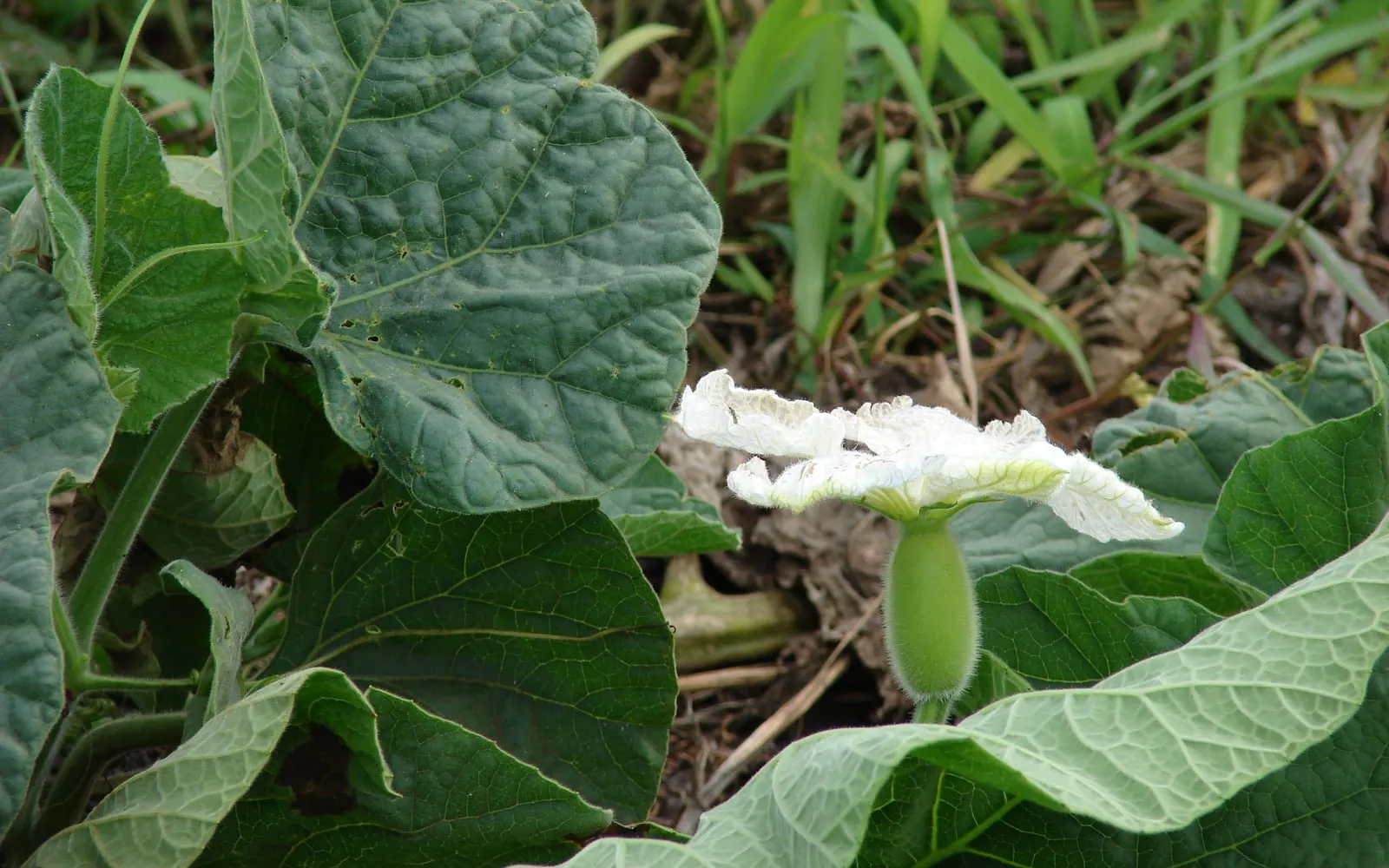
The flowers separate it from every other gourd here. They are white rather than yellow, 5 to 10 cm across, and they open in the late afternoon or evening and close by mid-morning. Moths pollinate them.
Male flowers stand on long stalks, up to 20 cm; females sit on short ones with a tiny gourd already shaped behind the petals.
Fruit shape is the most variable of any cultivated plant. Long slim clubs, round bowls, flattened discs, waisted bottles, coiled snakes over a metre long, all one species and all cross-freely with one another.
A young fruit is pale green with a fine downy skin and white flesh. Left on the vine it hardens, dries, turns buff brown and loses its water until the seeds rattle inside a shell like thin wood.
Where it is from
Bottle gourd is African in origin, from wild populations in southern Africa and Zimbabwe, and it is the only crop that reached the Americas before humans did in any numbers.
Wild gourds float, and the shell keeps seed viable in seawater for months. Genetic and archaeological work supports both an ocean drift route and human carriage into the New World, and the plant is found in Peruvian and Mexican sites older than maize.
Asia domesticated it separately. Chinese and Indian material goes back several thousand years and produced the eating cultivars grown today.
The shell did the work. It became bottles, ladles, floats, birdhouses, pipes, snuff containers, penis sheaths, and the resonating body of the sitar, the kora, the berimbau and dozens of other instruments.
How it grows
Sow in late April or May at 22 to 25 deg C. Soak the seed for 24 hours and nick the edge, since the coat is thick and dry sowing gives patchy results.
Sow 2 cm deep, two to a 9 cm pot, thinning to the strongest.
Plant out after the last frost, into a greenhouse or polytunnel border for reliability, or onto the warmest bed outdoors.
Give it a strong support. Wires, a pergola or a stout arch, since the vine is heavy and each fruit adds to it.
Sling any fruit grown on a vertical support in a net or an old pair of tights, or the weight will pull it off.
Pinch the leader at 2 m. Female flowers come on the laterals and a plant left unpinched runs to length and produces almost nothing.
Hand-pollinate in the evening. The flowers open at dusk, so this is an evening job rather than a morning one.
Harvest eating gourds young at 20 to 40 cm, while a thumbnail still marks the skin.
Leave craft gourds on the vine until the stalk browns and dries, then cut with a long stalk and dry them somewhere airy for three to six months, turning them weekly and accepting that surface mould is part of the process.
Through the seasons
Late April and May are for sowing warm after soaking and chipping the seed.
June is planting out and getting the support in before the vine needs it.
July is running growth, pinching the leader and tying in the laterals.
Late July and August are for evening hand pollination and the first harvests of young fruit.
September is the last of the eating gourds and the month to stop picking any you want to dry.
October brings the frost that kills the vine, and the point at which craft gourds are cut.
Winter is drying. A gourd hung in a cool airy shed loses water for months and is ready when the seeds rattle.
Care difficulty
Moderate under glass. Growth is easy and the timing is the difficulty.
The seed needs warmth and a nicked coat to germinate evenly.
Evening flowering means hand pollination has to happen at dusk, which catches people out.
The vine needs a support built for the weight rather than for a cucumber.
Craft gourds need a longer season than a cool summer offers outdoors, so start early and grow under cover.
Tasting before cooking is the one non-negotiable habit.
Watering
Water two or three times a week from planting out, daily under glass in July.
Soak deeply at the root, since the plant is large and the root goes down.
Keep the leaves dry to slow mildew.
Mulch heavily.
Do not let a fruiting plant dry out, because a check to growth is what pushes a plant towards bitter fruit.
Reduce watering in late September for gourds intended to dry.
Warning signs, diseases and pests
White powder on the upper leaves from midsummer is powdery mildew, and bottle gourd gets it as reliably as any cucurbit.
A young fruit that yellows at 3 cm and drops was not pollinated, which under glass usually means nobody was there at dusk.
Fruit rotting at the point where it touches the soil needs a board or a sling.
Fine speckling with webbing is red spider mite.
Sticky leaves with sooty black growth are the residue of aphids.
Grey fuzz on a spent flower is botrytis, and picking off dead flowers stops it spreading into the fruit.
A bitter taste in a raw slice means the whole fruit goes in the bin.
A vine that runs 8 m and sets nothing has not been pinched.
Growing environment
A greenhouse, polytunnel or a hot sheltered bed against a south wall.
Full sun.
Minimum 12 deg C, with 20 to 30 deg C for real growth.
Deep rich soil with plenty of organic matter.
A strong support, and a sling for every hanging fruit.
Room to run, which means a couple of square metres per plant at least.
An airy frost-free shed for drying craft gourds afterwards.
Feeding
Dig in rotted manure or compost before planting.
Feed a balanced liquid feed fortnightly from planting out.
Switch to high potash once the first fruit sets.
Keep feeding through the picking season if you are cutting young fruit regularly.
Stop feeding gourds intended for drying once they reach full size.
Avoid heavy nitrogen, which produces stem and leaf and delays flowering.
Troubleshooting
Why do the flowers only open in the evening? They are moth-pollinated. Male and female flowers open at dusk and close by mid-morning, so hand pollination has to be done in the evening.
My gourd tastes bitter. Can I cook it out? No. Throw the whole fruit away. Cucurbitacins are not destroyed by heat and bitter bottle gourd has caused serious poisoning and deaths. Taste a small raw piece of every fruit before cooking.
Is lauki the same as a calabash? Yes, and the same as dudhi, opo squash and the birdhouse gourd. One species with many cultivars.
How do I dry one for a birdhouse? Leave it on the vine until the stalk is brown and dry, cut it with a long stalk, and hang it somewhere cool, dry and airy for three to six months. Surface mould is normal and scrubs off. It is ready when it feels light and the seeds rattle.
Can I eat a gourd I dried? No. By then it is a shell and the flesh has gone. Eating and drying are different jobs and usually different cultivars.
Why did my fruit snap off the vine? Weight. Sling every fruit on a vertical support in a net or a stocking as soon as it starts to swell.
Nothing set fruit. Either the vine was never pinched, so it made only male flowers on a long leader, or nobody pollinated the females at dusk.
Will it cross with my courgettes? No. Lagenaria is a separate genus from Cucurbita and will not cross with courgettes, pumpkins or squashes. It will cross with other bottle gourds, including ornamental ones, which is a reason not to save seed from a mixed planting.
Bottle Gourd problem guides
Not sure what is wrong? See the common vegetable pests guide.