
Pest
Grape phylloxera
Daktulosphaira vitifoliae
Also called Vine louse
Grape phylloxera is a microscopic aphid-relative that weakens vines by feeding on the roots. It destroyed much of Europe's vineyard area in the nineteenth century, and most wine grapes are now grown on resistant rootstock.
At a glance
- Type
- Pest
- Cause
- Insect
- Severity
- Can kill the plant
- Affects
- Herbs and edibles
- Active
- May to September
- Established in
- North America, Europe, Asia, Africa, Australia, Central and South America and Pacific Islands
What you are seeing
- A vine declining gradually over several seasons, with reduced vigour, smaller leaves, poor shoot growth and shrinking yield and no single obvious cause
- Swollen, hooked or nodule-like galls on fine roots, visible when a struggling vine is carefully dug and the roots examined
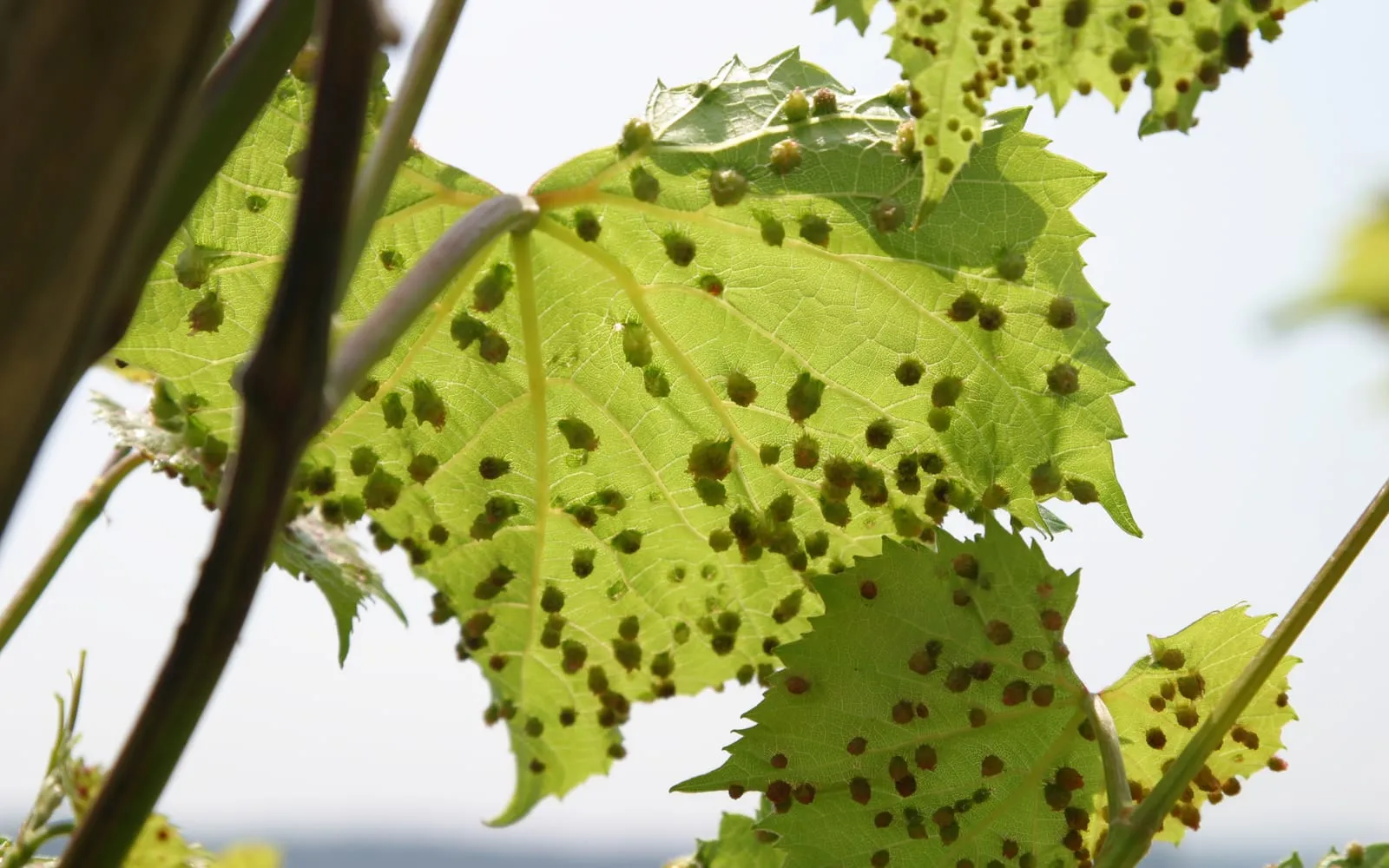
- Small, wart-like galls on the underside of leaves on American and hybrid grape species, which tolerate the insect and rarely decline from it
- Yellowing foliage in patches through a vineyard, spreading outward over years from an initial point rather than appearing all at once
- Vine death typically three to ten years after the root system is significantly colonised, on ungrafted, susceptible vines
- Microscopic pale yellow insects, under 1 mm, visible only with a hand lens on washed root samples
Before you treat anything
None. This pest affects the vine's survival and productivity rather than the safety of the fruit.
What you are looking at
A vine that declines gradually rather than collapsing all at once: reduced vigour, smaller leaves, weaker shoot growth and a shrinking crop over several seasons, often with no obvious cause visible above ground. Dig carefully around a struggling vine’s fine roots and the explanation is usually there, small swollen or hooked nodules and galls where the insect has been feeding, distinct from the soft blackened collapse of a rotted root. The insect itself is microscopic, under 1 mm and pale yellow, visible only with a hand lens on a washed root sample.
American and hybrid grape species show a different, milder symptom: small wart-like galls on the leaf underside, which the vine tolerates well and which rarely causes the decline seen on susceptible roots.
The insect that reorganised the world’s vineyards
Native to eastern North America, where wild grape species evolved alongside it and tolerate it without much trouble, this insect was carried to Europe on imported vine material around 1860. What followed was one of agriculture’s genuine catastrophes: more than 4 million acres of vineyard destroyed within forty years, entire wine regions replanted from nothing, and a permanent shift in how grapes are grown almost everywhere. Grafting European Vitis vinifera, the species behind nearly every classic wine grape, onto rootstock bred from resistant American species turned out to be the only defence that worked, and it remains standard practice in the great majority of the world’s vineyards today.
Chile is the major exception. The Andes, the Atacama Desert and the Pacific Ocean have helped keep phylloxera out, and a meaningful share of Chilean wine is still grown on ungrafted, own-rooted vines. South Australia also maintains strict quarantine controls and still has significant vineyard areas without the pest. New Zealand has kept it out entirely.
What to do about it
Plant on resistant rootstock rather than a vine’s own roots. Grafting ended the nineteenth-century crisis and remains the standard answer everywhere the pest occurs.
Buy only certified nursery stock and inspect roots for swollen nodules before planting.
Avoid moving soil, roots or cuttings from a known infested area into a region or vineyard that is currently free of the pest, and follow local quarantine rules exactly where they exist, particularly in Chile, parts of Australia and New Zealand.
Where a specific grafted vinifera variety is not essential, growing a naturally resistant American species such as fox grape or muscadine sidesteps the problem entirely for a garden planting.
What it gets mistaken for
Root rot produces soft, blackened, collapsing roots following waterlogged soil, quite different from the small firm nodules and galls this insect causes on an otherwise healthy root system.
Verticillium wilt shows brown staining inside a cut stem and can develop within a single season; phylloxera damage stays confined to the roots and takes years to show above ground.
Not established in New Zealand
Do not prune, spray or otherwise treat a suspected case. Doing so risks spreading an organism the country has kept out, and it disturbs the evidence needed to identify it. Photograph what you can see, leave the plant alone, and contact your national or state plant health authority. The control advice further down this page is written for regions where this problem is already established.
Native to eastern North America, where the wild grape species it evolved alongside tolerate it without much harm. Introduced into Europe on imported vine material around 1860, it destroyed more than 4 million acres of vineyard within forty years and permanently changed how the world grows grapes, since grafting European vines onto resistant American rootstock turned out to be the only durable defence. It is now present in nearly every wine-growing country. Chile is the significant exception: protected by the Andes, the Atacama Desert and the Pacific, it has never been introduced, and much of Chilean wine is still grown on the vine's own roots as a direct result. Australia carries a similar pocket of freedom on a smaller scale, with South Australia in particular maintaining strict quarantine to keep the pest out of a wine region that still grows a significant share of its vines ungrafted. New Zealand has kept it out entirely.
What to do, in order
The steps below apply where this problem is already established.
Nothing available to a gardener will cure this once a plant has it. The steps below are about limiting the spread and deciding what to plant in its place.
Start here
Prevention, and the changes that stop the problem returning. Most of these pages should end at this tier.
- Plant on resistant rootstock rather than the vine's own roots
- This is the control that ended the nineteenth-century crisis and remains the standard practice almost everywhere the pest occurs. Vitis vinifera, the species behind nearly all classic wine grapes, is highly susceptible on its own roots; grafted onto rootstock bred from resistant American species, the same vine produces the same fruit while the root system underneath tolerates the insect indefinitely. Buying grafted vines rather than own-rooted ones is the single most important decision a vineyard or garden grower makes anywhere phylloxera is present.
- Avoid moving soil, roots or vine cuttings from a known infested area
- The insect spreads through infested nursery stock, contaminated soil clinging to equipment, and root fragments moved between vineyards far more readily than by crawling or flying any real distance on its own. This is exactly how it crossed the Atlantic in the first place, and it is why regions that remain free of it, including Chile and parts of Australia, enforce strict quarantine on incoming plant material and soil.
- Choose resistant American species for a garden planting where grafted vinifera is impractical
- Fox grape and muscadine, both native American species, tolerate the insect with little or no impact on vigour, which is the same resistance rootstock breeding draws on. A garden grower prioritising low maintenance over a specific European variety can sidestep the issue by growing one of these directly rather than seeking out grafted vinifera stock.
Then reach for a barrier
Netting, hand removal and water. Nothing here harms anything except the target.
- Inspect nursery stock and root systems before planting
- Checking roots for the characteristic swollen nodules before planting, and buying only certified stock from a reputable nursery, catches an infestation before it enters a new planting rather than after.
Then bring in the predators
Encourage what already lives in the garden, and buy predators in where the problem is under glass and nothing will arrive on its own.
- Rely on rootstock resistance rather than a direct biological control
- No biological control targets this insect effectively once established in the soil, since it spends nearly its whole life cycle protected within root galls or below ground. Resistant rootstock remains the practical answer everywhere the pest occurs, rather than any control applied after the fact.
Biological controls are live organisms and their sale and release are regulated country by country. An agent sold freely in one place may be unapproved in another, so buy from a licensed supplier where you live and never import or move one yourself.
Plants affected
Guides that name it among the problems to watch for. The list is the plants it is characteristic of rather than everything it will feed on.