
Pest
Glassy-winged sharpshooter
Homalodisca vitripennis
Also called GWSS
A large, plain leafhopper that feeds on woody stems rather than leaves, leaving trails of white sap residue and, far more seriously, carrying the bacterium behind Pierce's disease from vine to vine. Native to the south-eastern United States, it turned a manageable vineyard disease into a major threat once it reached California in the 1990s.
At a glance
- Type
- Pest
- Cause
- Insect
- Severity
- Destroys the crop or display
- Affects
- Herbs and edibles, Garden plants
- Active
- April to September
- Established in
- North America
What you are seeing
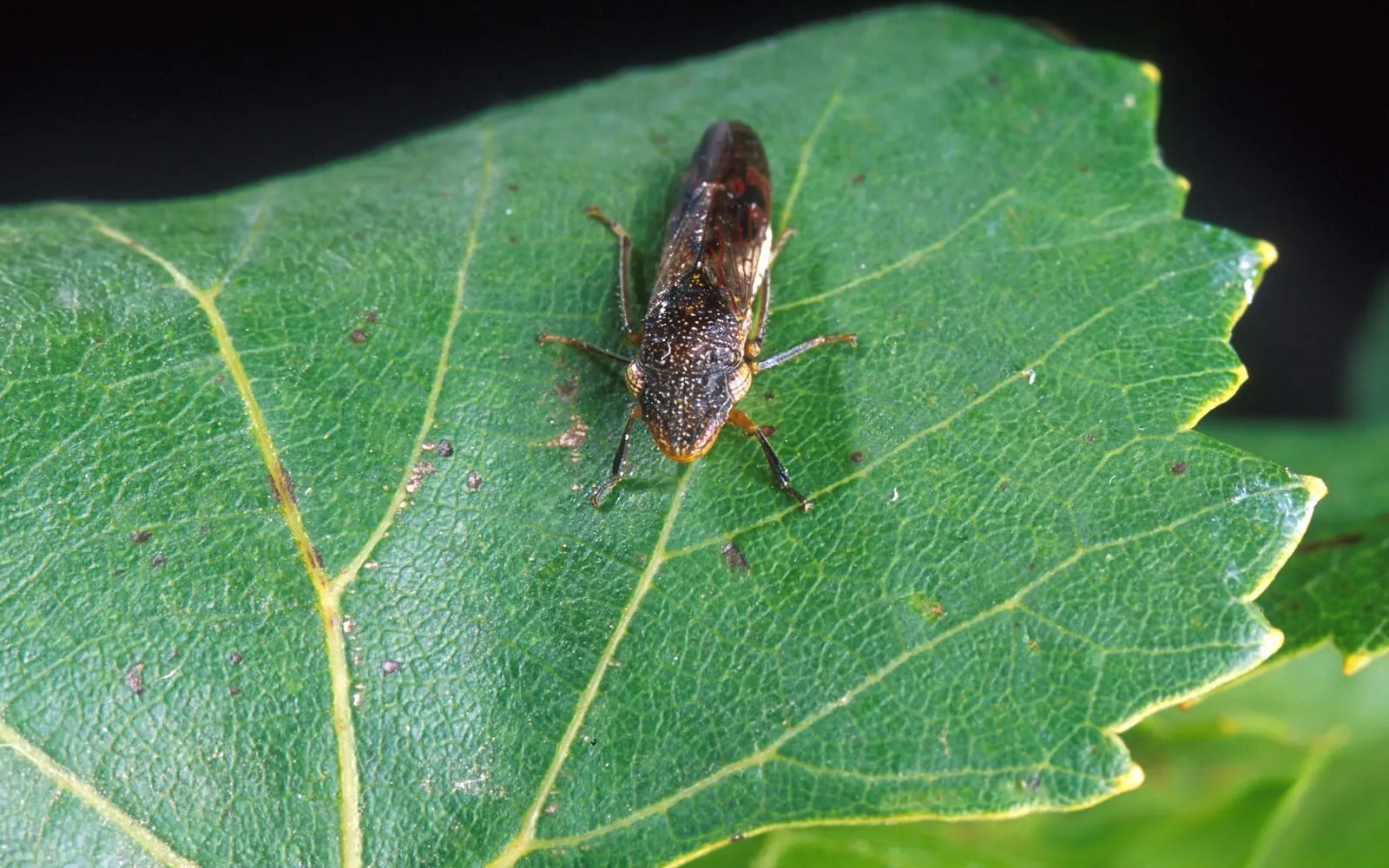
- Large, brownish, wedge-shaped leafhoppers, around 12 to 14 mm long, with translucent wings marked by fine dark veins, found on woody stems and shoots rather than on leaf surfaces
- Rows or patches of white, chalky excrement residue, called leafhopper rain, spattered on leaves and fruit beneath where the insects have been feeding
- Feeding punctures in a line along young woody stems, sometimes visible as small scars once the tissue matures
- Egg masses laid in neat rows just under the surface of a leaf, visible as a raised, slightly blistered patch when held up to the light
- Marginal leaf scorch, dieback and eventual vine collapse appearing on plants the insect has fed on, which are symptoms of the Pierce's disease bacterium it transmits rather than of its feeding directly
What you are looking at
A large, plain brownish leafhopper, 12 to 14 mm long, wedge-shaped and carrying translucent wings marked with fine dark veins, found on woody stems and shoots rather than on leaf surfaces the way most leafhoppers are. Beneath an area where it has been feeding, leaves and fruit often carry rows or patches of white, chalky excrement residue, a distinctive sign known locally as leafhopper rain. Egg masses show as neat rows laid just under the surface of a leaf, visible as a slightly raised, blistered patch when the leaf is held up to the light.
The insect’s own feeding does some direct damage to young shoots, but the serious threat is what it carries while doing it. As a xylem feeder, it moves the bacterium behind Pierce’s disease from plant to plant as it feeds, and marginal leaf scorch, dieback and vine collapse following a population of this insect are symptoms of that infection rather than of the feeding itself.
From a minor Texan pest to California’s most damaging vine vector
Native to the south-eastern United States and north-eastern Mexico, this species stayed a minor concern for most of its range, kept in check by natural enemies and by the more limited susceptibility of its usual native hosts. That changed once it spread into southern California in the late 1980s or early 1990s, almost certainly carried in on nursery stock. Freed from the natural enemies that controlled it at home and moving through vineyards planted with susceptible grape varieties, it became the region’s most significant vector of Pierce’s disease, contributing to tens of millions of dollars in vineyard losses across areas including Temecula, Bakersfield and the Coachella Valley since the outbreak began.
It has been intercepted repeatedly in French Polynesia, Hawaii and other Pacific islands, and remains a quarantine concern both for the movement of nursery stock out of California within the United States and for any region without an established population. It has not established outside North America.
What to do about it
Buy nursery stock only from certified, pest-free sources, since infested planting material is how this insect reached California in the first place and remains the main way it could reach a new region.
Control weeds and remove overgrown or infested host material at the edges of a vineyard or orchard, since this insect breeds on a wide range of woody plants beyond the crop itself.
Monitor with yellow sticky traps at field margins to catch a rising population early, and report a sighting outside its established range in the south-eastern United States and California to the local plant health authority immediately.
Support area-wide parasitoid release as the primary control. Reserve a registered systemic insecticide for a high-value planting under heavy pressure that parasitoid release, monitoring and infected-vine removal have not brought under control on their own.
What it gets mistaken for
Aphids cluster in soft colonies on new growth and leaf undersides and leave clear, sticky honeydew rather than the chalky white spatter this leafhopper produces, and they do not feed preferentially on woody stems the way this species does.
Not established in Europe, Australia, New Zealand and Pacific Islands
Do not prune, spray or otherwise treat a suspected case. Doing so risks spreading an organism the country has kept out, and it disturbs the evidence needed to identify it. Photograph what you can see, leave the plant alone, and contact your national or state plant health authority. The control advice further down this page is written for regions where this problem is already established.
Native to the south-eastern United States and north-eastern Mexico, where its natural host range and natural enemies kept it a minor concern. It spread into southern California in the late 1980s or early 1990s, almost certainly through the movement of nursery stock, and proliferated there to become the region's most significant vector of Xylella fastidiosa, the bacterium behind Pierce's disease. It has since been intercepted repeatedly in French Polynesia, Hawaii and other Pacific islands, and remains a quarantine concern for California nursery exports within the United States and for any region without an established population.
What to do, in order
The steps below apply where this problem is already established.
Start here
Prevention, and the changes that stop the problem returning. Most of these pages should end at this tier.
- Inspect and buy nursery stock only from certified, pest-free sources
- Movement of infested nursery plants was the way this insect reached California from its native range, and it remains the primary route by which it could reach a currently unaffected region, which is why certified stock and vigilant inspection of anything moved between regions matters as much for this pest as for the diseases it carries.
- Control weeds and remove infested plant material near vineyards
- This insect breeds in citrus, ornamentals and a wide range of other woody plants beyond grapevine itself, and removing overgrown or infested host material at the edge of a vineyard reduces the local population feeding into the crop.
- Report a suspected sighting outside its established range immediately
- Because this species is both a direct concern and, more seriously, an efficient vector of Pierce's disease, a suspected sighting anywhere outside its established range in the south-eastern United States and California should go to the local plant health or biosecurity authority immediately rather than being treated as a routine pest.
Then reach for a barrier
Netting, hand removal and water. Nothing here harms anything except the target.
- Monitor with yellow sticky traps
- Yellow sticky traps placed at vineyard and orchard margins are the standard early-detection tool used across affected parts of California, giving warning of a rising population before feeding damage or disease transmission becomes significant.
Then bring in the predators
Encourage what already lives in the garden, and buy predators in where the problem is under glass and nothing will arrive on its own.
- Support release of egg parasitoid wasps where established
- Small parasitoid wasps that attack this insect's eggs have been released at scale in California and have measurably reduced local populations, working alongside the natural enemies already present in the insect's native range that keep it a lesser concern there.Deployed as part of coordinated regional biological control programmes in California, including releases of the wasp Gonatocerus ashmeadi; not something purchased or released independently.
Biological controls are live organisms and their sale and release are regulated country by country. An agent sold freely in one place may be unapproved in another, so buy from a licensed supplier where you live and never import or move one yourself.
Plants affected
Guides that name it among the problems to watch for. The list is the plants it is characteristic of rather than everything it will feed on.