
Disease
Xylella fastidiosa
Xylella fastidiosa
Also called Olive quick decline syndrome, Pierce's disease, Citrus variegated chlorosis
A bacterium that blocks a plant's own water-conducting tissue, producing a scorched, drought-like browning that no amount of watering fixes. Different strains cause olive quick decline in the Mediterranean, Pierce's disease in American vineyards and citrus variegated chlorosis in Brazil, and there is no cure once a plant is infected.
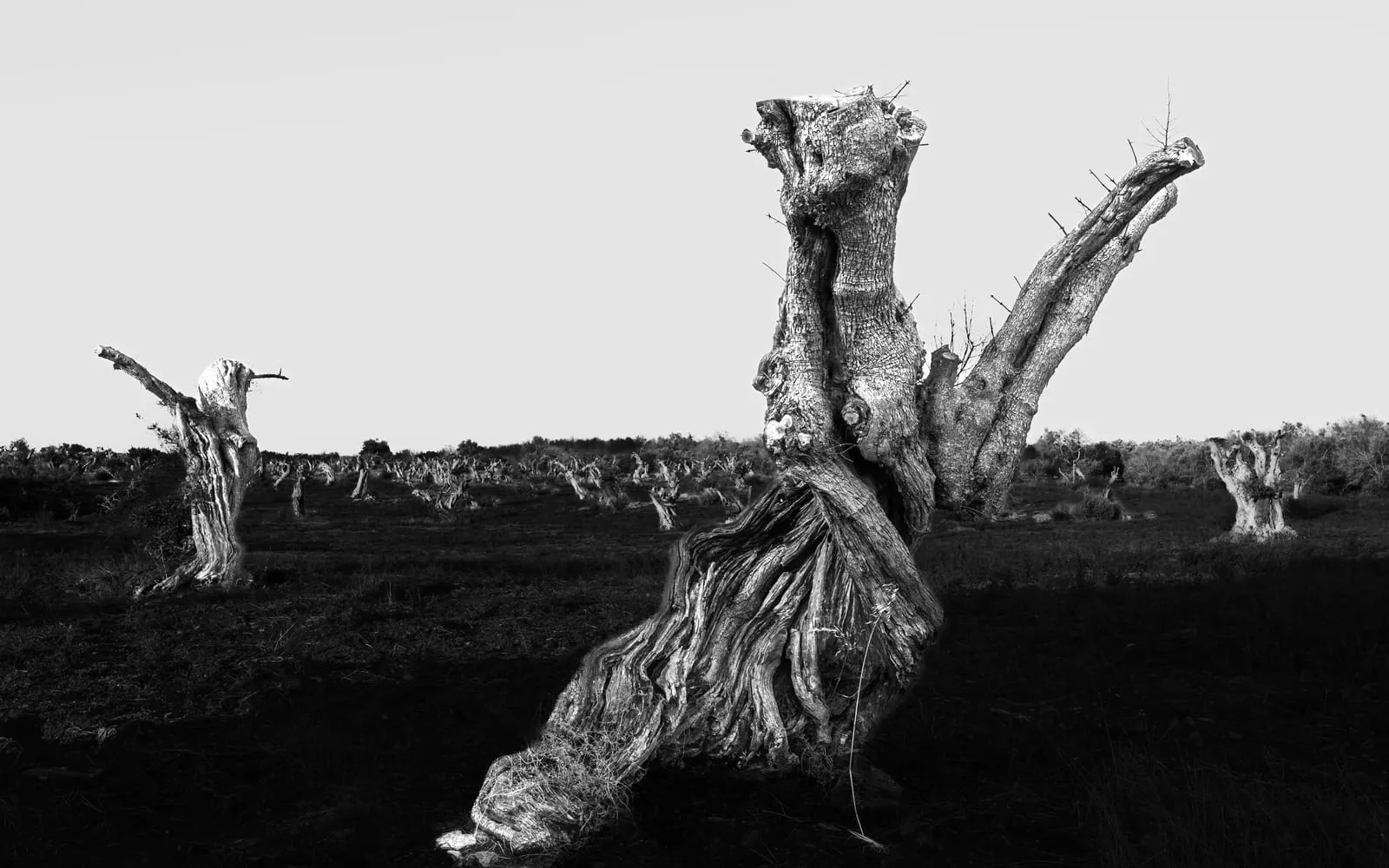
At a glance
- Type
- Disease
- Cause
- Bacterium
- Severity
- Can kill the plant
- Affects
- Herbs and edibles, Garden plants
- Active
- May to September
- Established in
- Europe, North America, Central and South America and Asia
What you are seeing
- Marginal leaf scorch, a browning that starts at the leaf edge or tip and spreads inward, closely resembling drought stress
- Scattered dieback of individual twigs and branches, often starting in the upper canopy, spreading over one to several seasons
- Stunted, undersized new growth and shortened internodes on affected shoots
- Rapid overall decline and death within one to five years depending on the host and strain, rather than a slow gradual weakening
- No improvement in scorching after watering, which separates it from ordinary drought stress in a plant otherwise getting enough water
- Fruit failing to ripen properly or dropping early on an infected tree or vine
What you are looking at
Leaves scorching from the edge or tip inward, closely resembling drought stress, except that watering the plant properly does nothing to improve it. Individual twigs and branches, often starting high in the canopy, die back over the course of a season or several, while the rest of the plant can still look reasonably healthy for a while. New growth on affected shoots comes stunted, with shortened internodes, and fruit on an infected tree or vine frequently fails to ripen properly or drops early.
The underlying cause is a bacterium that colonises the xylem, the tissue a plant uses to move water up from the roots, and progressively blocks it. That is why the visible symptom looks so much like drought even when the plant has plenty of water available: functionally, the infected parts of the plant are cut off from the water supply regardless of how much is in the soil. Depending on the host and the particular strain involved, decline runs from about one to five years, ending in the death of the affected plant or, in a severe outbreak, the whole planting.
One bacterium, several named diseases, no cure once it takes hold
This bacterium is native to the Americas, where it has caused Pierce’s disease in grapevines for well over a century and, since the 1980s, citrus variegated chlorosis across Brazil’s orange groves. A separate introduction reached the Salento peninsula in southern Italy around 2013, causing olive quick decline syndrome, and has devastated commercial olive groves across parts of Apulia since; further outbreaks, each under active containment or eradication, have been confirmed in Corsica, Provence in France, and the Balearic Islands, Alicante and Madrid in Spain. A related strain causes pear leaf scorch in Taiwan. Different subspecies and strains favour different hosts, which is part of why the same underlying bacterium carries several different disease names depending on the crop and region it turns up in.
There is no cure once a plant is infected. Every affected region’s response centres on the same combination: certified planting material, prompt removal of confirmed infected plants, and control of the sap-feeding insects, sharpshooter leafhoppers in the Americas and spittlebugs in Europe, that carry the bacterium from plant to plant as they feed. It has not been found in Africa, Australia, New Zealand or the Pacific, all of which treat a suspected case as a quarantine matter of the highest concern given the scale of the damage already done elsewhere.
What to do about it
Buy planting material only from certified, inspected nurseries, since infected propagation material is the primary way this bacterium has crossed between regions.
Report a suspected case to the national plant health authority immediately rather than waiting to confirm it personally, given that there is no cure and vectors can spread it onward before symptoms are obvious.
Support prompt removal of confirmed infected plants in an affected area, including the root system, which reduces the reservoir available to local insect vectors.
Control the sap-feeding insects known to spread the disease locally, and grow a resistant or tolerant variety where current regional guidance identifies one, understanding that resistance is strain-specific rather than universal.
What it gets mistaken for
Drought stress improves once the plant is properly watered and affects the whole plant fairly evenly, unlike this bacterium’s scorch, which does not respond to watering and often appears first on scattered individual branches.
Verticillium wilt is a soil fungus entering through the roots, typically showing a one-sided pattern up a single stem with vascular staining visible in a cut section, rather than the marginal leaf scorch spread by insect vectors through the canopy that this bacterium produces.
Not established in Africa, Australia, New Zealand and Pacific Islands
Do not prune, spray or otherwise treat a suspected case. Doing so risks spreading an organism the country has kept out, and it disturbs the evidence needed to identify it. Photograph what you can see, leave the plant alone, and contact your national or state plant health authority. The control advice further down this page is written for regions where this problem is already established.
Native to the Americas, where it has caused Pierce's disease in grapevines for well over a century and citrus variegated chlorosis across Brazil's orange groves since the 1980s. A separate introduction reached the Salento peninsula in southern Italy around 2013, causing olive quick decline syndrome, and has since spread through parts of Apulia; further outbreaks, under active containment or eradication, have been confirmed in Corsica, Provence in France, and the Balearic Islands, Alicante and Madrid in Spain. A related strain causes pear leaf scorch in Taiwan. It has not been found in Africa, Australia, New Zealand or the Pacific, all of which treat it as a quarantine pest of the highest concern given the scale of damage it has done elsewhere.
What to do, in order
The steps below apply where this problem is already established.
Nothing available to a gardener will cure this once a plant has it. The steps below are about limiting the spread and deciding what to plant in its place.
Start here
Prevention, and the changes that stop the problem returning. Most of these pages should end at this tier.
- Buy planting material only from certified, inspected nurseries
- Movement of infected plants and propagation material is the primary way this bacterium has spread between countries and continents, and certified, inspected stock remains the single most effective way an individual grower avoids introducing it to a currently unaffected area.
- Report a suspected case immediately rather than waiting to confirm it personally
- Because there is no cure and because insect vectors can spread the bacterium onward from an infected plant before symptoms are obvious, every region where this disease is a live concern treats a suspected case as something for the national plant health authority to confirm and act on immediately, rather than something to manage at the level of an individual planting.
- Remove and destroy confirmed infected plants promptly
- Removing an infected plant, including the root system, reduces the reservoir available to insect vectors that could carry the bacterium onward to healthy plants nearby, and is standard practice in every containment and eradication programme run against this disease so far.
Then reach for a barrier
Netting, hand removal and water. Nothing here harms anything except the target.
- Control the sap-feeding insects that spread the bacterium between plants
- This bacterium moves between plants exclusively through insects that feed on xylem sap, including sharpshooter leafhoppers and spittlebugs depending on the region, so reducing the local population of whichever vector is present, alongside removing infected source plants, is central to slowing spread within an affected area.
Then bring in the predators
Encourage what already lives in the garden, and buy predators in where the problem is under glass and nothing will arrive on its own.
- Grow resistant or tolerant varieties where available
- Some olive, grape and citrus varieties show useful tolerance to particular strains of this bacterium, and breeding and screening programmes in affected regions continue identifying more, though none removes the need for vector control and sanitation in an area under active outbreak.Resistance varies by host, strain and region; check current local guidance, since a variety tolerant of one Xylella strain is not necessarily tolerant of another.
Biological controls are live organisms and their sale and release are regulated country by country. An agent sold freely in one place may be unapproved in another, so buy from a licensed supplier where you live and never import or move one yourself.
Plants affected
Guides that name it among the problems to watch for. The list is the plants it is characteristic of rather than everything it will feed on.