
Edible
Cardoon
Cynara cardunculus
Also known as Cardone, Artichoke thistle, Chard artichoke
How to grow cardoons, Cynara cardunculus. Blanching the leaf stalks in autumn, the difference from a globe artichoke, and the seed heads that curdle cheese.
At a glance
- Difficulty
- Moderate
- Water
- Weekly through summer
- Light
- Full sun
- Temperature
- Hardy to about -10 deg C. Winter wet kills more than cold
- Hardiness
- USDA 7-10, RHS H4, hardy to -10 C
- Type
- Hardy perennial, usually grown as an annual for the stalks
- Height
- 1.5-2.5 m in flower
- Native to
- The Mediterranean
- Best month
- September in the Northern Hemisphere, March in the Southern Hemisphere
Winter wet at the crown kills far more plants than cold does, so sharp drainage matters more than a mild climate. It is a Mediterranean plant and behaves like one. Take the invasiveness seriously, since it is a declared noxious weed across southern Australia and much of California, where it has taken over grassland.
Hardiness zones describe winter cold alone. Summer heat, humidity, rainfall and the length of the growing season decide as much, so treat the range as the outer limit rather than as a recommendation.
Every month named in this guide is for the temperate Northern Hemisphere. If you garden in the Southern Hemisphere, shift each one by six months, so September becomes March. Closer to the equator the wet and dry seasons matter more than the calendar, and the shift stops being a useful guide.
Skin irritant
- Safe to eat
- The blanched leaf stalks and midribs, cooked
- Harm from
- Handling it
- Affects
- People
Cardoon is a food crop used across the Mediterranean and carries no meaningful toxicity concern. The RHS does not list Cynara cardunculus among plants harmful if eaten and the ASPCA does not list it as toxic to cats and dogs. The practical cautions are handling and choking. The leaves and stalks contain sesquiterpene lactones, chiefly cynaropicrin, which causes contact dermatitis in some people who handle the plant regularly, and which is why unblanched stalks are too bitter to eat. Wear gloves when cutting back a large clump. The second is mechanical rather than chemical. Most traditional cardoon varieties carry sharp spines on the leaf midribs and stalks, and they draw blood. Spineless varieties exist and are worth seeking out. Cardoon flowers contain the enzyme cyprosin and have been used for centuries in Portugal and Spain to curdle milk for sheep's cheeses such as Serra da Estrela, which makes them one of the few vegetarian rennets with a long documented history.
Sources: RHS potentially harmful garden plants, ASPCA toxic and non-toxic plants
About
The cardoon is the plant the globe artichoke was bred from, grown in the opposite direction. Where the artichoke was selected for a fat flower bud, the cardoon was selected for thick fleshy leaf stalks, which are blanched in autumn and cooked like celery.
Flavour is the reason to bother. Blanched cardoon tastes of artichoke heart with a slight bitterness, and it is the basis of bagna cauda in Piedmont and a Christmas vegetable across Spain and Italy.
As a plant it is magnificent and enormous. Two and a half metres of silver foliage and violet thistle flowers, and it appears in ornamental borders far more often than in vegetable beds. Anybody growing it as an ornamental already has the crop and does not know it.
Appearance and character
A very large clump of arching, deeply cut, silver-grey leaves, each up to a metre long, forming a mound 1.5 m across.
Leaf stalks and midribs are thick, fleshy and grooved, which is the crop. Most traditional varieties carry sharp spines along them.
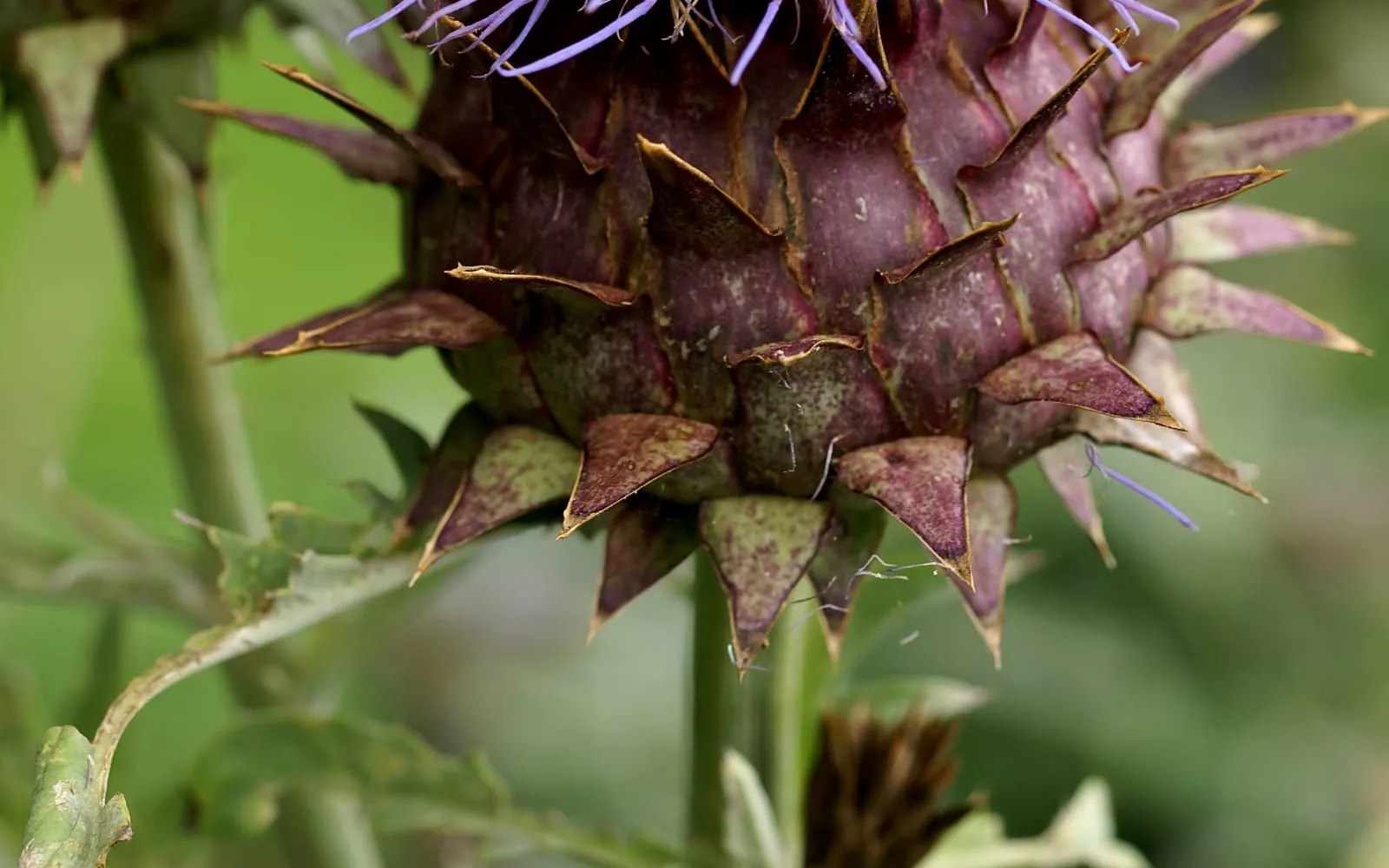
Flower stems rise to 2 or 2.5 m, branching to carry several thistle heads, smaller and spinier than an artichoke’s.
Flowers are violet-blue and 8 cm across, opening in late summer and heavily worked by bees.
Blanched stalks are pale cream, tender and considerably milder than green ones, which are too bitter to eat.
The whole plant is close enough to a globe artichoke that the difference is one of proportion. Cardoon has larger, more finely cut, spinier leaves and smaller heads.
Where it is from
Cynara cardunculus is native to the Mediterranean and North Africa, where wild cardoon still grows on dry stony ground.
Greeks and Romans grew and ate it, and Pliny records it as an expensive delicacy. It was the form the classical world knew, since the globe artichoke was selected from it much later.
Italy, Spain, France and Portugal have all kept it as a winter vegetable. Piedmont serves it raw in bagna cauda, Spain cooks it with almonds at Christmas, and Portugal uses the flowers to curdle its sheep’s milk cheeses.
Britain grew it in Tudor and Stuart kitchen gardens alongside the artichoke, then dropped it entirely, keeping the plant only as an ornamental.
It has become an invasive weed in Australia, Argentina and California, where the wild form has naturalised on grassland.
How it grows
Sow indoors in March at 15 to 18 deg C, or take offsets from an established plant in April as you would for an artichoke.
Prick out and pot on. Plant out in late May at 1.2 m apart, which is more space than most people expect to give a vegetable.
Water and feed through the summer. Cardoon needs to build a great deal of leaf, and a plant grown hard gives thin stalks.
Blanch in September. Gather the leaves upright, tie them loosely with string, and wrap the bundle in cardboard, black polythene or corrugated paper from the base to about a metre.
Wait five or six weeks. Blanching takes longer than for celery because the stalks are thicker.
Lift the whole plant in November and December, cut off the leaf blades, and use the pale stalks.
Grow it as an annual for the stalks, or leave a plant to flower and treat it as an ornamental and a rennet source.
Through the seasons
Early spring is sowing indoors in March, or taking offsets from an established clump in April.
Late spring is planting out, in late May, at 1.2 m apart into ground dug with manure.
Summer grows the plant. Water weekly and feed fortnightly with a nitrogen-rich feed, since leaf stalks are the crop and nitrogen builds them.
Early autumn is blanching. Choose a dry day in September, gather and tie the leaves, and wrap the bundle. Wet stalks wrapped up rot.
Late autumn and winter are the harvest, from November through December. Lift whole plants as needed. A hard frost through an unwrapped plant ends the crop.
Care difficulty
Moderate, and closer to celery than to artichoke in what it asks for.
Space is the first thing. This is a very large plant and 1.2 m each way is the minimum. Growers who treat it as an ordinary vegetable are usually surprised.
Blanching is the operation that decides whether it is edible. Unblanched stalks are too bitter to eat, and the wrap has to go on a dry plant or the stalks rot.
Slugs treat the inside of a blanching wrap as ideal accommodation. Check under the wrap every couple of weeks.
Spines are a practical nuisance in the older varieties. Wear gauntlets, or grow a spineless variety.
Winter wet kills a plant kept as a perennial, as it does an artichoke.
Watering
Water weekly through summer, 15 to 20 litres per plant in dry weather. This is a large plant with a large leaf area.
A dry summer gives thin, tough, stringy stalks, which is the same failure celery has for the same reason.
Water at the base rather than over the plant.
Mulch generously after planting to hold moisture.
Stop watering once the wrap goes on in September, and water the ground around the plant rather than the plant itself.
Keep winter water off the crown of a plant kept as a perennial.
Warning signs, diseases and pests
Blackfly cluster on the stems and in the leaf bases in early summer. Wash them off with a jet of water and leave the predators to the remainder.
Slugs shelter inside the blanching wrap and eat the stalks you are trying to produce. Lift the wrap every couple of weeks and clear them out.
Grey mould rots the stalks inside a wrap put on when the plant was wet. Blanch on a dry day and use a wrap that breathes, such as corrugated cardboard, rather than sealing it in polythene.
Root and crown rot follow winter waterlogging on heavy soil.
Powdery mildew coats the leaves in a dry late summer and arrives too late to affect the crop.
Thin stringy stalks mean drought, poor feeding or crowding.
Bitter stalks mean the blanching was too short or the wrap let light in.
Growing environment
Full sun.
Deep, rich, free-draining soil with plenty of well-rotted manure dug in.
Neutral to slightly alkaline, pH 6.5 to 7.5.
Space at 1.2 m each way, and more if you can.
Shelter from strong wind, which shreds the big leaves and snaps the flower stems.
Sharp drainage in winter for a plant kept as a perennial, which on heavy ground means a raised bed.
A position where the plant’s size is an asset rather than a problem, since it will dominate whatever is next to it.
Feeding
Dig in plenty of well-rotted manure before planting.
Feed fortnightly with a nitrogen-rich liquid feed from June until blanching begins. Leaf stalk is the crop, so nitrogen is right here in a way it is not for a globe artichoke grown for buds.
Stop feeding when the wrap goes on.
Mulch a perennial plant with compost in autumn.
Never use fresh manure, which gives soft growth that rots inside a wrap.
Troubleshooting
The stalks are too bitter to eat. Not blanched, or blanched for too short a time. Wrap for five or six weeks and make sure no light reaches the stalks.
The stalks rotted inside the wrap. The plant was wet when it was wrapped, or the wrap does not breathe. Blanch on a dry day and use cardboard rather than sealed polythene.
Slugs living inside the wrap. They find it before you do. Lift the wrap every couple of weeks and clear them out.
Thin, stringy stalks. Drought, crowding or too little feed. Give 1.2 m each way, water weekly, and feed fortnightly through summer.
The leaves cut my hands. Most traditional varieties are spiny. Wear gauntlets, or grow a spineless variety.
The plant died over winter. Waterlogging rather than cold. Improve drainage or grow it as an annual.
Is this the same as a globe artichoke? Very nearly. The artichoke is a selection of this species for its flower buds, and the cardoon is a selection for its leaf stalks. Cardoon leaves are larger, more finely cut and spinier, and its heads are smaller.
Can I eat the flower buds too? Yes, though they are small, spiny and fiddly compared with an artichoke. The flowers are more useful as a vegetarian rennet for cheese-making, which is their traditional use in Portugal and Spain.
Cardoon problem guides
Not sure what is wrong? See the common vegetable pests guide.