
Edible
Fox grape
Vitis labrusca
Also known as Concord grape, Slip-skin grape, Northern fox grape
How to grow fox grape, Vitis labrusca. The American slip-skin grape behind Concord juice, hardier and more disease-resistant than a European vine.
At a glance
- Difficulty
- Moderate
- Water
- Fortnightly in dry spells, less once established
- Light
- Full sun
- Temperature
- Fully hardy to -25 deg C
- Hardiness
- USDA 4-8, RHS H6, hardy to -30 C
- Type
- Deciduous woody climber, long-lived
- Height
- 6-10 m unrestricted, kept to 3-4 m on wires
- Native to
- Eastern North America
- Best month
- September and October in the Northern Hemisphere, March and April in the Southern Hemisphere
Cold-hardy well beyond the range of a wine grape and resistant to the phylloxera root aphid, which is why American rootstocks were shipped to Europe to save its vineyards in the 1880s. Humid summers suit it. The flavour is the strong musky one of Concord grape juice, so it is a different fruit rather than a hardier version of the same one.
Hardiness zones describe winter cold alone. Summer heat, humidity, rainfall and the length of the growing season decide as much, so treat the range as the outer limit rather than as a recommendation.
Every month named in this guide is for the temperate Northern Hemisphere. If you garden in the Southern Hemisphere, shift each one by six months, so September becomes March. Closer to the equator the wet and dry seasons matter more than the calendar, and the shift stops being a useful guide.
Toxic to dogs if eaten
- Safe to eat
- The fruit and the young leaves, for people
- Do not eat
- The fruit, where dogs are concerned
- Harm from
- Eating it
- Affects
- Dogs
The fruit is food for people and the leaves are eaten stuffed across the eastern Mediterranean. The RHS does not list Vitis among harmful plants. The important entry is the veterinary one. Grapes and raisins cause acute kidney failure in dogs, and the ASPCA lists Vitis vinifera as toxic on that basis. The mechanism was identified only recently and is thought to involve tartaric acid, which grapes carry in quantity. There is no reliable safe dose, individual dogs vary enormously, and a small quantity has killed. Treat any grape eaten by a dog as an emergency and ring a vet the same day. The same caution covers windfalls under a vine, which is where most cases start.
Sources: RHS potentially harmful garden plants, ASPCA toxic and non-toxic plants
About
Bite a Concord grape and the pulp shoots out of the skin in one piece, leaving the skin behind. That slip-skin habit belongs to the American species and marks it out from any European wine grape, where skin and flesh stay together.
The flavour is the other difference. Fox grapes are musky and perfumed, a taste Americans grew up with in grape juice and grape jelly and Europeans often find strange. The compound behind it is methyl anthranilate, and it is the reason artificial grape flavouring tastes nothing like a supermarket grape.
For temperate gardens the appeal is toughness. This species resists the mildews that plague European vines, survives -25 deg C, and ripens earlier.
It will not make good wine. Grown for eating, juicing and jelly it is a much easier plant than a wine grape.
Appearance and character
A vigorous deciduous climber attaching by forked tendrils that grip wire, trellis or neighbouring branches.
Stems become thick and woody, with bark peeling in long shaggy strips on older wood.
Leaves are large, 10 to 20 cm, rounded with three shallow lobes and toothed edges, dark green above and covered beneath in dense white or rusty felt. That felted underside is the quickest identification.
Flowers are tiny and green, in dense panicles in June, easy to miss but strongly scented.
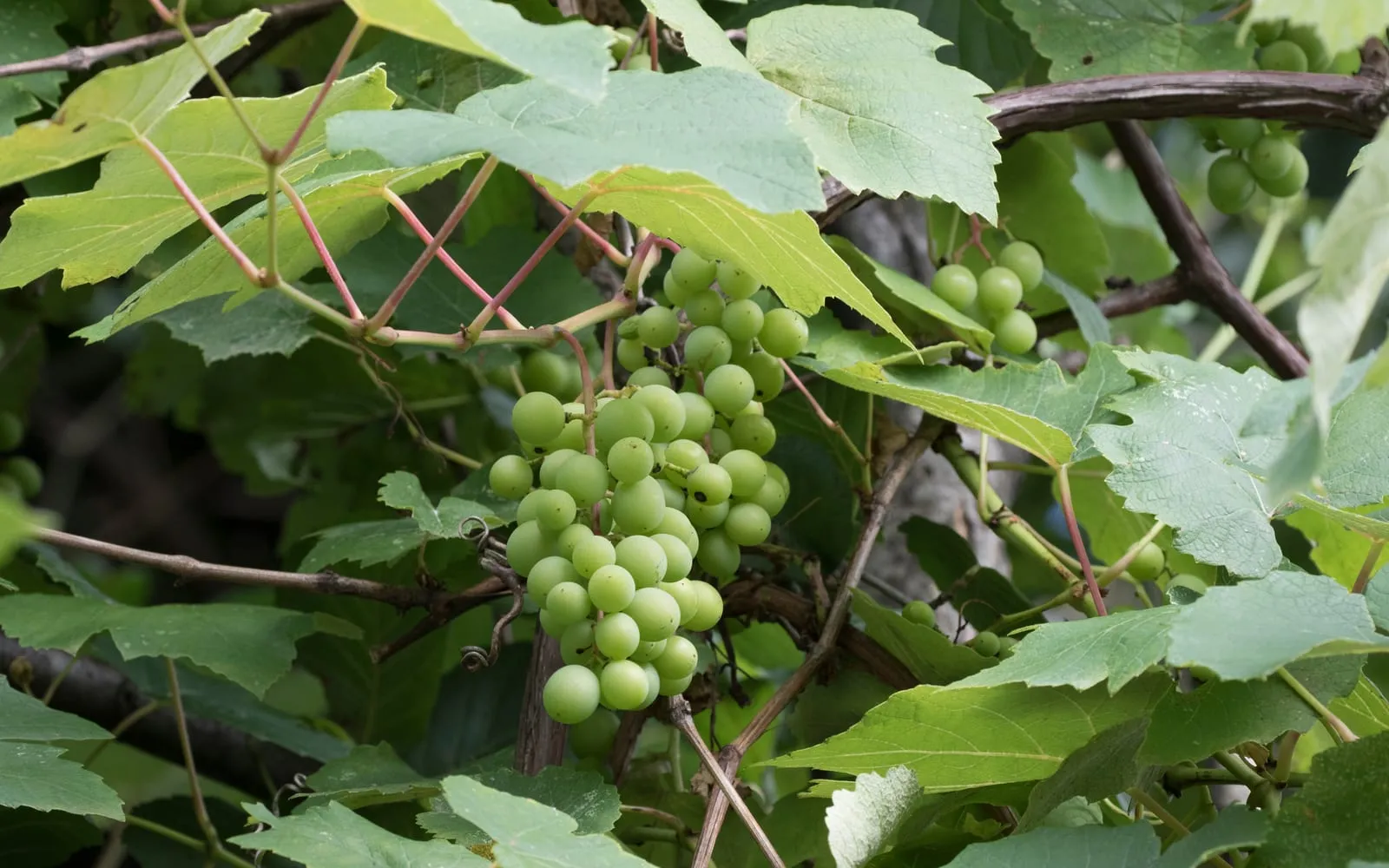
Fruit hangs in compact bunches, each berry 1.5 to 2 cm, round, blue-black with a heavy bloom in ‘Concord’ or amber-green in ‘Niagara’, with slip skins and a few large seeds.
Where it is from
Vitis labrusca is native to eastern North America, from New England south to Georgia and west to the Appalachians and beyond.
It grows in woodland edge, riverbank and thicket, climbing into trees to reach light.
Early European settlers found it growing so abundantly that they named coastal Vinland long before anyone tried to farm it, and repeated attempts to grow European wine vines in the same ground failed to the diseases and pests the native species tolerates.
‘Concord’ was raised by Ephraim Bull in Concord, Massachusetts in 1849, and it became the foundation of an entire industry in juice and jelly.
American vine roots also solved Europe’s phylloxera crisis in the nineteenth century, when almost all European vineyards were grafted onto resistant American rootstock.
How it grows
Buy a named variety. ‘Concord’ is the standard blue-black grape and ‘Niagara’ the white, and both fruit in a cool climate given a reasonable summer.
Plant in early spring in full sun against a south or west wall, or on a post and wire system in the open.
Set up wires before planting. Three or four horizontal wires at 40 cm intervals up to about 1.8 m suits a cordon.
Train a single stem to the top wire in the first two years, then build permanent arms and spur-prune the side shoots.
Prune in winter while fully dormant, before Christmas if possible, since a vine cut late bleeds sap heavily.
Summer-prune by shortening side shoots to five or six leaves beyond a bunch, which puts energy into fruit rather than foliage.
Through the seasons
Bud break is in April and the early growth is vulnerable to a late frost.
Flowering follows in June, self-fertile and needing no partner.
Thin the bunches in July if the vine has set heavily, since a Concord will carry more than it can ripen in a cool summer.
Summer pruning through July and August lets light onto the fruit, which is what ripens it.
Harvest from September into October. Ripe fruit colours fully, softens, and comes away with the whole bunch by cutting the stalk.
Prune hard in early winter. This species fruits on shoots growing from last year’s wood, so most of the previous season’s growth is removed.
Care difficulty
Moderate. It is easier than a wine grape and harder than a currant.
Disease resistance is the main advantage. Powdery and downy mildew trouble it far less than a European vine, which removes most of the spraying.
Pruning is the skill to learn, and it is unforgiving of neglect. An unpruned vine becomes a mass of unproductive wood within three years.
Ripening is the limitation in a cool climate. It needs a warm sunny position, and in a cool summer the fruit stays sharp.
The vine itself survives minus 30 deg C, so the winter is the easy part and the summer decides the crop.
Watering
Water fortnightly in dry spells during the first two or three years.
An established vine is deep-rooted and drought-tolerant, and needs water only in a prolonged dry summer.
A wall-trained vine sits in rain shadow and needs more attention than one in the open.
Avoid heavy watering close to harvest, which dilutes the flavour and splits the berries.
Mulch in spring with compost, kept off the stem, and keep the base free of weeds.
Warning signs, diseases and pests
White powdery coating on leaves and young bunches. Powdery mildew, much less common on this species than on a wine grape. Improve airflow by summer pruning.
Yellow oil-spot patches on leaves with grey mould beneath. Downy mildew in a wet summer. Remove affected leaves and open the canopy.
Grey furry rot spreading through a bunch. Grey mould. Thin bunches, remove affected berries and keep the fruit exposed to air.
Berries hollowed out in September. Wasps and birds. Bag individual bunches in fine mesh or muslin if the crop matters.
Brown limpet-like bumps on old wood. Scale insects. Scrub off in winter.
New shoots blackened in April. Late frost. Fleece a wall-trained vine on cold nights.
Small wart-like galls on the leaf underside. Grape phylloxera, a root and leaf aphid this native American species evolved alongside and largely tolerates. It is why fox grape rootstock is used to graft European vines almost everywhere the pest occurs.
Growing environment
Full sun is essential for ripening. A south or west wall is the best position where summers are cool.
Well-drained soil of moderate fertility at pH 5.5 to 6.5. Rich soil produces growth rather than fruit.
Shelter helps the fruit ripen and protects early growth from frost.
Air movement around the canopy reduces mildew, so avoid a stagnant enclosed corner.
Allow 3 to 4 m of wall or wire per vine. It also works over a pergola, though fruit ripens better on a wall where it gets reflected heat.
Feeding
Apply a balanced general fertiliser in spring as growth starts.
Sulphate of potash in late winter improves fruit quality and wood ripening, and it is the more useful of the two feeds on decent soil.
Avoid nitrogen-rich feeds, which produce leafy growth, delay ripening and increase mildew.
Mulch with compost in spring rather than manure, which is often too rich for a vine.
A container vine needs a balanced liquid feed monthly from May to July and a pot of at least 50 cm.
Troubleshooting
Plenty of growth, no fruit. Under-pruned, over-fed, or too shaded. Vines fruit on shoots from last year’s wood and need hard annual pruning.
Bunches small and sour. A cool summer, or too many bunches left on. Thin in July and summer-prune to expose the fruit.
Vine bleeding sap from cuts. Pruned too late. Cut in early winter while fully dormant.
Berries splitting. Heavy rain or watering after a dry spell. Water steadily and mulch.
Fruit tasting musky and odd. That is the foxy character of the species rather than a fault.
Leaves yellowing between the veins. Iron or magnesium shortage on limy soil. Apply chelated iron or Epsom salts.
Fox grape problem guides
Not sure what is wrong? See the common vegetable pests guide.