
Edible
Butternut Squash
Cucurbita moschata
Also known as Butternut pumpkin, Winter squash, Crookneck squash
How to grow butternut squash, Cucurbita moschata. The heat it needs to ripen in a cool summer, choosing a short-season cultivar, and curing the fruit so it stores until spring.
At a glance
- Difficulty
- Moderate
- Water
- Twice weekly through summer, tapering off in September
- Light
- Full sun, in the warmest position available
- Temperature
- 20-30 deg C. Growth stops below 15 deg C
- Hardiness
- USDA 10-11, RHS H1c, hardy to 2 C
- Type
- Tender annual
- Height
- 40 cm tall, trailing 3-4 m
- Native to
- Central and northern South America
- Best month
- May in the Northern Hemisphere, November in the Southern Hemisphere
Cucurbita moschata needs more heat than the other squashes and 100 to 120 frost-free days to ripen a fruit that will store, which is why a cool summer gives green fruit that rots by November. It resists squash vine borer and the mildews better than the rest of the genus, so warm humid regions grow it where others fail.
Hardiness zones describe winter cold alone. Summer heat, humidity, rainfall and the length of the growing season decide as much, so treat the range as the outer limit rather than as a recommendation.
Every month named in this guide is for the temperate Northern Hemisphere. If you garden in the Southern Hemisphere, shift each one by six months, so May becomes November. Closer to the equator the wet and dry seasons matter more than the calendar, and the shift stops being a useful guide.
Not known to be toxic
- Safe to eat
- The flesh, the seeds, the young leaves and the flowers
Butternut squash is a food crop and carries no toxicity concern. The RHS does not list Cucurbita moschata as a potentially harmful garden plant and the ASPCA does not list it as toxic to cats and dogs. One point is worth knowing and applies to every cucurbit. The family produces cucurbitacins, intensely bitter compounds that cause severe vomiting and diarrhoea, and they have been bred out of edible varieties. They can reappear in a plant grown from seed saved after a cross with an ornamental gourd, and there have been documented poisonings from home-saved courgette and squash seed in Europe, including at least one death. The rule is simple and absolute. Taste a small piece of raw squash before cooking it, and if it is bitter, throw the whole fruit away and do not taste any more. Bought seed from a reputable supplier does not carry this risk. The seeds are edible roasted and the flowers and young shoot tips are eaten across Central America.
Sources: RHS potentially harmful garden plants, ASPCA toxic and non-toxic plants
About
Butternut is Cucurbita moschata, a different species from the pumpkins and the winter squash already covered in these guides, which are Cucurbita maxima, and from courgettes, which are Cucurbita pepo. The distinction matters in a cool summer, because moschata needs more heat than either.
A butternut wants a long warm season to ripen, and an average cool summer is marginal for the standard cultivars. Choose a short-season cultivar. ‘Hunter’, ‘Harrier’ and ‘Barbara’ all ripen where the older ‘Waltham Butternut’ often does not.
The second half of the crop happens after picking. A butternut cut in September and eaten in October is watery and bland. The same fruit cured for two weeks in warmth and then stored cool tastes considerably better and keeps until March.
Appearance and character
A long trailing vine, 3 to 4 m, with stout ridged stems and branching tendrils.
Leaves are large, broadly heart-shaped and shallowly lobed, softly hairy, often with silver-grey mottling along the veins, which is a normal marking rather than a disease.
Flowers are large, funnel-shaped and orange-yellow, with separate male and female flowers on the same plant. Female flowers carry a tiny fruit behind the petals before they open.
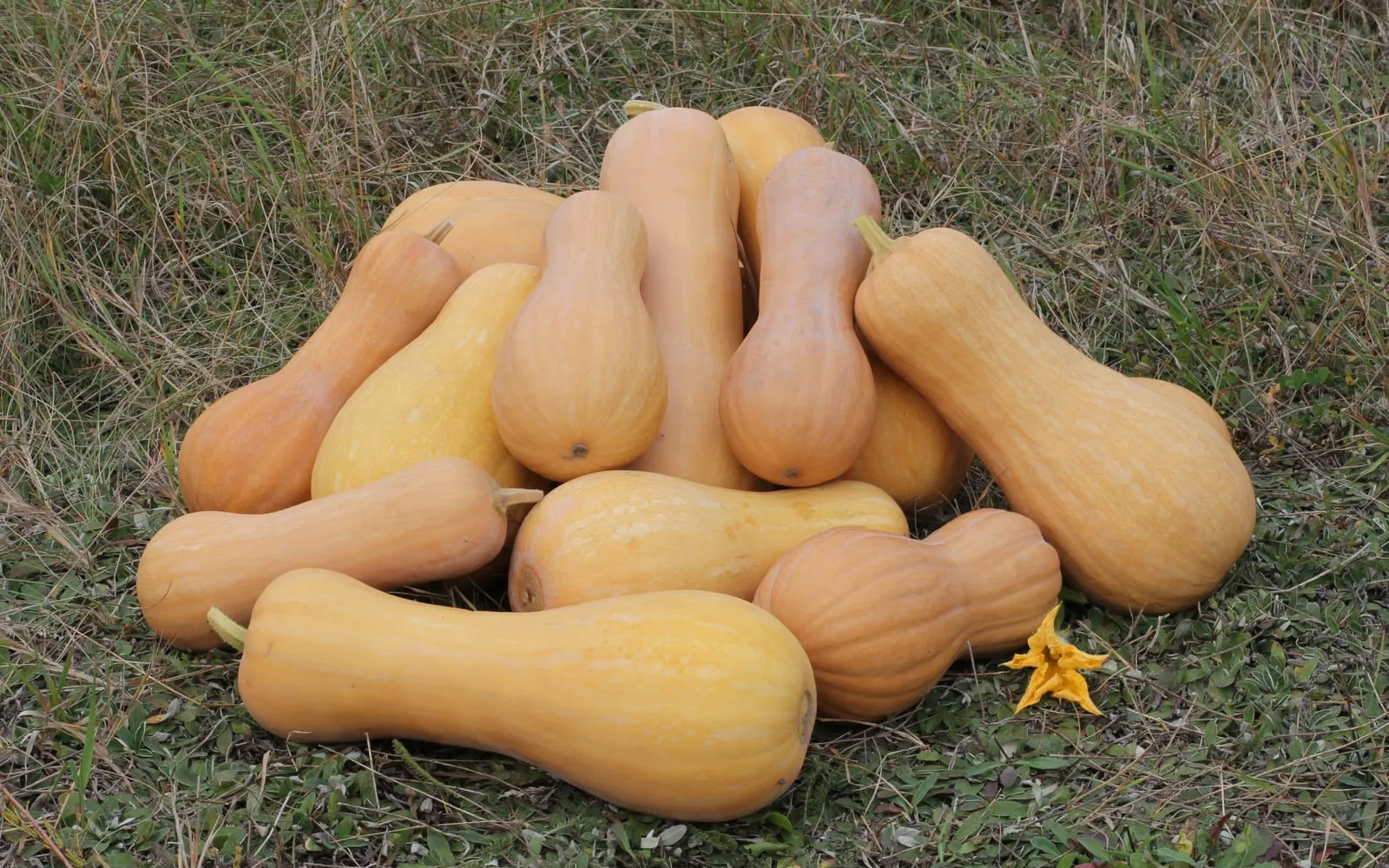
Fruit is the familiar pear or bell shape, with a long solid neck and a rounded seed cavity at the base, in matt buff-tan skin.
Flesh is deep orange, dense and sweet, with a nutty flavour that develops during curing and storage rather than on the plant.
Where it is from
Cucurbita moschata was domesticated in the lowland tropics of Central and northern South America, with archaeological remains in Mexico and Peru going back several thousand years.
It is the most heat-tolerant of the cultivated squashes and the most resistant to squash vine borer, which is why it dominates in the American south and across the tropics.
Butternut itself is a modern variety rather than an ancient landrace. Charles Leggett developed it in Stow, Massachusetts, in the 1940s by crossing a Hubbard type with a gooseneck squash, and it reached commercial catalogues in the 1950s.
Northern Europe grew almost no butternut until the 1990s. Short-season breeding and warmer summers have made it a realistic garden crop there in the last twenty years.
How it grows
Sow indoors in late April or early May at 20 deg C, two seeds to a 9 cm pot on their edge, thinning to the stronger. Sowing on edge reduces rotting.
Germination takes five to ten days in warmth.
Harden off carefully and plant out in late May or early June after the frosts, at 90 cm to 1.2 m apart. The plants are large.
Prepare a station for each plant with a bucket of well-rotted manure dug in and a slight mound to help drainage.
Warm the soil with black plastic laid a fortnight before planting, and plant through a slit. This is worth doing wherever summers are cool.
Pinch out the main shoot at 60 cm to encourage side shoots, which carry more female flowers.
Slide a tile, slate or piece of wood under each developing fruit to keep it off wet soil.
Cut in late September or early October with 8 cm of stalk, before the first frost. A fruit without a stalk rots in store.
Through the seasons
Late spring is sowing time, indoors in late April, and soil warming outdoors with black plastic from mid-May.
Early summer is for planting out, from late May in the south and mid-June further north. Water in generously.
Summer grows the vine. Water twice weekly, feed with high potash once fruit has set, and hand-pollinate in a cool wet spell by transferring pollen from a male flower to a female one with a paintbrush.
Late summer is when the fruits fill. Remove any flowers forming after mid-August, since they will not ripen. Three or four fruits per plant is a realistic target in a cool summer.
Autumn is the harvest and the cure. Cut with a long stalk in late September, cure at 25 to 30 deg C for ten to fourteen days, then store at 10 to 15 deg C until spring.
Care difficulty
Moderate, and heat is the recurring theme.
Variety choice is the most important decision and the one most people get wrong. Short-season cultivars ripen in a cool summer and long-season American ones frequently do not.
Warm soil at planting matters. Black plastic mulch is worth the trouble.
Powdery mildew arrives in August without fail and is manageable rather than preventable at that stage of the crop.
Limiting the fruit is the technique that decides whether you get ripe squash. Three or four per plant, and remove flowers after mid-August.
Curing is the step people skip, and skipping it costs both flavour and storage life.
Watering
Water twice weekly through summer, 15 to 20 litres per plant in dry weather. Squash are large plants with large leaves and they transpire heavily.
Water at the base and never over the foliage, which is the main way powdery mildew spreads.
Sinking a pot or a length of pipe alongside each plant at planting gives a way to water directly to the roots, which is worth doing.
Mulch generously after planting to hold moisture and suppress weeds.
Taper off watering from mid-September. A dry finish concentrates the sugars and improves storage, and a wet one gives watery fruit that rots.
Container growing needs at least 45 litres per plant and daily watering, and yields are lower.
Warning signs, diseases and pests
Powdery mildew coats the leaves with a white bloom from August, and every squash plant gets it eventually in a damp climate. Water at the base, space the plants, and accept it late in the season. It matters if it arrives in July and hardly at all in September.
Slugs graze young plants to the ground and rasp holes in ripening fruit. Protect new transplants and slide a tile under each fruit.
Cucumber mosaic virus mottles and distorts the leaves and stunts the plant. It is spread by aphids and there is no cure. Remove affected plants and control aphids.
Poor fruit set means cold wet weather at flowering, when pollinating insects are inactive. Hand-pollinate with a paintbrush.
Fruit rotting on the soil is prevented with a tile or slate underneath.
Fruit failing to ripen means a long-season variety, a cold summer, or too many fruits left on the plant.
Rot in store almost always traces back to a fruit cut without a stalk or one that was not cured.
Squash vine borer and cucumber beetle both attack this crop across North and South America, though butternut’s more solid stem is attacked by the borer far less often than a courgette’s growing alongside it. A wilted vine with sawdust-like frass at the base is the borer; slit the stem and remove the caterpillar. Neither pest has established outside the Americas.
Growing environment
Full sun in the warmest, most sheltered position available.
Rich, deep, moisture-retentive but free-draining soil. Dig a bucket of well-rotted manure into each planting station.
Neutral to slightly acid, pH 6 to 7.
Black plastic mulch laid a fortnight before planting warms the soil and is the most useful single intervention outdoors in a cool summer.
Space at 90 cm to 1.2 m. The vines trail 3 to 4 m and can be trained along a path edge or up a strong support with the fruit slung in nets.
Rotate on three years with courgettes, cucumbers and other cucurbits.
Feeding
Dig a bucket of well-rotted manure into each planting station.
Feed weekly with a high-potash tomato feed once the first fruit has set.
Avoid nitrogen after flowering, which gives vine at the expense of fruit.
Stop feeding in mid-September so the fruit finishes and hardens rather than continuing to swell.
A container plant needs feeding from six weeks after planting, and more often than one in the ground.
Troubleshooting
The fruits never ripened. A long-season variety, a cold summer, or too many fruits on the plant. Grow ‘Hunter’, ‘Harrier’ or ‘Barbara’, warm the soil with black plastic, and limit each plant to three or four fruits.
Female flowers form tiny fruits that yellow and drop. Poor pollination in cold wet weather. Hand-pollinate with a paintbrush from a male flower.
White powdery coating on the leaves from August. Powdery mildew. Water at the base, space the plants, and accept it late in the season.
The fruit rotted where it touched the ground. Slide a tile, slate or piece of wood underneath each developing fruit.
Mottled distorted leaves and a stunted plant. Cucumber mosaic virus, spread by aphids. Remove the plant and control aphids on the rest.
The squash tasted watery and bland. It was not cured. Hold at 25 to 30 deg C for ten to fourteen days after cutting, then store cool.
They rotted in store. Cut without a stalk, or not cured. Always cut with 8 cm of stalk attached and cure before storing.
It tastes bitter. Stop eating it and throw the fruit away. Bitterness in a cucurbit means cucurbitacins, which cause severe illness. This happens with home-saved seed that has crossed with an ornamental gourd, not with bought seed.
Butternut Squash problem guides
Not sure what is wrong? See the common vegetable pests guide.
- Powdery mildew, which arrives every August
- Slugs on young plants and on ripening fruit
- Cucumber mosaic virus, spread by aphids
- Aphids on the growing tips
- Poor fruit set from cold or wet weather at flowering
- Squash vine borer across the Americas, though this variety is more resistant than courgette
- Cucumber beetle across the Americas, which can carry bacterial wilt