
Edible
Fig-Leaf Gourd
Cucurbita ficifolia
Also known as Chilacayote, Malabar gourd, Black-seeded squash, Siam pumpkin
How to grow fig-leaf gourd, Cucurbita ficifolia. The cold-tolerant squash used as a cucumber rootstock, the black seeds, and the fruit that keeps for years.
At a glance
- Difficulty
- Easy
- Water
- Weekly through summer
- Light
- Full sun
- Temperature
- 15-25 deg C, and it tolerates cooler conditions than other squash
- Hardiness
- USDA 9-11, RHS H2, hardy to 0 C
- Type
- Short-lived perennial grown as an annual
- Height
- 30 cm tall, trailing 5-10 m
- Native to
- The highlands of Central and South America
- Best month
- May in the Northern Hemisphere, November in the Southern Hemisphere
It grows in cooler conditions than any other cultivated squash, which follows from a mountain origin, and it crops at altitudes and in seasons that stop the rest. In a frost-free climate it is perennial and runs for years. Its resistance to soil disease makes it the standard rootstock for grafted glasshouse cucumbers.
Hardiness zones describe winter cold alone. Summer heat, humidity, rainfall and the length of the growing season decide as much, so treat the range as the outer limit rather than as a recommendation.
Every month named in this guide is for the temperate Northern Hemisphere. If you garden in the Southern Hemisphere, shift each one by six months, so May becomes November. Closer to the equator the wet and dry seasons matter more than the calendar, and the shift stops being a useful guide.
Not known to be toxic
- Safe to eat
- The young fruit as a vegetable, the mature flesh candied, the seeds and shoots
Fig-leaf gourd is a food crop grown across Latin America and Asia and carries no toxicity concern. Neither the RHS nor the ASPCA lists Cucurbita ficifolia. The cucurbit caution applies as it does across the family, since cucurbitacins cause violent vomiting and diarrhoea and can reappear in plants grown from home-saved seed that has crossed with an ornamental gourd. Taste a small piece of raw flesh before cooking a whole fruit and discard anything bitter. This species crosses less readily with the other cultivated squashes than they do with each other, which reduces the risk with saved seed rather than removing it. The mature flesh is fibrous and almost tasteless, which is why it is candied or made into the Mexican sweet called cabello de angel rather than eaten as a vegetable. Young fruit is cooked like a marrow, the black seeds are eaten roasted, and the shoot tips are used as a green.
Sources: RHS potentially harmful garden plants, ASPCA toxic and non-toxic plants
About
Fig-leaf gourd is the odd one out among the cultivated squashes. It is the only one that tolerates cool conditions rather than demanding heat, the only one with black seeds, and the only perennial in the group, and it produces fruit that keeps for two or three years in a shed without any processing.
Most growers meet it as a rootstock rather than as a crop. Cucumbers and melons grafted onto Cucurbita ficifolia gain its cold tolerance and its resistance to soil diseases, which is why commercial glasshouse cucumbers are almost always grafted plants.
As a crop in its own right it is a curiosity here and a staple in the Andes and in parts of Asia. The vine is enormous, running five to ten metres, so it needs a fence, a shed roof or a corner of the plot nobody else wants.
Appearance and character
A very long trailing or climbing vine, five to ten metres in a season, with angular hairy stems and strong branching tendrils.
Leaves are large and deeply five-lobed, and the resemblance to a fig leaf is what gives the plant its name. They are rough-hairy and often show pale mottling.
Flowers are large, yellow-orange and funnel-shaped, with separate males and females, opening in the morning.
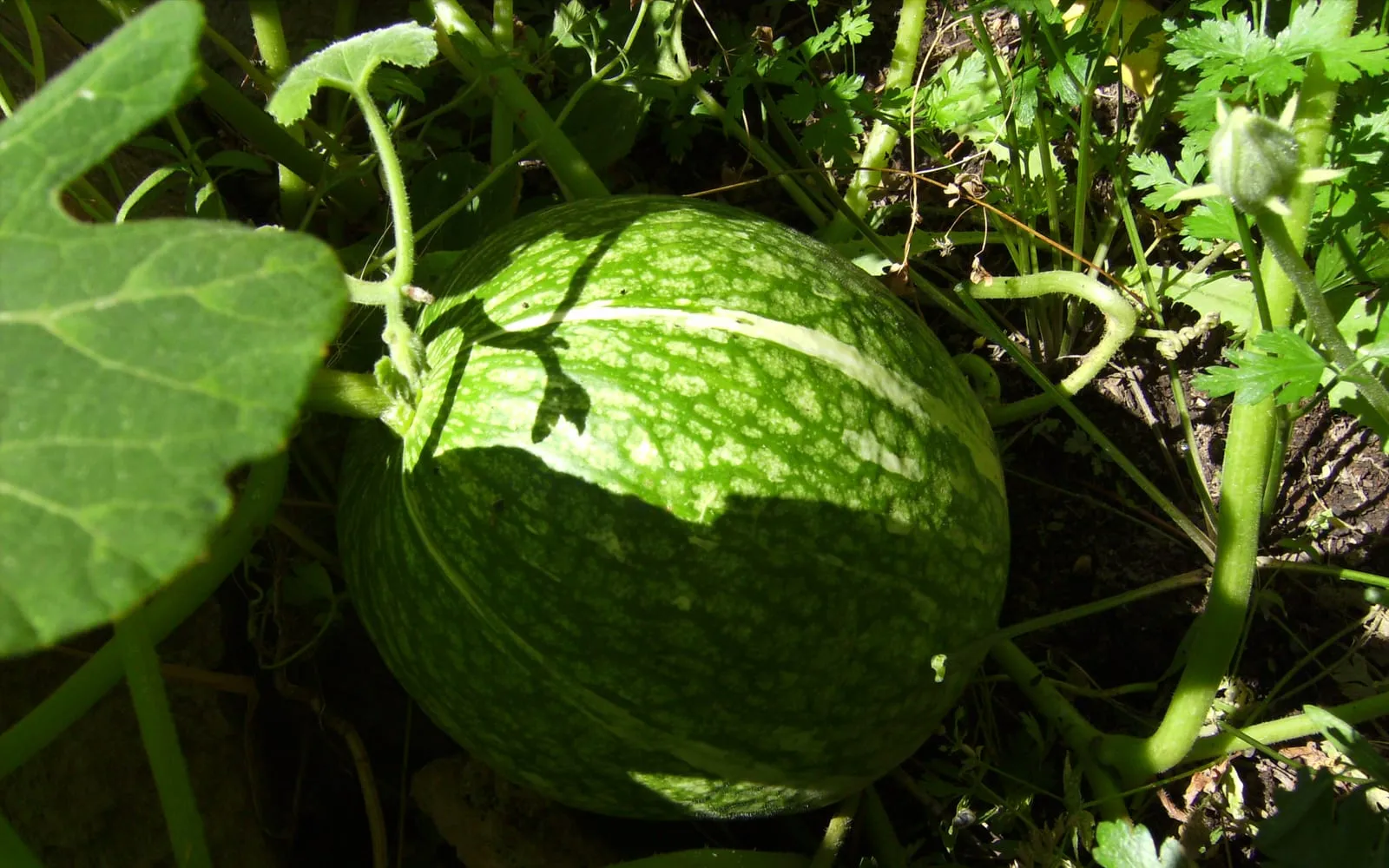
Fruit is oval to round, 20 to 50 cm long, with a hard smooth skin in dark green mottled and streaked with white, in the pattern of a watermelon.
Seeds are the giveaway. Black or very dark brown, unlike the cream or buff seeds of every other cultivated squash.
Flesh is white and fibrous, sweetish and bland, and it separates into strands when cooked, which is why it becomes a candied filling rather than a vegetable.
Where it is from
Cucurbita ficifolia comes from the highlands of Central and South America, where it grows at altitudes that would kill the other cultivated squashes.
Domestication is ancient, and archaeological remains from Peru go back several thousand years. Its wild ancestor has never been identified with certainty.
Its distribution is unusual. It travelled to Asia early enough that names like Malabar gourd and Siam pumpkin attached to it, and India, China and the Philippines all grow it.
Mexico uses the mature flesh for cabello de angel, angel’s hair, a candied sweet filling for pastries, and the young fruit as a vegetable.
Its use as a rootstock began in Japan in the twentieth century and is now standard practice in glasshouse cucumber production worldwide.
How it grows
Sow indoors in late April at 18 to 20 deg C, one seed to a 9 cm pot on its edge. Germination is quicker and more reliable than in other squashes and takes five to ten days.
Plant out in late May or early June after the frosts, at 1.5 m apart or more. This plant needs far more room than a butternut.
Prepare a station with a bucket of well-rotted manure dug in.
Give it somewhere to go. A fence, a wire, a shed roof or a rough corner. Trained upwards it takes far less ground and the fruit hangs without rotting.
Pinch out the main shoot at a metre to force side shoots, though the plant is vigorous enough that this is optional.
Pick young fruit at 20 cm for use as a vegetable, or leave the fruit to mature and cut it in October with a long stalk.
Store mature fruit somewhere cool and dry. It keeps for two or three years, which is exceptional among cucurbits.
Through the seasons
Late spring is sowing, indoors in late April, and preparing the station outdoors.
Early summer is for planting out, from late May. Water in generously and direct the first shoots where you want them to go.
Summer grows an enormous amount of vine. Water weekly, keep the shoots off paths and other crops, and hand-pollinate in a cold wet spell.
Autumn ripens the fruit. Cut in October before the first hard frost, leaving a long stalk.
Winter is storage. The fruit keeps in a cool dry shed for years, so there is no rush to use it.
Care difficulty
Easy, and easier than any other squash in this wave, with one caveat about space.
Cold tolerance is what makes it easy. It sets fruit in conditions where a butternut sulks, and it needs no black plastic and no fleece.
Space is the real cost. Ten metres of vine will smother a small plot. Grow it up a fence or a structure, or give it a corner of rough ground.
Powdery mildew arrives late and the plant resists it better than most cucurbits.
Slugs take young plants and lose interest once it is away.
Nothing else troubles it much. The vigour that makes it a problem for neighbouring crops also makes it hard to harm.
Watering
Water weekly through summer, around 15 litres per plant in dry weather.
The plant is more drought-tolerant than other squashes and produces less when dry.
Water at the base rather than over the foliage.
Mulch generously after planting, though the vine shades its own ground within a few weeks.
Taper off watering in September as the fruit hardens.
Container growing is impractical given the size, and a very large tub against a fence will produce a plant and few fruits.
Warning signs, diseases and pests
Powdery mildew coats the leaves late in the season. This species resists it better than other squashes and the damage is minor at that stage.
Slugs graze young transplants. Protect them for the first fortnight.
Aphids cluster on the growing tips and are dealt with by predators.
Poor fruit set means cold wet weather during flowering, when insects are inactive. Hand-pollinate with a paintbrush from a male flower to a female one.
Smothered neighbours are the main practical problem rather than a pest. Direct the vine or grow it up a structure.
Fruit rotting on wet ground is prevented with a tile underneath, or avoided entirely by training the plant upwards.
Rot in store is rare, since the skin is hard and the fruit keeps for years.
Growing environment
Full sun, and it accepts a cooler and shadier position than any other squash.
Fertile, moisture-retentive but free-draining soil, with a bucket of manure per station.
Neutral to slightly acid, pH 6 to 7.
Space, and a great deal of it. Allow 1.5 m between plants at minimum, and provide a fence, wire or structure to climb.
Shelter is unnecessary. The plant is tough and the growth is too dense to be badly damaged by wind.
Rotate on three years with the other cucurbits, though it shares fewer soil diseases than most, which is precisely why it is used as a rootstock.
Feeding
Dig a bucket of well-rotted manure into each station and leave it at that.
The plant is vigorous enough that further feeding produces more vine rather than more fruit.
Avoid nitrogen entirely after planting.
A high-potash feed once fruit has set is worthwhile only on very poor ground.
Never feed a plant that is already outgrowing its space.
Troubleshooting
It has taken over the plot. Ten metres of vine is normal. Train it up a fence, a wire or a shed roof, or give it a corner where it can run.
Female flowers yellow and drop. Poor pollination in cold wet weather. Hand-pollinate with a paintbrush from a male flower.
The mature flesh is fibrous and tasteless. That is what it is. Mature fig-leaf gourd is candied or made into a stranded sweet filling, not eaten as a vegetable. Pick fruit young at 20 cm to use it like a marrow.
The seeds are black rather than cream. Correct, and the easiest way to identify the species.
White powdery coating on the leaves in September. Powdery mildew. It arrives late and this species resists it well, so the crop is unaffected.
Can I really keep the fruit for years? Yes. A sound mature fruit with its stalk on keeps two or three years in a cool dry shed, which is exceptional among squashes.
Why is it sold as a rootstock? Cucumbers and melons grafted onto it gain its cold tolerance and its resistance to soil-borne disease, which is standard practice in commercial glasshouse growing.
Will it cross with my courgettes? Less readily than the other cultivated squashes cross with each other, since it is a separate species. Saved seed is still worth tasting before you cook it.
Fig-Leaf Gourd problem guides
Not sure what is wrong? See the common vegetable pests guide.