
Edible
Cherry Plum
Prunus cerasifera
Also known as Myrobalan plum, Myrobalan
How to grow cherry plum, Prunus cerasifera. The first blossom of the year, why the fruit is worth more than its reputation, and its use as a hedge.
At a glance
- Difficulty
- Easy
- Water
- Weekly in the first two summers, rarely after that
- Light
- Full sun to partial shade
- Temperature
- Fully hardy to about -25 deg C
- Hardiness
- USDA 4-8, RHS H6, hardy to -30 C
- Type
- Deciduous tree, long-lived
- Height
- 6-8 m
- Native to
- South-eastern Europe, Western Asia
- Best month
- February in the Northern Hemisphere, August in the Southern Hemisphere
First of all the fruit trees into flower, often while the weather is still wintry, which is what makes it valuable as a hedge for early bees and unreliable as a crop. Chill is modest at 400 to 600 hours. Expect a heavy crop in the years frost misses the blossom and none in the years it does not.
Hardiness zones describe winter cold alone. Summer heat, humidity, rainfall and the length of the growing season decide as much, so treat the range as the outer limit rather than as a recommendation.
Every month named in this guide is for the temperate Northern Hemisphere. If you garden in the Southern Hemisphere, shift each one by six months, so February becomes August. Closer to the equator the wet and dry seasons matter more than the calendar, and the shift stops being a useful guide.
Poisonous if eaten
- Safe to eat
- The ripe fruit flesh
- Do not eat
- The kernel inside the stone, and the leaves, twigs and bark
- Harm from
- Eating it
- Affects
- People, cats, dogs and horses
The ripe fruit is food and the rest of the tree is not. Like every Prunus, this tree keeps cyanogenic glycosides in its seeds, leaves, twigs and bark, releasing hydrogen cyanide when they are chewed or digested. A stone swallowed whole passes through intact, so the hazard is cracking stones open to eat the kernel. Those kernels taste of bitter almond, which is the warning, and a handful is enough to poison a child. Do not eat them. For animals the foliage matters more than the fruit, and wilted foliage most of all, because cyanide release rises sharply as the leaf dies. Branches pruned into a paddock have killed horses and cattle, so clear prunings away. A dog swallowing a windfall risks an obstruction from the stone as much as anything chemical. The RHS lists Prunus among plants harmful if eaten and the ASPCA lists the genus as toxic to cats, dogs and horses.
Sources: RHS potentially harmful garden plants, ASPCA toxic and non-toxic plants
About
Cherry plum is the tree that flowers before anything else. White blossom on bare black twigs in February, sometimes in late January in a mild winter, three or four weeks ahead of blackthorn and long before any other plum.
That makes it valuable and unreliable in the same breath. The flowers are the first serious nectar source of the year for early bumblebees, and they are also the most likely blossom in the garden to be destroyed by frost.
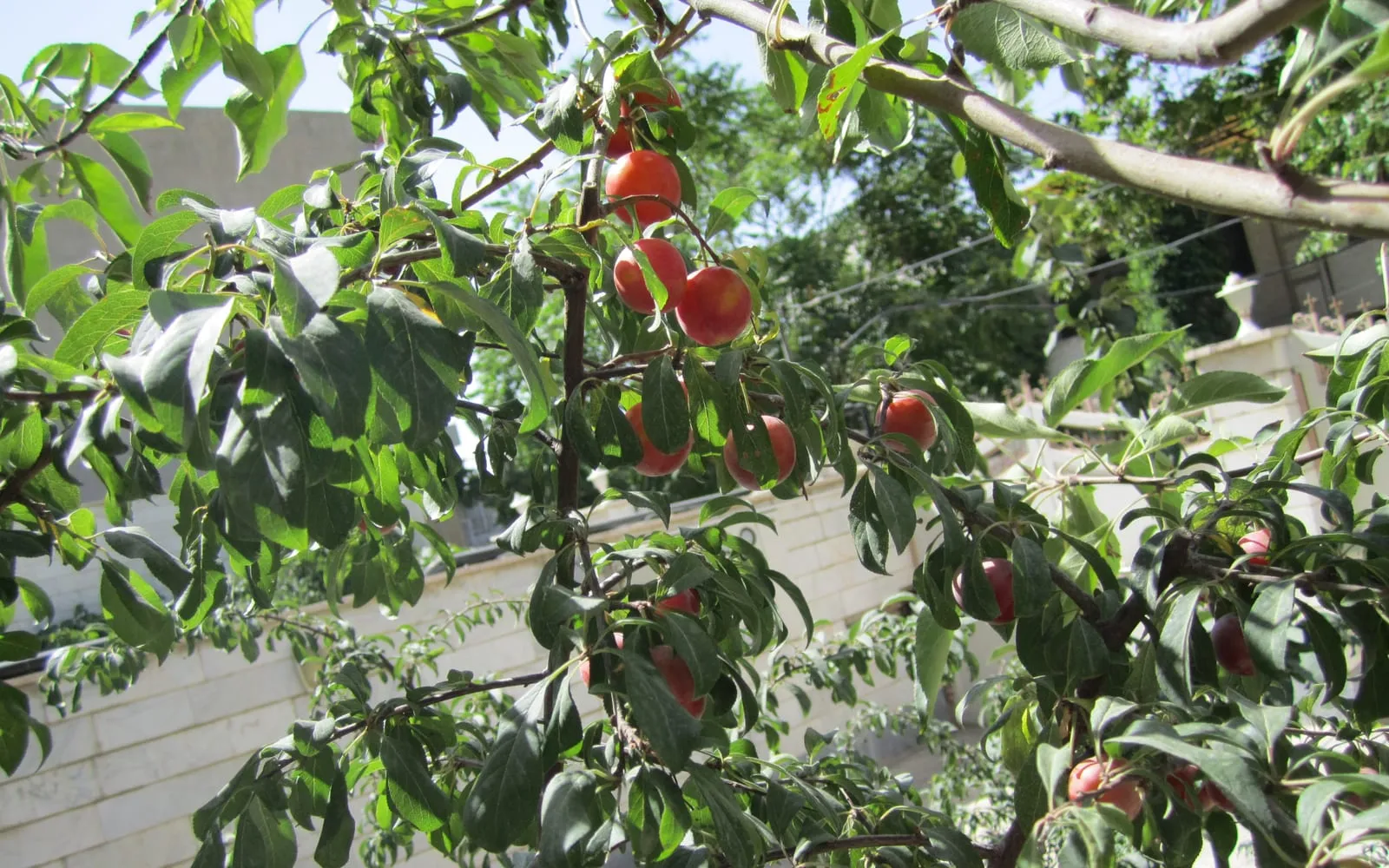
The fruit has a poor reputation it does not deserve. A ripe cherry plum is round, about the size of a large cherry, red or yellow, and sweet with a sharp skin. It makes excellent jam and a good sharp sauce, and the reason people dismiss it is that they eat them under-ripe.
It is also the standard hedging plum and the rootstock behind many garden plums.
Appearance and character
A dense twiggy small tree or large shrub, 6 to 8 m, often multi-stemmed and sometimes slightly thorny, though far less so than blackthorn.
Bark is dark and smooth, becoming finely fissured.
Leaves are small, oval, finely toothed and bright glossy green, appearing with or just after the flowers, which is one way to separate it from blackthorn.
Flowers are white, 2 cm across, borne singly on bare wood in February, smothering the twigs.
Fruit is round, 2 to 3 cm, red or yellow, with a shallow groove and a smooth skin. It ripens in July and August.
The purple-leaved forms grown as street trees, ‘Nigra’ and ‘Pissardii’, are selections of this species with pink blossom and dark foliage. They fruit less freely.
Where it is from
Cherry plum is native to the Balkans, the Caucasus and western Asia, where it grows in scrub and woodland edge.
It has been cultivated for a very long time and was carried west early, becoming naturalised widely in hedgerows and on waste ground across Europe and North America.
The name myrobalan comes from the trade in dried fruit and is still the name used in the nursery trade, where seedling cherry plum is a common rootstock for plums, apricots and peaches.
It is one of the two parents of the domestic plum. Prunus domestica is a hybrid between Prunus cerasifera and the sloe, Prunus spinosa.
The purple-leaved forms were introduced from Iran in the 1880s and became one of the most widely planted ornamental street trees in Europe.
How it grows
Buy a grafted named variety for fruit, or seedling stock for hedging.
Plant between November and March. Cherry plum is undemanding about soil and grows on heavy clay where other fruit sulks.
Space at 5 to 6 m as a tree, or 45 cm apart in a double staggered row for a hedge.
Full sun gives the best crop and the tree tolerates partial shade.
Prune in summer only, between May and August, exactly as for any other plum.
Cut a hedge after flowering, accepting that this removes that year’s fruit. A hedge grown for fruit is cut hard only every few years.
Expect fruit from the third or fourth year.
Harvest in July and August. Ripe fruit is soft, fully coloured and comes away easily, and the difference between a ripe and an under-ripe cherry plum is the difference between a good fruit and a sour one.
Through the seasons
Midwinter is for planting. The tree may already be in bud by late January.
February is blossom, and it is the earliest in the garden. Nothing can be done about frost on a full-sized tree.
Spring brings leaves immediately after the flowers, which separates it from blackthorn, where the flowers come well before the leaves.
Summer swells the fruit. Prune now if pruning is needed.
July and August are the harvest. Pick when fully soft and coloured.
Care difficulty
Easy. This is the least demanding fruit tree in the wave.
It tolerates heavy clay, partial shade, exposure and cold, and it needs no feeding on ordinary ground.
Frost on the February blossom is the only real limitation, and in most years enough flowers escape to give a crop.
Silver leaf and bacterial canker are the diseases to avoid, and summer pruning avoids both.
Suckering is the practical nuisance on seedling-grown trees, which throw shoots from the base and from the roots.
It is a good tree for a difficult site, a wildlife hedge or a first fruit tree.
Watering
Water weekly through the first two summers after planting.
An established cherry plum rarely needs watering in a temperate climate.
Water in a severe drought while the fruit is swelling, since drought gives small sour fruit.
Mulch every second late winter with compost over the root spread.
The species tolerates heavy wet ground better than most stone fruit, though it still dislikes standing water in winter.
Warning signs, diseases and pests
Frost-blackened blossom in February is normal in a cold year and rarely costs the whole crop, because the tree flowers over several weeks.
Silver leaf gives leaves a silvery sheen and stains cut wood purple-brown. Prune in summer to avoid it.
Bacterial canker sinks bark and oozes amber gum. Cut into clean wood in dry summer weather.
Brown rot turns fruit brown and firm with buff pustule rings in a wet summer. Remove affected fruit.
Aphids curl new growth in spring and predators usually clear them.
Suckers from the base and roots are common on seedling trees. Pull rather than cut them, since cutting encourages more.
Sour fruit almost always means it was picked too early.
Growing environment
Full sun for the heaviest crop, and it will fruit in partial shade.
Almost any soil suits it, including heavy clay, chalk and poor ground.
It tolerates exposure and wind better than any other plum, which is why it is used for shelter belts and hedging.
Avoid deep frost pockets where possible, though the tree itself is unharmed and only the blossom suffers.
Give it room, since a mature tree is broad and twiggy.
It is a good choice at the back of a garden, in a mixed native hedge, or as an early nectar source near a fruit garden that needs pollinators.
Feeding
Cherry plum needs no feeding on ordinary ground and crops well on poor soil.
Mulch every second late winter with compost over the root spread if the tree is cropping heavily.
Avoid nitrogen feeds, which produce soft growth, more suckers and more canker.
Sulphate of potash at 20 g per square metre in February helps a tree on very light sand.
A hedge needs nothing at all beyond what falls on it.
Troubleshooting
The fruit is sour. Picked too early. A ripe cherry plum is soft to the touch and fully coloured, and it comes away from the spur without pulling.
The blossom was killed by frost. Normal for a tree that flowers in February. The long flowering period usually leaves something to set.
Shoots keep coming up around the base and in the lawn. Suckering, which is common on seedling trees. Pull them out rather than cutting them.
Is this blackthorn? Cherry plum leafs out with or just after its flowers and has smooth green twigs. Blackthorn flowers well before any leaf and has vicious black thorns.
Silvery leaves on one branch. Silver leaf. Cut back into clean wood in summer.
Can I use it as a hedge? Yes, and it is one of the best, being dense, cheap, tolerant and very early flowering. Cutting it annually costs the fruit.
Do I need two trees? Most cherry plums are self-fertile, and a second tree improves the crop.
When do I prune it? Between May and August, like every plum. Never in winter.