
Outdoor plant
Blackthorn
Prunus spinosa
Also known as Sloe, Sloe bush
How to grow blackthorn, Prunus spinosa. Blossom on bare stems before hawthorn, picking sloes for gin, planting a stockproof hedge and controlling the suckers.
At a glance
- Difficulty
- Easy
- Water
- Rarely once established
- Light
- Full sun to partial shade, and it flowers best in sun
- Temperature
- Extremely hardy, and it stands wind, salt and exposure
- Hardiness
- USDA 4-8, RHS H6, hardy to -30 C
- Type
- Deciduous shrub or small tree, long lived and strongly suckering
- Height
- 3-6 m
- Native to
- Europe and western Asia, and native throughout Britain
- Best month
- March in the Northern Hemisphere, September in the Southern Hemisphere
It flowers on bare wood before the leaves, early enough that a hard frost during blossom takes the sloe crop, and the cold snap that often coincides is called a blackthorn winter. It suckers freely and stands salt wind. It is a declared weed in Tasmania and parts of New Zealand, where thickets take over pasture, so check before planting in the southern hemisphere.
Hardiness zones describe winter cold alone. Summer heat, humidity, rainfall and the length of the growing season decide as much, so treat the range as the outer limit rather than as a recommendation.
Every month named in this guide is for the temperate Northern Hemisphere. If you garden in the Southern Hemisphere, shift each one by six months, so March becomes September. Closer to the equator the wet and dry seasons matter more than the calendar, and the shift stops being a useful guide.
Skin irritant
- Safe to eat
- The flesh of the ripe sloes, once cooked or steeped
- Do not eat
- The stones inside the sloes, and the leaves
- Harm from
- Eating it and handling it
- Affects
- People, cats, dogs and horses
Blackthorn is a hedgerow food plant with the ordinary cautions that apply to everything in the genus Prunus. The flesh of a ripe sloe is edible and is used for sloe gin, jellies and wine, and it is intensely astringent raw rather than dangerous. The stone inside contains cyanogenic glycosides, as plum and cherry stones do, so stones should not be crushed or eaten. Steeping whole sloes in gin is entirely safe, and the traditional practice of leaving them in the bottle for a long period is fine because the stone stays intact. Leaves and twigs also contain cyanogenic compounds, which matters mainly for horses and livestock browsing wilted clippings, since wilting increases the release of cyanide. Never throw blackthorn prunings into a paddock. The more likely injury is physical. Blackthorn thorns are long, hard and notoriously prone to causing infected wounds and plant thorn synovitis if a fragment breaks off in a joint. Wear thick gloves and eye protection when cutting it, and take a deep puncture near a joint seriously.
Sources: RHS potentially harmful garden plants, ASPCA toxic and non-toxic plants
About
Blackthorn is the white blossom that appears in March on stems with no leaves on them at all.
That single detail settles the confusion that surrounds it. Blackthorn flowers first, on bare black wood, usually in March and sometimes February. Hawthorn flowers in May, after its leaves are fully out. Both are white, both are thorny, both grow in the same hedge, and the timing tells them apart every time.
A cold snap during blackthorn flowering has its own name in English. A blackthorn winter is the sharp frost that often coincides with the blossom.
The fruit is the other reason people care about this plant. Sloes are small, blue-black, and so astringent raw that they dry the mouth out, and steeped in gin with sugar they make the best-known British hedgerow drink.
As a hedge it is unmatched for keeping things in or out. The thorns are vicious and the growth is dense. As a garden plant it is a thug, suckering outwards indefinitely.
Appearance and character
A deciduous shrub or small tree reaching 3 to 6 m, forming a dense suckering thicket.
Stems are very dark, almost black, which is the origin of the name, and armed with straight, hard, sharp thorns up to 4 cm long. The thorns are modified side shoots and often carry leaves themselves.
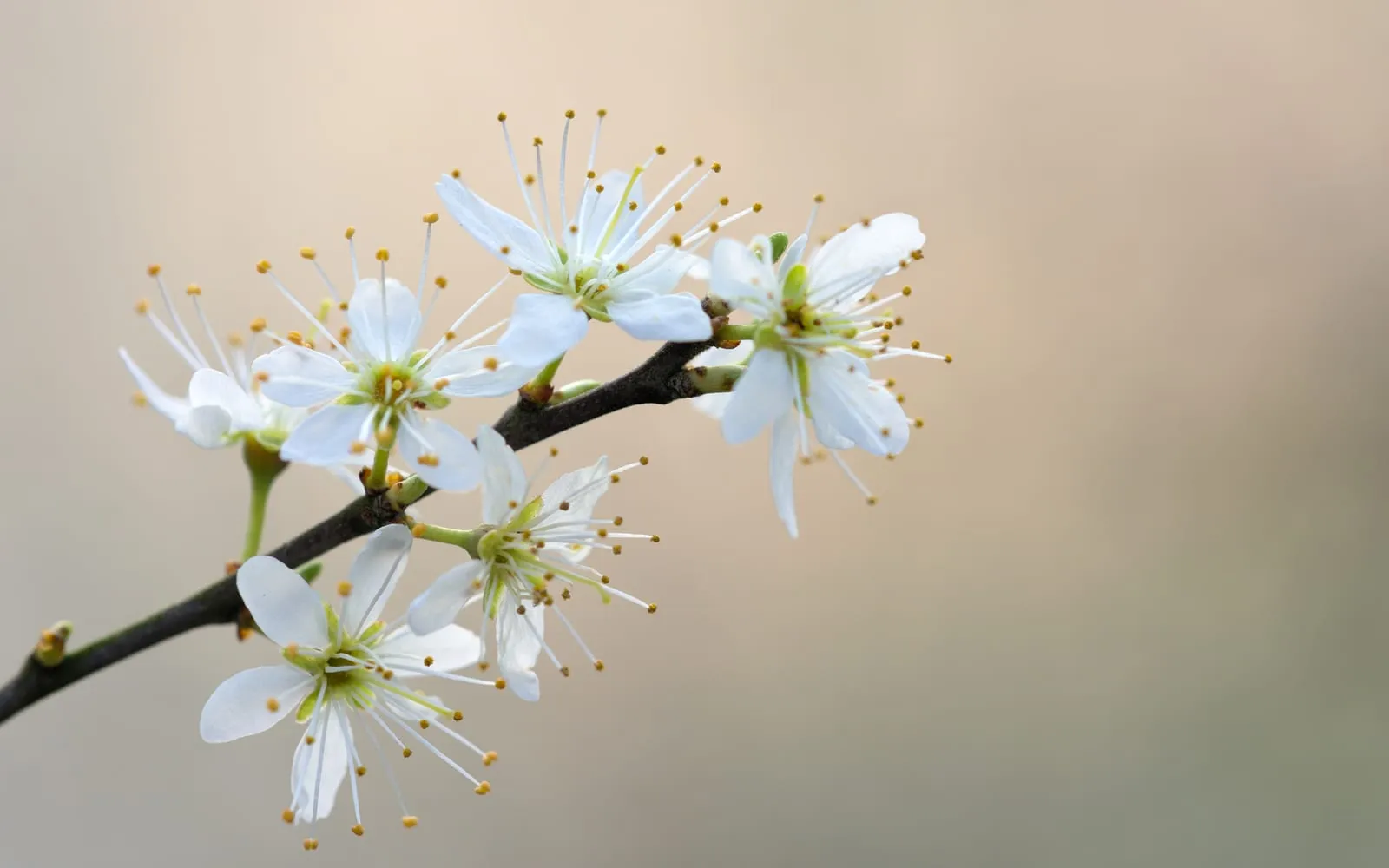
Flowers open in March, sometimes late February, before any leaves appear. Each is about 1.5 cm across, pure white with five petals and a boss of stamens, and they open singly rather than in clusters, densely along the whole length of the twig.
Leaves follow the flowers in April, small, oval, finely toothed, dull dark green, and 2 to 4 cm long.
Sloes ripen from September, round, 1 to 1.5 cm across, blue-black with a waxy grey bloom, each holding a single stone.
Bark is very dark brown to black, and the whole plant reads as dark where hawthorn reads as green.
The thicket habit is characteristic. Blackthorn suckers freely from the roots and spreads outwards to form dense scrub.
Where it is from
Europe and western Asia, and native throughout Britain and Ireland.
It grows in hedgerows, scrub, woodland edges, on coastal cliffs and on downland, on any soil including heavy clay, chalk and thin poor ground.
It is a pioneer species and colonises abandoned grassland rapidly by suckering, which is why blackthorn scrub is both an important habitat and a management problem on downland reserves.
The wood is very hard and was traditionally used for the Irish shillelagh, and cut blackthorn stems make walking sticks.
Sloe gin is documented from the eighteenth century and remains the standard British use of the fruit.
Its wildlife value is high. Blackthorn is the food plant of the brown hairstreak butterfly, which lays its eggs on young blackthorn stems, and hedge management that cuts every year removes exactly the growth those eggs are on.
How it grows
Plant bare-root whips between November and March, which is far cheaper than container-grown stock and establishes better.
For a hedge, plant a double staggered row 30 cm apart in rows 30 cm apart, giving about five plants per metre, and mix it with hawthorn, hazel, field maple and dog rose for a better wildlife hedge.
Cut every whip back hard to 15 to 20 cm after planting. This is what produces a hedge thick at the base rather than a row of bare legs.
Trim established hedges in winter, and avoid cutting between March and August when birds are nesting, which is a legal consideration as well as a courtesy.
Cut on a rotation rather than every year if you can. Blackthorn flowers and fruits on wood at least two years old, so an annually flailed hedge produces no sloes and no brown hairstreak habitat.
Control the suckers, which is the main work. Blackthorn spreads outwards by root suckers and will colonise a lawn or a border. Mow them, or dig them out with as much root as you can, and expect to keep doing it.
Do not plant it in a small garden as a specimen. It is a hedge and scrub plant.
Pick sloes from late September. The traditional advice is to wait until after the first frost, which softens the skins, and freezing them overnight in a bag achieves the same thing.
Through the seasons
Winter is planting, cutting and laying season. Bare black stems make the plant easy to identify.
Spring is the blossom, in March on bare stems, which is the single most useful identification point.
Summer puts on growth and swells the fruit. Leave hedges alone for nesting birds.
Autumn ripens the sloes from September. Pick after the first frost, or freeze them to imitate it.
Care difficulty
Easy to grow and difficult to contain.
It survives almost anything. Clay, chalk, drought, waterlogging, salt wind, hard frost and neglect all leave it unbothered.
The two difficulties are suckering and thorns. A blackthorn hedge expands outwards every year unless the suckers are cut or mown, and every job on the plant is slower and more painful than it would be on hawthorn.
Nothing about it needs feeding, watering or winter protection.
Watering
Water bare-root plants through their first summer after planting, which is when losses happen.
Established blackthorn needs no watering in a temperate climate.
Mulch a newly planted hedge to suppress grass, which competes far more seriously than drought does.
Warning signs, diseases and pests
Blossom wilt and brown rot both affect blackthorn as they do other Prunus. Blossom wilt kills flowers and the shoot tips behind them, and brown rot turns fruit into shrivelled mummies that hang on the branch. Cut out affected wood and clear fallen fruit.
Silver leaf enters through pruning wounds and gives the foliage a silvery sheen with a dark stain inside cut wood. Prune in summer rather than winter on any specimen you care about, though hedges are conventionally cut in winter and rarely suffer.
Suckers appearing several metres from the hedge are normal blackthorn behaviour rather than a disease. Mow or dig them.
No flowers or fruit on a hedge nearly always means it is being cut too often. Move to a two or three year rotation.
Thorn punctures are the injury to take seriously. Blackthorn wounds infect readily, and a fragment left in a joint causes plant thorn synovitis which sometimes needs surgical removal. Wear thick gloves and eye protection, and see a doctor about a deep puncture near a joint that stays painful and swollen.
Never leave prunings where horses or livestock can reach them. Wilted Prunus foliage releases cyanide.
Growing environment
Full sun to partial shade. It flowers and fruits far better in sun.
Any soil, including heavy clay, chalk, sand and poor ground. It is indifferent.
Exposure is no obstacle. It stands coastal salt wind, upland cold and open sites that defeat most hedging plants.
Give it room to sucker or plan to control it. Do not plant it against a lawn edge or a neighbour’s boundary without thinking about where it will be in ten years.
It suits a boundary hedge, a stockproof field hedge, a wild corner or a shelter belt.
Its wildlife value is high and depends on management. Early blossom feeds insects when almost nothing else is out, the dense thorny growth is prime nesting cover, sloes feed thrushes, and the brown hairstreak depends on it.
Pair it with the hawthorn in the same hedge, which is what most old British hedges did, and the two flowering seasons extend the value.
Feeding
None needed on ordinary soil.
Mulch a newly planted hedge with compost or bark for its first two springs, which helps by suppressing grass more than by feeding.
Avoid nitrogen, which produces soft growth and more suckering.
A weak hedge is usually competing with grass at its base rather than short of nutrients.
Troubleshooting
Is this blackthorn or hawthorn? Look at the leaves when it flowers. Blackthorn blossoms in March on completely bare black stems. Hawthorn blossoms in May after its leaves are out, and its leaves are deeply lobed where blackthorn’s are small, oval and toothed.
When do I pick sloes? From late September, and traditionally after the first frost. Freezing them overnight in a bag does the same job and lets you pick earlier.
My hedge has never had sloes. It is being cut too often. Blackthorn fruits on wood at least two years old, so an annually trimmed hedge never gets there. Cut on a two or three year rotation.
Suckers are coming up in my lawn. Normal. Blackthorn spreads by root suckers. Mow them regularly or dig them out with as much root as possible, and expect it to continue.
A thorn went in and the joint is still swollen. See a doctor. Blackthorn wounds infect readily and a fragment in a joint causes a persistent inflammation that sometimes needs surgery.
Can I use the prunings for anything? Keep them away from horses and livestock, since wilted Prunus foliage releases cyanide. Straight stems make good walking sticks.
When can I cut the hedge? Winter, and avoid March to August when birds are nesting.
Can I eat sloes raw? You can, and you will not want to. They are extraordinarily astringent. Cook them or steep them in gin, and do not crush the stones.