
Edible
Hyssop
Hyssopus officinalis
Also known as Common hyssop
How to grow hyssop, Hyssopus officinalis. The blue-flowered bee herb for a dry sunny bed, its bitter culinary use, and the biblical plant it is probably not.
At a glance
- Difficulty
- Easy
- Water
- Rarely. Weekly for the first summer only
- Light
- Full sun
- Temperature
- Hardy to about -20 deg C given dry ground
- Hardiness
- USDA 4-9, RHS H6, hardy to -20 C
- Type
- Hardy semi-evergreen sub-shrub
- Height
- 30-60 cm
- Native to
- southern Europe, western Asia
- Best month
- July and August in the Northern Hemisphere, January and February in the Southern Hemisphere
Dry chalky ground is what it wants, and on that it takes -20 deg C, while heavy wet soil rots it at a fraction of that cold. Cut it back by half each spring or it goes bare and woody at the base. Bees work it as heavily as almost anything in the garden.
Hardiness zones describe winter cold alone. Summer heat, humidity, rainfall and the length of the growing season decide as much, so treat the range as the outer limit rather than as a recommendation.
Every month named in this guide is for the temperate Northern Hemisphere. If you garden in the Southern Hemisphere, shift each one by six months, so July becomes January. Closer to the equator the wet and dry seasons matter more than the calendar, and the shift stops being a useful guide.
Edible, with limits
- Safe to eat
- Leaves and flowers, in small culinary quantities
- Do not eat
- The concentrated essential oil
- Harm from
- Eating it
- Affects
- People
The herb is used in cooking and in liqueurs and is safe in the small amounts a kitchen calls for. Hyssop does not appear on the RHS list of potentially harmful garden plants and the ASPCA holds no entry for it. The caution attaches to the essential oil, which contains pinocamphone and isopinocamphone and has caused seizures in documented cases where the oil was taken by mouth in quantity. Herbal references therefore advise against the oil in pregnancy and for anyone with epilepsy. Leaves in a stew or a tea are a different proposition from the distilled oil, and it is the oil that is worth respecting. Nothing suggests a hazard to cats, dogs or horses grazing the plant.
Sources: RHS potentially harmful garden plants, NC State Extension, Hyssopus officinalis
About
Hyssop is grown now for its flowers and its bees rather than for the kitchen. The deep blue-violet spikes open from July into September, and a plant in full flower on a warm day carries more insects than anything else in a herb bed.
The flavour is bitter and camphorous, closer to a medicinal herb than a culinary one, and a little goes a long way. It suits fatty meat, game and pulses in small quantities, and it is one of the botanicals in Chartreuse and in several absinthes.
As a garden plant it is easy, tidy and long flowering, provided the soil drains. It comes from dry rocky ground in southern Europe and it dies in wet clay, which is the same condition every Mediterranean sub-shrub in this collection sets.
Appearance and character
An upright bushy sub-shrub, 30 to 60 cm, woody at the base with soft green shoots each year.
Leaves are narrow, dark green, almost linear, 2 to 4 cm long, held in dense opposite pairs up the stems. They stay through mild winters and drop in hard ones.
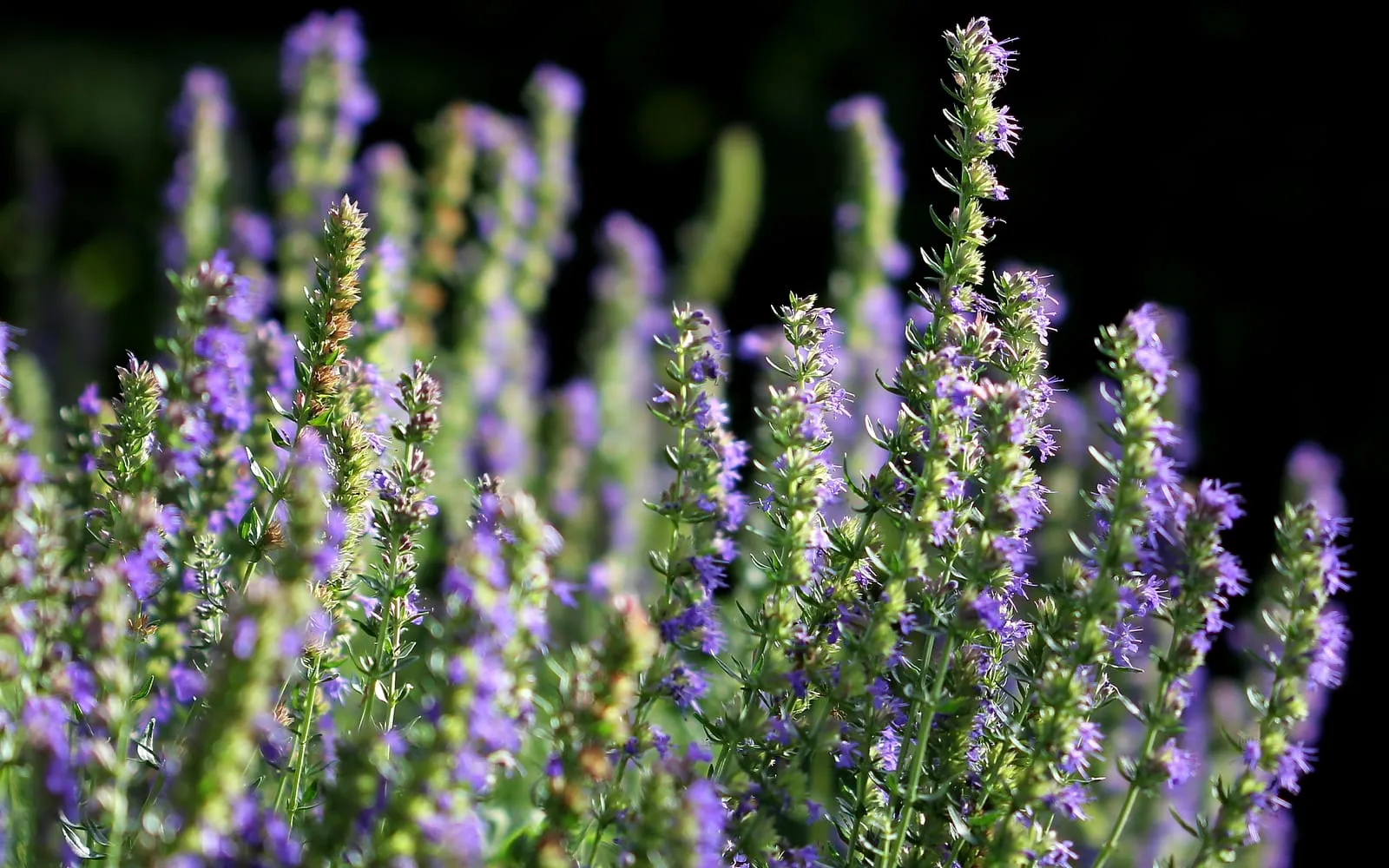
Flowers are the reason to grow it. Deep blue-violet, two-lipped, packed into one-sided spikes at the tips of the shoots from July to September. Pink and white forms are sold and neither is as good as the blue.
Stems are square, hairy, and woody at the base from the second year.
The scent is sharp, camphorous and slightly bitter, closer to sage or rosemary than to a sweet herb.
The plant makes a neat narrow column rather than a dome, which is why it was used for low hedging in knot gardens and still works clipped in a formal herb bed.
Where it is from
Hyssop is native to southern Europe, the Middle East and central Asia, growing on dry rocky slopes and limestone screes.
It has been cultivated for at least two thousand years for medicine and for flavouring, and it was one of the standard monastery garden plants across medieval Europe.
The biblical hyssop is probably a different plant. Scholarly opinion mostly favours Syrian oregano, Origanum syriacum, which grows in the right places and has the right form for the uses described, whereas Hyssopus officinalis is scarce in the region. The name transferred anyway, and it has stuck for centuries.
Britain grew it from at least the fourteenth century. Tudor knot gardens used clipped hyssop as a low hedge, and it survived in cottage gardens long after its medicinal use faded.
The liqueur trade keeps it commercially relevant. Hyssop is among the herbs in Chartreuse and Benedictine and it appears in absinthe recipes, which is a larger market for it now than any kitchen.
How it grows
Sow indoors in March or April at around 18 deg C. Surface sow and press the seed in without covering it, since it germinates better in light. Expect two to three weeks.
Cuttings are quicker for a named form. Take softwood cuttings in June or semi-ripe cuttings in August, both of which root easily.
Plant out in late spring into full sun and free-draining soil. Space at 30 to 45 cm, or 25 cm for a clipped hedge.
Pinch young plants to make them branch. An unpinched plant makes one thin column.
Cut back by a third in spring once growth starts. Do not cut into old bare wood, because the plant will not reliably break from it.
Trim off spent flower spikes to extend the flowering and to reduce self-seeding, which is generous in gravel.
Harvest leaves before flowering for the strongest flavour and flowers as they open. Both dry well.
Replace the plant after five or six years, when the base has gone bare.
Through the seasons
Winter keeps some leaf in a mild year and loses it in a hard one. Leave the old stems standing, since they protect the crown, and keep mulch off the base.
Spring brings new shoots in April. Cut back by a third then, into green growth, and take out any dead wood.
Early summer is growth and cuttings. The plant fills out fast once the soil warms.
Midsummer to early autumn is the flowering season, from July to September, and the plant works for pollinators the whole time. Deadhead to keep it going.
Autumn needs nothing. Leave the plant standing rather than cutting it down, and clear leaf litter off the crown.
Care difficulty
Easy in a dry sunny position and short-lived in a damp one.
Drainage matters more than cold. Hyssop takes -20 deg C on stony ground and rots at the crown in cold cold wet clay. Grit, a raised bed or a gravel garden solves it.
Pruning follows the same rule as lavender, rosemary and the savories: cut into green growth in spring, never into bare old wood. A stem pruned into old wood usually dies.
The plant needs no feeding, no staking and almost no watering once established, which makes it one of the lowest-maintenance edible plants here.
Self-seeding is worth watching in gravel. Seedlings come up freely and are easy to pull, though a neglected gravel bed will end up with a hundred of them.
Age is the eventual limit. Take cuttings in year four so a replacement is ready when the parent goes bare.
Watering
Water new plants weekly through their first summer. After that, nothing.
An established hyssop in the ground needs no watering in an ordinary year. The roots go deep and the plant evolved on ground that dries out for months.
Water a container weekly in high summer and let it dry between times. Terracotta suits it.
Water at the base in the morning if you water at all. Wet foliage in still weather brings mildew.
Never leave a pot standing in a saucer, and keep the ground around the crown free of anything that holds moisture.
Keep it dry from September so it goes into winter with dry roots.
Warning signs, diseases and pests
Root and crown rot in wet ground is the main risk. The plant blackens at the base and fails to shoot in spring, and nothing treats it. Improve drainage before replanting.
Powdery mildew whitens the foliage of a crowded plant in humid still weather. Thin the stems and cut the affected growth away.
Aphids gather on flowering spikes in early summer. Rub them off rather than spraying a plant covered in bees.
Bare woody stems with growth only at the tips mean the plant is old or was never trimmed. Cut into green growth in spring, or replace it.
A stem that dies after being cut into old wood is the plant behaving normally rather than a disease.
Leggy growth leaning towards the light means too much shade.
Plants dying out in the centre of a clipped hedge usually means the hedge was clipped too hard into bare wood.
Growing environment
Full sun. Hyssop in shade is thin, leaning and shy of flowering.
Free-draining soil, poor to moderate. It does not want a rich bed, and rich ground shortens its life.
Neutral to alkaline, around pH 6.5 to 8. It is a limestone plant and thrives on chalk.
A gravel bed, a raised bed, a bank or a wall top all suit it. So does the front of a dry sunny border with lavender and thyme.
Shelter is not needed. The stems are stiff and stand up to wind.
It is one of the best plants in this collection for pollinators. Bees, hoverflies and butterflies all work it, and the long flowering season from July to September covers a period when many gardens run short of nectar.
Feeding
None in the ground. A hyssop grown lean is longer lived, better shaped and more aromatic than one that has been fed.
Do not mulch with compost or manure against the crown. It holds moisture where the plant cannot take it.
Grit or gravel is the right surface mulch, keeping the base dry and reflecting heat.
A container plant takes a weak balanced feed once in May and needs nothing else for the year.
Repot into fresh gritty compost every second or third spring instead of feeding an old pot harder.
Troubleshooting
It died over the winter. Wet at the crown rather than cold. Replant into gravel, a raised bed or a pot.
I cut it back hard and half of it died. Hyssop does not break from old bare wood. Prune into green growth only.
Seedlings everywhere. It self-seeds freely in gravel. Deadhead after flowering, and hoe the seedlings off while they are small.
It tastes bitter. It is a bitter herb, and that is what it is for. Use small amounts with fatty meat or pulses rather than treating it like a soft herb.
No flowers. Too much shade, or too much feeding. It flowers on poor soil in full sun.
Is this the hyssop of the Bible? Probably not. Most scholarship points at Syrian oregano instead. The name transferred and stayed.
Is it safe to eat? In the amounts a kitchen uses, yes. The essential oil is a different matter and should not be taken by mouth, particularly by anyone with epilepsy or during pregnancy.