
Outdoor plant
Cultivated Tobacco
Nicotiana tabacum
Also known as Common tobacco, Virginia tobacco, Tabac, Tabaco
How to identify cultivated tobacco, Nicotiana tabacum. Leaf and flower features, differences from ornamental Nicotiana and the limits of safe identification advice.
At a glance
- Difficulty
- Easy
- Light
- Full sun
- Temperature
- 20-30 deg C, and it is killed by frost
- Hardiness
- USDA 8-11, RHS H2, hardy to 10 C
- Type
- Tender annual, or a short-lived perennial where it is frost free
- Height
- 1-2 m
- Native to
- the Andes, Bolivia, northern Argentina
It needs three to four frost-free months and warm nights, and the leaf is worthless without curing, which is a controlled process of heat and humidity rather than drying. Flue-curing, air-curing and fire-curing each produce a different tobacco from the same leaf. Growing it for personal use is legal in most countries, including Britain and the United States, and selling or processing it commercially is not without a licence and duty.
Hardiness zones describe winter cold alone. Summer heat, humidity, rainfall and the length of the growing season decide as much, so treat the range as the outer limit rather than as a recommendation.
Poisonous if eaten
- Do not eat
- Every part, and the leaves most of all, because of nicotine
- Harm from
- Eating it and handling it
- Affects
- People, cats, dogs and horses
Nicotine is a fast-acting poison and the plant is full of it. Eating leaf material causes nausea, vomiting, sweating, a racing then slowing heart, confusion and, in enough quantity, seizures and respiratory failure. Small children and pets are at risk from surprisingly little, and cigarettes, cigarette butts, nicotine pouches, patches and vaping liquid are all common causes of poisoning in dogs. Any suspected ingestion by a child or an animal is an emergency. Get medical help, or a vet for an animal, without delay. Nicotine also passes through intact skin. Green tobacco sickness is an occupational illness of field workers who handle wet leaves, producing nausea, dizziness, headache and vomiting from skin absorption alone, and gloves are what prevents it. The health harm from smoking is separate and larger. WHO attributes over eight million deaths a year worldwide to tobacco, including around a million from second-hand smoke, and tobacco use is the leading preventable cause of death in most countries that measure it. The RHS lists Nicotiana as harmful if eaten and the ASPCA lists the genus as toxic to cats, dogs and horses.
Sources: WHO fact sheet on tobacco, RHS potentially harmful garden plants, ASPCA toxic and non-toxic plants
About
Nicotiana tabacum is the plant behind the most damaging legal crop in the world. It is a tall soft-leaved annual in the nightshade family, sticky to the touch, with pink trumpet flowers, and it has never been found growing wild anywhere. Every plant is descended from cultivated stock, and the species appears to be an ancient hybrid of two South American wild tobaccos.
Raychis does not recommend growing tobacco, and cultivation is restricted or regulated in many jurisdictions. Some countries permit small-scale growing for personal use and prohibit any processing or sale, some licence the crop, some tax it at the point of manufacture, and some ban it outright. The rules differ by country and often by region. Check the position where you live rather than assuming.
This page identifies the plant and stops there. Sowing, growing, topping, suckering, harvesting, curing, ageing and use are all absent from it.
Appearance and character
An upright annual with a single stout stem, 1 to 2 m tall, covered in fine sticky glandular hairs that leave a resinous smell on the hands.
Leaves are the first thing anyone notices. They are enormous, 30 to 60 cm long and sometimes more, broadly oval to lance-shaped, pale to mid green, soft, and carried alternately with the bases running down the stem.
Leaf surfaces are sticky with glandular hairs, and the whole plant smells sharp and green when handled.
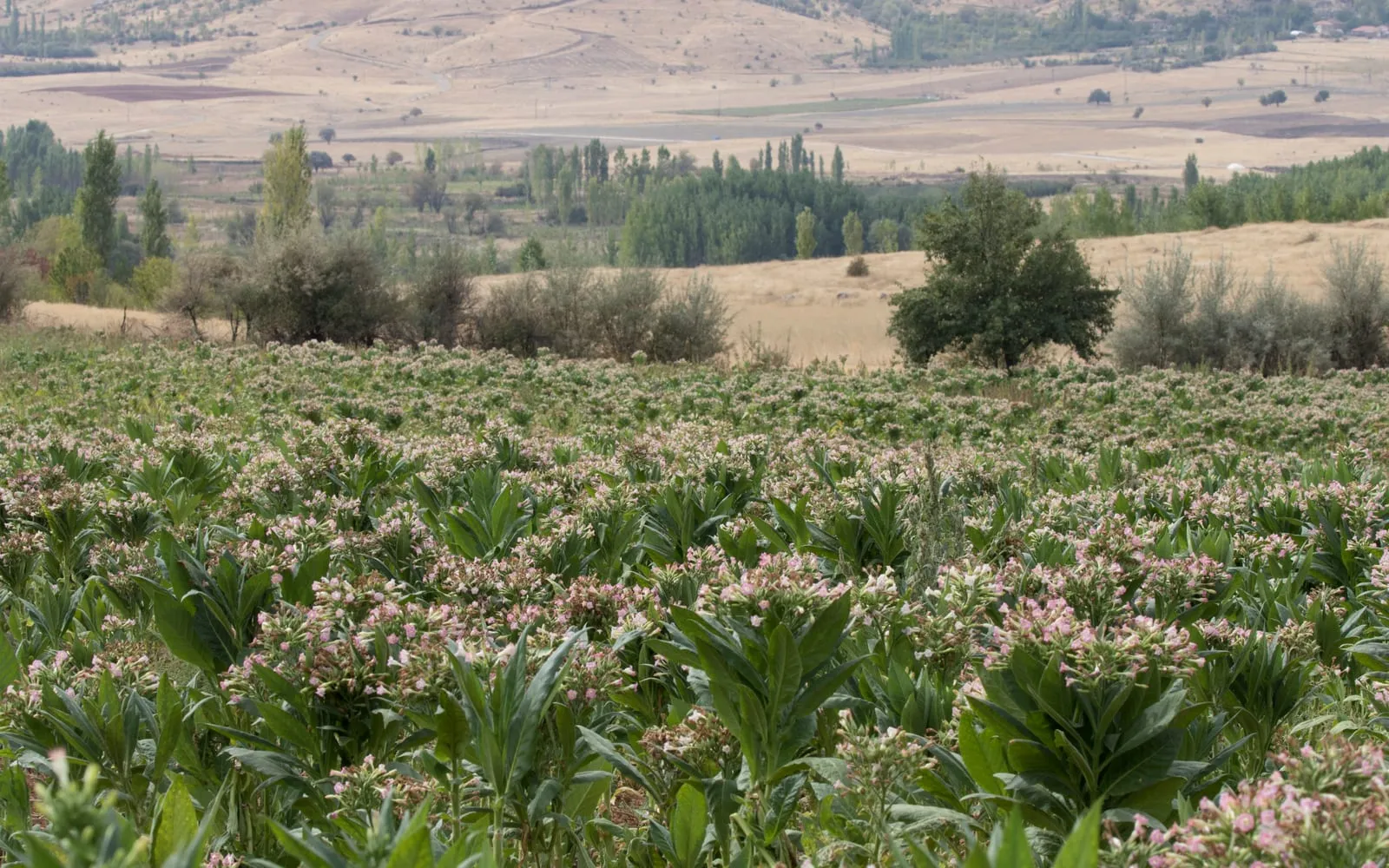
Flowers come in a branched cluster at the top of the stem. Each is a slender trumpet 4 to 5 cm long, pink to pale rose, flaring into five pointed lobes.
The flowers open in the day and have little scent, which separates them from the white night-scented ornamentals in the same genus.
Fruit is a small dry capsule holding an enormous number of extremely fine seeds, so small that a single plant produces hundreds of thousands.
Roots are shallow and fibrous.
Nicotiana rustica, the other cultivated species, is shorter, with rounder leaves and yellow-green flowers, and is a separate plant covered in its own guide.
Where it is from
Nicotiana tabacum is a hybrid of two wild South American species, most likely Nicotiana sylvestris and a member of the Nicotiana tomentosa group, and the cross happened in the Andes of Bolivia and northern Argentina.
The plant has never been found wild. It exists only in cultivation, which makes it one of a small number of crops with no natural population anywhere.
American peoples across two continents used tobacco long before European contact, in ceremony, medicine and trade, and the practices attached to it were elaborate and various.
Columbus’s crews carried it back to Europe in the 1490s, and it spread through Spanish and Portuguese trade to Africa, India, China and Japan within a century.
Virginia planted it commercially from 1612, and the crop shaped the colonial economy of the American south and the enslavement that supported it.
China is now by far the largest producer, followed by India, Brazil, Zimbabwe and the United States.
How it grows in the wild
Tobacco does not grow in the wild. Nicotiana tabacum exists only in cultivation and no natural population has ever been found, which is unusual even among long-domesticated crops.
Escapes occur near where it is grown, on disturbed ground and field margins, and they rarely persist for more than a season or two.
The plant germinates from extremely fine seed that needs light to do so, which is why it is surface-sown rather than buried wherever it is raised.
Growth is rapid through warm weather, and the plant runs up to flower within three or four months of germination.
Flowering is triggered by maturity rather than by day length in most cultivars.
Frost kills it outright, and it behaves as an annual everywhere it is grown outside the tropics.
Its wild relatives are Andean plants of dry rocky ground, and they retain the nicotine chemistry that the plant evolved as an insecticide.
Through the seasons
Spring is when seed germinates on the surface of warm soil, needing light rather than depth.
Early summer is rapid leaf growth, with the plant putting on most of its bulk in a few weeks.
Midsummer is when the leaves reach full size and the plant approaches its final height.
Late summer brings the terminal flower cluster, with pink trumpets opening over several weeks.
Early autumn is seed set, with each capsule holding thousands of very fine seeds.
The first frost kills the plant outright.
Winter leaves nothing above ground, and any seed that shed will germinate the following spring if it lands somewhere open.
Where you will see it
Tobacco fields across China, India, Brazil, Zimbabwe, Turkey and the American south east, which are the main producing regions.
Southern European gardens and smallholdings, where small plantings for personal use are a long tradition in parts of Italy, Greece and the Balkans.
Botanic gardens and teaching collections, where it is grown as a historically important crop and as the plant on which tobacco mosaic virus was first described.
Occasional garden borders in Britain, where seed is sold and the plant is grown as a tall foliage annual rather than for its leaves.
Disturbed ground near where it has been grown, as a short-lived escape.
Look-alikes and confusion
Ornamental Nicotiana is the usual confusion, and it runs both ways. Nicotiana alata and Nicotiana sylvestris are widely grown for their scent, and both are in the same genus with the same nicotine chemistry.
Nicotiana sylvestris is the closest in appearance, being tall with very large leaves, and it carries drooping white tubular flowers rather than pink ones.
Nicotiana alata is smaller with white, green or red flowers that open in the evening and are strongly scented, which cultivated tobacco is not.
Nicotiana rustica is shorter and coarser with rounded leaves and yellow-green flowers, and it is a different species with its own guide.
Comfrey, Symphytum officinale, is mistaken for it at the rosette stage, having large coarse hairy leaves. Comfrey’s leaves are rougher and bristly rather than sticky, and its flowers are bell-shaped and nodding.
Foxglove rosettes cause the same confusion in spring, and foxglove leaves are softly downy and grey-green with a wrinkled surface.
The reliable characters are sticky glandular hairs over the whole plant, very large leaves running down the stem, and pink day-opening trumpet flowers with little scent.
Growing it is restricted
Raychis does not recommend growing tobacco, and cultivation is restricted or regulated in many jurisdictions.
The rules take different shapes in different places. Some countries permit growing a small number of plants for personal use while prohibiting any sale or processing, some require registration or a licence for any planting, some regulate at the point of manufacture through excise duty rather than at the plant, and some prohibit cultivation altogether.
Regional rules within a country are common, and the position changes.
Nothing on this page is a statement about the law where you live. Look up your own jurisdiction before planting anything, and be aware that legal cultivation and legal processing are separate questions in many places.
This site does not describe sowing, growing, topping, suckering, harvesting, drying, curing, ageing, blending or any use of the leaf. Those sections are absent by decision rather than by oversight.
If you find one growing
A tobacco plant in a temperate garden is far more likely to have been planted deliberately as an ornamental than to be anything else, since seed is sold and the plant is handsome.
Where local rules require registration or removal, follow the position that applies where you are rather than the position described anywhere online.
Keep it away from children and animals. Nicotine is a fast-acting poison and the leaves carry a great deal of it, and a child or a dog chewing a leaf is a medical emergency.
Wear gloves if you handle wet foliage. Nicotine crosses intact skin, and green tobacco sickness is a recognised occupational illness among field workers.
Do not burn the foliage where anyone will breathe the smoke.
Compost or dispose of removed plants in line with local rules, and wash your hands afterwards.
Troubleshooting
Will this page tell me how to grow or cure tobacco? No. Raychis publishes identification and botany for this plant and nothing about growing, harvesting, curing or use.
Is it legal to grow tobacco? It depends entirely on where you are. Some places allow a few plants for personal use, some require a licence, some regulate the manufacture rather than the plant, and some prohibit it. Look up your own jurisdiction.
Is the ornamental Nicotiana in my border the same thing? Not the same species, and the same genus and the same chemistry. Nicotiana alata and Nicotiana sylvestris are widely sold as scented annuals and are toxic in the same way.
Is it dangerous to my dog? Yes, severely. Nicotine is fast-acting and small amounts matter. Cigarette butts, pouches, patches and vaping liquid are the common causes, and any suspected ingestion needs a vet immediately.
What is green tobacco sickness? Nicotine poisoning through the skin from handling wet leaves, causing nausea, dizziness, headache and vomiting. It is an occupational illness of field workers and gloves prevent it.
Why is it in the app? Because people photograph it and want to know what it is. Identification and endorsement are different things.
Why has it never been found wild? Because it is an ancient hybrid that arose in cultivation. Nicotiana tabacum exists only where people have grown it, and no natural population is known.
What is tobacco mosaic virus? The first virus ever described, isolated from this plant in the 1890s, and still a standard organism in plant pathology. It is the reason tobacco appears in biology textbooks.
How do I tell it from Nicotiana rustica? Height and flower colour. Cultivated tobacco is taller, with pink trumpet flowers and long pointed leaves whose bases run down the stem. Nicotiana rustica is shorter and coarser, with rounded stalked leaves and dull yellow-green flowers.
Cultivated Tobacco problem guides
Not sure what is wrong? See the common vegetable pests guide.