
Outdoor plant
Perennial Pepperweed
Lepidium latifolium
Also known as Dittander, Broadleaved pepperweed, Tall whitetop, Peppergrass
How to grow perennial pepperweed, Lepidium latifolium. A British salt-marsh native that seasoned food before pepper was affordable, and a listed noxious weed across the western United States.
At a glance
- Difficulty
- Easy
- Water
- None. It survives drought and flooding alike
- Light
- Full sun
- Temperature
- Fully hardy, to about -30 deg C
- Hardiness
- USDA 4-9, RHS H7, hardy to -30 C
- Type
- Vigorous rhizomatous perennial
- Height
- 60-150 cm
- Native to
- southern Europe, western Asia, and native to British coasts
Salt, drought, flooding and any winter are all taken, which is exactly why it has become a problem where it is not native. It is a listed noxious weed across California, Oregon, Washington, Nevada, Idaho and much of the American west, where it takes over wetland and riparian ground, and it is regulated in parts of Canada and Australia. On its native western European coasts it is a scarce salt-marsh plant instead.
Hardiness zones describe winter cold alone. Summer heat, humidity, rainfall and the length of the growing season decide as much, so treat the range as the outer limit rather than as a recommendation.
Edible, with limits
- Safe to eat
- The young leaves and the root, both used historically as a hot seasoning
- Do not eat
- Large quantities of the green plant, for grazing animals
- Harm from
- Eating it
- Affects
- People and horses
Perennial pepperweed is not poisonous and was eaten in Britain for centuries as dittander, a hot pungent seasoning used before black pepper became affordable. The pungency comes from glucosinolates that release isothiocyanates when the tissue is crushed, the same chemistry that makes horseradish and mustard hot. Those compounds irritate the mouth and gut in quantity, and they are the reason the plant is a seasoning rather than a vegetable. As with other brassicas, large amounts of the green plant in a grazing ration risk goitre and digestive upset in livestock, and the plant accumulates salt in its leaves, which it deposits on the soil surface as the leaves die. The more serious issue with this species is not toxicity at all. It is a listed noxious weed across much of the western United States, where it displaces native marsh and meadow vegetation, and it should not be planted where it can escape.
Sources: RHS on potentially harmful garden plants, British Horse Society on poisonous plants
About
Perennial pepperweed is a British native with two reputations. On the salt marshes and sea walls of southern and eastern England it is a scarce coastal plant of no particular concern. In the western United States, where it was introduced with contaminated seed in the early twentieth century, it is a listed noxious weed that has taken over river margins, irrigated meadows and wetlands across several states.
Before that it had a kitchen. Dittander was the hot seasoning of English cooking before black pepper became widely affordable, and the leaves and root were used much as horseradish is. Gerard and Culpeper both describe it, and it persists in old garden sites and hedge banks where it was once grown.
The plant’s power comes from below ground. A deep, thick, brittle rhizome system spreads laterally, regenerates from small fragments, and survives cutting, flooding, drought and salt. Anyone planting it needs to understand that first.
Appearance and character
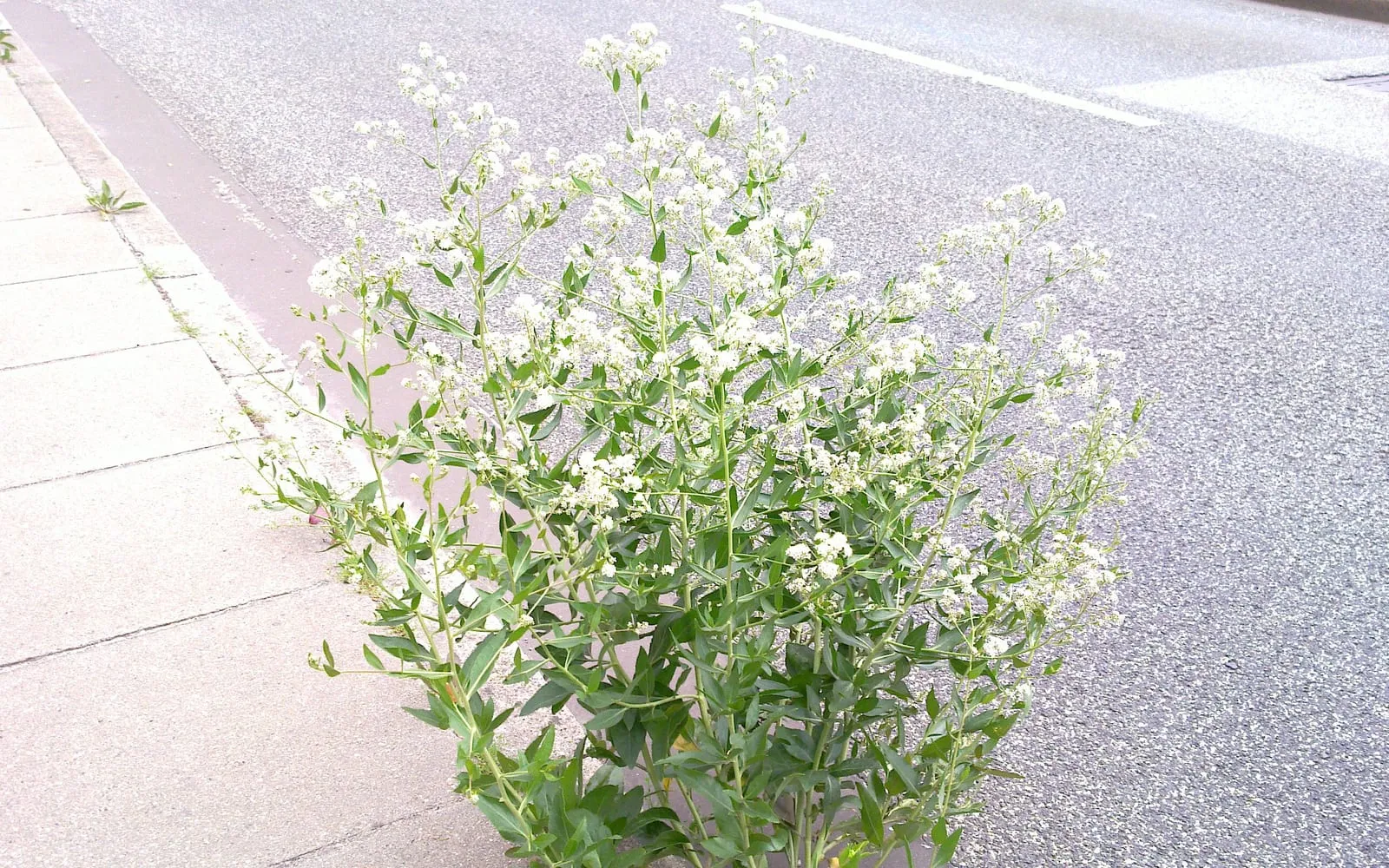
The plant sends up stout leafy stems, waist to chest high, from a spreading root system. The basal leaves are large, up to 30 cm, oval and long-stalked with toothed margins, and they wither as the stems rise. The stem leaves are smaller, narrower and stalkless, and they do not clasp the stem, which separates this species from several relatives.
The flowers are tiny white four-petalled brassica flowers packed into dense branched heads at the top of the plant, and a stand in flower reads as a cloud of white from a distance. The American name tall whitetop comes from that.
The seed pods are minute, round and flattened, about 2 mm across, held in the same dense heads. A single plant produces enormous numbers of them, and they are carried on water and on machinery.
Where it is from
Lepidium latifolium is native to southern Europe, western and central Asia, and it reaches its northern limit on British coasts, where it grows on salt marshes, sea walls, ditch banks and brackish ground in southern and eastern England.
Its inland occurrences in Britain are mostly relics of cultivation, since the plant was grown in gardens as dittander for centuries and persists where it was once planted.
It was introduced to North America around 1900, probably in contaminated sugar beet seed, and spread rapidly through irrigated and riparian systems in California, Nevada, Utah and beyond. It is now listed as a noxious weed in several western states and is the subject of substantial control programmes.
How it grows
The plant grows from a deep, extensive, brittle rhizome system that stores carbohydrate and sends up new shoots along its length. Fragments as small as a few centimetres regenerate into new plants, which is why cultivation spreads it rather than controlling it.
Shoots emerge in spring, the stems extend rapidly through May, and the plant flowers in June and July, producing very large quantities of seed.
It tolerates salinity that kills most vegetation, and it takes salt up into its leaves and deposits it on the soil surface as they die, which changes the ground in its own favour and works against the plants around it.
After flowering the stems die back, and the plant regrows from the rhizome the following year. Established stands persist indefinitely.
Through the seasons
Shoots appear in March and April, and the basal leaves are at their best for picking then, before the stems rise.
The stems extend through May and the plant flowers in June and July, holding its white heads for several weeks.
Seed ripens through August and the stems die back in autumn. The root remains active below ground, and this is the season in which any attempt at control has the best chance, since the plant is moving reserves downward.
Care difficulty
Growing it is easy to the point of being a warning. The plant tolerates drought, flooding, salt, alkalinity, cutting and neglect, and it spreads through a rhizome system that regenerates from fragments.
The difficulty is containing it. Do not plant it in open ground unless you are prepared for it to spread and are certain it cannot reach a watercourse. A large container sunk in the ground, or a deep root barrier, is the only sensible approach in a garden.
Digging is not control. Every fragment left behind starts a new plant, and a single season of rotavating a patch will multiply it. If a stand has to go, cut it repeatedly through the growing season to exhaust the root, and expect it to take years.
Watering
None required. The plant is drought tolerant and flood tolerant in equal measure, which is a large part of why it is such a successful invader of river margins and irrigated land.
An established stand needs no attention of any kind in a temperate garden.
Its salt tolerance is the more unusual property. It grows on salt marsh and in saline irrigated soils that would kill almost anything else, and it concentrates salt in its leaves as it does so.
Warning signs, diseases and pests
Nothing much troubles it, which is part of the problem. The plant carries the usual brassica pests without being noticeably damaged by them.
Flea beetle shot-holes the young leaves in spring, cabbage white caterpillars graze them, and aphids gather on the flower heads. None of it slows the plant.
Powdery mildew appears late in the season on crowded stems and arrives too late to matter.
The warning sign worth watching for is the plant appearing several metres from where it was planted. That is the rhizome, and it means containment has failed.
Growing environment
Full sun and almost any soil. The plant grows on clay, sand, chalk, salt marsh, disturbed ground and irrigated meadow, from acid to strongly alkaline, wet or dry.
Its natural British habitat is coastal, on salt marshes, sea walls and brackish ditch banks in the south and east. That is where it belongs and where it causes no trouble.
Anywhere else, the environment to think about is the one downstream. Seed travels on water and root fragments travel on boots and tools, and the American experience shows what happens when a plant with this root system reaches a river system that suits it.
Feeding
Feed nothing. The plant is vigorous enough without help, and fertility produces a larger stand rather than a better one.
If it is being grown deliberately for the leaves, ordinary garden soil produces more than anyone will use from a single plant.
The plant does its own soil chemistry, drawing salt up into the leaves and depositing it at the surface as they decay, which alters the ground around it over time.
Troubleshooting
What is dittander? The old English name for this plant, used as a hot seasoning before black pepper became affordable. The leaves and root were used much as horseradish is, and Gerard and Culpeper both describe it.
Is it a British native? Yes, on the coast. It grows on salt marshes, sea walls and brackish ditch banks in southern and eastern England. Inland records are mostly relics of garden cultivation.
Should I plant it? Only in a container or behind a deep root barrier, and never where it can reach a watercourse. It spreads by rhizome, regenerates from fragments, and is a listed noxious weed across much of the western United States.
How do I get rid of it? Not by digging, which multiplies it from root fragments. Repeated cutting through the growing season to exhaust the rhizome is the approach that works, and it takes several years.
What does it taste like? Hot and pungent, like a coarse horseradish, from the same class of compounds. It is a seasoning rather than a vegetable, and a little of it goes a long way.
Why is it called tall whitetop in America? For the dense flat-topped clouds of tiny white flowers that a stand carries in early summer, which is how it is spotted in the field there.
Can livestock eat it? In small amounts as part of a mixed ration. Large quantities of any brassica risk goitre and digestive upset, and this one also concentrates salt in its leaves.
How is it different from garden cress? Same genus, different plant. Garden cress is Lepidium sativum, a small fast annual grown on windowsills. This is a large invasive perennial with a rhizome system.
Perennial Pepperweed problem guides
Not sure what is wrong? See the common vegetable pests guide.