
Outdoor plant
Sunn Hemp
Crotalaria juncea
Also known as Indian hemp, Madras hemp, Brown hemp, San
How to grow sunn hemp, Crotalaria juncea. A fast nitrogen-fixing green manure with a fibre history, the rattling pods that name the genus, and why it is never grazed.
At a glance
- Difficulty
- Moderate
- Water
- Once a week, and it tolerates drought well
- Light
- Full sun
- Temperature
- 20-30 deg C, and it stops below 12
- Humidity
- Moderate
- Hardiness
- USDA 9-11, RHS H2, hardy to 10 C
- Type
- Tender annual legume
- Height
- 1-3 m
- Native to
- India, South Asia
- Best month
- May and June in the Northern Hemisphere, November and December in the Southern Hemisphere
A tropical legume grown as a green manure rather than for a harvest, and it fixes nitrogen fast, suppresses root-knot nematodes and produces a large amount of biomass in eight to twelve weeks. It is a short-day plant, so it flowers late or not at all at high latitude, which does not matter when the point is the green material. Soil needs about 20 C to sow and frost ends it.
Hardiness zones describe winter cold alone. Summer heat, humidity, rainfall and the length of the growing season decide as much, so treat the range as the outer limit rather than as a recommendation.
Every month named in this guide is for the temperate Northern Hemisphere. If you garden in the Southern Hemisphere, shift each one by six months, so May becomes November. Closer to the equator the wet and dry seasons matter more than the calendar, and the shift stops being a useful guide.
Toxic if eaten
- Do not eat
- The seeds above all, and the foliage, because of pyrrolizidine alkaloids
- Harm from
- Eating it
- Affects
- People, horses, cats and dogs
Sunn hemp is a green manure and a fibre plant rather than a food, and the reason is chemical. Crotalaria species contain pyrrolizidine alkaloids, which cause cumulative and irreversible liver damage, and horses are especially susceptible. The seeds carry the highest concentration and cases of poisoning in horses, cattle and poultry are recorded from seed contamination of feed. Crotalaria juncea carries less than several of its relatives, and some cultivars are used as forage under controlled conditions, which is a decision for an agronomist rather than a gardener. The safe position in a garden is that no part of the plant is food for people or animals. Do not let horses graze it, do not feed the seed to poultry, and clear the pods before they shed if you keep livestock. EFSA treats pyrrolizidine alkaloids as a contaminant of concern in food and feed. Neither the RHS nor the ASPCA lists this species by name, and the ASPCA lists other Crotalaria species as toxic.
Sources: EFSA scientific opinion on pyrrolizidine alkaloids in food and feed, RHS potentially harmful garden plants, ASPCA toxic and non-toxic plants
About
Sunn hemp is one of the fastest green manures there is. Sown into warm soil it puts on 2 m in eight or nine weeks, fixes a substantial amount of nitrogen, smothers weeds, breaks up compaction with a strong taproot, and suppresses root-knot nematode. American and Indian growers use it between cash crops for exactly that list.
It shares a common name with hemp and nothing else. Crotalaria juncea is a legume, related to broom and gorse rather than to Cannabis, and the name records that both plants were once retted for cordage. Indian rope, fishing net, paper and cigarette paper were all made from sunn fibre.
The genus name is the sound it makes. Crotalaria comes from the Greek for a rattle, after the inflated pods, in which the ripe seeds come loose and rattle when the plant is shaken.
None of it is food. Pyrrolizidine alkaloids in the seeds and foliage cause cumulative liver damage, and the plant is grown to be dug in rather than eaten.
Appearance and character
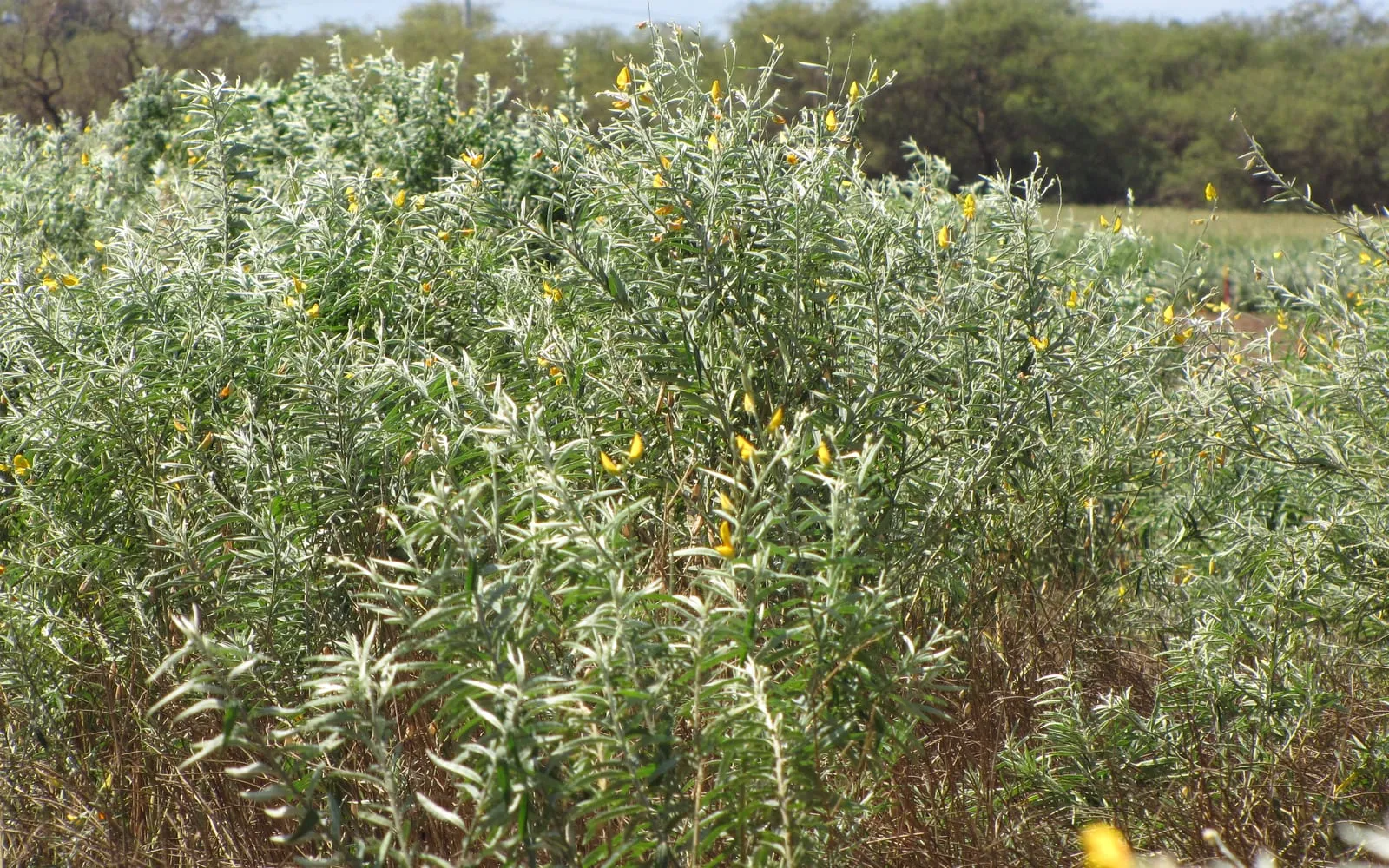
An upright annual legume, 1 to 3 m tall, branching lightly, with a ribbed green stem covered in fine down.
Leaves are simple rather than trifoliate, which is unusual in a legume. Each is narrow and oblong, 4 to 12 cm long, mid green, downy beneath, on a short stalk.
Flowers are bright deep yellow pea flowers, 2 to 3 cm, in loose upright racemes at the shoot tips, and a field in flower is a strong sight.
Pods are the identification. Each is inflated and cylindrical, 3 to 5 cm long, covered in short brown down, turning almost black when ripe, holding six to twelve dark heart-shaped seeds that come loose and rattle.
The root system is strong, with a deep taproot and heavy nodulation by nitrogen-fixing bacteria.
The stem yields a bast fibre similar to jute but stronger and more resistant to rotting in water, which is why it made fishing nets.
Where it is from
Crotalaria juncea comes from India, where it has been cultivated for fibre for several thousand years and where no wild population is known.
Indian use covered cordage, sacking, fishing net, canvas and paper, and sunn fibre was traded westwards through the ancient world.
The cigarette paper industry took it up in the twentieth century, since sunn fibre gives a thin strong paper.
Brazil, the southern United States and much of Africa now grow it as a cover crop and green manure rather than for fibre, and cultivars have been selected for biomass and low seed set rather than for stem quality.
Britain has almost no tradition of growing it, and it appears here in green manure seed mixes for polytunnels and warm-season cover.
How it grows
Sow in late May or June once the soil is warm, at 20 deg C or above. Cold soil gives poor patchy germination.
Broadcast or drill at about 3 g per square metre for a green manure stand, 2 cm deep, and rake in.
Inoculated seed nodulates better on ground that has not grown Crotalaria before, though it will manage without.
Water it in and then leave it. The plant is drought-tolerant once it is up.
Feed nothing, since it is fixing its own nitrogen and a fed plant does less of it.
Cut or dig in at flowering, which is around eight to ten weeks from sowing, and which is the point of maximum nitrogen and minimum lignin.
Chop the top growth before digging it in, since a 2 m stem is hard to incorporate whole.
Do not let it set seed if livestock or poultry have any access to the ground.
For fibre, cut at flowering, ret the stems in water for one to two weeks, then strip and wash the fibre in the same way as jute.
Frost kills it, so a British stand finishes in October regardless.
Through the seasons
Late May and June are for sowing into warm soil, and sowing earlier wastes seed.
July is rapid growth, and the stand closes over and smothers weeds.
August brings flowering at about eight to ten weeks, which is the moment to cut it.
Late August or September is digging in, which is the whole purpose of the crop.
September is also the retting month if fibre is what you are after.
October kills any plant left standing, at the first frost.
Winter is nothing. The nitrogen is in the soil and the ground is ready for the next crop.
Care difficulty
Moderate, and the difficulty is entirely about timing in a short season.
It needs warm soil to germinate, which means late May at the earliest.
Growth after that is fast and untroubled, and it asks for nothing.
The window between sowing and digging in is short, and a stand left past flowering goes woody and takes far longer to break down.
Seed set is a management problem where there are animals.
Nothing about the plant itself is fragile once the soil is warm.
Watering
Water the seed in at sowing.
Water once a week through establishment.
Leave it alone after that, since it is drought-tolerant and deep-rooted.
Water in a prolonged dry spell if growth stalls.
Avoid waterlogging, which the taproot will not tolerate.
Nothing is needed once the crop is cut and dug in.
Warning signs, diseases and pests
Patchy germination usually means the soil was too cold at sowing.
Seedlings collapsing at soil level are damping off in cold wet ground.
Grazed seedlings are slugs.
Curled tips with sticky residue are aphids.
Wilting in wet ground is root rot.
Woody stems that resist chopping mean the stand was left past flowering, and it will take months rather than weeks to break down.
Pods rattling means seed is ripe and about to shed, which is the point to clear it if animals have access.
Poor nodulation, shown by pale growth and no pink nodules on the roots, means the soil lacks the right rhizobia.
Growing environment
An open sunny bed outdoors in a warm summer, or a polytunnel border between crops.
Full sun.
Light free-draining soil, and poor ground is fine.
Minimum 12 deg C, with 20 to 30 deg C for growth.
Warm soil at sowing, which in Britain means late May onwards.
Room for a stand 2 m tall.
No livestock or poultry access to the ground while it is seeding.
Feeding
Feed nothing at any point.
Skip manure and fertiliser entirely, since a fed legume fixes less nitrogen.
Inoculate the seed with rhizobia if the ground has never grown Crotalaria.
Let the crop feed the soil rather than the other way around.
Chop and dig the top growth in at flowering, which is when the nitrogen is highest.
Follow it with a hungry crop, which is what the nitrogen is for.
Troubleshooting
Is this the same as hemp? No. Sunn hemp is Crotalaria juncea, a legume related to broom and gorse. Hemp is Cannabis sativa. They share a name because both were retted for cordage, and nothing else.
Can I feed it to animals? No. Crotalaria species contain pyrrolizidine alkaloids that cause cumulative liver damage, and horses are especially susceptible. Some cultivars are used as forage under agronomic supervision, and that is not a garden decision.
When should I dig it in? At flowering, about eight to ten weeks from sowing. Later than that the stems go woody and take months to break down.
How much nitrogen does it fix? A good stand fixes a substantial amount, on the order of what a clover green manure gives in a much longer season. The speed is what makes it useful.
Why is my germination patchy? The soil was too cold. Wait until late May or June in Britain, when the soil is at 20 deg C or above.
What is the rattle? The ripe seeds coming loose in the inflated pods. Crotalaria is named after it, from the Greek for a rattle.
Can I use it for fibre? Yes, and it makes a strong rot-resistant cordage fibre. Cut at flowering, ret for one to two weeks, then strip and wash as you would jute.
Will it survive a temperate winter? No. The first frost kills it, which makes it a summer green manure rather than an overwintering one.
Does it help with nematodes? Yes. Sunn hemp suppresses root-knot nematode populations, which is a large part of why it is used between crops in warm climates.
Sunn Hemp problem guides
Not sure what is wrong? See the common vegetable pests guide.