
Outdoor plant
Wild Tobacco
Nicotiana rustica
Also known as Aztec tobacco, Mapacho, Makhorka, Rustica
How to identify wild tobacco, Nicotiana rustica. The shorter, coarser, far stronger tobacco of the Americas, its ceremonial history, and why the page stops at identification.
At a glance
- Difficulty
- Easy
- Light
- Full sun
- Temperature
- Grows through a temperate summer and is killed by frost
- Hardiness
- USDA 7-11, RHS H2, hardy to 5 C
- Type
- Tender annual
- Height
- 0.5-1.5 m
- Native to
- the Andes, Peru, Ecuador
Nicotiana rustica carries several times the nicotine of the cultivated species and was the tobacco grown across much of the Americas before Nicotiana tabacum displaced it. It is hardier and shorter-season than cultivated tobacco, which is why it reached higher latitudes. Nicotine extracted from it was a garden insecticide for centuries and is now banned as a pesticide across Britain, the European Union and the United States.
Hardiness zones describe winter cold alone. Summer heat, humidity, rainfall and the length of the growing season decide as much, so treat the range as the outer limit rather than as a recommendation.
Poisonous if eaten
- Do not eat
- Every part, and the leaves most of all, at nicotine levels several times those of cultivated tobacco
- Harm from
- Eating it and handling it
- Affects
- People, cats, dogs and horses
Nicotiana rustica carries nicotine at concentrations several times higher than Nicotiana tabacum, reaching figures around nine per cent of leaf dry weight against roughly one to three per cent, which makes it one of the most nicotine-rich plants known. Everything said about tobacco poisoning applies here with a smaller margin. Eating leaf material causes nausea, vomiting, sweating, a racing then slowing heart, confusion, and in enough quantity seizures and respiratory failure, and the quantity needed is small. Suspected ingestion by a child or an animal is an emergency. Get medical help, or a vet for an animal, without delay. Nicotine passes through intact skin, so handling wet foliage without gloves can cause green tobacco sickness. The plant was used historically as a garden insecticide for the same reason, and nicotine is no longer approved as a pesticide in Britain or the European Union. The RHS lists Nicotiana as harmful if eaten and the ASPCA lists the genus as toxic to cats, dogs and horses. WHO's account of the harm from tobacco use applies to this species as much as to the other.
Sources: WHO fact sheet on tobacco, RHS potentially harmful garden plants, ASPCA toxic and non-toxic plants
About
Nicotiana rustica is the other cultivated tobacco, and it is the stronger of the two by a wide margin. Its leaves can carry nicotine at around nine per cent of dry weight against one to three per cent for common tobacco, which makes it one of the most nicotine-rich plants there is.
It is the tobacco of the Americas before the Europeans arrived. Amazonian ceremonial use, the Aztec picietl, and the tobacco of the eastern North American peoples were all this species, and it remains the mapacho of Amazonian shamanism. Russia and Eastern Europe grew it as makhorka.
Raychis does not recommend growing it, and cultivation is restricted or regulated in many jurisdictions in the same way as common tobacco. The rules differ from place to place and change, so look up the position where you live.
This page identifies the plant. It carries nothing about sowing, growing, harvesting, curing or any use, and that is a decision rather than an omission.
Appearance and character
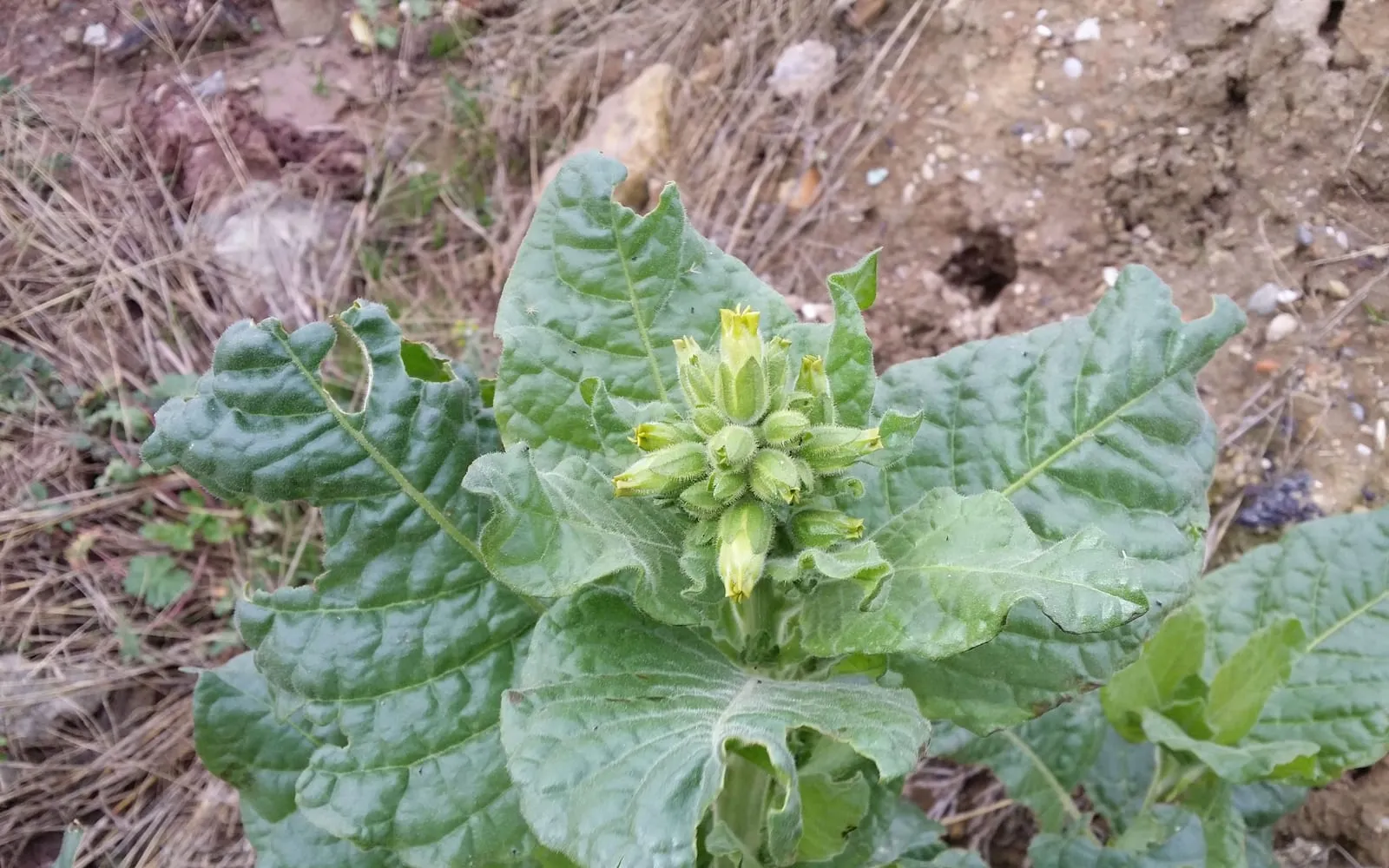
A shorter, coarser annual than common tobacco, usually 50 cm to 1.5 m, branching from lower down the stem.
Stems are stout, sticky with glandular hairs, and often flushed purple at the base.
Leaves are broadly oval to almost round with a blunt tip, 10 to 25 cm long, thick, dark green and distinctly stalked. That stalk is a good separator, since common tobacco’s leaves run down the stem instead.
Leaf surfaces are sticky and the plant has a strong rank smell when brushed.
Flowers are short tubes 1.5 to 2 cm long, greenish yellow to dull yellow, with five shallow rounded lobes, held in a compact cluster at the top of the stem.
Those yellow flowers are the fastest identification. Common tobacco’s are pink and twice as long.
Capsules are rounded and hold the same enormous number of very fine seeds.
The whole plant is stockier, darker and harsher-looking than common tobacco, and noticeably less handsome.
Where it is from
Nicotiana rustica is an ancient hybrid of two Andean wild species, arising in cultivation in Peru and Ecuador, and like common tobacco it has no wild population.
It spread north through the Americas long before European contact, reaching Mexico as picietl and eastern North America as the tobacco of the Iroquois, Cherokee and other nations.
Ceremonial use is its main history. Amazonian communities use it as mapacho, Andean and Mesoamerican traditions used it in ritual, and the sacred pipe traditions of North America involved this species rather than the commercial one.
Europeans took it home first, before common tobacco displaced it, and it was grown across Europe in the sixteenth and seventeenth centuries.
Russia, Ukraine and Poland grew it as makhorka into the twentieth century, and it was the ordinary tobacco of the Soviet Union for decades.
India, Vietnam and parts of Africa still grow it, some of it for nicotine extraction and for insecticide manufacture rather than for smoking.
How it grows in the wild
Like common tobacco, Nicotiana rustica exists only in cultivation and has no known wild population, though it escapes readily and persists longer than its relative.
Escapes appear on disturbed ground, field margins and old cultivation sites, and in warm regions they can naturalise.
Seed is extremely fine and germinates on the soil surface in light, which is why it establishes on bare disturbed ground rather than in turf.
Growth is fast and the plant is hardier and less demanding than common tobacco, tolerating cooler conditions and poorer soil, which is why it was grown at higher latitudes.
It flowers within two or three months of germination and sets seed heavily.
Frost kills it, and the annual cycle ends there.
Its nicotine content is a defence against insect herbivores, and the plant is grazed by very little.
Through the seasons
Spring brings surface germination on bare warm ground.
Early summer is rapid growth, and the plant reaches most of its height quickly.
Midsummer is full leaf, with the thick dark stalked leaves at their largest.
Late summer brings the compact head of dull yellow flowers.
Early autumn is heavy seed set, with each capsule holding thousands of fine seeds.
The first frost kills the plant.
Winter leaves seed in the soil, which will germinate on open ground the following spring.
Where you will see it
Amazonian communities across Peru, Ecuador, Colombia and Brazil, where it is grown for ceremonial use as mapacho.
Small plantings across Eastern Europe and Central Asia, a survival of the makhorka tradition.
Fields in India, Vietnam and parts of Africa, some grown for nicotine extraction rather than for smoking.
Botanic gardens and ethnobotanical collections, where it is grown for its historical importance.
Occasional garden plantings in Britain, where seed is available and the plant is grown as a curiosity.
Disturbed ground near old cultivation, where it escapes and persists better than common tobacco does.
Look-alikes and confusion
Nicotiana tabacum is the obvious comparison, and the two separate on flower and leaf. Common tobacco is taller with pink trumpet flowers 4 to 5 cm long and leaves that run down the stem. Wild tobacco is shorter, with dull yellow flowers under 2 cm and leaves on distinct stalks.
Nicotiana glauca, the tree tobacco, is a naturalised shrub in warm regions with blue-green waxy leaves and long yellow tubular flowers, and it is woody rather than herbaceous.
Henbane, Hyoscyamus niger, has sticky hairy leaves of similar size and is another poisonous nightshade. Its flowers are dull yellow with a purple net of veins and a dark throat, quite different from wild tobacco’s plain yellow tubes.
Comfrey and foxglove rosettes cause the same spring confusion here as with common tobacco. Comfrey’s leaves are bristly rather than sticky and foxglove’s are grey-green and wrinkled.
The reliable characters are stalked rounded leaves, short dull yellow flowers in a compact head, sticky glandular hairs, and a rank smell when the foliage is handled.
Growing it is restricted
Raychis does not recommend growing wild tobacco, and cultivation is restricted or regulated in many jurisdictions in the same way as common tobacco.
The rules take the same variety of shapes. Some places allow a small personal planting and prohibit processing or sale, some require a licence, some regulate manufacture through excise duty, and some prohibit growing altogether. Regional rules within a country are common.
Its very high nicotine content is a further reason for caution. A plant carrying several times the nicotine of common tobacco is a serious poisoning risk in a garden where children or animals go, quite separately from any legal question.
Nothing here is a statement about the law where you live. Look up your own jurisdiction.
This site does not describe sowing, growing, harvesting, drying, curing or any use of this plant. Those sections are absent by decision.
If you find one growing
Treat it as a poisonous plant first and a legal question second.
Keep children and animals away from it. The nicotine content is several times that of common tobacco and a small quantity of leaf is enough to cause serious poisoning.
Wear gloves if you handle it, particularly when the foliage is wet, since nicotine crosses intact skin.
Where local rules require registration or removal, follow the position that applies where you are.
Remove and dispose of the plant in line with local rules if you decide it should not be there, and wash your hands and tools afterwards.
Do not burn the foliage where anyone will breathe the smoke.
Troubleshooting
How is this different from ordinary tobacco? Nicotine content above all. Wild tobacco can reach around nine per cent of leaf dry weight against one to three per cent for common tobacco. It is also shorter, coarser, with rounded stalked leaves and dull yellow flowers rather than pink trumpets.
Will this page tell me how to grow or cure it? No. Raychis publishes identification and botany for this plant and nothing about cultivation, harvesting, curing or use.
Is it legal to grow? That depends entirely on where you are, and the rules are much the same as for common tobacco. Look up your own jurisdiction.
What is mapacho? The Amazonian name for this species, used ceremonially across Peru, Ecuador, Colombia and Brazil.
What is makhorka? The Eastern European and Russian tobacco made from this species, which was the ordinary tobacco of the Soviet Union for decades.
Is it more dangerous than common tobacco? As a poison in a garden, yes, because of the nicotine concentration. As a smoked product the health harms are the same class of harm.
Was it used as an insecticide? Yes. Nicotine extracted from this species was a standard garden insecticide for a long time. It is no longer approved as a pesticide in Britain or the European Union.
Is it dangerous to my dog? Yes, severely, and more so than common tobacco. Any suspected ingestion needs a vet immediately.
Why is it in the app? Because people photograph it and want to know what it is. That is what a plant identification app does.
Wild Tobacco problem guides
Not sure what is wrong? See the common vegetable pests guide.