
Outdoor plant
Mayapple
Podophyllum peltatum
Also known as American mandrake, Wild mandrake, Devil's apple
How to grow Podophyllum peltatum as woodland ground cover. Umbrella leaves over a hidden flower, the one edible part of a poisonous plant, and the cancer drug it produced.
At a glance
- Difficulty
- Easy
- Water
- Through the first summer, then in dry spells
- Light
- Partial to deep shade
- Temperature
- Fully hardy, to about minus 30 deg C
- Hardiness
- USDA 3-8, RHS H7, hardy to -30 C
- Type
- Hardy herbaceous perennial from a running rhizome
- Height
- 30-45 cm
- Native to
- the deciduous woodlands of eastern North America
A colony spreading by rhizome through moist woodland shade, and a patch of a hundred stems is often a single plant. Cold suits it and it dies back by midsummer. Everything except the fully ripe fruit is toxic, and podophyllotoxin from the root is the starting point for the cancer drug etoposide.
Hardiness zones describe winter cold alone. Summer heat, humidity, rainfall and the length of the growing season decide as much, so treat the range as the outer limit rather than as a recommendation.
Toxic if eaten
- Safe to eat
- The fully ripe fruit, in small quantity, with the seeds discarded
- Do not eat
- The rhizome, roots, leaves, stems and unripe fruit
- Harm from
- Eating it and handling it
- Affects
- People, cats and dogs
Mayapple is a poisonous plant with one edible part, and the distinction has to be made carefully. The ASPCA lists mayapple as toxic to dogs and cats, naming the whole plant and describing vomiting, diarrhoea and drooling. NC State Extension lists Podophyllum peltatum as poisonous, names the rhizome, roots, leaves and unripe fruit, and records that the ripe fruit is edible in small quantities while everything else is not. The compound responsible is podophyllotoxin, which stops cells dividing. That is why the plant matters medically: podophyllotoxin is the starting material for etoposide and teniposide, two chemotherapy drugs, and it is used directly in preparations for genital warts. Handling the rhizome causes skin irritation in some people. The practical position for a garden is that the ripe yellow fruit is eaten in small amounts by people who know the plant, and that a child cannot be expected to distinguish ripe from unripe, so the fruit is worth removing where small children play.
Sources: ASPCA, Mayapple, NC State Extension, Podophyllum peltatum, RHS potentially harmful garden plants
About
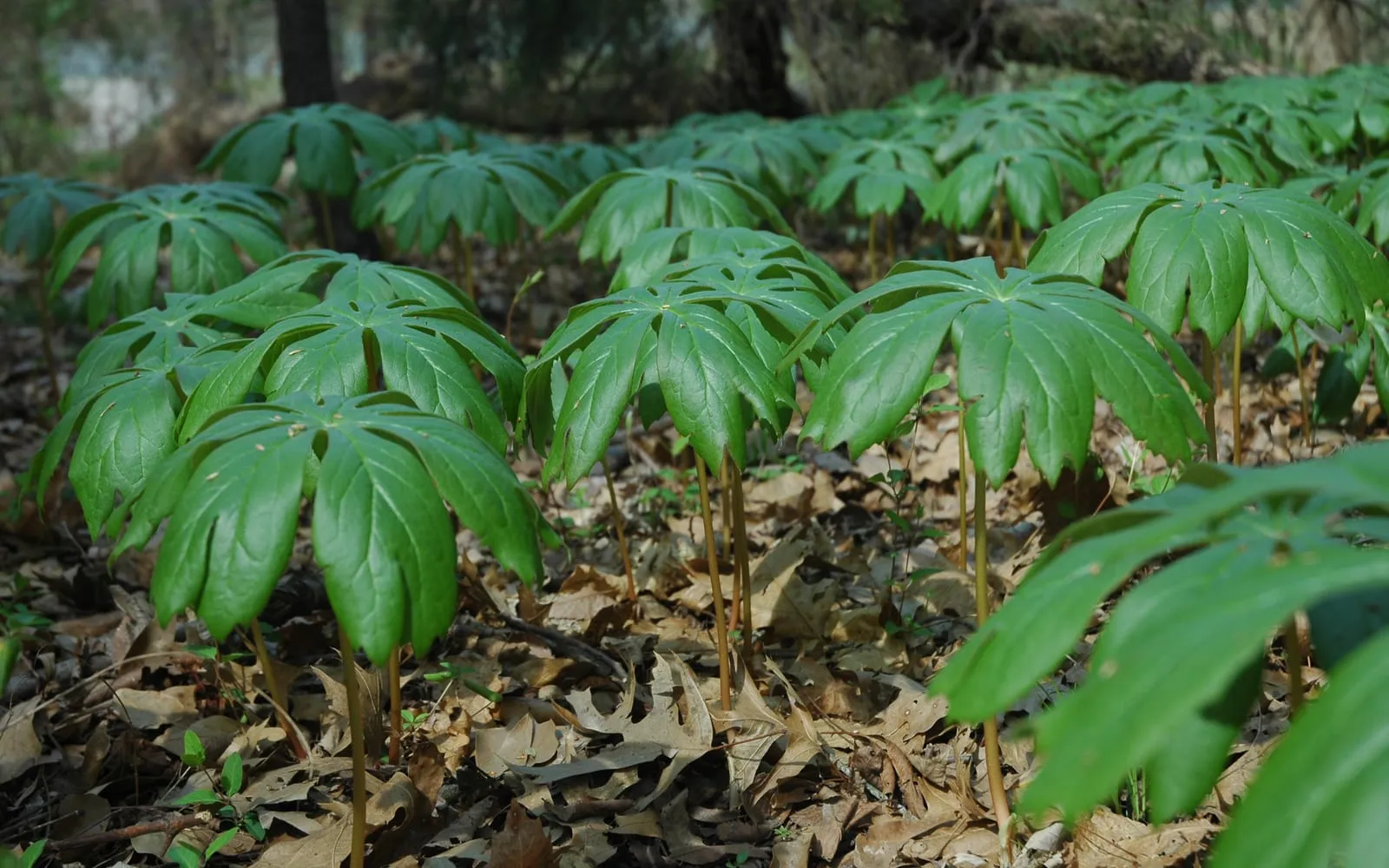
A mayapple colony in April is one of the best sights a shaded garden can offer. Shoots push through the leaf litter as tight furled spears, then open into umbrella-like leaves held horizontally on a single central stalk, and a large patch reads as a sheet of green parasols a foot above the ground.
The flower is hidden. Only shoots that carry two leaves produce one, and it hangs in the fork between the two stalks, underneath the canopy, so it is invisible from above. It is white, waxy, 3 to 5 cm across and faintly scented, and finding one means getting down and looking up.
The plant’s other claim is pharmacological. Podophyllotoxin from the rhizome is the starting point for etoposide and teniposide, two chemotherapy drugs in regular clinical use, which makes this modest woodland perennial one of the more consequential plants in the collection.
Appearance and character
Each shoot carries one leaf or two. A single-leaved shoot holds a round blade up to 30 cm across, deeply divided into five to nine lobes, attached at its centre to the stalk so it stands like an umbrella. A two-leaved shoot carries a pair of smaller lobed leaves and a flower between them.
The flower opens in April and May, nodding on a short stalk in the fork of the two leaf stalks, white, waxy, with six to nine petals and a boss of yellow stamens, 3 to 5 cm across.
The fruit follows through the summer and ripens in late July or August to a yellow oval berry 3 to 5 cm long, soft when ripe, with the texture of a small lemon. It is the only edible part and the rest of the plant is not.
Where it is from
Podophyllum peltatum grows across eastern North America from Ontario and Quebec to Florida and west to Texas and Minnesota, in deciduous woodland, on wooded slopes and in shaded clearings with deep leaf litter.
It forms extensive colonies from a running rhizome, and a large patch in an American wood is usually one clone that has been spreading for decades.
The Asian relatives are grown in temperate gardens and are a different proposition. Podophyllum hexandrum, the Himalayan mayapple, and the Chinese species have mottled or marbled foliage and are more sought after ornamentally, and they contain the same compounds.
How it grows
The plant spreads by a running rhizome a few centimetres below the surface, extending steadily each year and sending up shoots along its length. A planted group closes into a patch in three or four seasons and keeps going.
The whole above-ground season is short. Shoots emerge in April, flower almost at once, hold their leaves through early summer, and die back by August in dry conditions or September in damp ones.
Flowering happens only on two-leaved shoots, and a colony produces relatively few of them. Fruit set is lower still, since the flowers need cross-pollination and a large clonal patch may be a single genetic individual.
Through the seasons
Plant rhizome divisions in autumn, 5 cm deep in shaded ground improved with leaf mould, 30 cm apart. Autumn suits the plant’s cycle.
Shoots come through in April, unfurling into umbrellas over a week or two, and flowers open beneath them almost immediately. Slug protection in April is the one real job.
Fruit ripens in late summer, and the foliage dies back and disappears completely by early autumn, leaving bare ground. Mulch with leaf mould in autumn. Divide established colonies in autumn by lifting a section of rhizome.
Care difficulty
Easy in the right place and useless in the wrong one. Shade, leaf mould and moisture produce a colony that spreads steadily and needs nothing. Sun or dry soil produce a plant that scorches in June and disappears.
Plan for the summer dormancy. The foliage goes completely by early autumn, so a mayapple patch leaves bare ground, and it is best planted where later perennials or ferns fill the space.
The spread is worth thinking about too. The rhizome runs, and in good conditions it will take ground from smaller and slower neighbours.
Watering
Water through the first summer after planting while the rhizome establishes.
An established colony under a leaf mould mulch handles most summers on its own, and the plant responds to drought by dying back early rather than by dying, which is a normal survival response.
Waterlogged ground rots the shallow rhizome, so moist and draining is the target rather than wet.
Warning signs, diseases and pests
Slugs take the furled shoots as they emerge in April, and a shoot lost then is lost for the year, since the plant makes no more.
Rust spots the leaves in a wet summer, showing as small yellow-orange pustules on the undersides. It disfigures rather than kills and clearing dead foliage in autumn reduces it.
The safety point is the standing one. A soft yellow fruit at knee height in August looks like food, only the fully ripe one is edible and only in small quantity, and a child cannot make that judgement. Remove the fruit where young children play.
Growing environment
Partial to deep shade under deciduous trees. This is a woodland floor plant that completes its season before the canopy closes fully and dislikes direct sun.
Soil should be deep, moist, rich in leaf mould and slightly acid, with drainage that stops water standing.
Hardiness is not a consideration. The species survives minus 30 deg C and requires a cold winter to break dormancy properly.
Feeding
Leaf mould in autumn is all it needs, and it does more for soil moisture than for nutrition.
Manufactured fertiliser is unnecessary. The plant is adapted to a forest floor where nutrients arrive as rotting leaves.
Where the soil is thin, work leaf mould and composted bark in before planting, since the rhizome should not be disturbed afterwards.
Troubleshooting
Can I eat the fruit? The fully ripe yellow fruit is edible in small quantity with the seeds discarded, and every other part of the plant is poisonous. Unripe fruit is not edible. Given that distinction, remove the fruit in a garden used by young children.
Where is the flower? Hanging underneath, in the fork between the two leaf stalks on two-leaved shoots. Single-leaved shoots never flower. You have to look up from below.
Why has my patch not flowered? Most shoots carry one leaf and never flower. Two-leaved shoots come with maturity and good conditions, and even then a large clonal colony often sets little fruit because it needs cross-pollination.
Why did it disappear in August? Normal summer dormancy, and earlier in dry conditions. The plant completes its year early and the foliage goes entirely. Plant ferns or later perennials to fill the gap.
Is it really used for cancer drugs? Podophyllotoxin from the rhizome is the starting material for etoposide and teniposide, both in clinical use, and it is also used directly in preparations for genital warts.
Is it the same as mandrake? No. American mandrake is a common name for this plant, and true mandrake is Mandragora, a Mediterranean member of the nightshade family. They are unrelated.
How do I propagate it? Lift and divide a section of rhizome in autumn, ensuring each piece has a bud, and replant at once at the same depth.