
Outdoor plant
Hemp
Cannabis sativa
Also known as Industrial hemp, Cannabis, Ganja plant, Marijuana plant
How to identify hemp, Cannabis sativa. The leaf people think they know, the difference between fibre hemp and the drug crop, and why this page does not tell you how to grow it.
At a glance
- Difficulty
- Moderate
- Light
- Full sun in the wild and in cultivation
- Temperature
- Grows through a temperate summer and is killed by frost
- Hardiness
- USDA 3-11, RHS H2, hardy to 2 C
- Type
- Annual, usually with male and female flowers on separate plants
- Height
- 1-4 m depending on the type
- Native to
- Central Asia, the Tibetan plateau
It grows almost anywhere with a frost-free season of about four months and it is a short-day plant, so daylength triggers flowering and the latitude decides how tall it gets first. What governs growing it is the law, and the threshold differs. Industrial hemp must stay below 0.3 per cent THC in the United States under the 2018 Farm Bill and across the European Union, and Britain requires a Home Office licence with the same limit. Growing it without that licence is an offence whatever the variety.
Hardiness zones describe winter cold alone. Summer heat, humidity, rainfall and the length of the growing season decide as much, so treat the range as the outer limit rather than as a recommendation.
Toxic if eaten
- Do not eat
- The flowering tops and leaves, which carry cannabinoids
- Harm from
- Eating it
- Affects
- People, cats, dogs and horses
Cannabis is one of the small number of plants whose main risk is pharmacological rather than a matter of accidental poisoning. The cannabinoids concentrated in the flowering tops and leaves cause intoxication in people, and in animals the effects are worse rather than milder. Dogs are the common casualty, and the ASPCA lists the plant as toxic to cats, dogs and horses, with incoordination, tremors, vomiting, dilated pupils, a slow heart rate, agitation and in serious cases collapse. A dog that has eaten plant material or an edible product needs a vet rather than observation at home, and vets do not report owners for it. Smoke inhalation affects animals in the same room. For people, the health evidence covers dependence, respiratory harm from smoking, and an association between heavy use and psychosis, particularly with early and frequent use of high-potency material. That is the whole of what this page says about use, and it is here because the harm belongs on the record rather than because the site has any advice to give about it.
Sources: ASPCA toxic and non-toxic plants, RHS potentially harmful garden plants
About
Cannabis sativa is one of the oldest cultivated plants in the world and one of the most argued about. It has been grown for bast fibre for at least six thousand years, for oilseed for nearly as long, and for its cannabinoids for much of that time, and those three uses have pulled its cultivars in different directions.
Growing this plant is restricted or illegal in many countries and in many parts of countries, and Raychis does not recommend attempting it. Where cultivation is permitted at all it is usually under licence, with conditions on the variety, the cannabinoid content and the disposal of the crop. The rules differ between countries and often between regions of the same country, and they change. Check the law that applies where you are before doing anything at all, and treat what a website says about somewhere else as irrelevant to your situation.
This page is written for identification. The app recognises the plant, and someone who has photographed a tall palmate-leaved plant on waste ground wants to know what it is. What the page does not do is tell you how to grow it, how to harvest it, or what to do with it afterwards.
Appearance and character
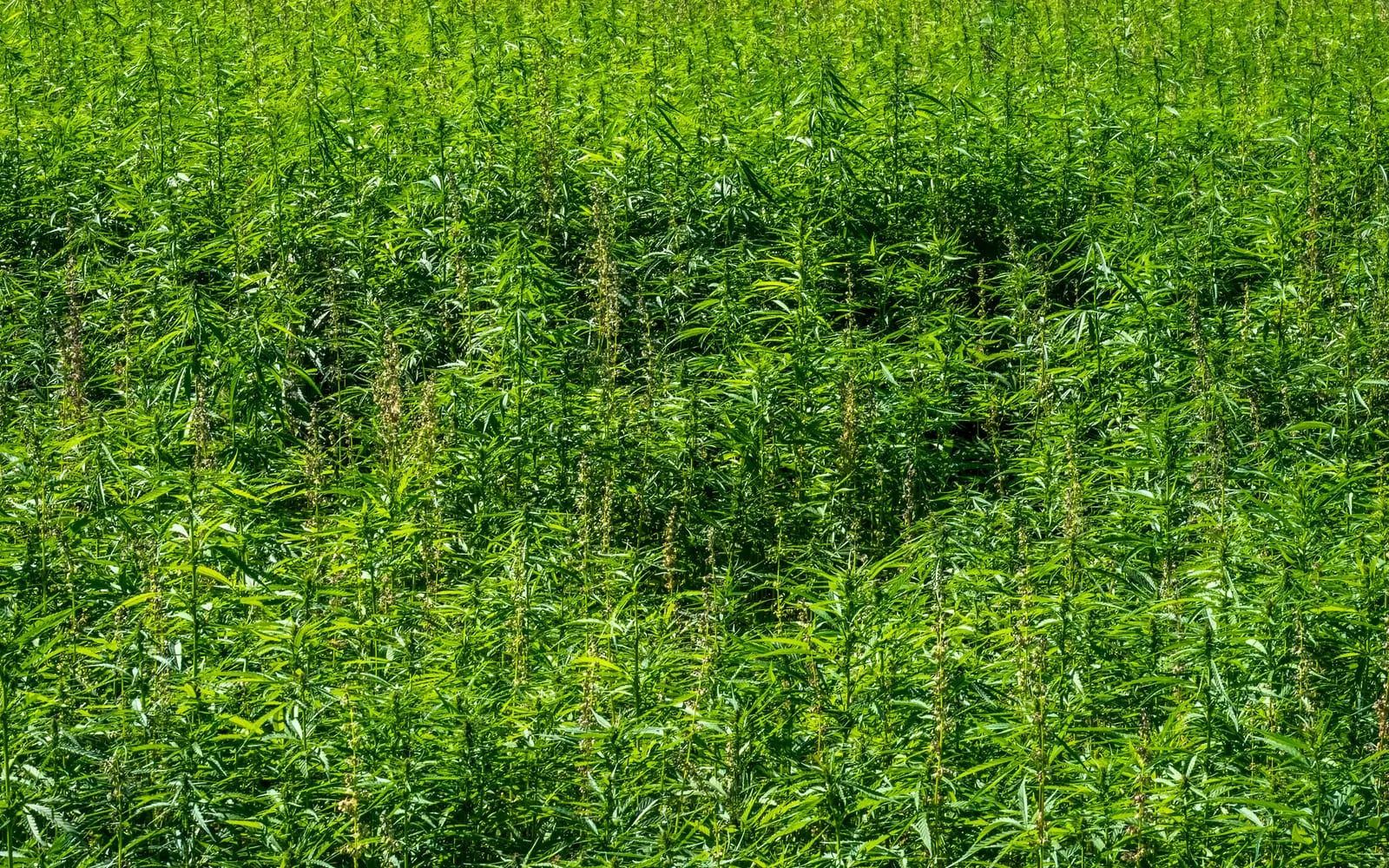
An upright annual, from 1 m on a compact plant to 4 m or more on a fibre variety grown in a dense stand.
Stems are ridged and hollow in older plants, rough to the touch, and the bark peels away in long fibrous strips when the stem is bent and broken.
The leaf is the part people recognise. Each is palmate, divided to the base into five to nine separate narrow leaflets radiating from one point, each leaflet lance-shaped with sharply serrated margins.
The lowest leaves are opposite on the stem and the upper ones alternate, which is a reliable character.
Leaf surfaces carry short hairs, and the whole plant releases a strong resinous smell when brushed or crushed.
Most plants are either male or female. Males carry loose drooping panicles of small pale green five-parted flowers; females carry tight clusters of small green flowers each wrapped in a bract, with a pair of white or cream stigmas protruding.
Seeds are small, hard, mottled grey-brown and oval, about 4 mm.
Fibre varieties are tall, sparsely branched and grown close together; other types are shorter, denser and more branched.
Where it is from
Cannabis sativa originated in Central Asia, and genetic work points to the region around the eastern Tibetan plateau as the most likely centre, with domestication beginning several thousand years BC.
Chinese Neolithic sites contain cord-marked pottery made with hemp cordage, and Chinese texts describe hemp cloth, hemp seed as a grain and hemp fibre for paper.
The plant travelled west with steppe peoples, reaching Europe in prehistory, and hemp cordage and sailcloth became strategically important to every maritime power. British naval rope was hemp, and Tudor legislation required landowners to grow it.
It reached the Americas with European settlers and was a major colonial crop.
Twentieth-century drug control ended most Western cultivation. Licensed industrial hemp has returned in Europe, Canada and parts of the United States under strict cannabinoid limits, grown for fibre, seed, animal bedding and construction materials.
The plant naturalises readily on disturbed ground and grows wild across much of Central Asia and Eastern Europe.
How it grows in the wild
Cannabis is a plant of open disturbed ground. Wild and escaped populations colonise riverbanks, field margins, roadsides and waste ground, and they thrive on the nitrogen-rich soil of old farmyards and rubbish tips.
It germinates in spring as the soil warms, grows fast through long days, and flowers as the days shorten in late summer.
Day length controls flowering in most types. The plant grows vegetatively while the days are long and initiates flowers as they shorten, which is why latitude matters so much to when it flowers.
Pollen is carried on the wind and travels a long way, and a single male plant pollinates a wide area.
Frost kills it. The annual cycle runs from spring germination to autumn seed and death, and the seed overwinters in the soil.
Stands grown close together run up tall and unbranched, while a plant with room around it branches heavily and stays shorter.
Seed is eaten by birds and spread in their droppings, which is how populations appear far from any deliberate planting.
Through the seasons
Spring brings germination on disturbed ground as the soil warms.
Early summer is rapid vegetative growth, which is when the plant puts on most of its height.
Midsummer is when a stand closes over and the leaves are at their largest.
Late summer brings flowering as the days shorten, with males shedding pollen before the females are fully open.
Early autumn is seed set on the female plants.
Mid autumn is when male plants die back, having done their work.
The first frost kills everything above ground, leaving seed in the soil for the following spring.
Where you will see it
Waste ground, riverbanks, roadsides and field margins across much of Central Asia, Eastern Europe and the Middle East, where wild and escaped populations are common.
Old farmyards, tips and disturbed nitrogen-rich ground anywhere the plant has been grown historically.
Licensed fibre and seed fields in France, the Netherlands, Canada and parts of the United States, which are dense unbranched stands cut before seed sets.
Garden borders occasionally, from spilled bird seed, since hemp seed is a component of some wild bird mixes. Those seedlings are usually a surprise to whoever finds them.
Botanic gardens under licence, where it is grown for teaching.
Look-alikes and confusion
Japanese maple, Acer palmatum, is the commonest false alarm. Its leaves are palmately lobed rather than divided, meaning the lobes are joined by a continuous blade rather than being separate leaflets on a common stalk.
Kenaf, Hibiscus cannabinus, has deeply cut palmate leaves and is another fibre crop. Its leaves have joined lobes and its flowers are large and hibiscus-like.
Cassava, Manihot esculenta, has a palmate leaf cut to the base into narrow lobes and is regularly mistaken for cannabis in photographs. Its leaflets are smooth-edged rather than serrated and its leaf stalks are often red.
Cleome hassleriana, the spider flower, has palmate leaves of five to seven leaflets and is a common garden annual. Its flowers are showy pink or white with long protruding stamens.
Coral plant, Jatropha multifida, and several Fatsia and Schefflera species also produce alarmed photographs.
The reliable characters are separate leaflets joined at a single point, sharply serrated leaflet margins, opposite lower leaves becoming alternate above, and a strong resinous smell when the foliage is crushed.
Growing it is restricted
Growing Cannabis sativa is restricted or illegal in many jurisdictions, and Raychis does not recommend attempting it.
Where cultivation is allowed it is generally under licence, with conditions attached to the variety grown, the cannabinoid content of the crop, the recording of what is planted and where, and the disposal of the material afterwards. Licences are usually issued for fibre and seed production rather than for general growing.
The rules vary by country and often by region within a country, and they change. Some places distinguish sharply between low-cannabinoid industrial hemp and everything else; some make no distinction at all in practice.
Nothing on this page should be read as a statement about the law where you live. Look up the position in your own jurisdiction before doing anything.
This site does not describe cultivation, propagation, harvesting, drying, curing, extraction, processing or use for this plant. The identification and botany above are what a plant identification app is for.
If you find one growing
A plant that has appeared in your garden without being planted is usually a bird seed volunteer, and it is still the same species with the same legal status.
Where local law requires it, remove and destroy the plant and dispose of it in line with the rules that apply where you are.
Contact the relevant authority where local law requires that, rather than assuming it does or does not. What that authority is, and whether contacting it is expected, differs from place to place.
Do not assume a plant is a low-cannabinoid variety on the strength of its appearance. The types cannot be told apart by eye and the law generally does not care what you believed.
Do not photograph and post it with your location attached before you know where you stand.
If you are a tenant or an employee, the plant may also be somebody else’s problem, and telling them early is usually better than telling them late.
Troubleshooting
Is this page going to tell me how to grow it? No. Raychis does not publish cultivation, harvesting, curing or processing information for this plant. Identification and botany are what the page is for.
Is industrial hemp legal? Somewhere, yes; where you are, look it up. Many countries permit licensed cultivation of low-cannabinoid varieties under conditions, and many do not. The distinction is defined in law rather than by appearance.
How do I tell hemp from cannabis grown for drugs? By eye, you cannot. Fibre varieties are typically taller and less branched, and that is a tendency rather than a test. The legal distinction rests on measured cannabinoid content.
A plant has come up in my garden. What is it? Most likely a bird seed volunteer, since hemp seed is in some wild bird mixes. Check the leaf characters above, then look up the position where you live.
Is it dangerous to my dog? Yes. The ASPCA lists cannabis as toxic to cats, dogs and horses. A dog that has eaten plant material or an edible product needs a vet, and vets are there to treat the animal rather than to report you.
What does the leaf look like? Palmate, divided to the base into five to nine separate narrow leaflets with sharply serrated edges, opposite low on the stem and alternate above, with a strong resinous smell when crushed.
Is Japanese maple related? No. Acer palmatum has a lobed leaf where the lobes are joined by continuous blade, not separate leaflets. It is the most common false identification there is.
Why is the plant in the app at all? Because people photograph it and want to know what it is, which is what a plant identification app is for. Recognising a plant and recommending it are different things.
What is CBD? One of the cannabinoids the plant produces. Products containing it are regulated differently from the plant in many places, and the position where you are is a question for a pharmacist or a regulator rather than for a plant guide.
Hemp problem guides
Not sure what is wrong? See the common vegetable pests guide.