
Edible
Chokeberry
Aronia melanocarpa
Also known as Black chokeberry, Aronia
How to grow chokeberry, Aronia melanocarpa. A tough shrub with brilliant autumn colour, and fruit so astringent it is named for what it does to your mouth.
At a glance
- Difficulty
- Easy
- Water
- First summer only, then none
- Light
- Full sun for fruit and autumn colour, tolerates shade
- Temperature
- Fully hardy to -30 deg C
- Hardiness
- USDA 3-8, RHS H7, hardy to -35 C
- Type
- Deciduous shrub, long-lived, suckering into a clump
- Height
- 1-2 m, occasionally 2.5 m
- Native to
- Eastern North America
- Best month
- September and October in the Northern Hemisphere, March and April in the Southern Hemisphere
One of the hardiest fruits in cultivation and among the least particular about soil, tolerating both wet ground and drought once rooted. Crops fall away in mild-winter regions, where it needs roughly 800 chill hours to flower evenly.
Hardiness zones describe winter cold alone. Summer heat, humidity, rainfall and the length of the growing season decide as much, so treat the range as the outer limit rather than as a recommendation.
Every month named in this guide is for the temperate Northern Hemisphere. If you garden in the Southern Hemisphere, shift each one by six months, so September becomes March. Closer to the equator the wet and dry seasons matter more than the calendar, and the shift stops being a useful guide.
Not known to be toxic
- Safe to eat
- The fruit, usually cooked or juiced
- Do not eat
- Seeds, at trace levels
The fruit is food and is grown commercially for juice across Poland and eastern Europe. Neither the RHS nor the ASPCA lists Aronia as harmful. As in other members of the rose family the small seeds contain cyanogenic glycosides at trace levels, far below any quantity that could be eaten in practice. The astringency is tannin rather than poison, and a mouthful of raw fruit produces a dry puckered sensation that passes within minutes. Eating a large quantity raw may loosen the stomach. The plant carries no recorded risk to cats or dogs.
Sources: RHS potentially harmful garden plants, ASPCA toxic and non-toxic plants
About
The name is a warning and an accurate one. A raw chokeberry is so astringent that the inside of your mouth dries out and puckers, and the sensation lasts several minutes. Nobody eats them by the handful.
Cooked, juiced or blended with sweeter fruit, they turn into something worth having. Poland grows thousands of hectares for juice, and the colour is extraordinary, a deep near-black purple that stains everything it touches.
As a garden shrub it is one of the most reliable plants available. It grows in wet ground, in dry ground, in poor sand, in shade, in exposure, and at temperatures far below anything most gardens will ever see.
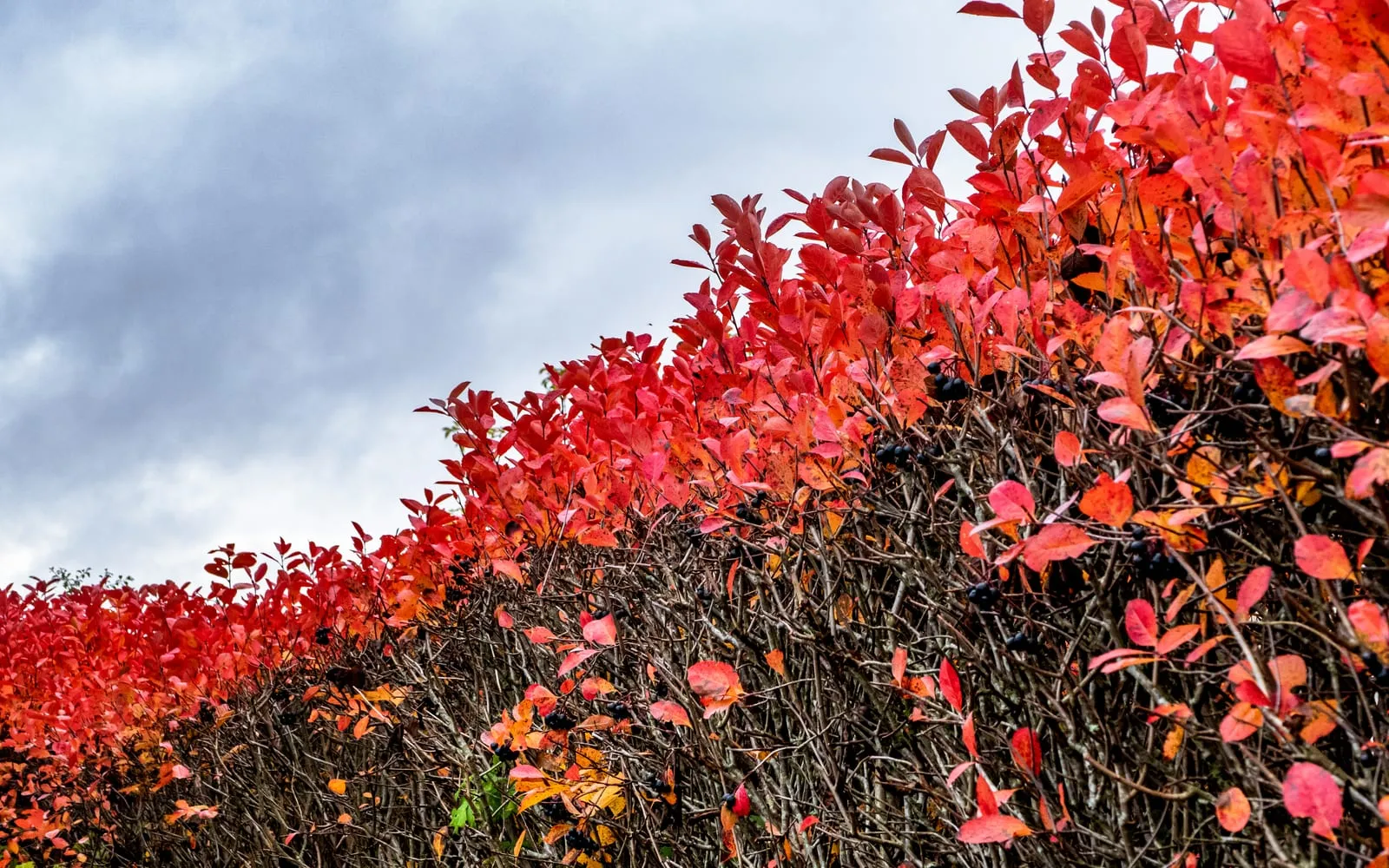
The autumn colour is the reason most gardeners plant it. Scarlet and crimson across the whole shrub for several weeks, with black fruit hanging against it.
Appearance and character
An upright multi-stemmed shrub, spreading slowly by suckers into a clump about as wide as it is tall.
Leaves are oval with finely toothed edges, 3 to 6 cm, glossy dark green above. Small dark glands run along the midrib on the upper surface, which is the reliable way to separate Aronia from similar shrubs.
Flowers open in May in flat clusters of ten to twenty, each 1 cm across, white with five petals and prominent pink-red anthers.
Fruit is a round pome 6 to 12 mm across, glossy and black-purple, hanging in clusters from August and persisting into winter.
Autumn colour is the plant’s strongest feature, turning scarlet to deep crimson, and it holds for two or three weeks.
Where it is from
Aronia melanocarpa is native to eastern North America, from Newfoundland down to Georgia and west to Minnesota.
It grows in bogs, swamp edges, damp woodland and also on dry rocky outcrops, which is an unusually wide range of habitat for one species and explains its tolerance in gardens.
Indigenous peoples of the region used the dried fruit in pemmican and as a medicine.
The commercial story is eastern European. Russian breeders selected large-fruited forms in the twentieth century, and Poland became the world’s main producer, with most of the crop pressed for juice and concentrate.
‘Viking’ and ‘Nero’ are the varieties behind most of that industry, and both are available to gardeners in cool climates.
How it grows
Buy a container-grown plant and put it in at any time from autumn to spring.
Choose ‘Viking’ or ‘Nero’ for fruit, since both carry berries larger than the wild species and crop heavily from a young age.
Plant into any soil. It grows on wet clay that would kill a blueberry and on dry sand that would kill most other fruit.
Space at 1.5 to 2 m for a group, or 1 m for a hedge.
It is self-fertile, so a single plant crops without a partner.
Prune only to renew. Take out a few of the oldest stems at the base every second or third winter and let the suckers replace them.
Fruit appears from the second or third year and builds quickly.
Through the seasons
Spring brings the leaves and then, in May, flat white flower clusters that attract a good range of pollinators.
Through summer the shrub is quiet and the fruit swells from green to red to black.
August and September bring ripening. Fruit turns fully black and stays firm rather than softening, so ripeness is judged by colour.
Pick from September. The berries hang without spoiling, so there is no rush, and the astringency drops slightly after a frost.
October is the display. The whole shrub turns scarlet with black fruit against it, and this is when people ask what it is.
Winter leaves a neat twiggy outline, with any remaining fruit taken by birds once better food runs out.
Care difficulty
Easy. It is arguably the most tolerant fruiting shrub in cultivation.
It withstands waterlogging, drought, shade, exposure, poor soil and cold to -30 deg C, and pests almost ignore it.
It needs no spraying, no netting until late in the season, no feeding, and no support.
Pruning is a job for every second or third winter and takes ten minutes.
The only genuine question is whether you will use the fruit, since the astringency puts people off and a shrub grown for looks alone leaves the crop to the birds.
Watering
Water weekly through the first summer to establish it.
After that, nothing. The plant tolerates both drought and standing water, which removes watering from the job list entirely in open ground.
Fruit is larger on soil that stays moist through July and August, so a watering in a severe drought pays off, though the plant will not suffer without it.
Mulch in spring with compost or bark to hold moisture and suppress weeds around the suckering base.
A container plant needs watering all season and is one of the few fruiting shrubs that will not object to sitting in a saucer of water.
Warning signs, diseases and pests
Brown crisp leaf edges in a hot dry summer on a young plant. Leaf scorch. Water and mulch through the establishment years.
White powdery film on the leaves. Powdery mildew, following dry roots. Mulch and the plant grows through it.
Purple-ringed spots on leaves in a wet season. Leaf spot. Rake up fallen leaves and expect no lasting damage.
Curled sticky new growth. Aphids. Ladybirds usually deal with them before you need to.
Fruit disappearing in December. Birds, once other food runs short. This is late enough that the crop is usually picked already.
Shoot tips blackened and hooked. Fireblight. Rare on Aronia, but cut 30 cm into clean wood and burn the prunings if it appears.
Growing environment
Full sun gives the heaviest fruit and the strongest autumn colour. In shade the plant grows well, fruits lightly and colours poorly.
Soil is close to irrelevant. It grows on wet clay, dry sand, chalk and acid peat, at any pH from 5 to 7.5, and mildly acid ground suits it best.
Wind and cold are tolerated fully, which makes it useful on exposed sites and in cold gardens.
It suckers slowly, so give it 1.5 m of width and expect a clump rather than a single stem.
A wet corner where nothing else will fruit is the position where this plant earns its keep.
Feeding
No feeding is needed on ordinary garden soil, and the plant fruits well on ground that would starve most crops.
A compost mulch every second spring is sufficient and does more for the soil than for the shrub.
On very poor sand, a general-purpose fertiliser in March for the first two or three years helps it establish.
Avoid nitrogen-rich feeds, which push leafy growth at the expense of fruit and weaken the autumn colour.
A container plant needs a balanced liquid feed monthly from April to August.
Troubleshooting
Fruit painfully astringent. Working as intended. Cook it, juice it, or blend it with apple, and pick after a frost when the tannin softens slightly.
Poor autumn colour. Too much shade. Move the plant or thin what overhangs it.
Few flowers and little fruit. Shade again, or a plant crowded by neighbours.
Shrub spreading further than wanted. Suckers. Slice through them with a spade in spring and pull the pieces out.
Old plant becoming leggy with bare stems. Renewal pruning overdue. Take a third of the oldest stems to ground level in winter and repeat for three years.
Leaves yellowing on very limy soil. Iron shortage. Apply chelated iron, though this is uncommon since the plant tolerates alkalinity better than most.