
Edible
Loofah
Luffa aegyptiaca
Also known as Sponge gourd, Luffa, Egyptian cucumber, Turai, Smooth loofah
How to grow loofah, Luffa aegyptiaca. Eating the young fruit, growing the bathroom sponge, and why a short season is only just long enough for one of the two.
At a glance
- Difficulty
- Moderate
- Water
- Two or three times a week, daily under glass in summer
- Light
- Full sun
- Temperature
- 20-30 deg C, nothing below 15
- Humidity
- Moderate to high
- Hardiness
- USDA 10-12, RHS H1b, hardy to 8 C
- Type
- Tender annual climber
- Height
- 5-9 m in a season
- Native to
- South and South East Asia
- Best month
- April and May in the Northern Hemisphere, October and November in the Southern Hemisphere
Growing the vegetable takes 90 days and growing a sponge takes 150 to 200, since the fruit has to mature and dry on the vine, and that gap is why sponges come from the tropics and young loofahs from anywhere warm. Nothing below 15 deg C.
Hardiness zones describe winter cold alone. Summer heat, humidity, rainfall and the length of the growing season decide as much, so treat the range as the outer limit rather than as a recommendation.
Every month named in this guide is for the temperate Northern Hemisphere. If you garden in the Southern Hemisphere, shift each one by six months, so April becomes October. Closer to the equator the wet and dry seasons matter more than the calendar, and the shift stops being a useful guide.
Edible, with limits
- Safe to eat
- The young fruit, the shoots, the flowers and the leaves
- Do not eat
- A mature fruit, which is fibrous and purgative rather than poisonous
- Harm from
- Eating it
- Affects
- People
Young loofah is a vegetable eaten across Asia and Africa and it is not harmful. Two practical points follow. A fruit left to mature turns fibrous and bitter, and eating one in that state acts as a strong purgative, which is why the mature fruit ends up in the bathroom rather than the kitchen. The bitterness comes from cucurbitacins, and the same rule that applies to bottle gourd applies here: taste a small raw piece, and if it is bitter, discard the fruit. Ridged loofah, Luffa acutangula, is the sharply angled species sold as turai or Chinese okra, and it behaves the same way. Neither the RHS nor the ASPCA lists Luffa, and cooked young fruit is harmless to cats and dogs in small amounts.
Sources: RHS potentially harmful garden plants, ASPCA toxic and non-toxic plants
About
The bathroom loofah is a fruit, not a sea sponge, and the plant that makes it is a climbing cucurbit that will grow in a polytunnel almost anywhere.
Picked at 10 to 15 cm it is a vegetable, mild and slightly sweet, cooked across India as turai and across China and Vietnam in soups and stir-fries. Left on the vine for another two months it goes fibrous, dries out, and turns into the skeleton of interlocking fibres people buy for scrubbing.
Two species share the name. Smooth loofah, Luffa aegyptiaca, gives the classic cylindrical sponge. Ridged loofah, Luffa acutangula, has ten sharp longitudinal ribs and is the one South Asian grocers usually sell for eating, since its fibre is coarser.
Getting a sponge out of a cool summer is the harder of the two goals. The fruit needs four months from setting to a fully lignified skeleton, and that means sowing in March and growing under cover.
Appearance and character
A strong annual climber, 5 to 9 m in a season, with angular ridged stems that feel harsh rather than downy.
Leaves are 10 to 25 cm across, palmately five to seven lobed with a rough surface, held on long stalks.
Tendrils branch into two to six arms and grip hard.
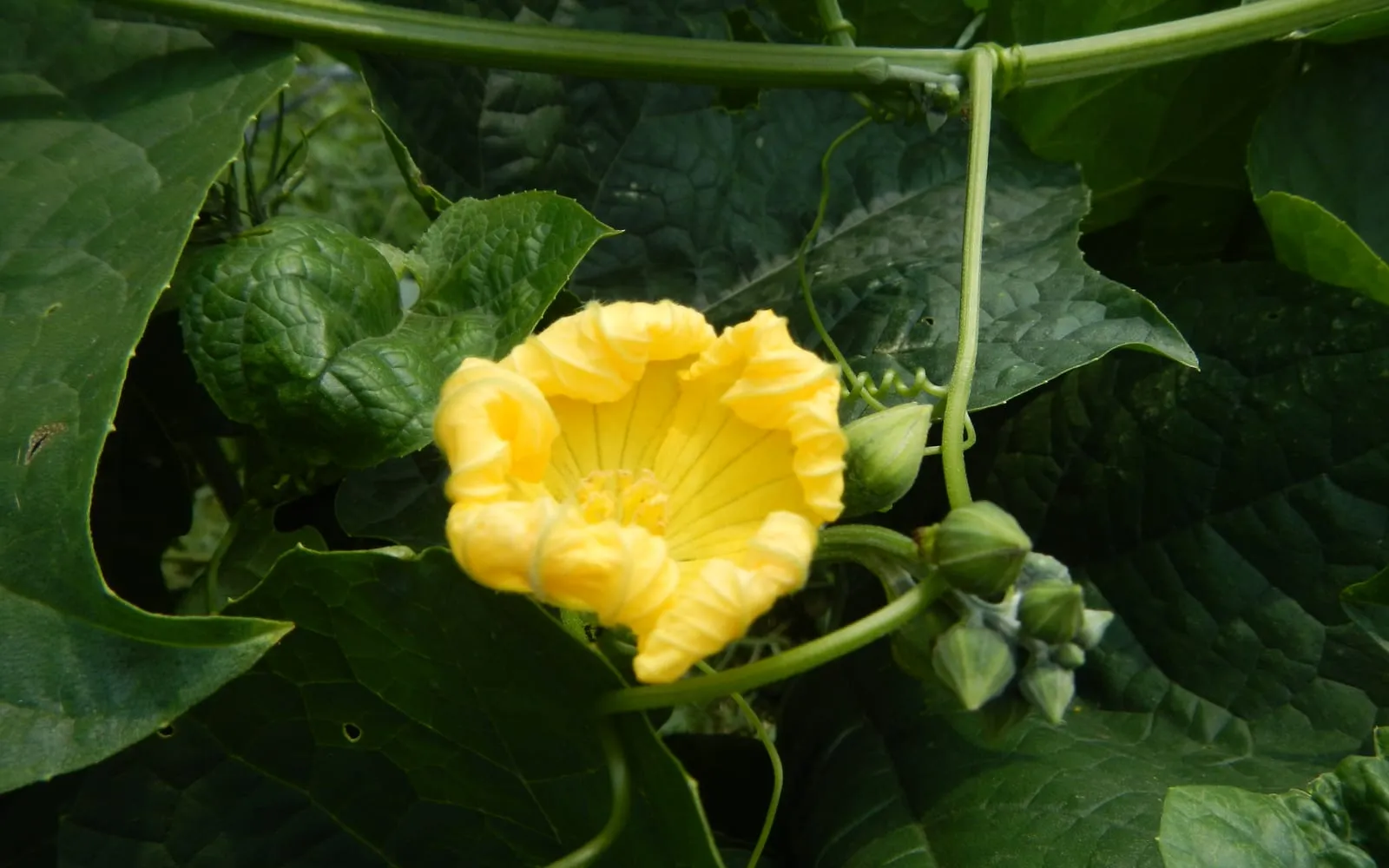
Flowers are yellow and open in the morning, which separates loofah from bottle gourd at a glance. Males come in long-stalked racemes of ten or more buds opening one at a time; females sit singly on shorter stalks with a slim ribbed ovary behind them.
The young fruit is smooth, cylindrical, dark green and slightly tapered, 10 to 30 cm long, with tender flesh and undeveloped seeds.
A mature fruit is 30 to 60 cm, pale tan, light in the hand and dry, and it rattles. Inside is the network of vascular fibres people know, holding black flat seeds that fall out when the end cap is knocked off.
The skin of a mature fruit peels away in brittle sheets once it has dried, and the fibre beneath is cream coloured and springy.
Where it is from
Luffa aegyptiaca is native to tropical South and South East Asia, most likely India, despite the name pointing at Egypt. The species name records where European botanists first met it rather than where it began.
Asian cultivation is ancient and covers both uses at once, with the same plant giving a summer vegetable and a household scrubber.
It spread through the Arab world and into Africa, and the English name comes through Arabic luf. Egyptian and Sudanese growers supplied the European sponge trade in the nineteenth and twentieth centuries.
Japan built an industry on it. Before plastics, loofah fibre was used in industrial filters and in the linings of steel helmets, and Japanese growers selected long straight cultivars for it.
China, Vietnam, India and Central America now grow most of the crop, with Egypt and Guatemala supplying much of the sponge trade.
How it grows
Sow in March or early April, earlier than any other gourd here, at 22 to 25 deg C. Soak the seed for 24 hours and nick the coat.
Pot on before the roots circle, since a checked loofah seedling sulks for weeks.
Plant out into a greenhouse or polytunnel border in late May, when nights are reliably above 12 deg C.
Train it up strings, netting or wires. It climbs willingly and holds its own fruit weight better than bottle gourd, though a heavy sponge is still worth supporting.
Pinch the leader at 2 m to bring on the laterals, which carry the female flowers.
Hand-pollinate in the morning under glass, brushing a stripped male flower into the centre of a female.
For eating, cut fruit at 10 to 20 cm, while a thumbnail marks the skin easily.
For sponges, leave the earliest-set fruit alone and pick everything later. One vine will only mature two or three good sponges in a short season.
Harvest a sponge when the fruit is light, tan and rattling, with the skin dry and papery. Cut it, knock off the end, shake the seeds out, peel the skin away, then soak the fibre in water, scrub it clean, and bleach it in dilute household bleach if you want it pale. Dry it hard in the sun.
Through the seasons
March is the sowing month for anyone who wants a sponge, and it is earlier than instinct suggests.
April is potting on and keeping the seedlings warm and growing.
Late May is planting out under cover.
June and July are growth, training and pinching.
Late July and August bring flowering and morning hand pollination, and the first cuttings of young fruit for the kitchen.
September is when the earliest fruit stops swelling and starts to dry.
October is the sponge harvest, which has to happen before frost blackens the vine.
Winter is for cleaning, bleaching and drying the fibre, and for saving seed.
Care difficulty
Moderate for eating and difficult for sponges, which is the same plant judged against two different finishing lines.
Season length is the whole problem. A sponge needs four months on the vine from a flower that opens in late July.
Germination needs 22 deg C and a nicked seed, and cold sowing wastes a month.
Growth is fast and untroubled once the plant is warm.
Powdery mildew arrives in August and can strip a vine before its fruit has matured.
Pinching for laterals makes the difference between a long green rope and a crop.
Watering
Water two or three times a week from planting out, daily under glass in high summer.
Increase while fruit is swelling, since the young fruit is almost entirely water.
Water at the root in the morning and keep the leaves dry.
Mulch thickly.
Reduce watering from mid-September for fruit you intend to dry, which speeds the drying and hardens the fibre.
Stop watering a maturing sponge fruit altogether once the skin starts to pale.
Warning signs, diseases and pests
White powdery patches on the leaves from August are powdery mildew, which is the usual reason a sponge crop fails.
Angular yellow blotches with grey mould beneath are downy mildew after wet weather.
Fine speckling and webbing is red spider mite in dry greenhouse air.
Curled shoots with sticky honeydew are aphids.
Young fruit yellowing at 3 cm and dropping was not pollinated.
A fruit that stays green and heavy into October will not become a sponge, and it should have been eaten.
Fibre that comes out brown and stained means the fruit was picked wet or left lying on damp ground.
A bitter taste in a raw slice means that fruit is not for eating.
Growing environment
A polytunnel or greenhouse where summers are cool. Outdoors, only as an eating crop in a hot summer.
Full sun.
Minimum 15 deg C, with 20 to 30 deg C for growth.
Rich deep soil with plenty of compost.
Vertical support of 2 to 3 m, with netting or strings.
Good ventilation to slow mildew.
A dry airy space for curing the sponges afterwards.
Feeding
Dig in rotted manure before planting.
Feed a balanced liquid feed fortnightly from planting out.
Switch to a high-potash tomato feed as the first fruit sets.
Keep feeding through August if you are picking young fruit regularly.
Stop feeding fruit destined to become sponges once they reach full length, since further growth is not wanted.
Avoid heavy nitrogen after midsummer.
Troubleshooting
Is a loofah a sea sponge? No. It is the dried fibrous skeleton of a gourd, grown on a climbing plant in a field.
When do I pick one to eat? At 10 to 20 cm, while the skin is soft enough to mark with a thumbnail. After that the fibre starts to form and the texture goes.
When do I pick one for a sponge? When it is light, tan, dry and rattling with seed, with papery skin. Cutting it green gives a soft grey fibre that falls apart.
My sponges never matured. The season ran out. Sow in March, grow under cover, and let only the two or three earliest fruit stay on the vine.
How do I clean the fibre? Knock the end off and shake out the seeds, peel the dry skin away, soak the fibre in water and rub the sap out, then wash it. A weak bleach solution pales it. Dry it hard.
Why is my fruit bitter? Cucurbitacins, the same compounds that make a bitter bottle gourd dangerous. Do not eat it. Compost it and taste the next one before you cook.
Is turai the same plant? Usually the ridged one, Luffa acutangula, which is a close relative sold for eating. Both are grown the same way.
Can I grow it outdoors? For eating, in a hot summer, yes. For sponges, almost never in a cool climate without cover.
What do I do with the seeds? Save them. They keep for several years in a dry cool place and germinate better than fresh shop-bought seed.
Loofah problem guides
Not sure what is wrong? See the common vegetable pests guide.