
Outdoor plant
Potato Vine
Solanum laxum
Also known as Jasmine Nightshade, Solanum jasminoides
How to grow potato vine, Solanum laxum. Why its flowers look so much like a potato plant's despite producing no edible tubers, why a hard winter can kill the top growth and still leave the base to resprout, and why no part of the plant, including the berries, is safe to eat.
At a glance
- Difficulty
- Easy
- Water
- Regularly while establishing, then moderately once settled
- Light
- Full sun to light shade
- Temperature
- Semi-hardy; the top growth is damaged by hard frost but the base often survives
- Hardiness
- USDA 8-10, RHS H3-H4, hardy to -8 C
- Type
- Semi-evergreen twining climber, often cut back by cold and regrowing from the base
- Height
- 4-6 m
- Native to
- South America
The zone figures describe the roots rather than the whole plant. In a cold winter the top growth is commonly cut back hard or killed outright, while the woody base at soil level often survives and resprouts strongly the following spring, so a gardener at the cold edge of its range should expect to cut out dead wood each spring rather than assume the whole plant has died. Where winters stay mild it keeps most of its leaves and flowers for the greater part of the year.
Hardiness zones describe winter cold alone. Summer heat, humidity, rainfall and the length of the growing season decide as much, so treat the range as the outer limit rather than as a recommendation.
Toxic if eaten
- Do not eat
- The berries, and to a lesser extent the leaves and stems
- Harm from
- Eating it
- Affects
- People, cats, dogs and horses
Potato vine belongs to the nightshade family, Solanaceae, and like many of its relatives it produces the toxic glycoalkaloid solanine throughout the plant, most concentrated in the small berries that follow flowering. Eating the berries or foliage in quantity causes gastrointestinal upset, including vomiting, diarrhoea and abdominal pain, in people and in cats, dogs and horses, and the ASPCA lists Solanum jasminoides, an older name still used for this species, as toxic to cats and dogs. The berries are small, green ripening to black, and are not especially conspicuous or appealing compared with brighter garden berries, which limits how tempting they are to a child or a pet, but they should not be treated as safe to sample. The plant is unrelated to the edible potato despite the common name and despite the flowers looking similar to a potato plant's, and no part of it should be eaten under any circumstances.
Sources: ASPCA (Solanum jasminoides), RHS potentially harmful garden plants
About
Potato vine flowers for longer than almost any other hardy climber, often opening its first star-shaped blooms in late spring and continuing into autumn, with a mild winter barely interrupting the display at all. The flowers give the plant its common name, since they closely resemble the blooms of the edible potato, a fellow member of the nightshade family, though the vine itself produces no edible tubers and no part of it should be eaten.
It climbs fast, twining its stems around wires, trellis or any other narrow support, and can cover a substantial fence or wall within two or three seasons of planting. That same vigour means it needs a firm hand with the secateurs to stay in bounds rather than swamping whatever it is grown against.
At the cooler edge of where it is grown, treat it as a plant that may lose its top growth to a hard winter and come back from the base rather than as one guaranteed to look the same every spring.
Appearance and character
A fast-growing, semi-evergreen twining climber with slender, woody-based stems that thicken with age at the base while the newer growth stays soft and flexible.
Leaves are simple to slightly lobed, mid-green and glossy, giving the plant a light, airy texture that helps the flowers show well against the foliage rather than being hidden by it.
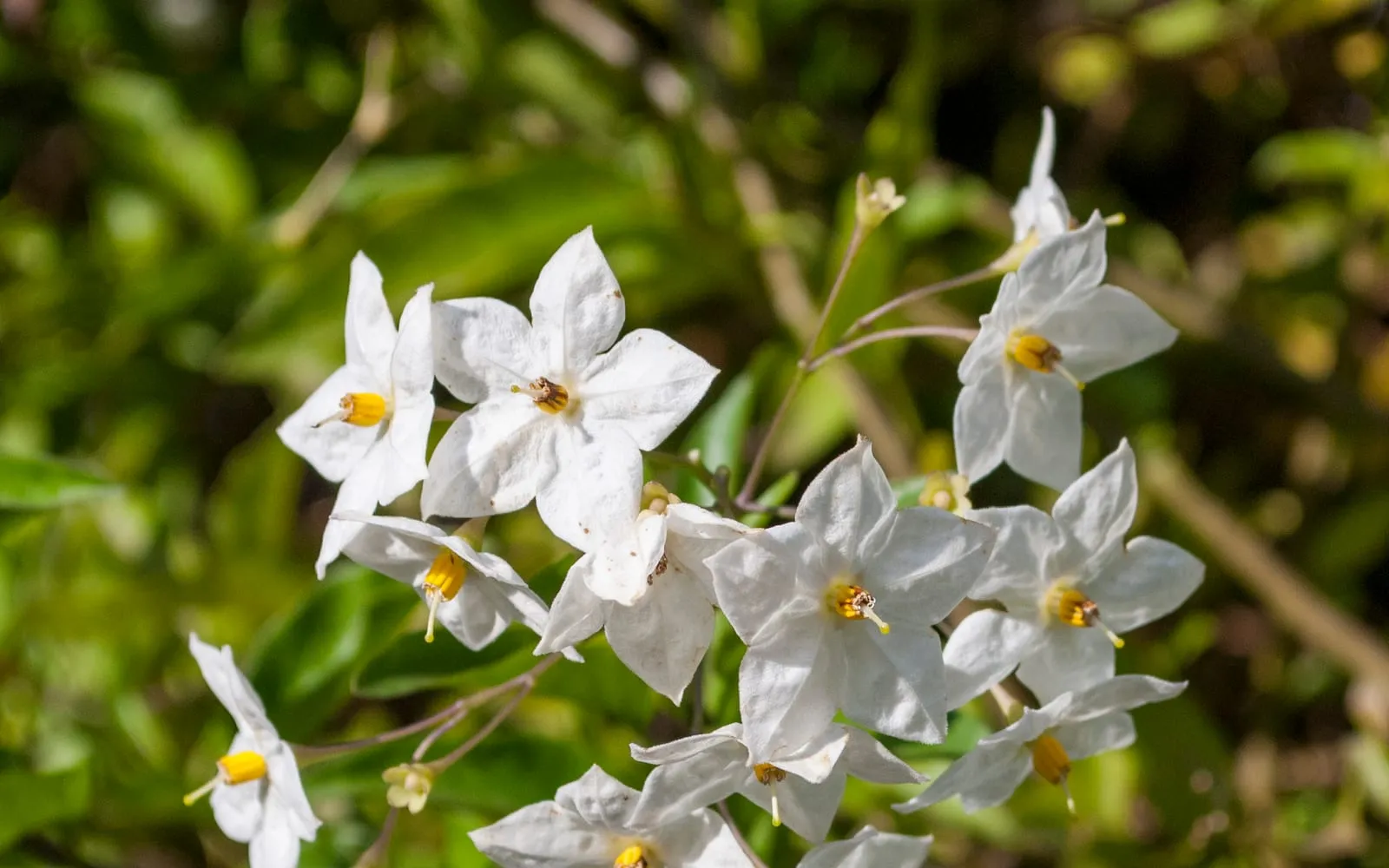
Flowers open pale blue-white to almost white, star-shaped with five pointed lobes and a cluster of bright yellow anthers at the centre, carried in loose clusters at the shoot tips from late spring through to autumn in a good year. The resemblance to potato flowers, right down to the yellow anther cluster, is close enough that the two are easy to confuse from a short distance.
Small berries, green ripening to black, occasionally follow flowering, though a plant grown for its long flowering display and regularly deadheaded or pruned often carries relatively few at any one time.
Where it is from
Solanum laxum is native to South America, where it grows as a scrambling climber through scrub and along forest margins in a broadly warm temperate to subtropical climate with no severe winter cold to contend with.
That background explains both its long flowering season and its limited tolerance of hard frost. A plant that evolved without a pronounced cold dormancy period keeps growing and flowering for as much of the year as warmth and light allow, but has comparatively little built-in resistance to the kind of deep winter cold that fully hardy climbers take in their stride.
It has been in cultivation in gardens with mild winters for a long time, valued for exactly the long flowering season its native climate produces, and gardeners further from that mild native range have learned to treat it as a plant that may need cutting back hard after a cold winter rather than one that stays pristine every year.
How it grows
Plant in fertile, well-drained soil in a position with full sun to light shade, ideally against a warm wall in a cooler climate, where the stored heat in the masonry offers some protection through winter.
Provide a sturdy support from the start, since growth is fast and a plant left without something to climb quickly becomes a tangled heap rather than a trained climber. Wires, trellis or netting all give the twining stems something to grip.
Tie in the main framework of stems as they grow, since the plant twines loosely rather than gripping tightly on its own, and unsupported growth can pull away from a wall or fence in wind.
Prune in spring, once the risk of hard frost has passed and any winter damage is visible, cutting out dead or damaged wood back to healthy growth and shortening the rest of the framework to control size. This species tolerates hard pruning well and regrows vigorously from cut stems.
Where the plant has been cut to the ground by a hard winter, clear away the dead top growth in spring and give the base time; healthy wood at soil level commonly resprouts strongly once the weather warms.
Through the seasons
Spring is the main pruning window, once winter damage is visible and new growth resumes strongly.
Summer brings the main flowering display, often continuing without much of a break through the warmest months.
Autumn frequently carries on flowering in a mild season, tapering only as the weather cools and the first frosts approach.
Winter is the risk period. A hard frost can cut the top growth back to the woody base, which then commonly resprouts the following spring in all but the most severe winters.
Care difficulty
Easy, and one of the most generous flowering climbers available for a gardener willing to accept some winter uncertainty at the cooler edge of its range. It grows fast, flowers for months on end, and needs no elaborate feeding or complicated pruning regime. The main task is keeping its vigorous growth tied in and under control, and being prepared to cut out frost-damaged wood each spring in a garden where winters are not consistently mild.
Watering
Water regularly while the plant is establishing through its first growing season, since a young root system cannot yet draw on much reserve moisture from the surrounding soil.
Once established, water moderately, letting the surface dry between waterings rather than keeping the ground constantly wet, and increase watering during any extended dry spell in summer when the plant is in full leaf and flower.
A plant trained against a wall sits in a rain shadow and dries out faster than one in open ground, so check it more often in a dry summer regardless of how established it otherwise is.
Warning signs, diseases and pests
Aphids cluster on the soft, fast-growing shoot tips, distorting new growth and leaving a sticky residue behind them. A strong jet of water or an insecticidal soap controls a light infestation without slowing the plant’s vigorous growth for long.
Whitefly can build up on the underside of the leaves, rising in a small cloud when the foliage is disturbed. Yellow sticky traps and a soap spray both help bring numbers down.
Spider mite favours hot, dry conditions against a sheltered wall, showing as fine pale speckling on the leaves with faint webbing in a bad case. Damping down the area around the plant in hot weather helps prevent it.
Powdery mildew can appear on congested growth with poor air movement, showing as a white coating on the leaves. Thin out crowded stems at the spring prune to improve airflow through the plant.
Blackened or shrivelled growth after a cold winter is frost damage rather than a disease. Cut back to live wood in spring once new growth shows where the plant is still viable, and give the base time to resprout before assuming the whole plant has died.
Growing environment
Full sun to light shade both suit it, with the strongest, longest flowering coming from a position with plenty of direct sun through the day.
A warm, sheltered wall gives real protection in a cooler climate, both extending the flowering season and improving the plant’s chances through a hard winter.
Fertile, well-drained soil suits it best, and it tolerates a wide range of garden conditions provided the ground does not stay waterlogged.
A robust support, whether wires, trellis or netting, is essential given how fast and vigorously the plant grows once established.
Feeding
Feed monthly through spring and summer with a balanced general-purpose fertiliser or a high-potassium feed to support the long flowering season, following the product’s recommended rate.
Stop feeding by early autumn so that new growth has a chance to harden before any cold weather arrives, since soft, actively growing tissue is more vulnerable to frost damage than mature wood.
A container-grown specimen benefits from more frequent, lighter feeding through the growing season than one established in open ground.
Troubleshooting
My plant was cut to the ground by frost. Is it dead? Not necessarily. The woody base often survives even when the top growth is killed outright. Clear away the dead stems in spring, be patient, and give it until early summer before assuming it has not survived.
How do I stop it swamping its support? Prune hard in spring, cutting back the framework to control size, and continue with lighter pruning through the growing season to keep fast new growth in check.
Are the berries dangerous? Yes. They contain solanine, the same toxic compound found through much of the nightshade family, and should not be eaten by people or pets. They are small and relatively inconspicuous, which limits but does not remove the risk.
Is this related to the potato I eat? Only distantly, through the same plant family. The flowers look similar, which is where the common name comes from, but this vine produces no edible tubers and no part of it is safe to eat.
Can I grow it somewhere with real winters? With caution. A sheltered position against a warm wall improves its chances, but expect to lose some or all of the top growth in a hard winter and to rely on the base resprouting the following spring.