
Outdoor plant
Ashwagandha
Withania somnifera
Also known as Indian ginseng, Winter cherry, Withania
How to grow Withania somnifera, the nightshade behind ashwagandha. Raising it as an annual where frost comes, lifting the root in its first autumn, and why the berry is not food.
At a glance
- Difficulty
- Moderate
- Water
- Sparingly once established
- Light
- Full sun, and it sulks in anything less
- Temperature
- Tender, and killed by the first frost
- Hardiness
- USDA 8-11, RHS H2, hardy to 0 C
- Type
- Short-lived shrub, grown as an annual where frost comes
- Height
- 60-150 cm
- Native to
- the dry country of India and Pakistan, north Africa, the Middle East
A dry warm season of six to seven months is what fills the root, and it is grown as an annual anywhere with a frost. Drought suits it and rich wet soil gives a poor root. India grows the crop on light soil in a rain-fed system and lifts it in the dry season.
Hardiness zones describe winter cold alone. Summer heat, humidity, rainfall and the length of the growing season decide as much, so treat the range as the outer limit rather than as a recommendation.
Toxic if eaten
- Do not eat
- The berries and the leaves. The root is the part people use
- Harm from
- Eating it
- Affects
- People, cats and dogs
Ashwagandha is a member of the nightshade family and its chemistry says so. The plant contains withanolides, a group of steroidal lactones, concentrated in the root and the leaves. NC State Extension lists Withania somnifera and notes that the fruit and the leaves cause vomiting and diarrhoea if eaten, so the red berries in their papery husks are not food, and a garden that children use is a reason to say so. The plant does not appear on the RHS list of potentially harmful garden plants or on the ASPCA list of plants toxic to dogs, cats and horses, and the absence from both reflects how rarely it is grown outside its native range rather than a finding of safety. The root is the part with the long history of human use, taken as a dried powder, and it is regulated as a food supplement in Britain rather than as a medicine. Case reports of liver injury associated with ashwagandha supplements have appeared in the medical literature, and several European regulators have reviewed the ingredient since 2023. Anyone taking it should say so to their GP, particularly alongside prescribed medicines, and the NHS page on herbal medicines sets out why that conversation is worth having.
Sources: NC State Extension, Withania somnifera, LiverTox, Ashwagandha, RHS potentially harmful garden plants, ASPCA toxic and non-toxic plants, NHS on herbal medicines
About
Ashwagandha is a scruffy grey shrub that looks like a tomato plant left out in a drought, which is close to what it is. Withania sits in the nightshade family alongside tomato, potato and deadly nightshade, and the family resemblance shows in the bell-shaped flowers and in the berry, a small red fruit wrapped in a papery husk of the sort a physalis wears.
The name comes from Sanskrit and means horse smell. Crush a fresh root between your fingers and you get a strong sweetish barnyard note that survives drying. Indian medicine has used the root for a very long time, and the plant is one of the most heavily traded herbs in the world, with production centred on Rajasthan and Madhya Pradesh.
Where frost comes the plant is a summer annual. It comes from dry country and it dies at the first frost, so the whole business is compressed into one season. Sow in March under glass, grow the plant hard in poor soil and full sun, then lift the root in October before the weather turns. What you get is a thin taproot the thickness of a pencil rather than the fat carrots in a herb shop, which come from a longer growing season and a hotter one.
Appearance and character
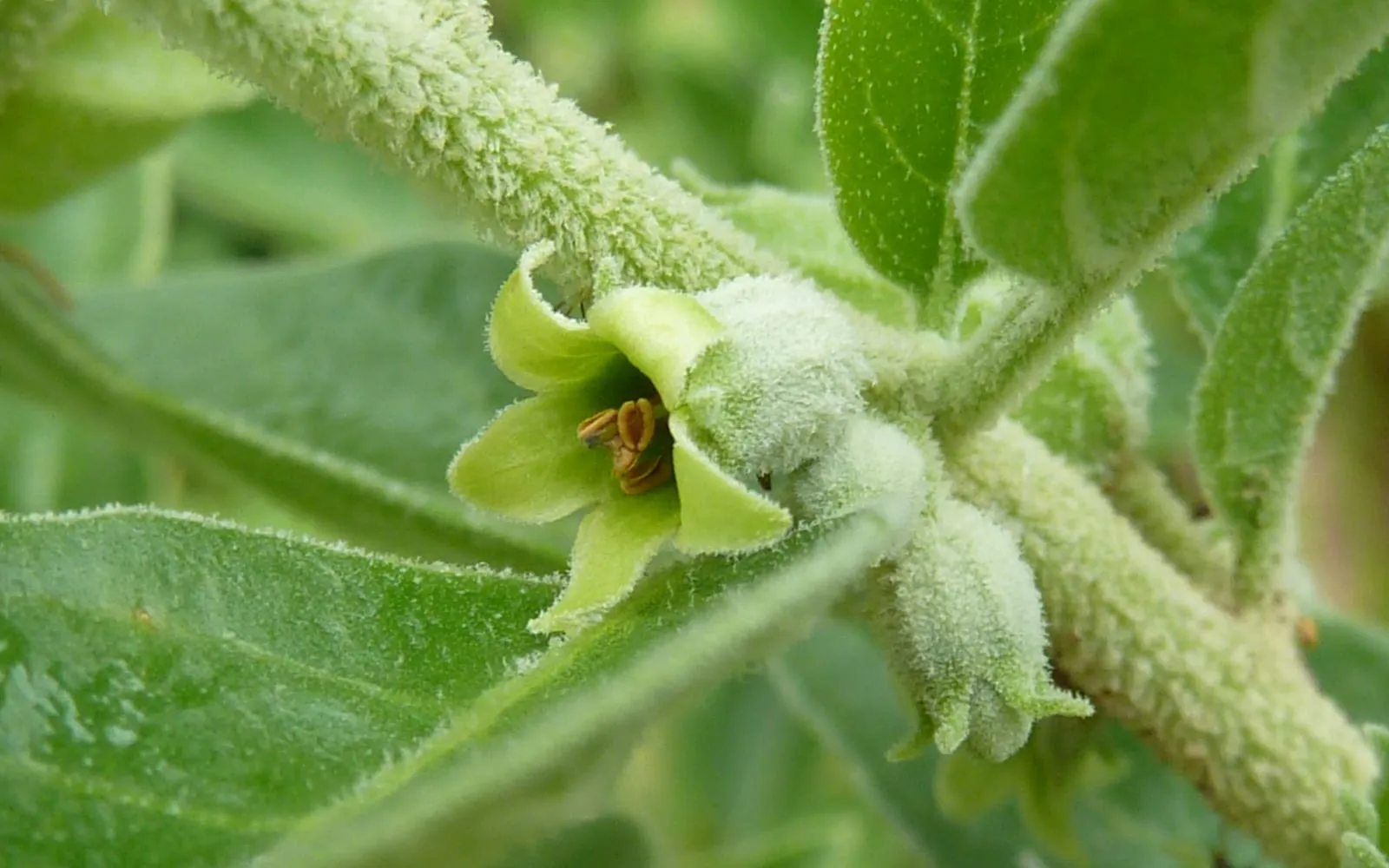
Everything about the plant is grey. The stems, the leaf undersides and the young growth all carry a fine felt of star-shaped hairs, which is what dulls the green and what makes the plant look dusty even after rain. Leaves are simple ovals up to 10 cm long, arranged alternately, and they have no scent when crushed.
Flowers are small and easy to miss, five to ten millimetres across, greenish yellow, hanging in tight clusters in the leaf axils. The berry that follows is the giveaway. It ripens orange to scarlet and sits inside an inflated calyx that dries to a papery lantern, so a plant in October carries what look like tiny Chinese lanterns down the length of every stem.
The root is a single pale taproot with few side branches. In a plant grown in poor sandy soil it runs straight down and comes up whole. In a rich bed it forks and stays short, which is why growers who want the root sow into ground nobody would choose for a vegetable.
Where it is from
Withania somnifera grows wild across a wide band of dry country, from the Canary Islands through north Africa and the Middle East into India, Pakistan and Sri Lanka, with populations in southern Africa too. It turns up on waste ground, field edges and roadsides, and in India it behaves as a weed of disturbed places rather than a plant of any particular habitat.
Commercial growing is concentrated in India, where the crop is sown with the first monsoon rains in June and lifted between December and March. The variety grown for the root, Jawahar Asgand-20 among others, was selected for a straight unbranched taproot rather than for anything you could see above ground.
The plant reached European gardens as a botanical curiosity long before anyone here wanted the root. It has been grown in Mediterranean gardens for centuries and naturalised in parts of Spain, Greece and Sicily, where the winters are mild enough for it to persist as the short-lived shrub it is.
How it grows
Given warmth, ashwagandha grows fast. Seed germinates in ten to twenty days at 20 deg C, seedlings put on height through the first six weeks, and the plant begins branching once it reaches about 30 cm. Flowering starts around ten weeks from sowing and continues until the cold stops it, so a single plant carries buds, open flowers and ripe berries at the same time.
The root develops in parallel with the top. Most of the thickening happens in the last six weeks before harvest, which is the argument for sowing early and protecting the plant from a late spring frost rather than sowing after the danger has passed.
In its native range the plant lives for several years and becomes woody at the base. That does not happen outdoors where frost comes, though a plant kept in a heated greenhouse over winter will survive and produce a heavier root in its second year. The trade-off is a greenhouse bench occupied for twelve months to gain a root you could have bought dried for a few pounds.
Through the seasons
Sow in March in a heated propagator, two or three seeds to a small pot, thinned to the strongest. The seed is fine and needs light to germinate, so press it onto the surface of the compost rather than covering it.
Pot on in April and harden off through late May, planting out when nights hold above 10 deg C. In a cool summer the plant does better in a large pot on a sunny wall or in an unheated greenhouse border than in open ground, since the rainfall is more than it wants.
Flowering runs from July to the first frost. Berries ripen from September and carry on producing, so a plant lifted in October usually has a few ripe ones to save for next year. Lift the root before the frost, wash it, slice it lengthways and dry it slowly somewhere warm and airy until it snaps rather than bends.
Care difficulty
The plant itself is undemanding once it has heat. The difficulty is that everything it wants runs against the habits of temperate gardening. Give it no feeding, poor soil, full exposure and a dry root, in a climate that supplies rain in July and darkness in September.
Growers who fail with it usually kill it with kindness. A rich compost and regular watering produce a big leafy plant with a forked stub of a root, which is the opposite of the goal. Grit in the compost and neglect in the watering can both work in your favour.
Getting seed to germinate is the other common stumbling block. Fresh seed from a reputable supplier germinates well; seed more than two years old often does not come up at all. Sow more than you need and thin.
Watering
Water seedlings and young plants enough to keep them growing, then reduce as the plant establishes. A mature plant in a pot wants the compost to dry most of the way down between waterings, and one in open ground rarely needs anything at all in a cool summer.
Overwatering shows first as yellowing lower leaves and then as collapse, because the root rots from the tip upwards in soil that stays wet. A plant that wilts in damp compost has root rot rather than thirst, and watering it again finishes it.
Stop watering entirely for the last fortnight before you lift the root. A drier plant lifts more cleanly, and the root dries faster once it is out.
Warning signs, diseases and pests
Under glass the plant collects the same pests as a tomato. Whitefly settles on the leaf undersides in numbers, red spider mite arrives in a dry conservatory and leaves a fine speckling on the upper leaf surface, and aphids cluster on the growing tips. All three are worse on a plant under stress.
Outdoors the pest pressure is light. Slugs take seedlings, and after that little else takes an interest in a grey felted nightshade. The real threat is the weather, since a wet August rots the base of the stem and a September frost ends the season early.
Watch for root rot, which is the disease that costs most crops here. The signs above ground are a plant that stops growing, then wilts in the middle of the day and does not recover overnight. By then the root is soft and there is nothing to save. Sharp drainage prevents it and no treatment cures it.
Growing environment
Full sun, all day. In a cool summer even a sunny wall gives less light than the plant is built for, and shade produces a lanky plant that flops.
Soil should be poor, gritty and free-draining, with a pH anywhere from 6 to 8. A mix of two parts loam-based compost to one part horticultural grit suits a container. Avoid manure, avoid peat-based composts that hold water, and avoid a bed that has been improved for vegetables.
Heat is the limiting factor. The plant grows well above 20 deg C, slows below 15, and stops below 10. A greenhouse or a polytunnel adds enough at both ends of the season to make the difference between a usable root and a token one.
Feeding
Do not feed it. A plant grown for its root in poor soil puts carbon underground; the same plant given nitrogen puts it into leaves and side shoots.
If you are growing in a container and the compost is exhausted by August, a single dilute feed high in potassium does no harm. Anything with a high nitrogen figure does.
The one soil amendment worth making is grit or coarse sand, worked in before planting. That is drainage rather than food, and drainage is what the plant asks for.
Troubleshooting
Can I grow ashwagandha outdoors in a cool climate? For one summer, yes. It is tender and will not survive a frost, so it behaves as an annual. Expect a thinner root than the dried pieces sold in shops, which come from a six-month growing season in India.
Why has my plant grown tall and produced no root? Too much food, too much water or too little light, and often all three. The plant diverts to top growth whenever conditions are generous. Poor gritty soil and full sun are what push it underground.
When do I lift the root? In October, before the first frost, at around 180 days from sowing. Wash it, split thick pieces lengthways so they dry evenly, and dry them until they snap.
Are the berries edible? No. The fruit and the leaves cause vomiting and diarrhoea, which NC State Extension records for the species. The root is the part with a history of use.
Is it related to deadly nightshade? Both sit in the Solanaceae, along with tomato, potato, aubergine and tobacco. Withania is a long way from Atropa within that family and carries a different class of compound, so the family link is a botanical fact rather than a warning about the root.
Will it self-seed in the garden? Not where frost comes. Seedlings need warmth to germinate and the parent plant dies each autumn, so it has no way to establish. In Mediterranean gardens it does naturalise.
Can I keep a plant over winter? In a frost-free greenhouse, yes. Cut it back by half, keep the compost nearly dry, and restart watering in March. A second-year plant gives a heavier root.