
Pest
Pink bollworm
Pectinophora gossypiella
Also called PBW
A small pink caterpillar that tunnels inside a cotton boll from the flower stage onwards, staining the lint and cutting both yield and fibre quality. One of the most damaging cotton pests worldwide, eradicated from the continental United States after a five-decade campaign but still a major threat across much of Asia, Africa and Latin America.
At a glance
- Type
- Pest
- Cause
- Insect
- Severity
- Destroys the crop or display
- Affects
- Herbs and edibles, Garden plants
- Active
- June to October
- Established in
- Asia, Africa and Central and South America
What you are seeing
- Flowers with petals fused into a tight, rosetted, closed shape rather than opening normally, an early and distinctive sign of larvae feeding inside
- Small holes in developing bolls, often with a trace of frass or webbing around the entry point
- Lint inside an affected boll stained yellow or brown and stuck together in a tangled mass rather than opening cleanly
- Seeds damaged, holed or partly eaten inside an affected boll, reducing both yield and seed quality
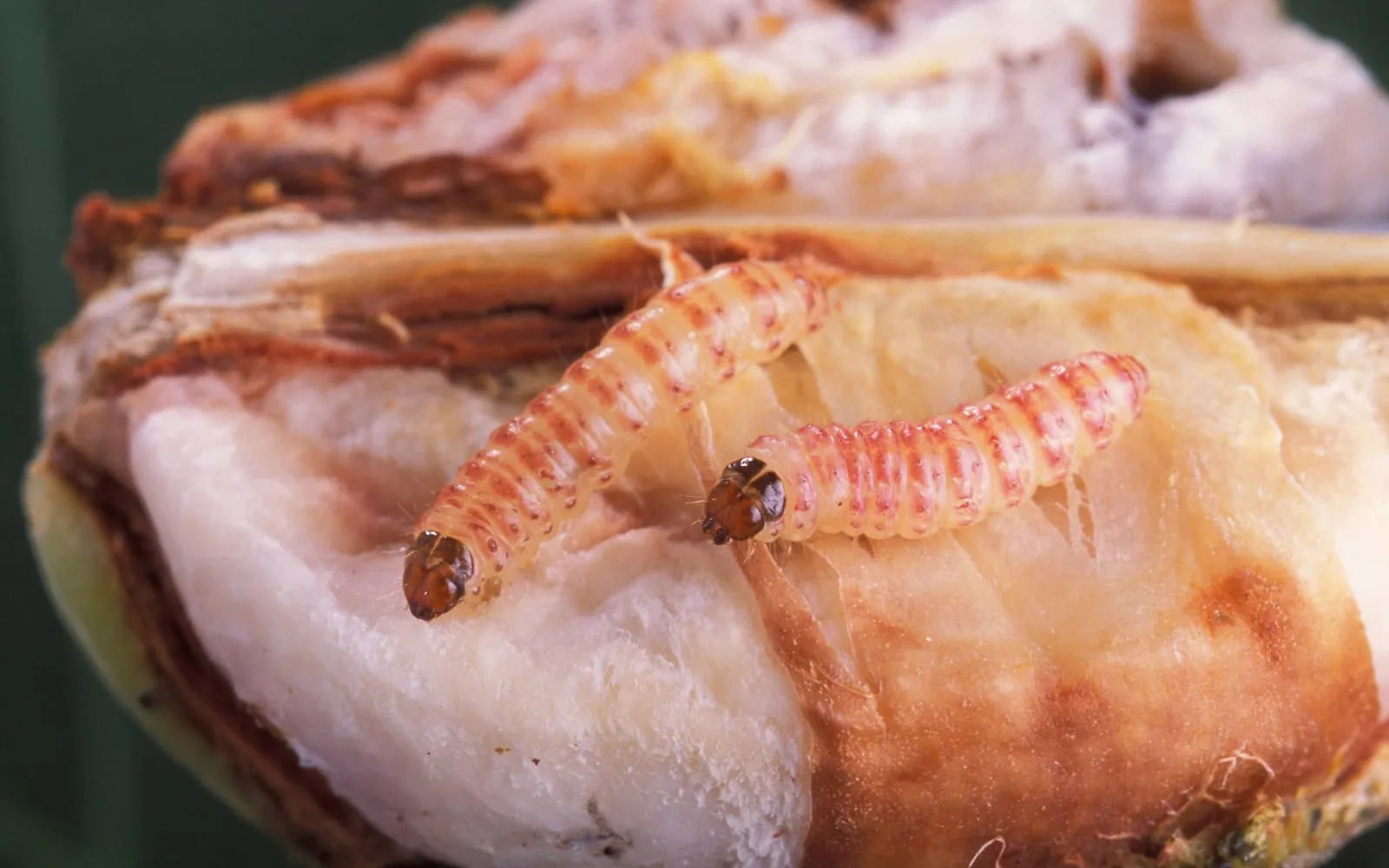
- Small, pinkish-striped caterpillars found inside bolls when opened, the colouring that gives the species its name
- Bolls failing to open properly at harvest, or opening to reveal reduced, damaged lint rather than a full clean boll
What you are looking at
A cotton flower with its petals fused into a tight, rosetted shape instead of opening normally is often the earliest visible sign, marking where a larva is already feeding inside. As the boll develops, small entry holes appear on its surface, sometimes with a trace of frass or fine webbing around them, and opening an affected boll usually finds small, pinkish-striped caterpillars inside, the colouring the species is named for. The lint around them is stained yellow or brown and stuck together in a tangled mass rather than opening cleanly, seeds are holed or partly eaten, and at harvest an affected boll frequently fails to open properly or reveals reduced, damaged lint rather than a full clean one.
From a minor Asian pest to a target of a fifty-year eradication campaign
Native to Asia, this species has become one of the most economically damaging cotton pests worldwide, established across much of Africa, Asia and Latin America wherever cotton is grown outside a small number of successful eradication zones. It reached the continental United States in the 1910s and remained a serious pest there for a century, until a coordinated campaign, run jointly with Mexico across the south-western United States and the northern Mexican cotton belt, combined pheromone mating disruption, Bt cotton and billions of sterile moths released by air. That combination achieved full eradication, confirmed in 2018, after more than fifty years of sustained effort, and stands as one of the larger insect eradication successes on record. It has never established in Europe, Australia, New Zealand or the Pacific, all of which treat a find as reportable given the scale of damage it has caused wherever it has become established elsewhere.
What to do about it
Destroy crop residue, old bolls and volunteer cotton plants promptly after harvest, since larvae overwinter in exactly this material.
Use certified, pest-free planting seed, since infested seed and raw cotton are among the main ways this insect has spread to new regions.
Monitor with pheromone traps to detect a rising population early, and time planting to avoid the period of peak local moth activity where regional guidance recommends it.
Grow an approved Bt cotton variety where locally registered, and support any area-wide mating disruption or sterile release programme running in the district rather than relying on individual-field treatment alone.
Treat with insecticide only as a last resort, once Bt cotton, mating disruption and sterile release have not held a genuine outbreak back; timed to egg hatch, before larvae reach the protection of the boll, and checked against current local resistance management guidance first.
What it gets mistaken for
Boll weevil is a snout-nosed beetle whose larvae feed inside the same structures but leave a distinctive raised, warty puncture scar on the outside of a bud or boll, and the adult itself is a weevil rather than a caterpillar, easy to tell apart on sight. This species’ rosetted flowers and pink-striped caterpillars found inside the boll are the more reliable sign where both pests might occur.
Not established in North America, Europe, Australia, New Zealand and Pacific Islands
Do not prune, spray or otherwise treat a suspected case. Doing so risks spreading an organism the country has kept out, and it disturbs the evidence needed to identify it. Photograph what you can see, leave the plant alone, and contact your national or state plant health authority. The control advice further down this page is written for regions where this problem is already established.
Native to Asia, and now one of the most economically damaging cotton pests across much of Africa, Asia and Latin America, wherever cotton is grown outside a small number of eradication zones. It reached the continental United States in the 1910s and remained a major pest there for a century, until a coordinated campaign combining pheromone mating disruption, Bt cotton and billions of sterile moths released by air, run jointly with Mexico across the south-western states and northern Mexican cotton belt, achieved eradication confirmed in 2018. It has never established in Europe, Australia, New Zealand or the Pacific, all of which treat a find as reportable given the scale of loss it has caused wherever it has become established.
What to do, in order
The steps below apply where this problem is already established.
Start here
Prevention, and the changes that stop the problem returning. Most of these pages should end at this tier.
- Destroy crop residue and volunteer cotton plants promptly after harvest
- Larvae overwinter in old bolls, plant debris and seed, and destroying stalks and residue immediately after harvest, rather than leaving them over winter, removes the local carryover population before the next season starts.
- Use certified, pest-free planting seed
- This insect can be carried in seed and in raw cotton itself, and movement of infested material is one of the main ways it has spread to new regions historically, which is why certified, inspected seed matters as much here as for any other quarantine pest.
- Time planting to avoid the period of peak moth activity where local guidance recommends it
- Adjusting planting and harvest dates so the crop's most vulnerable stage falls outside the period of highest local moth activity is a standard, low-cost part of integrated management programmes across affected cotton-growing regions.
Then reach for a barrier
Netting, hand removal and water. Nothing here harms anything except the target.
- Monitor with pheromone traps
- Traps baited with the species' sex pheromone are the standard tool for detecting a rising population and timing any further response, used both by individual growers and by government surveillance and eradication programmes.
Then bring in the predators
Encourage what already lives in the garden, and buy predators in where the problem is under glass and nothing will arrive on its own.
- Grow Bt cotton varieties expressing resistance to this pest, where approved locally
- Cotton varieties engineered to express a Bacillus thuringiensis toxin active against this species have substantially reduced damage and insecticide use where adopted at scale, and were a central part of the successful eradication campaign in North America alongside sterile insect releases.Widely grown across major cotton-producing countries including India, China and the United States; approval and specific traits vary by country, so check what is registered locally.
- Use mating disruption with synthetic pheromone dispensers
- Saturating a field or district with the synthetic sex pheromone disrupts males' ability to find females, reducing successful mating and the following generation's population, and was one of the tools combined with sterile releases in the North American eradication effort.Registered and used at scale across affected cotton-growing regions and as part of area-wide eradication programmes; check local registration and supplier before use.
- Support sterile insect release programmes where run by regional authorities
- Releasing large numbers of sterilised moths to mate unproductively with the wild population was, combined with Bt cotton, the approach that achieved full eradication from the continental United States after a campaign lasting more than fifty years.Run by government agricultural agencies as an area-wide intervention, historically including a joint programme across the south-western United States and northern Mexico; not something an individual grower arranges.
Biological controls are live organisms and their sale and release are regulated country by country. An agent sold freely in one place may be unapproved in another, so buy from a licensed supplier where you live and never import or move one yourself.
Plants affected
Guides that name it among the problems to watch for. The list is the plants it is characteristic of rather than everything it will feed on.