
Outdoor plant
Tree Peony
Paeonia suffruticosa
Also known as Moutan Peony
How to grow tree peony, Paeonia suffruticosa. Why the graft union is planted 10 to 15 cm deep to let the scion root itself, the frost that can blacken swelling spring buds overnight, and why a young plant can take five years to flower.
At a glance
- Difficulty
- Moderate
- Water
- Regularly while establishing, then only in extended dry spells
- Light
- Full sun to light dappled shade; afternoon shade in hot climates
- Temperature
- Fully hardy; spring buds are frost-tender
- Hardiness
- USDA 4-8, RHS H6, hardy to -25 C
- Type
- Woody deciduous shrub, living many decades
- Height
- 1-2 m
- Native to
- China
Hardy well beyond most gardens' winters, since the woody framework survives severe cold without dying back the way a herbaceous peony's stems do. The vulnerability sits in spring, when the fat flower buds swell early and a late frost can blacken them outright, losing the year's display on wood that itself takes no lasting harm.
Hardiness zones describe winter cold alone. Summer heat, humidity, rainfall and the length of the growing season decide as much, so treat the range as the outer limit rather than as a recommendation.
Harmful if eaten
- Do not eat
- All parts, particularly the roots and bark
- Harm from
- Eating it
- Affects
- People, cats, dogs and horses
Peony bark and root have been used medicinally for centuries in Chinese herbal preparations, prepared and dosed with care, which is a different matter from eating a piece raw out of a border. The ASPCA lists Paeonia as toxic to dogs, cats and horses, causing vomiting, diarrhoea, lethargy and depression, generally mild and rarely dangerous unless a large quantity is eaten. In people, the same compounds cause stomach upset if plant material is eaten in quantity, though a case of real concern from a garden peony is uncommon. The practical risk is fairly low: peonies are not a plant animals or children are typically drawn to chew, and the roots that carry the highest concentration are underground and out of easy reach unless a border is freshly dug.
Sources: ASPCA (Peony, Paeonia spp), RHS potentially harmful garden plants
About
Tree peony is a woody peony. Unlike herbaceous peonies, it keeps a permanent framework of stems above ground through winter and flowers from that older wood in late spring.
It is slow to establish but long-lived when planted well. The graft union is usually planted deeply so the shrub can form its own roots, and the plant is best left undisturbed once settled. Spring buds can be damaged by late frost, so a sheltered position helps protect the display.
Appearance and character
The woody framework is the defining feature, pale grey to tan stems that persist through winter and thicken with age, eventually forming a gnarled, architectural shrub even without leaves or flowers.
Leaves are large and twice-divided, glaucous green, giving the whole plant a soft, blue-toned texture even before the flowers open.
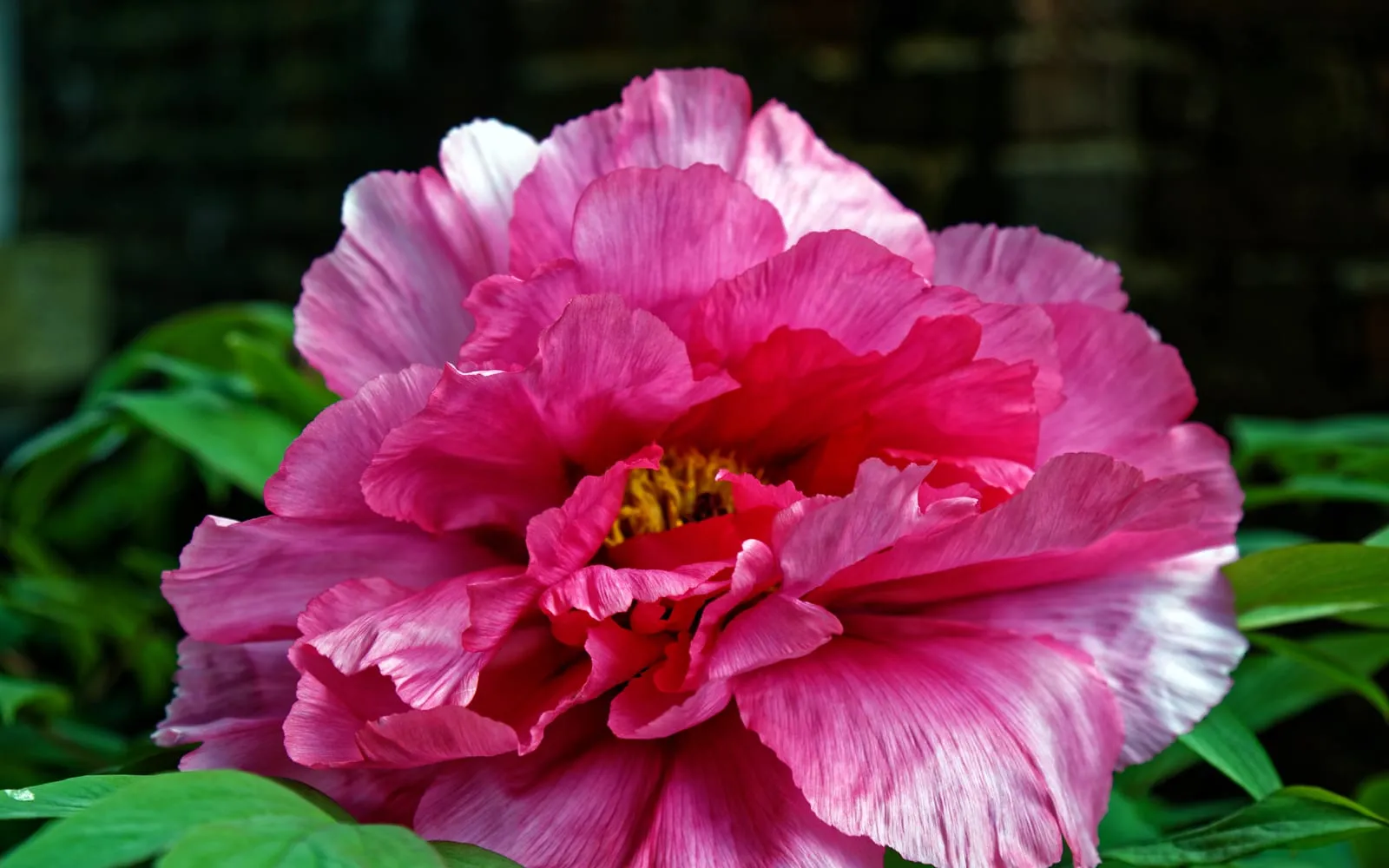
Flowers appear in late spring, enormous and ruffled compared with any herbaceous peony, in a colour range spanning white, pink, red, purple and yellow, often with a darker blotch at the base of each petal. A well-grown mature plant can carry fifty or more blooms in a single flush, though each individual flower lasts only a matter of days.
Where it is from
Paeonia suffruticosa is native to China, where wild populations grow on rocky mountain slopes and it has been cultivated in gardens since at least the Tang dynasty, prized above all other flowers in Chinese horticultural tradition and associated in that tradition with wealth and honour.
It reached Europe in the late eighteenth century and Japan much earlier, where a parallel tradition of tree peony breeding produced many of the cultivars grown today, some Chinese in origin and some Japanese, with subtly different flower forms between the two traditions.
How it grows
Plant in deep, fertile, well-drained soil, ideally neutral to slightly alkaline, in a position sheltered from strong wind and, where possible, from the earliest morning sun, which thaws frosted buds too fast and worsens the damage.
If the plant is grafted, a common way tree peonies are propagated, set the graft union around 10 to 15 cm below soil level rather than at or above the surface. This encourages the scion, the tree peony half of the graft, to form its own roots over time, which improves its long-term vigour and independence from the rootstock it was grafted onto.
Plant in autumn where possible, giving the roots time to establish before the following spring’s growth begins.
Avoid moving an established plant once it is settled. Root disturbance can set a tree peony back for a year or more after transplanting, sometimes with no flowers the following spring.
Prune only to remove dead, damaged or crossing wood, in late winter before growth starts. Unlike many flowering shrubs, it does not need or benefit from routine hard pruning, since flowers form on the previous year’s wood and heavy cutting removes the coming season’s display along with it.
Through the seasons
Late winter is for any necessary pruning of dead or damaged wood, done before growth resumes.
Spring brings bud swell, the period of greatest frost risk, followed by the main flowering display in late spring.
Summer is quiet growth after flowering. Water during any extended dry spell and deadhead spent flowers if seed set is not wanted.
Autumn is the best planting time for new specimens, and a good time to mulch around an established plant’s root zone.
Care difficulty
Moderate, and largely a matter of patience rather than ongoing labour. Once planted correctly and left undisturbed, a tree peony needs comparatively little routine attention. It needs no hard annual pruning, no staking beyond the largest cultivars, and no repeated feeding beyond an annual application. The two real risks are a late frost catching the spring buds and moving the plant once it has settled, both of which cost a season’s flowers rather than the plant itself.
Watering
Water regularly through the first two growing seasons while the root system establishes, a deep soak rather than frequent light watering, which encourages roots to grow down rather than staying shallow.
Once established, water only during an extended dry spell, particularly while flower buds are swelling in spring, since drought stress at that stage can reduce the size and number of the season’s blooms.
Warning signs, diseases and pests
Peony wilt, or peony grey mould, blackens young shoots and buds at the base in wet spring weather, sometimes with a grey, fuzzy mould visible on the affected tissue in damp conditions. Cut out and destroy affected growth promptly, and clear fallen leaves and debris from around the plant in autumn, since the fungus overwinters in plant debris on the ground.
Honey fungus occasionally affects older or stressed plants, showing as gradual dieback and, eventually, fungal growth at the base near soil level. There is no reliable treatment once it takes hold, and removal is usually the only option.
Frost damage to swelling spring buds is by far the commonest cause of a disappointing display, browning or blackening the buds before they can open. There is no cure once it has happened, only prevention the following spring: choose a sheltered site and cover vulnerable buds with fleece on forecast frosty nights.
Growing environment
Full sun to light dappled shade suits it best in most climates; in a hot summer climate, some afternoon shade helps the flowers last longer before fading.
Deep, fertile, well-drained soil is essential. It does not tolerate waterlogged ground, which rots the roots regardless of how well the top growth otherwise performs.
Shelter from strong wind and from the earliest morning sun protects both the woody framework, which can be brittle at the joints in youth, and the frost-vulnerable spring buds.
Mulch the root zone in autumn with well-rotted compost, keeping it clear of the stems, both to feed the soil and to moderate temperature swings around the shallow feeder roots.
Feeding
Apply a balanced fertiliser or a bonemeal-based feed in early spring, as growth resumes, following the product’s guidance for a woody shrub rather than over-applying.
A yearly mulch of well-rotted compost or manure around the root zone in autumn supplies most of the general fertility a tree peony needs beyond that single spring application.
Avoid heavy nitrogen feeding, which pushes soft leafy growth at the expense of flowering and can also make new shoots more vulnerable to frost damage.
Troubleshooting
The flower buds turned black before opening. Frost, almost certainly, if this happened after a cold night in spring. There is no recovery for that year’s buds; protect the plant with fleece on forecast frosty nights in future springs, and consider a more sheltered position if this happens repeatedly.
It has not flowered since I moved it. Transplanting stress. Tree peonies commonly skip a season or more of flowering after being moved, and time and a stable position from now on are the only real fix, since further disturbance only extends the recovery.
New shoots blackened and collapsed in spring. Peony wilt is the likely cause in cool, damp spring weather. Cut out affected growth straight away and clear fallen debris from the base to reduce the chances of it recurring.
Why is my plant still small after several years? Tree peonies grow slowly by nature, and a young plant can take five years or more to reach a flowering size that shows what it is capable of. Steady, undisturbed growing conditions matter more here than any feeding regime.
Can I grow it in a container? Yes, in a large, deep pot with excellent drainage, though it grows and flowers more slowly than one planted in open ground and needs repotting into fresh soil every few years to keep it in good health long term.