
Pest
Boll weevil
Anthonomus grandis
Boll weevil punctures cotton squares and bolls to feed and lay eggs. It has been eradicated from nearly the entire United States, but remains present in Mexico, Central America and a small corner of south Texas.
At a glance
- Type
- Pest
- Cause
- Insect
- Severity
- Destroys the crop or display
- Affects
- Herbs and edibles
- Active
- June to August
- Established in
- North America and Central and South America
What you are seeing
- Small punctures in cotton squares (the flower buds) and developing bolls, each surrounded by a slightly raised, warty scar
- Squares that yellow, wither and drop from the plant within days of being punctured, a condition known as flared squares before they fall
- Grubby white larvae, legless and curved, feeding inside a punctured square or boll
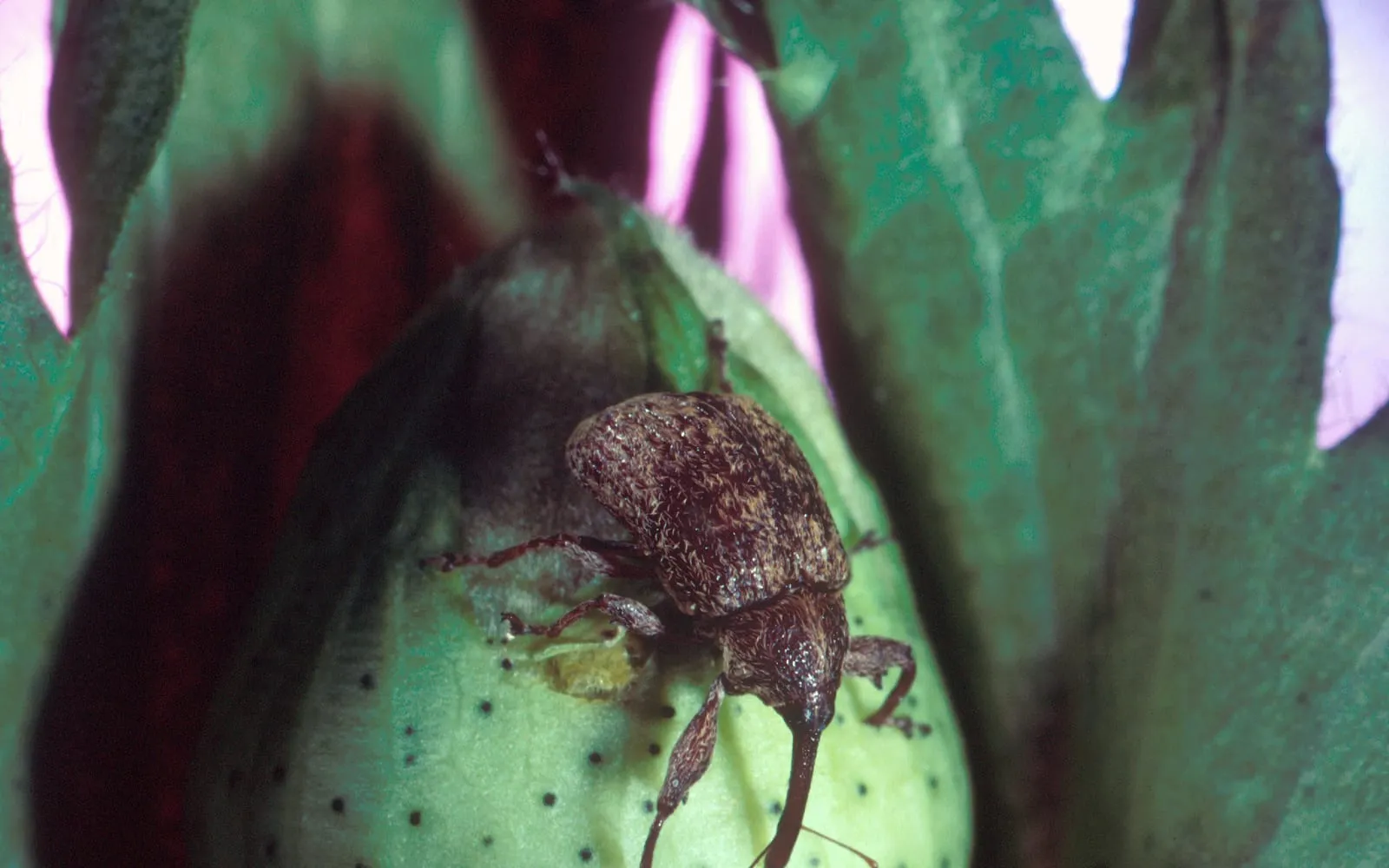
- Adult weevils 6 mm long, greyish brown, with a long curved snout roughly a third of the insect's total body length
- Damage concentrated on the flowering and boll-forming parts of the plant rather than the leaves
Before you treat anything
None beyond ordinary field hygiene. This pest affects fibre and seed yield rather than food safety.
What you are looking at
Small punctures in cotton squares, the flower buds that would otherwise open and set a boll, each surrounded by a slightly raised, warty scar. A punctured square yellows, withers and drops from the plant within days, a stage growers historically called flared squares, since a heavily infested field carried noticeably fewer developing bolls than punctures would suggest on their own. Cut a puncture open and there is often a grubby white, legless, curved larva feeding inside.
The adult is a greyish-brown beetle about 6 mm long, distinguished from almost anything else on a cotton plant by a long curved snout that runs to roughly a third of its total body length, used to bore the puncture and lay a single egg inside it.
A genuine eradication success story
Few pests illustrate the difference between “established” and “everywhere it could survive” better than this one. Native to Mexico and Central America, it crossed into Texas in the 1890s and spread through the entire United States Cotton Belt within thirty years, becoming the single most consequential agricultural pest in the country’s history and the direct inspiration for the boll weevil monument in Enterprise, Alabama, erected because the crop failures it caused forced a shift to more diverse farming that left the region better off in the long run.
A coordinated, decades-long eradication campaign combining pheromone traps and targeted, precisely timed insecticide applications has since removed it from nearly every cotton-growing state. The most recent reporting places the only surviving US population in a small area of the Lower Rio Grande Valley in extreme southern Texas, kept under active suppression rather than left to recover. It remains established through Mexico and parts of Central and South America, and it has never established anywhere outside the Americas.
What to do about it
Outside the Lower Rio Grande Valley, a weevil matching this description is unusual enough to be worth reporting to the state eradication programme or plant health authority rather than treated as a routine field pest, since catching a reintroduction early is what keeps decades of progress from being undone.
Within an area still managing a population, destroy cotton stalks promptly after harvest rather than leaving them standing, and support the area-wide pheromone trapping programme rather than relying on individual field measures alone, since this is a pest that coordinated regional action brought under control and individual action alone did not.
What it gets mistaken for
Capsid bugs leave ragged marks on leaves and shoot tips rather than the small, round, warty-rimmed punctures this weevil leaves specifically on squares and bolls. A dropped, yellowing flower bud carrying a clear puncture mark is the more distinctive sign to look for.
What to do, in order
Start here
Prevention, and the changes that stop the problem returning. Most of these pages should end at this tier.
- Destroy stalks promptly after harvest
- Adults overwinter in plant debris, leaf litter and nearby wild host plants close to where cotton grew. Removing and destroying stalks immediately after picking, rather than leaving them standing over winter, is one of the standard practices behind the eradication programme's success and remains the first line of defence in any area with a remaining population.
- Report a suspected find outside the known remaining range
- Given how close the United States is to complete eradication, a weevil matching this description anywhere outside the Lower Rio Grande Valley of Texas should be reported to the state's boll weevil eradication programme or plant health authority rather than treated as a routine pest, since early detection is what keeps a reintroduction from re-establishing.
Then reach for a barrier
Netting, hand removal and water. Nothing here harms anything except the target.
- Monitor with pheromone-baited traps
- Species-specific pheromone traps, deployed as part of coordinated area-wide programmes rather than by individual growers acting alone, are what made eradication achievable in the first place, giving early warning of any population before it can build up and spread.
Then bring in the predators
Encourage what already lives in the garden, and buy predators in where the problem is under glass and nothing will arrive on its own.
- Conserve generalist predators in and around the field
- Various generalist predators take eggs and larvae, though none has proven sufficient on its own against a heavy infestation, which is why the historical answer to this pest was area-wide, coordinated suppression rather than a single farm-level control.
Biological controls are live organisms and their sale and release are regulated country by country. An agent sold freely in one place may be unapproved in another, so buy from a licensed supplier where you live and never import or move one yourself.
Plants affected
Guides that name it among the problems to watch for. The list is the plants it is characteristic of rather than everything it will feed on.