
Outdoor plant
Betel Nut
Areca catechu
Also known as Areca nut, Areca palm, Supari, Pinang, Paan nut
How to identify the betel nut palm, Areca catechu. Palm features, areca nut use, health risks and the limits of safe cultivation advice.
At a glance
- Difficulty
- Easy
- Light
- Light shade when young, full sun when mature
- Temperature
- 25-32 deg C, and it is damaged below 15
- Humidity
- High. It is a wet tropical palm
- Hardiness
- USDA 10-12, RHS H1b, hardy to 13 C
- Type
- Tender evergreen palm
- Height
- 10-20 m
- Native to
- the Philippines, island South East Asia
Wet lowland tropical Asia. It wants constant warmth, high humidity and no dry season, and it will not tolerate a cool night. Palms are slow to bear and crop from about year seven.
Hardiness zones describe winter cold alone. Summer heat, humidity, rainfall and the length of the growing season decide as much, so treat the range as the outer limit rather than as a recommendation.
Poisonous if eaten
- Do not eat
- The nut, which contains arecoline and is a Group 1 carcinogen
- Harm from
- Eating it
- Affects
- People
The areca nut is classified by the International Agency for Research on Cancer as carcinogenic to humans, in Group 1, both on its own and in the betel quid with or without tobacco. Chewing it causes oral submucous fibrosis, a progressive stiffening of the lining of the mouth that eventually restricts jaw opening and is a precursor to oral cancer, and it raises the risk of cancers of the mouth, pharynx and oesophagus substantially. Around six hundred million people use it worldwide, which makes it roughly the fourth most widely used psychoactive substance after caffeine, alcohol and nicotine, and the disease burden across South and South East Asia is very large. The active compound, arecoline, is a cholinergic agonist producing a stimulant effect, sweating, salivation and a raised heart rate, and it is dependence-forming. Acute overdose causes vomiting, diarrhoea, seizures and, rarely, death. The nut is a serious poisoning risk to a child or a pet who swallows one. This is the whole of what the page says about use.
Sources: IARC list of classifications, RHS potentially harmful garden plants, ASPCA toxic and non-toxic plants
About
The betel nut palm is the source of the areca nut, which around six hundred million people chew, putting it roughly fourth in the world after caffeine, alcohol and nicotine. The red stains on pavements across South Asia and the Pacific are what the habit leaves behind.
The nut is not the leaf. A betel quid wraps a piece of areca nut and slaked lime in the leaf of the betel pepper, Piper betle, which is a different plant in a different family, and tobacco is often added. The naming has confused English speakers for four hundred years.
Raychis does not recommend growing this palm for its nut, and its sale or use is restricted in a growing number of jurisdictions. The palm itself is a legal orchard crop across South and South East Asia and an ornamental elsewhere, so this page does not tell anyone to destroy one. What it declines to do is explain harvesting, curing or preparation.
IARC classifies the areca nut as carcinogenic to humans, in Group 1, and the disease burden it causes across South and South East Asia runs into millions of cases of oral disease.
Appearance and character
A very slender single-trunked palm, 10 to 20 m tall with a trunk only 10 to 15 cm thick, which makes it look impossibly thin for its height.
The trunk is smooth, grey-green, and marked with prominent evenly spaced rings where old fronds have fallen away.
There are no spines anywhere on the plant, which separates it from many palms at a glance.
The crown is small for the height, holding only eight to twelve fronds at a time.
Fronds are pinnate, 1.5 to 2 m long, arching, with broad ribbed leaflets that often fuse towards the tip.
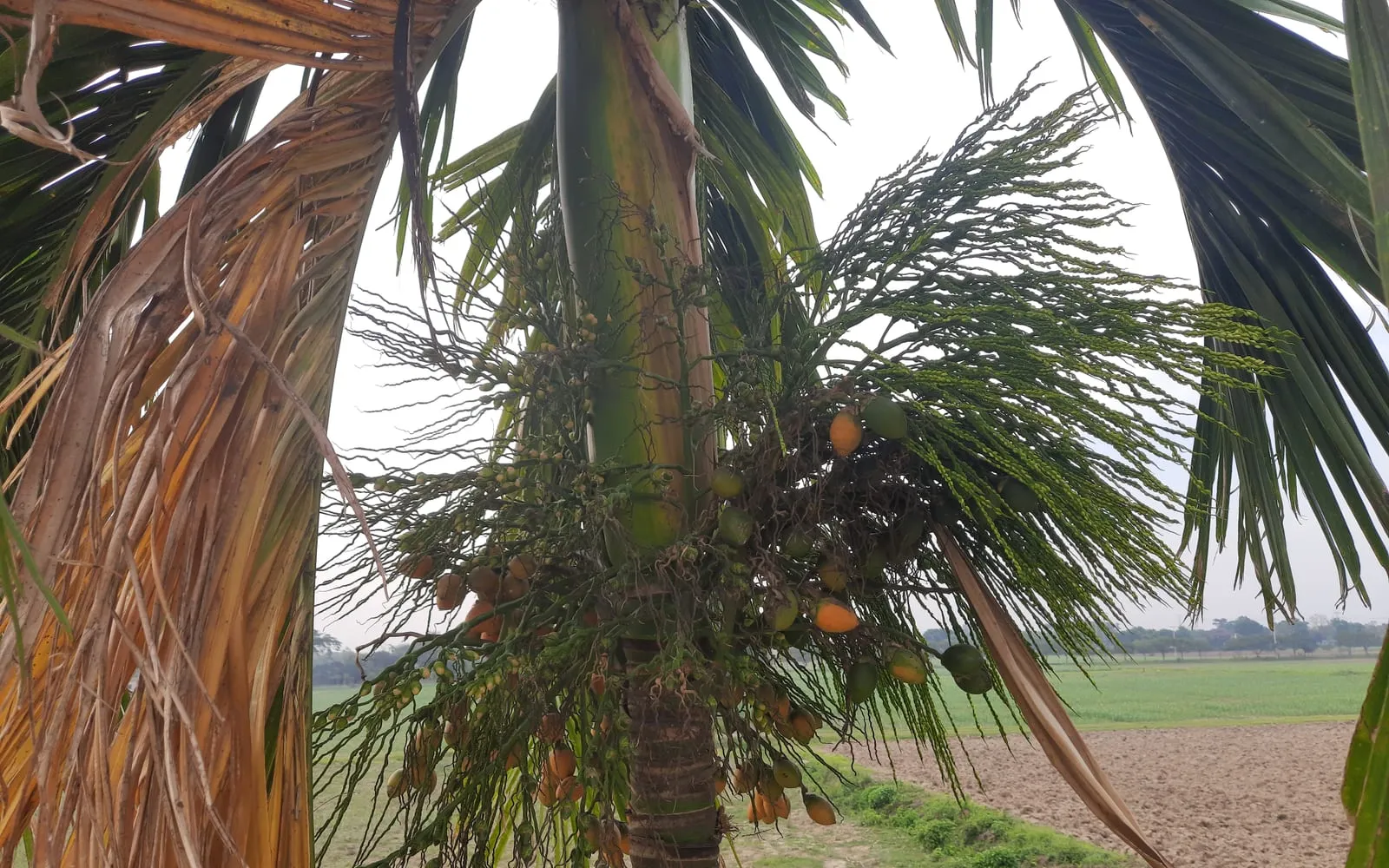
A smooth green crownshaft, formed by the tubular bases of the fronds, wraps the top of the trunk below the crown.
Flowers emerge from below the crownshaft in a branched spray, cream-white and strongly scented, with small males above and larger females below on the same spray.
Fruit hangs in bunches of fifty or more, each an orange to scarlet ovoid 4 to 5 cm long with a fibrous husk over a single hard seed.
That seed is the areca nut, mottled brown and white in cross-section like a nutmeg.
Where it is from
Areca catechu has no known wild population and is thought to have been domesticated in the Philippines or elsewhere in island South East Asia, several thousand years ago.
Austronesian voyagers carried it west and east, and betel chewing spread with them across South and South East Asia, into the Indian subcontinent and out across the Pacific.
Archaeological evidence for chewing goes back at least four thousand years, with stained teeth from burials in the Philippines and Vietnam.
The practice became embedded in social and ceremonial life across the whole region. Betel boxes, cutters and spittoons are part of the material culture of India, Myanmar, Thailand, Indonesia, Papua New Guinea and Taiwan.
India is now the largest producer, followed by Myanmar, Bangladesh, Indonesia and Taiwan.
Public health efforts to reduce use are underway across the region, with advertising restrictions, sales bans in some Indian states and public education campaigns in Taiwan and Papua New Guinea.
How it grows in the wild
No wild population of Areca catechu is known, and the palm exists in cultivation and as an escape from it.
Escapes and self-sown seedlings appear in wet tropical forest and around villages, germinating in the shade beneath established palms.
Seedlings grow in shade and move into full sun as they gain height, which is the usual pattern for a canopy palm.
Growth needs constant warmth and high humidity, and the palm is damaged below about 15 deg C.
It is a wet-tropics plant. Prolonged dry spells check it and it does not tolerate drought.
Flowering begins at four to eight years old and continues year round in the tropics, with several bunches at different stages on one palm.
Fruit is spread by fruit bats and by people, and the seed germinates readily when it falls into warm damp litter.
The root system is shallow and fibrous, which makes tall palms vulnerable in storms.
Through the seasons
In the wet tropics the palm has no seasonal cycle worth speaking of, and flowers and fruits year round.
Where there is a monsoon, flowering follows the rains and fruit ripens through the dry months.
A young palm spends its first few years in shade, putting out fronds slowly and gaining little height.
From about the fourth year the trunk begins to extend, and height increases faster than crown size.
From four to eight years the first flower spray appears below the crownshaft.
Thereafter the palm carries fruit bunches continuously, at several stages of ripeness at once.
Under glass outside the tropics the palm grows through summer and rests through winter, and it does not flower.
Where you will see it
Smallholder orchards and mixed gardens across India, Sri Lanka, Bangladesh, Myanmar, Thailand, Malaysia, Indonesia and the Philippines.
Taiwan, where large plantations grew rapidly in the late twentieth century and where the crop has been the subject of both public health campaigns and hillside erosion concerns.
Village gardens across Papua New Guinea and the Solomon Islands, where chewing is close to universal in some communities.
Botanic garden palm houses in Europe, where it is grown as a specimen.
Occasionally as a conservatory palm outside the tropics, though it is demanding and other palms are easier.
Look-alikes and confusion
The houseplant called an areca palm is a different species. Dypsis lutescens, sold everywhere as the areca palm or butterfly palm, is a clumping palm with many slender yellow-green stems, and it is unrelated to the betel nut palm beyond the family.
Other Areca species, including Areca triandra, are smaller clumping palms with much smaller fruit.
Royal palms, Roystonea species, share the smooth ringed trunk and green crownshaft but are far stouter, with trunks 40 to 60 cm thick.
Bottle palm and spindle palm, both Hyophorbe species, also have a crownshaft and smooth trunk and have distinctly swollen trunks.
Nutmeg is confused with the nut rather than the palm, since a cut areca nut has the same mottled brown and white pattern. Nutmeg comes from Myristica fragrans, a broadleaf tree in a different family.
The reliable characters are an extremely slender ringed trunk for the height, a small crown of eight to twelve fronds, a smooth green crownshaft, no spines anywhere, and hanging bunches of orange fruit.
Growing it is restricted
Raychis does not recommend growing this palm for its nut.
The palm itself is a legal orchard crop across South and South East Asia and is grown ornamentally in tropical gardens worldwide. What is increasingly restricted is the sale and use of the nut. Several Indian states have banned gutka and similar products, Taiwan and Papua New Guinea run public health campaigns against chewing, and a number of countries restrict import or sale. The position varies and it is changing.
Look up the rules where you live before buying, importing or selling areca nut in any form, since import restrictions catch people out more often than cultivation rules do.
This site does not describe harvesting, curing, preparation of a quid, or any use of the nut. Those sections are absent by decision.
The toxicity record on this page sets that limit. The areca nut is classified by IARC as carcinogenic to humans, and the site is not going to explain how to prepare it.
If you find one growing
An areca palm in a tropical garden is a legitimate ornamental and a legitimate crop, and there is no reason to remove it.
Keep the fallen fruit away from children and pets. A nut swallowed by a small child or a dog is a serious poisoning risk quite separate from the long-term cancer risk of chewing.
Clear fallen fruit regularly if the palm overhangs a play area or a path.
Where local rules restrict the sale of the nut, growing the palm and selling its fruit are different questions, and the second is the one to check.
If you have inherited a palm and do not want it, remove it as you would any other tree and dispose of the material normally.
Nothing about the palm itself requires reporting to anyone.
Troubleshooting
Is the areca palm sold as a houseplant the same thing? No. The houseplant areca palm is Dypsis lutescens, a clumping palm from Madagascar. The betel nut palm is Areca catechu, a single-trunked palm from South East Asia, and it does not make a good houseplant.
What is the difference between betel nut and betel leaf? Different plants. The nut comes from this palm; the leaf comes from the betel pepper, Piper betle, a climbing vine in the pepper family. A quid wraps the nut in the leaf, which is where the confusion started.
Will this page tell me how to prepare it? No. Raychis publishes identification and botany for this palm and nothing about harvesting, curing or preparation.
Is chewing it harmful? Yes. IARC classifies the areca nut as carcinogenic to humans in Group 1. Chewing causes oral submucous fibrosis and raises the risk of cancers of the mouth, pharynx and oesophagus substantially.
Why are the pavements red? The quid produces a copious red saliva that chewers spit out, and the stain is characteristic across South Asia and the Pacific.
Is it legal? The palm is a legal crop across its growing range. The sale of prepared products is restricted in a growing number of places, and import rules catch travellers out. Check the position where you are.
Can I grow one outside the tropics? Only in a heated humid conservatory or palm house, and it is demanding. It wants 15 deg C as an absolute minimum and high humidity year round, and it will not flower here.
Why is it in the app? Because people photograph it and want to know what it is, which is what a plant identification app is for.
Is it related to nutmeg? No. A cut areca nut has a mottled pattern that looks like nutmeg, and nutmeg comes from Myristica fragrans, a broadleaf tree in an unrelated family.
Betel Nut problem guides
Not sure what is wrong? See the common vegetable pests guide.