
Edible
Shagbark Hickory
Carya ovata
How to grow shagbark hickory, Carya ovata. Why a young tree can take a decade or more before its first useful nut crop, why transplanting past its first year rarely succeeds, and the juglone in its roots that stunts nearby tomatoes.
At a glance
- Difficulty
- Difficult
- Water
- Deep, regular watering while young; occasional deep watering once mature
- Light
- Full sun
- Temperature
- Fully hardy
- Hardiness
- USDA 4-8, RHS H7, hardy to -30 C
- Type
- Slow-growing, very long-lived deciduous tree
- Height
- 20-30 m
- Native to
- eastern North America
One of the most cold-hardy nut trees available, tolerating winters that would kill a pecan outright, and it needs a shorter, cooler growing season than its warmer-climate relative to mature a crop. The zone number understates how slow it is to reward that hardiness: a tree can take a decade or more before it produces meaningful quantities of nuts, regardless of how well suited the climate is.
Hardiness zones describe winter cold alone. Summer heat, humidity, rainfall and the length of the growing season decide as much, so treat the range as the outer limit rather than as a recommendation.
Edible, with limits
- Safe to eat
- Ripe, sound kernels
- Do not eat
- Moldy fallen nuts and husks
- Harm from
- Eating it
- Affects
- Dogs
The sweet kernel inside a sound, ripe shagbark hickory nut is edible and has long been gathered and eaten in the same way as pecan, its close relative. The documented risk is the same one that applies across the genus: old, damp nuts and husks left on the ground can develop tremorgenic mycotoxins from Penicillium mould, which have caused tremors and seizures in dogs that eat mouldy walnuts and hickory nuts. A tree also produces juglone, a compound in its roots, leaves and husks that suppresses the growth of some nearby plants, tomatoes and members of the nightshade family in particular. That is a threat to other plants sharing the root zone rather than to a person, pet or grazing animal. Raking up old fallen nuts before they mould is the practical safeguard where dogs have access to the tree.
Sources: ASPCA toxic and non-toxic plants, RHS potentially harmful garden plants
About
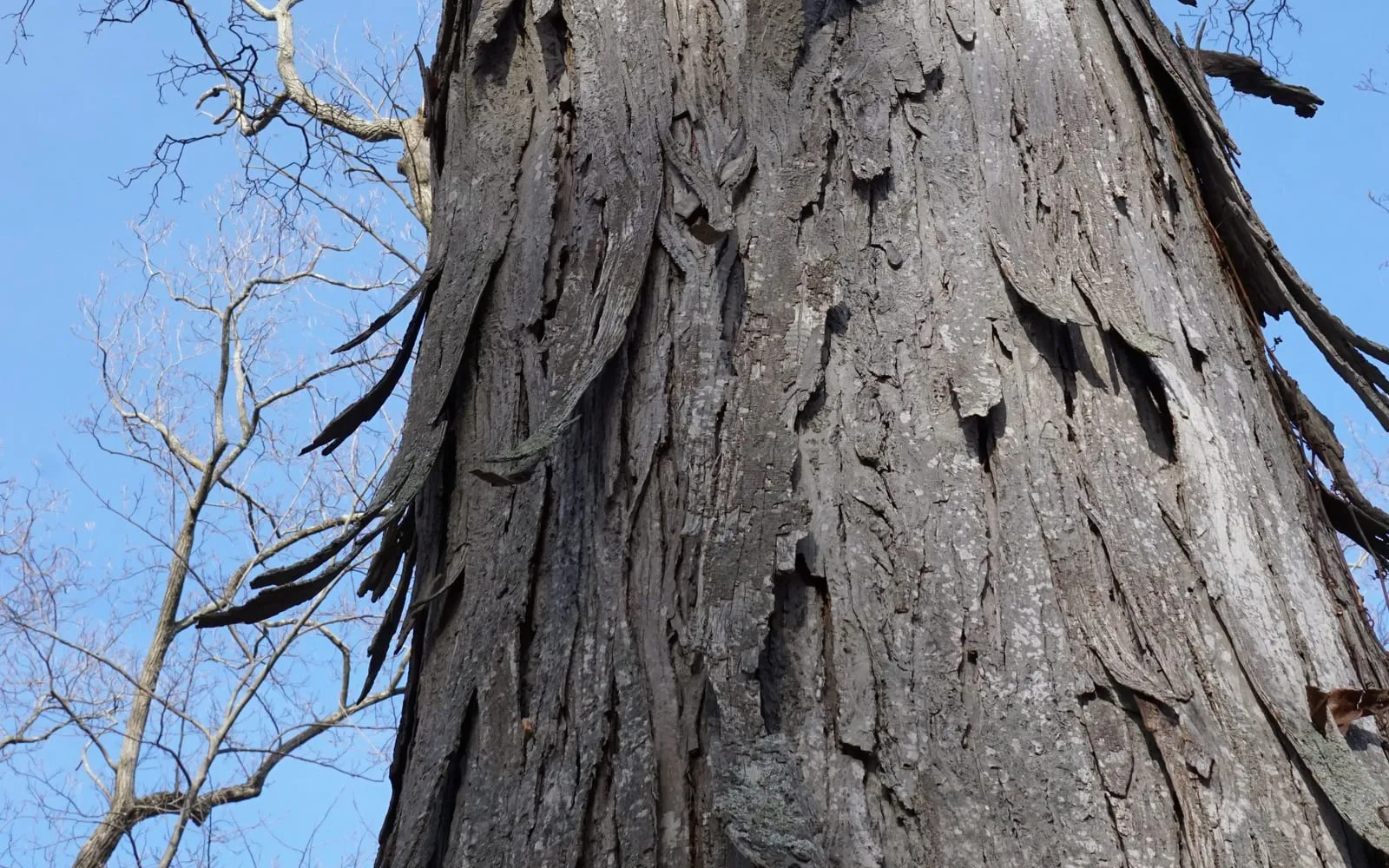
Shagbark hickory is a tall, slow-growing native tree best known for the long, curling plates of grey bark that peel away from the trunk as it matures, giving older specimens an unmistakable shaggy silhouette. It also produces one of the sweetest-tasting nuts of any native hickory, though a young tree takes considerably longer to bear than most fruit or nut trees a gardener plants deliberately.
Cold is rarely a problem for it. What tests a grower’s patience is the tree’s pace: slow early growth, a deep taproot that resents disturbance, and often a decade or more before the first worthwhile crop of nuts.
Appearance and character
The bark is the tree’s defining feature once it reaches maturity, splitting into long, thick, vertical plates that curl away from the trunk at both ends while staying attached in the middle, a texture unlike any other common tree. Young trees have smooth, grey bark and only develop the shaggy character with age, usually after several decades.
Leaves are pinnately compound with typically five broad leaflets, the terminal three noticeably larger than the pair closest to the stem, and turn a warm golden yellow in autumn. The nuts develop inside a thick, four-part husk that splits cleanly open at ripeness, releasing a smooth, off-white shell that cracks to reveal a sweet, plump kernel prized above most other hickories for flavour.
The overall form is tall and relatively narrow-crowned compared with a spreading pecan, well suited to growing among other trees in the mixed hardwood forest that is its natural setting.
Where it is from
Carya ovata is native across eastern North America, from southern Quebec and Ontario down through the eastern and central United States, most commonly found on well-drained upland slopes and in rich, mixed hardwood forest alongside oaks. It is an exceptionally long-lived tree, regularly reaching two to three hundred years of age where undisturbed.
Growing among tall forest neighbours for light has shaped its narrow, upright form, and centuries of competing with established oaks and other hardwoods for space and nutrients likely explains its notoriously slow early growth, a strategy that favours a tree adapted to outlast its neighbours rather than to outgrow them quickly.
How it grows
Plant in deep, fertile, well-drained soil in full sun, choosing the final position with real care, since the tree’s deep taproot makes it one of the hardest species to transplant successfully once it is more than a year or two old.
Water deeply and consistently through the first several years while the taproot is establishing, since this is the period when the tree is most vulnerable to drought stress and when its slow, steady root growth is setting up decades of future performance.
Expect slow growth for the first several years above ground even in good conditions, since much of a young hickory’s early energy goes into establishing that deep taproot rather than visible top growth. Patience at this stage, rather than heavy feeding, is what gets a tree through it.
Avoid crowding it with other trees if a strong nut crop is the goal. While it tolerates the dappled shade of a young forest well, it fruits far more heavily with reasonable direct sun on its canopy.
Through the seasons
Spring brings leaf emergence, later than many other trees, and flowering as wind-pollinated catkins open.
Summer is the main growing season, with nuts developing steadily inside their green husks through the warmer months.
Autumn brings the nut harvest as the husks split and drop, along with good golden foliage colour before leaf fall.
Winter is complete dormancy. The tree is exceptionally cold hardy and needs no protection through even a severe winter once established.
Care difficulty
Difficult, and the difficulty is almost entirely about time rather than ongoing labour. The tree needs no elaborate care once planted, but the combination of a taproot that punishes transplanting, slow early growth above ground, and a long wait before the first useful nut crop tests a gardener’s patience more than their skill. A grower prepared to plant it young, in its permanent position, and wait is rewarded eventually with an exceptionally long-lived, low-maintenance tree.
Watering
Water deeply and regularly through the first several years, aiming for infrequent, thorough soakings that encourage the taproot to grow down rather than frequent shallow watering that keeps moisture near the surface.
Once established, a mature shagbark hickory tolerates normal seasonal dry spells well, needing supplemental watering only in an unusually prolonged drought, though consistent moisture through summer supports a fuller nut crop.
Warning signs, diseases and pests
Hickory nut weevil grubs develop inside maturing nuts, feeding on the kernel from within in a way that is often only discovered once the shell is cracked open. Removing and disposing of fallen, weevil-damaged nuts each autumn reduces the population able to complete its life cycle.
Phylloxera galls appear as small, irregular swellings on the leaves and leaf stalks, caused by tiny sap-feeding insects. They are mostly cosmetic on an otherwise healthy tree and rarely need treatment.
Walnut caterpillar and hickory tussock moth caterpillars can defoliate whole branches in a bad year, feeding in groups in mid to late summer. Removing egg masses or young colonies by hand limits damage on a manageable-sized tree.
Bracket fungi and wood decay develop in the trunk of old or previously wounded trees, visible as shelf-like fungal growths on the bark. There is no cure once decay is established internally, and a tree showing this on a major limb should be assessed for the risk of that limb failing.
Growing environment
Full sun to light shade suits it well, mirroring the dappled light of a young hardwood forest, though full sun on the canopy of a mature tree produces the heaviest nut crops.
Deep, well-drained, fertile soil favours strong root development, and a shallow or compacted soil profile limits the taproot the tree depends on for both stability and drought tolerance later in life.
Given its eventual great size and long lifespan, it is best planted where it will never need to be worked around or removed, since a mature specimen represents a very long-term commitment to that spot in the garden or landscape.
Feeding
Feeding needs are modest on reasonable soil, where an annual light application of a balanced fertiliser in spring is usually enough to support steady growth.
Avoid heavy or frequent feeding, particularly of high-nitrogen products, which can push soft growth at the expense of the slow, steady development that builds a strong, long-lived tree.
Troubleshooting
The tree has grown very little above ground for several years. This is typical rather than a sign of a problem. Young shagbark hickories put most of their early energy into the taproot, and visible top growth usually picks up noticeably once that root system is well established.
I transplanted a young tree and it has struggled since. Root disturbance is poorly tolerated because of the deep taproot, and recovery can take a full growing season or more, if the tree recovers at all. Planting future trees in their permanent position from the start avoids the problem entirely.
How long until it produces nuts? Considerably longer than most fruit or nut trees, often a decade or more from a young tree, and sometimes longer still from a seedling grown from a nut rather than a grafted selection.
Other plants nearby are struggling or dying. Shagbark hickory produces juglone, a compound that suppresses the growth of some sensitive neighbouring plants, tomatoes and other nightshades especially. Keeping sensitive plants well clear of the root zone, rather than close to the trunk, avoids most of the problem.
Is it safe for my dog to be around the tree? Fresh, sound nuts are not a concern, but old fallen nuts and husks left to rot on the ground can develop toxins that cause tremors in dogs that eat them. Regularly clearing fallen nuts removes the real risk.