
Edible
Rapeseed
Brassica napus
Also known as Oilseed rape, Canola, Colza, Swede
How to grow rapeseed, Brassica napus. The yellow fields that take over the landscape every spring, a hybrid of turnip and cabbage, and the two compounds that had to be bred out before anyone could eat it.
At a glance
- Difficulty
- Moderate
- Water
- Rain-fed. A garden patch needs nothing after establishment
- Light
- Full sun
- Temperature
- Winter types are hardy to minus 15 deg C once established
- Hardiness
- USDA 3-9, RHS H5, hardy to -15 C
- Type
- Annual or biennial, autumn or spring sown
- Height
- 100-180 cm
- Native to
- Europe, created in cultivation from turnip and cabbage
- Best month
- August, September, April and July in the Northern Hemisphere, February, March, October and January in the Southern Hemisphere
Winter and spring types split as they do in wheat. Winter rapeseed needs vernalisation, yields far more and is grown where winters are mild enough for it to survive standing, and spring rapeseed is sown where they are not, which is why Canada grows spring canola and Europe grows winter oilseed rape. Erucic acid and glucosinolates were both bred out in the 1970s, and the name canola records that work. Establishment is the hard part, and cabbage stem flea beetle became the defining problem after neonicotinoid seed treatments were banned for outdoor use across the EU and Britain in 2018.
Hardiness zones describe winter cold alone. Summer heat, humidity, rainfall and the length of the growing season decide as much, so treat the range as the outer limit rather than as a recommendation.
Every month named in this guide is for the temperate Northern Hemisphere. If you garden in the Southern Hemisphere, shift each one by six months, so August becomes February. Closer to the equator the wet and dry seasons matter more than the calendar, and the shift stops being a useful guide.
Edible, with limits
- Safe to eat
- The pressed oil, and the young leaves and shoots cooked
- Do not eat
- The unprocessed seed and meal of high-erucic varieties
- Harm from
- Eating it
- Affects
- People and horses
Rapeseed oil as sold in Britain is safe and is the country's main cooking oil. Getting there took deliberate breeding. Traditional rapeseed carried high levels of erucic acid, a fatty acid associated with heart muscle damage in animal studies, and high levels of glucosinolates, which made the residual meal bitter and harmful to livestock. Canadian breeders produced low-erucic and then double-low varieties from the 1960s and 1970s, and the name canola records that work. British and European law now limits erucic acid in food oils. High-erucic varieties are still grown under contract for industrial use, and their oil and meal are not food. Separately, brassica forage including rape can cause haemolytic anaemia and goitre in sheep and cattle when it makes up too much of the diet, and grazing management for brassica crops exists for that reason. The pollen is frequently blamed for hay fever, and rape pollen is heavy and insect-carried, so the grass pollen flowering at the same time is the more likely cause.
Sources: Food Standards Agency on plant toxins, British Horse Society on poisonous plants
About
Oilseed rape is the yellow that fills British fields in late April, and it covers around 300,000 hectares here in a typical year. The oil is the country’s main cooking oil, the meal feeds livestock, and the crop is the standard break between two cereals in an arable rotation.
The plant is a hybrid that arose in cultivation. Brassica napus is the product of a cross between turnip rape, Brassica rapa, and cabbage, Brassica oleracea, with the chromosomes of both retained. The same species also gives the swede, so the root in a Scottish neep and the oil in a British chip pan come from one plant.
Its rise as a food crop is recent and deliberate. Traditional rapeseed oil was industrial, used as a lubricant and a lamp oil, because it carried erucic acid at levels that made it unsuitable for eating. Canadian breeding in the 1960s and 1970s removed that, and then removed the glucosinolates that spoiled the meal, producing the double-low varieties grown today.
Appearance and character
The plant is upright and branching, standing waist to chest high, with blue-green leaves carrying a waxy bloom. The lower leaves are stalked and lobed, and the upper ones clasp the stem directly, which separates Brassica napus from Brassica rapa, whose upper leaves clasp the stem with distinct ears.
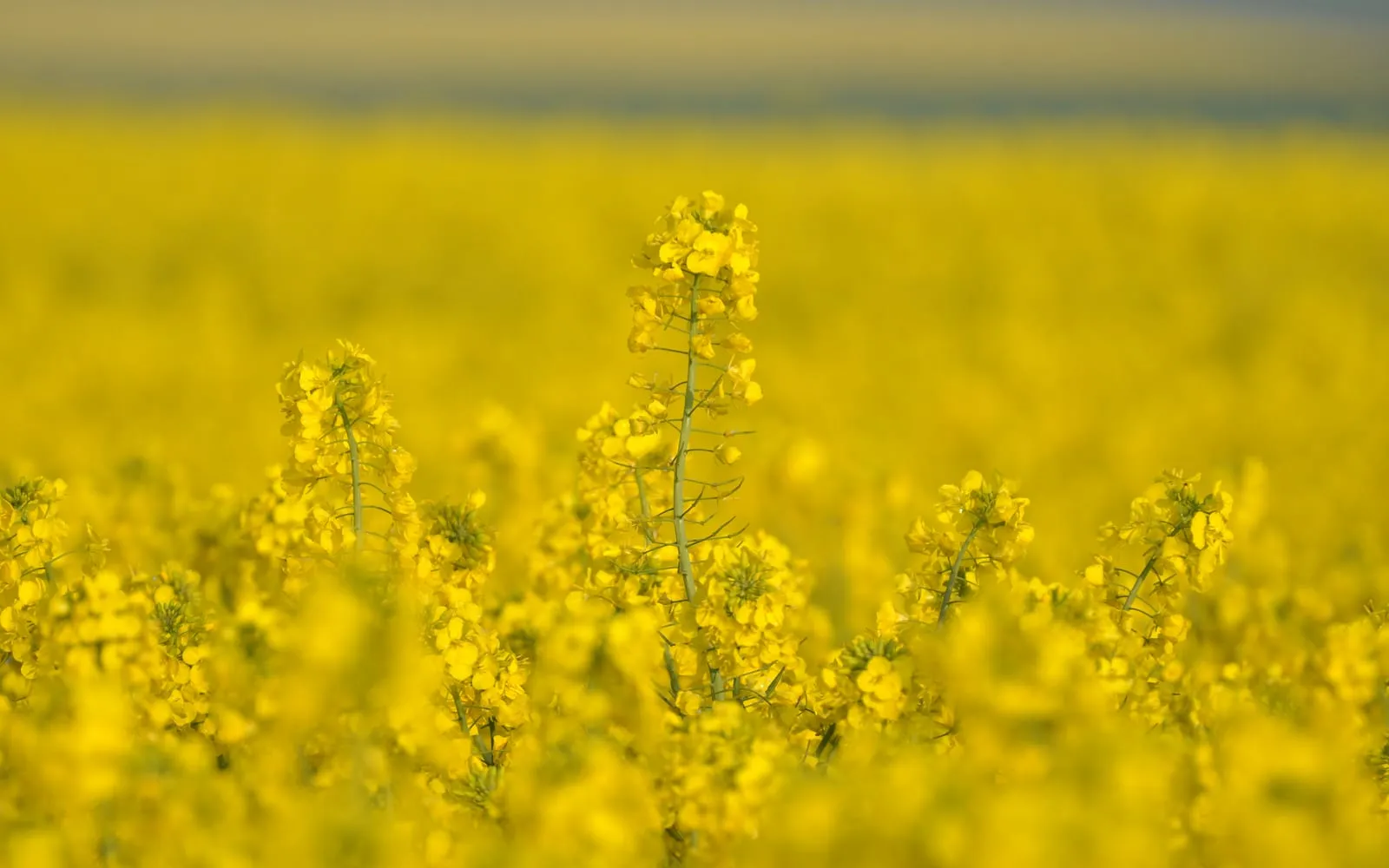
The flowers are typical brassica flowers, four yellow petals in a cross, carried in dense spikes that lengthen as they open from the bottom up. A field in full flower is one of the loudest colours in British agriculture and smells strongly sweet at close range.
The pods are slender upright siliques, 5 to 10 cm long, splitting along two seams when ripe to release small round seeds, black to reddish-brown and about 2 mm across. Those pods shatter readily, which is why a harvested field seeds itself with volunteers for years afterwards.
Where it is from
Brassica napus has no wild origin, because it arose in cultivation from a cross between turnip rape and cabbage. The hybridisation happened in Europe, probably in the medieval period or a little earlier, and the two forms that resulted are the oilseed and the swede.
Rapeseed oil was pressed in Europe from at least the sixteenth century, used for lamps and later as a steam-age lubricant, since it clings to metal surfaces washed by steam better than most oils.
Its transformation into a food crop was Canadian. Breeding programmes at Manitoba and Saskatchewan produced low-erucic varieties in the 1960s and double-low varieties in the 1970s, and the trademark canola, from Canadian oil low acid, dates from that work. European production followed, and the crop became a fixture of British arable farming in the 1970s and 1980s.
How it grows
Winter oilseed rape is sown in late August and September, immediately after the cereal harvest, and it needs to establish fast. The seedling stage is short and critical, and a crop that fails to get away is usually a crop that has been eaten.
It grows into a flat rosette through the autumn, sits out the winter, and extends rapidly in spring. Most varieties need a cold period before they will flower. Spring rape is sown in March and yields considerably less.
Flowering runs for three to four weeks from mid-April, and the crop is largely self-pollinating with substantial insect visitation. Pods fill over six weeks, and the crop ripens from the bottom of the plant up.
The final complication is shattering. Ripe pods split at a touch, so harvest timing is tight, and volunteer rape from shed seed comes up in the following crops for several years.
Through the seasons
Sow winter rape from mid-August to early September, shallowly into a moist seedbed, and protect it while it is small. Spring rape goes in during March.
The autumn crop forms a rosette by November and sits through the winter, taking pigeon grazing without much long-term harm if it is well rooted. Growth restarts in February with the first nitrogen.
Flowering is from mid-April into May, and the pods fill through June. Harvest in July, before the pods start shedding, and dry the seed thoroughly. In a garden a short row grown for the flowers and for a small quantity of seed is straightforward.
Care difficulty
Establishing the crop is the difficult part in Britain, and one insect explains why. Cabbage stem flea beetle shot-holes the cotyledons of an autumn-sown crop and its larvae then tunnel in the petioles and stem, and it has become the dominant problem since the neonicotinoid seed treatments that controlled it were banned for outdoor use across the EU and Britain in 2018. Growers now rely on sowing date, seed rate, companion cropping and variety vigour instead.
A garden row faces the same beetle at much less cost. Sow thickly, sow early into moisture so the plants outgrow the damage, and accept some shot-holing.
After establishment the crop is undemanding, and the main judgement is when to cut it, since ripe pods shatter and a week of delay costs a substantial part of the seed.
Watering
Rain-fed, and irrigation of oilseed rape is rare in Britain. The crop roots deeply and finds its own water through the spring.
Water a garden sowing once at establishment if late August is dry, since the plants need to get clear of the seedling stage fast.
Waterlogging over winter kills a crop as reliably as anything, causing yellow stunted plants with shallow roots that then fail in the spring. Choose drained ground.
Warning signs, diseases and pests
Cabbage stem flea beetle produces small round shot holes in the cotyledons and first true leaves in September, and its larvae tunnel inside the leaf stalks and stem over the winter. Cut a stem open in January and the tunnels are visible.
Phoma stem canker starts as pale leaf spots with tiny black dots and travels down the leaf stalk into the stem, where it produces a canker at the base that can break the plant. Light leaf spot shows as pale mottled patches with a fringe of white spore droplets at the edge, best seen after a leaf has been kept warm in a bag overnight.
Sclerotinia stem rot follows a wet flowering, showing as bleached lesions on the stem with white cottony growth and hard black bodies inside.
Pigeons graze winter crops hard, sometimes to the ground, and a well-rooted crop usually recovers. Cabbage aphid colonises the flower spikes in grey-green waxy clusters, and clubroot builds up where brassicas are grown too often.
Growing environment
Full sun on an open site. The crop is grown at field scale for good reason and a short garden row will do the same job on a much smaller stage.
Soil should be deep, drained and near neutral, from pH 6 to 7. Rape roots deeply into loam and clay and does poorly on thin sand. Keep it off acid ground, which encourages clubroot, and clubroot is a problem that lasts for decades.
Winter hardiness is good in established plants, down to about minus 15 deg C. The risk is a late-sown crop caught small by hard frost, which is one more argument for sowing in August rather than October.
Feeding
Rapeseed is one of the hungriest arable crops for nitrogen and it is exceptionally responsive to sulphur, which is a legacy of cleaner air. Sulphur deficiency was rare when coal smoke supplied it and is common now, showing as pale young leaves with cupping and a marbled appearance, and pale flowers.
For a garden row, a balanced granular feed as growth restarts in early spring covers both.
Do not feed in the autumn. The crop needs little then, and anything applied will leach over the winter.
Troubleshooting
Is rapeseed the same as canola? Effectively yes. Canola is a trademark for low-erucic-acid rapeseed developed in Canada, and the varieties grown for food in Britain meet the same standard. High-erucic varieties are still grown separately under contract for industrial use.
Does it cause hay fever? Very unlikely. Rape pollen is heavy and carried by insects rather than wind, and the grass pollen season that overlaps with flowering is the usual cause. The strong smell of a field in flower is a different thing from an allergen.
Why did the flea beetle problem get worse? The neonicotinoid seed treatments that controlled cabbage stem flea beetle were banned for outdoor use across the EU and Britain in 2018. Growers now manage it through sowing date, seed rate, companion cropping and variety choice.
Can I press my own oil? A small screw press will produce cold-pressed oil from home-grown seed, and it takes a surprising quantity of seed for a modest bottle. Roughly 40 per cent of the seed weight is oil, and a hand press recovers considerably less than that.
Is swede the same species? Yes. Brassica napus gives both the swede and the oilseed, one selected for a root and the other for seed.
Why do rape plants keep coming up in my beds? Shattering. Ripe pods split at a touch and shed seed, which stays viable in the soil for years. Volunteer rape in a following crop is a standard arable nuisance and it happens in a garden too.
Are the leaves edible? Young leaves and shoots are edible cooked, in the way any brassica green is, and they are eaten in parts of Europe and Asia. They are not what the crop is grown for.
What is the difference between winter and spring rape? Winter types need a cold period before flowering, are sown in late summer, and yield much more. Spring types are sown in March and finish in one season.
Rapeseed problem guides
Not sure what is wrong? See the common vegetable pests guide.
- Cabbage stem flea beetle, the crop's defining problem across northern Europe
- Slugs on autumn seedlings
- Pigeons, which graze a winter crop hard
- Light leaf spot and phoma stem canker
- Sclerotinia stem rot after a wet flowering
- Clubroot where brassicas have been grown repeatedly
- Cabbage aphid, which colonises the flower spikes