
Disease
Sclerotinia
Sclerotinia sclerotiorum
Also called White mould, Sclerotinia stem rot, Cottony rot, Watery soft rot
Sclerotinia makes stems soft and water-soaked, with dense white mould and hard black sclerotia inside. Dead petals often start infection, and the sclerotia can keep soil infectious for years.
At a glance
- Type
- Disease
- Cause
- Fungus
- Severity
- Destroys the crop or display
- Affects
- Garden plants, Herbs and edibles
- Active
- May to October
- Established in
- Worldwide
What you are seeing
- A pale, water-soaked, softening patch on a stem, often part way up rather than at the base
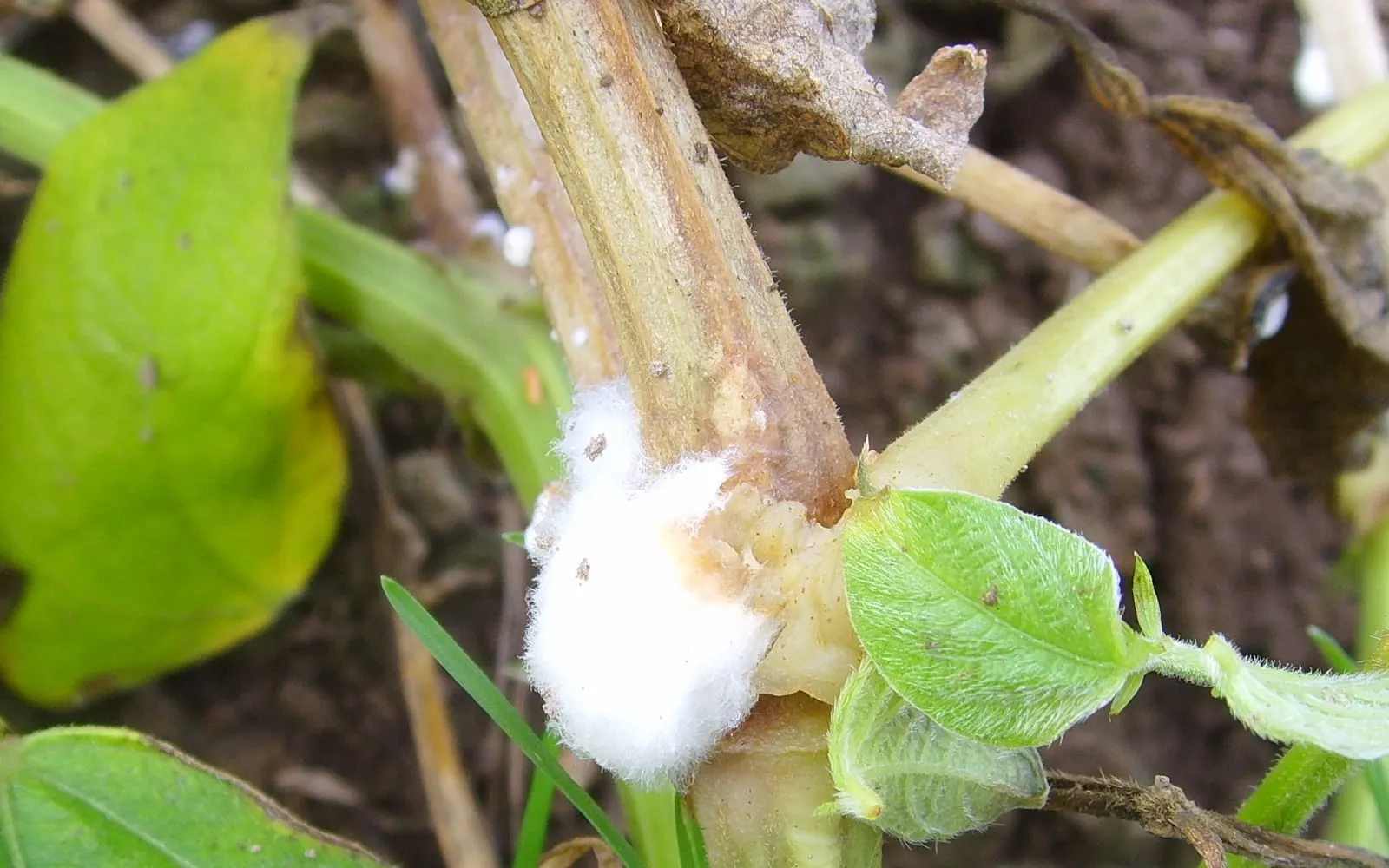
- Dense white mould like wet cotton wool over the rotting tissue
- Hard black lumps the size and shape of mouse droppings, on the surface and inside the hollow stem
- Whole plants wilting and collapsing from a single point on the stem
- A lettuce rotting into a slimy mass at the base while the outer leaves still stand
- Stored carrots and other roots turning soft under a mat of white fluff
- Small buff-coloured cups like tiny mushrooms coming out of the soil in damp weather
Before you treat anything
Rotted material is unpleasant rather than hazardous. Do not eat affected produce, since watery soft rots are usually colonised by bacteria as well.
What you are looking at
A plant that has collapsed from one point on its stem. Above that point everything has wilted; below it the plant looks untouched. The stem itself, at the place it failed, has gone pale, soft and water-soaked, as though it had been soaked and then wrung out.
Over that patch, in damp weather, grows white mould. Not a dusting or a bloom but a dense mass like wet cotton wool, thick enough to pull off in a piece.
Split the stem open. Inside the hollow are hard black lumps, irregular, five to ten millimetres long, which people almost always describe as mouse droppings. Those are the sclerotia, and they are what makes this disease a long-term problem rather than a bad season.
On lettuce the plant rots into a slimy heap at the base while the outer leaves are still standing. On stored carrots it is a white fluffy mat spreading between roots in the box.
The black lumps, and what they mean
A sclerotium is a survival package. Dense, dark-walled, packed with food reserves, and capable of sitting in soil for five to eight years, sometimes longer, waiting.
When conditions are right, in a cool damp spell during the growing season, a sclerotium near the soil surface germinates. What comes up looks like a tiny mushroom rather than a thread of mould, a buff-coloured cup on a stalk a few millimetres across, standing just above the ground. Those cups fire spores into the air, and the spores land on the crop.
Two things follow. Any infected plant left standing is manufacturing more of these packages, which is why removal has to be immediate rather than at the weekend. And any infested soil stays infested for years, whatever is done to it, which is why this page carries the flag saying there is no cure.
Why dead petals matter
An airborne spore landing on a healthy green leaf usually fails. The fungus is a poor invader of living tissue and needs something dead to establish on first.
Spent flower petals are what it uses. A petal falls off, lodges in a leaf joint or against a stem, and stays damp. The spore germinates on the dead petal, builds up a colony there, and then moves from the petal into the living stem underneath.
That explains almost everything about how the disease behaves. Beans get it shortly after flowering. Dahlias and chrysanthemums get it where the old blooms have been left to rot in the foliage. Rapeseed gets it in wet weather at petal fall, which is when growers spray for it.
For a gardener the useful consequence is that deadheading and regular picking are disease control rather than tidiness, and that a wet fortnight during flowering is the moment to pay attention.
What to do about it
Pull out any affected plant on the day you find it, bagged, with the soil around its base.
Bin or burn it. Nothing goes on the compost heap.
Deadhead dahlias and chrysanthemums and pick beans regularly so that spent petals do not sit in the foliage.
Space, support and thin the crop so that air moves through it, and take the lower leaves off beans and dahlias.
Water the soil in the morning rather than the foliage in the evening.
Keep the ground weed-free, since chickweed, sow thistle and dandelion carry it too.
Rotate onto sweetcorn, onions, cereals or grass, which it does not attack, and give affected ground five years or more.
Sort carrots carefully into store and keep them cold and dry.
What it gets mistaken for
Grey mould is dusty grey-brown and releases a visible cloud of spores when disturbed, where sclerotinia stays a dense white mat.
Onion white rot looks very similar and takes only onions, garlic and leeks, working up from the roots, and its black bodies are the size of pinheads rather than lumps.
Blight blackens the foliage from the top down in a wet July and moves through a crop in days.
Root rot rots from below in waterlogged ground and leaves no black bodies.
Damping off flattens seedlings within days of germination.
Bacterial soft rot turns tissue to a foul-smelling slime with no mould over it and nothing hard inside.
What to do, in order
Nothing available to a gardener will cure this once a plant has it. The steps below are about limiting the spread and deciding what to plant in its place.
Start here
Prevention, and the changes that stop the problem returning. Most of these pages should end at this tier.
- Pull out and destroy an affected plant the day you see it
- Every day it stands, it is making more of the black resting bodies, and each one is good for years in the soil. Take the whole plant, lift the soil immediately around the stem base with it, bag it, and bin or burn it. Do not shake it out over the bed and do not carry it through the plot unbagged.
- Keep it out of the compost heap
- The sclerotia survive a garden heap comfortably and spread wherever the compost is used. This is the commonest way one infected bean row becomes a whole-garden problem.
- Rotate for five years or more, and count the hosts
- The difficulty is the host range, which runs to hundreds of species across beans, lettuce, carrots, celery, sunflowers, dahlias, chrysanthemums, brassicas and many weeds. A conventional three-year rotation will hit a host every time. Plan around grasses, sweetcorn, onions and cereals, which this fungus does not attack, and give infested ground as long as you can manage.
- Space and support so that air moves through the crop
- The fungus needs a long spell of surface wetness and still humid air. A wide-spaced double row of beans on a well-built frame dries in a morning; a dense block on a collapsed one stays wet all day. Thin lettuce properly and take the lower leaves off beans and dahlias to open the base up.
- Water the soil, and water in the morning
- Overhead watering in the evening leaves the crop wet all night, which is the condition the fungus needs. A can or a leaky hose at the base of the plants removes most of the risk.
- Clear the dead flowers off the crop
- Spent petals falling into the leaf joints are the fungus's way in. Picking beans regularly, deadheading dahlias and chrysanthemums, and clearing fallen petals off the foliage all remove the starting point. Beans left unpicked over a wet fortnight in August are the classic case.
- Weed thoroughly
- Many common weeds, including chickweed, sow thistle and dandelion, host the same fungus and keep the population going through a break in the rotation.
- Store roots dry, cold and sorted
- Carrots and other roots going into store with the infection already present rot in the box and spread to their neighbours. Sort carefully as you lift, discard anything with a soft patch, and store cold and dry rather than in a warm shed.
Then reach for a barrier
Netting, hand removal and water. Nothing here harms anything except the target.
- Bury the sclerotia deeply, or leave them entirely alone
- The black bodies only infect from the top few centimetres of soil, where they germinate into small cups that release spores into the air. Deep digging that turns them well down puts them out of range, and after that the ground should not be dug again, since the next cultivation brings them straight back up. Choose one approach and hold to it.
- Mulch to break the spore route
- A thick mulch laid before the cups appear stops the spores reaching the air and the leaves. This is worth doing under dahlias and beans on ground with a history.
Plants affected
Guides that name it among the problems to watch for. The list is the plants it is characteristic of rather than everything it will feed on.