
Edible
Groundnut
Arachis hypogaea
Also known as Peanut, Monkey nut, Goober, Earthnut, Mani
How to grow peanuts, Arachis hypogaea. The flower that buries its own fruit, why a peanut is not a nut, and the mould that makes storage the risky part.
At a glance
- Difficulty
- Moderate
- Water
- Twice a week through flowering and pod fill, then stopping
- Light
- Full sun
- Temperature
- 25-30 deg C, with nothing below 15
- Humidity
- Moderate, with a dry period at harvest
- Hardiness
- USDA 9-11, RHS H1b, hardy to 5 C
- Type
- Tender annual legume
- Height
- 30-50 cm
- Native to
- Bolivia, northern Argentina
- Best month
- April and October in the Northern Hemisphere, October and April in the Southern Hemisphere
After the flower is fertilised the stalk bends down and drives into the soil, and the pod forms underground, so the ground has to be loose and sandy or the peg cannot enter and the crop fails with the plant looking healthy. It needs 120 to 150 frost-free days. Humid storage brings aflatoxin, so drying the crop hard matters more than growing it.
Hardiness zones describe winter cold alone. Summer heat, humidity, rainfall and the length of the growing season decide as much, so treat the range as the outer limit rather than as a recommendation.
Every month named in this guide is for the temperate Northern Hemisphere. If you garden in the Southern Hemisphere, shift each one by six months, so April becomes October. Closer to the equator the wet and dry seasons matter more than the calendar, and the shift stops being a useful guide.
Toxic if eaten
- Safe to eat
- The kernel, raw or roasted
- Do not eat
- Mouldy kernels, which carry aflatoxin, and the shells, which are a choking risk
- Harm from
- Eating it
- Affects
- People, dogs and cats
Peanuts are food for most people and one of the most significant food allergens in the world. Peanut allergy affects roughly one to two per cent of children in Britain, reactions can be severe and rapid, and anaphylaxis from peanut is a medical emergency requiring adrenaline and an ambulance. Anyone growing them where a peanut-allergic person lives should think about it before sowing. The second risk is aflatoxin. Peanuts are among the crops most prone to contamination by Aspergillus flavus, whose aflatoxin is a potent liver carcinogen, and the mould develops in pods left damp at harvest or stored wet. Dry the crop thoroughly, store it dry, and throw away any kernel that is shrivelled, discoloured or smells musty. Never feed mouldy peanuts to animals, since aflatoxicosis in dogs is severe and often fatal. Peanuts themselves are not toxic to dogs, though salted or coated ones and the shells cause their own problems. Xylitol in some peanut butters is dangerous to dogs and worth checking the label for.
Sources: NHS guidance on food allergy, ASPCA people foods to avoid feeding your pets, RHS potentially harmful garden plants
About
The peanut is a legume that buries its own fruit. After a flower is pollinated above ground, the stalk beneath the ovary elongates into a structure called a peg, which turns downwards, drives several centimetres into the soil, and only then does the pod develop underground. Botanists call it geocarpy, and very few plants do it.
A peanut is a pea, related to beans and lentils rather than to almonds or walnuts, and people allergic to one group are not always allergic to the other.
South America domesticated it, and the plant travelled the world on Portuguese and Spanish ships. West Africa took it up so thoroughly that the crop returned to the Americas with enslaved Africans, and the word goober comes from a Bantu word for it.
Growing peanuts in a cool climate works under glass and is more interesting than productive. A polytunnel and a light sandy soil will give a handful of pods per plant, and watching the pegs drive into the ground is worth the space.
Appearance and character
A low annual legume, 30 to 50 cm tall, either bunching upright or running flat depending on the type.
Leaves are pinnate with two pairs of oval leaflets, 3 to 7 cm long, bright green, and they fold together at night in the way many legumes do.
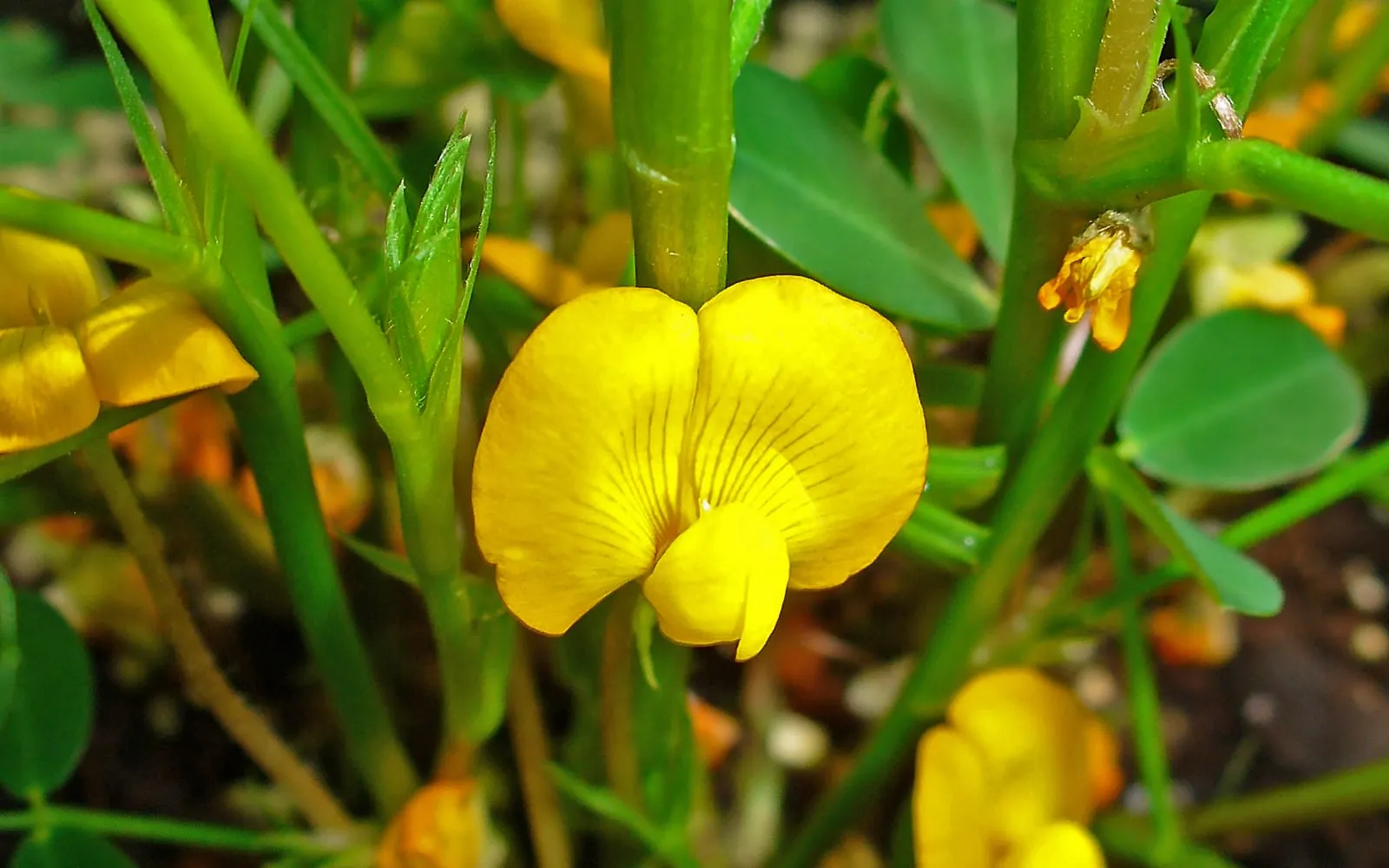
Flowers are small bright yellow pea flowers, about 1 cm, sitting close to the stem in the leaf axils. Each lasts a day.
The peg is what makes the plant. After fertilisation the base of the flower extends into a slender stalk that curves down, grows several centimetres, and pushes the tip into the soil.
Pods develop underground at the peg tip, 2 to 5 cm long, with the familiar wrinkled netted shell that constricts between the seeds.
Kernels are one to four per pod, covered in a thin red or pink papery skin.
Four market types exist. Runner and Virginia are the large-podded types, Spanish has smaller pods and higher oil, and Valencia usually carries three or four kernels in a long pod and is the one sold roasted in the shell.
Where it is from
Arachis hypogaea was domesticated in the valleys of southern Bolivia and northern Argentina, from a cross between two wild species, several thousand years ago.
It spread through South and Central America well before European contact, and Peruvian coastal graves contain peanuts and peanut-shaped pottery.
Portuguese ships carried it from Brazil to West Africa in the sixteenth century and Spanish ships took it across the Pacific to the Philippines and on to China.
West Africa adopted it completely, and it became a staple oil and protein crop across the Sahel. Groundnut stew is a defining dish of the region.
Enslaved West Africans carried it to North America, where it was long a subsistence and animal feed crop before George Washington Carver and the boll weevil between them turned it into a major southern commodity in the early twentieth century.
China and India are now the largest producers, followed by Nigeria and the United States.
How it grows
Sow in April at 22 to 25 deg C. Use raw unroasted peanuts still in their red skins, since roasted or salted ones are dead.
Sow 3 cm deep, one seed to a 9 cm pot, or direct into a tunnel border once the soil is warm.
Plant out or thin to 25 to 30 cm apart in light sandy loose soil. Heavy soil stops the pegs entering and the crop fails.
Give full sun and heat, with 25 to 30 deg C for real growth.
Earth up lightly around the plants as they spread, or top-dress with sand, which gives the pegs an easy surface to enter.
Water through flowering and pod fill, which is the critical period.
Feed almost nothing. It is a legume and it fixes its own nitrogen. A little potash is worth giving.
Stop watering three to four weeks before harvest, and let the plants dry down.
Lift the whole plant in October when the leaves yellow, shake off the soil, and hang it upside down somewhere warm and airy for two weeks.
Strip the pods, dry them thoroughly for another week or two, then store them dry.
Through the seasons
April is for sowing raw unroasted kernels in warmth.
May is growing the young plants on under cover.
Late May or June is planting out into a tunnel border of light soil.
July brings flowering, and the pegs start driving down within days of each flower.
August and September are pod fill underground, and the months that need heat and steady water.
Late September is when to stop watering and let the plants dry.
October is harvest, lifting the whole plant and hanging it to cure.
November is drying and storing, which decides whether the crop is safe to eat.
Care difficulty
Moderate under glass and unrealistic outdoors where summers are cool.
Warm loose sandy soil is the whole requirement, since the pegs cannot enter a heavy or crusted surface.
The pods fill through August and September, and they need heat to do it.
Watering has to stop before harvest, and a wet lift is what invites mould.
Curing and drying are the parts people skip, and they are the parts that make the crop safe.
Yields in a cool climate are modest. This is a plant grown to see how it works.
Watering
Water twice a week from planting out.
Increase through flowering and pod fill, which is the critical period.
Water at the root rather than over the crown, since wet foliage brings leaf spot.
Keep the soil surface loose rather than crusted, so the pegs can enter.
Stop watering three to four weeks before harvest.
Keep the lifted crop dry from the moment it comes out of the ground.
Warning signs, diseases and pests
Flowers appearing with no pegs entering the soil usually means the surface is too hard or too heavy. Top-dress with sand.
Dark spots with yellow haloes on the leaves are leaf spot, the main disease of the crop worldwide.
Yellowing plants in wet compost are showing root rot.
Curled tips with sticky residue are aphids.
Fine speckling with webbing is red spider mite under dry glass.
Pods that are shrivelled and empty mean the season was too short or too cold.
Grey-green powdery mould inside a pod at shelling is Aspergillus, and every affected kernel goes in the bin rather than the store.
A musty smell in a jar of stored kernels means they went into it damp.
Growing environment
A greenhouse or polytunnel where summers are cool. Outdoors is possible only in an exceptional one.
Full sun.
Minimum 15 deg C, with 25 to 30 deg C for growth.
Light sandy loose soil, 25 to 30 cm deep at least.
Spacing of 25 to 30 cm.
A dry warm airy space for curing the lifted plants.
Dry storage afterwards, since damp storage is where aflatoxin appears.
Feeding
Feed very little. Peanut is a nitrogen-fixing legume and rich soil makes leaf.
Skip nitrogen fertiliser entirely.
Give a high-potash feed monthly at most during pod fill.
Add gypsum or garden lime to the surface at flowering if the soil is very light, since the developing pods take up calcium directly from the soil around them.
Add sand rather than compost to improve the surface.
Stop feeding a month before harvest.
Troubleshooting
Is a peanut a nut? No. It is a legume, related to peas and beans. Tree nut allergy and peanut allergy are separate things, though many people have both.
How does it bury its own pods? After a flower is pollinated, the stalk below the ovary elongates into a peg that turns down, drives into the soil, and only then develops a pod. It is called geocarpy and very few plants do it.
Can I grow them from shop-bought peanuts? Only raw unroasted ones still in their red skins. Roasted, salted or blanched peanuts are dead.
Nothing formed underground. Either the pegs could not enter a hard or heavy surface, or the season was too cold. Use light sandy soil and top-dress with sand at flowering.
When do I harvest? October, when the leaves yellow. Lift the whole plant, shake the soil off, and hang it upside down somewhere warm and airy for two weeks before stripping the pods.
What happens if I do not dry them properly? Damp pods grow Aspergillus, which produces aflatoxin, a potent liver carcinogen. Dry the crop thoroughly and store it dry, and throw away anything shrivelled, discoloured or musty.
Can I give peanuts to my dog? Plain unsalted ones in small amounts are not toxic, though the fat and the shells cause problems. Check peanut butter labels for xylitol, which is dangerous to dogs. Never give a dog mouldy peanuts.
Why are they called groundnuts and monkey nuts? Groundnut for where the pods form, and monkey nut for the roasted in-shell Valencia type sold at fairgrounds and zoos.
What is the difference between the market types? Pod size and oil content. Runner and Virginia have large pods, Spanish has small high-oil pods, and Valencia carries three or four kernels in a long pod and is the one usually roasted in its shell.
Groundnut problem guides
Not sure what is wrong? See the common vegetable pests guide.