
Edible
Sweet Potato
Ipomoea batatas
Also known as Kumara, Batata, Yam (in American usage)
How to grow sweet potatoes, Ipomoea batatas. Starting slips, the warmth they need in a cool summer, growing under fleece or in a tunnel, and curing the roots to sweeten them.
At a glance
- Difficulty
- Moderate
- Water
- Weekly, and reduce sharply in the last month
- Light
- Full sun, and as much heat as can be arranged
- Temperature
- 21-26 deg C. Growth stops below 15 deg C and frost kills it
- Hardiness
- USDA 9-11, RHS H1b, hardy to 5 C
- Type
- Tender perennial grown as an annual
- Height
- 30-40 cm tall, trailing 2-3 m
- Native to
- Central and South America
- Best month
- May in the Northern Hemisphere, November in the Southern Hemisphere
Soil warmth is what makes the crop, since the roots swell only above about 20 deg C and a cool summer gives a mat of foliage and nothing underneath. It needs 100 to 150 frost-free days. Curing the lifted roots for a week at around 30 deg C in high humidity heals the skin and turns starch to sugar, and an uncured root neither keeps nor tastes of much.
Hardiness zones describe winter cold alone. Summer heat, humidity, rainfall and the length of the growing season decide as much, so treat the range as the outer limit rather than as a recommendation.
Every month named in this guide is for the temperate Northern Hemisphere. If you garden in the Southern Hemisphere, shift each one by six months, so May becomes November. Closer to the equator the wet and dry seasons matter more than the calendar, and the shift stops being a useful guide.
Not known to be toxic
- Safe to eat
- The storage roots and the young leaves and shoots, both cooked
Sweet potato is a food crop and carries no toxicity concern. The RHS does not list Ipomoea batatas as a potentially harmful garden plant and the ASPCA lists it as non-toxic to cats, dogs and horses, which sets it apart from most of its genus, since several ornamental Ipomoea species carry hallucinogenic alkaloids in the seed. Sweet potato is not related to the potato and contains none of the solanine that makes green potatoes a hazard, so a green-skinned sweet potato is safe. Two points are worth knowing. Roots damaged by black rot develop ipomeamarone, a bitter furanoterpenoid that is toxic to livestock and has killed cattle fed spoiled sweet potatoes, so discard any root with a hard dark rotten patch rather than cutting round it. And the leaves and shoots are eaten as a green across Africa and Asia and are excellent. That helps since a crop in a cool climate produces far more leaf than root.
Sources: ASPCA toxic and non-toxic plants, RHS potentially harmful garden plants
About
Sweet potatoes want a hot summer, and where the summer stays cool the crop makes a mat of handsome foliage and a handful of pencil-thin roots. Everything about growing it in such a climate is an attempt to manufacture heat.
Black plastic mulch over the bed, a fleece tunnel or a polytunnel, a sheltered south-facing position, and a modern short-season variety bred for cooler climates. ‘Beauregard’ and ‘Carolina Ruby’ crop reliably outdoors in a mild district. Older cultivars bred for the American south do not.
The plant is not a potato and is not related to one. It is a morning glory, grown for swollen storage roots rather than for tubers, which is why it is propagated from rooted shoots called slips rather than from seed tubers.
Appearance and character
A trailing vine, 30 to 40 cm tall and sprawling 2 to 3 m, with soft stems that root where they touch soil.
Leaves are heart-shaped or deeply lobed depending on variety, in fresh green or deep purple, and the ornamental purple-leaved forms sold for hanging baskets are the same species.
Flowers are pale purple morning-glory trumpets, and plants in a cool climate seldom produce them.
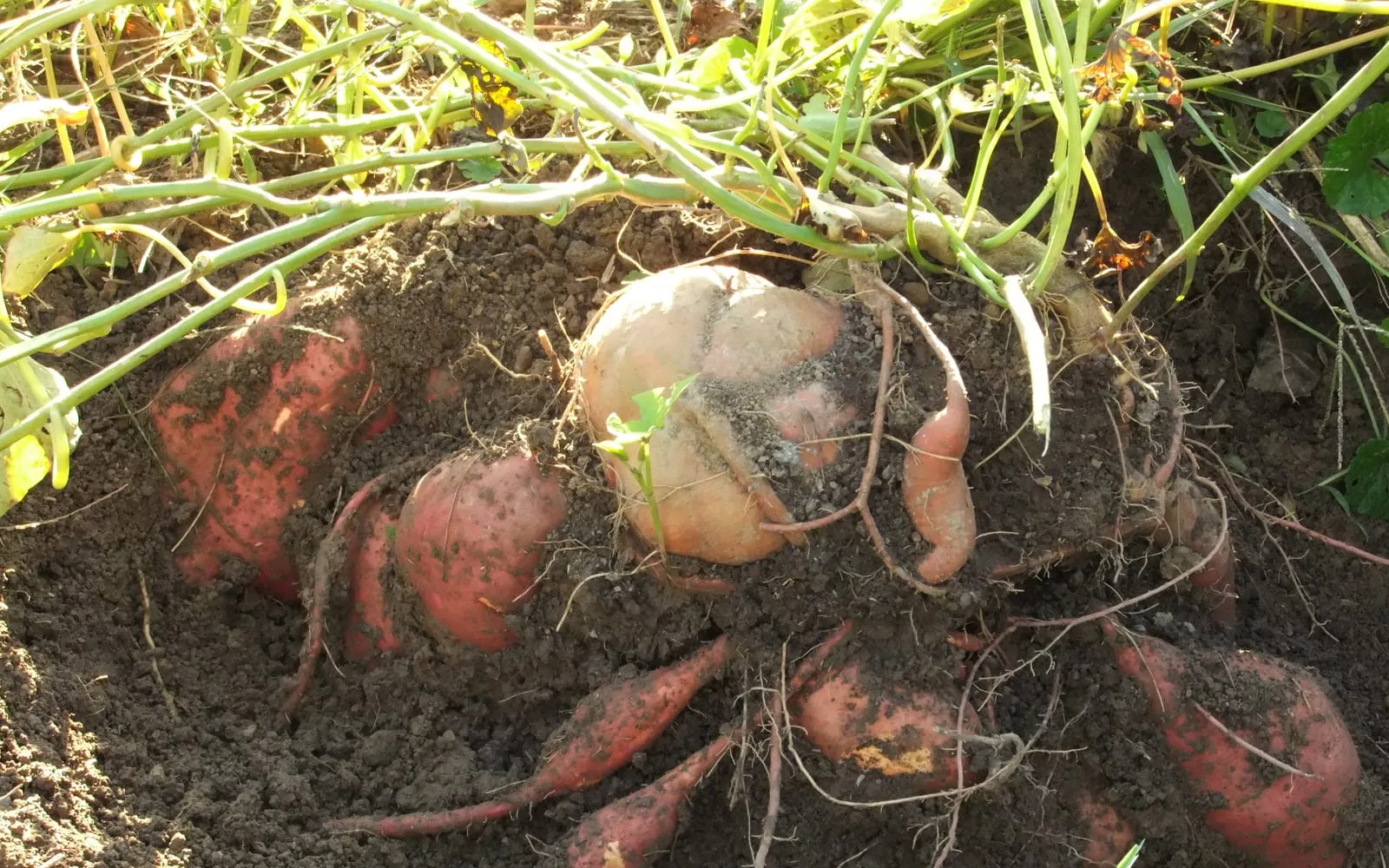
The roots are the crop. They are elongated and tapering, 10 to 25 cm long, with smooth skin in copper, red, purple or cream over flesh in orange, white, yellow or deep purple.
Flesh is dense and starchy when lifted and turns sweet during curing and storage, as enzymes convert starch into maltose. A freshly dug root is not very sweet at all.
Where it is from
Sweet potato originated in Central or South America, most likely in the region between the Yucatan and the Orinoco, and it was domesticated at least 5,000 years ago.
Its distribution across Polynesia before European contact is one of the more interesting puzzles in plant geography. The Maori name kumara resembles the Quechua kumar, and both natural dispersal and pre-Columbian human contact have been argued for.
Portuguese and Spanish trade spread it worldwide in the sixteenth century, and it took hold across Africa and Asia far more thoroughly than in Europe. China now grows the majority of the world crop.
Northern Europe grew it under glass in Victorian kitchen gardens and has only had outdoor cultivars for a couple of decades. Short-season breeding is what made it a realistic garden crop there.
How it grows
Grow from slips rather than roots. A slip is a rooted shoot, bought by mail order in spring or grown at home by suspending a sweet potato half-submerged in water on a warm windowsill from February and detaching the shoots at 15 cm.
Pot slips into 9 cm pots and grow on at 20 deg C or more until the frosts have finished.
Plant out in late May or early June, into soil warmed by black plastic laid two weeks beforehand. Plant through slits in the plastic at 30 cm apart in rows 75 cm apart.
Cover with fleece or a low tunnel for the first month, and keep it on all season in a cool garden.
Lift in October, before the first frost or immediately after it blackens the foliage. Frost damage travels down into the roots and spoils their keeping.
Cure the roots at 27 to 30 deg C and high humidity for a week, in an airing cupboard or a propagator inside a plastic bag. Curing heals the skin and starts the starch-to-sugar conversion, and it is the difference between a bland root and a good one.
Through the seasons
Late winter starts slips, either by ordering them or by suspending a root in water on a warm windowsill from February.
Spring grows the slips on under cover at 20 deg C or more, and warms the bed with black plastic from mid-May.
Early summer is for planting out, from late May in the south and mid-June elsewhere. Cover with fleece.
Summer is the growing season and warmth is everything. Water weekly, feed with potash from midsummer, and lift the trailing stems occasionally so they do not root at every node and start new plants at the expense of the crop.
Autumn fills the roots. Reduce watering from late September. Lift in October before frost, then cure the roots warm for a week.
Care difficulty
Moderate, and almost entirely a question of heat.
Warmth is the first requirement and the one a cool garden fails. Black plastic mulch, fleece and a sheltered sunny position between them add several degrees, and a polytunnel makes the crop straightforward.
Variety choice is the second. Short-season varieties bred for cooler climates crop here and long-season American ones do not.
Nitrogen is the classic mistake, giving a magnificent vine and no roots.
Lifting before frost matters, since frost-damaged roots rot in store.
Curing is the step people skip, and skipping it costs most of the flavour.
Watering
Water weekly through summer, around 12 litres per square metre in dry weather.
Reduce watering sharply from late September. A wet last month gives split roots that store badly.
Avoid waterlogging at any point. Sweet potato roots rot on heavy wet ground and this is the main reason to grow them on a ridge or a raised bed.
Water at the base rather than over the foliage, particularly under cover.
Container growing works well and solves both the warmth and the drainage problem. Use a pot of 40 litres or more, stand it against a south-facing wall, and water two or three times a week.
Warning signs, diseases and pests
Slugs hollow out the roots near the surface and are the main pest of a crop in a damp climate. Grow on a ridge, mulch with something coarse, and patrol on damp evenings.
Cold soil is the largest single cause of failure. Growth stops below 15 deg C and the plant sits and sulks. Warm the bed before planting and cover afterwards.
Wireworm tunnels the roots on ground recently turned from grass. Avoid planting into newly broken turf.
Root rot follows waterlogging on heavy soil.
Aphids and whitefly build up under cover in a warm tunnel. Ventilate, and introduce biological controls under glass.
Masses of foliage with pencil-thin roots means too much nitrogen, or a cold season, or both.
Black rot shows as hard, dark, sunken patches on the root. Discard the whole root rather than cutting around it, since the bitter compound it produces spreads into apparently sound tissue.
Sweet potato weevil tunnels the roots and triggers the same kind of bitter defensive compound, and it is the most damaging insect pest of this crop across the tropical and subtropical world. Hill soil regularly to cover cracks, since adults reach roots mainly by walking down through them. It has not established in Australia or New Zealand, both of which quarantine planting material because of it.
Growing environment
Full sun, and the warmest, most sheltered position in the garden.
Light, sandy, free-draining soil is what the crop wants. Heavy clay gives misshapen roots and rot, and a raised ridge of sandy compost solves it.
Slightly acid soil, pH 5.5 to 6.5.
Black plastic mulch is the single most effective thing to do for this crop outdoors in a cool summer. Lay it two weeks before planting and plant through slits.
A polytunnel or greenhouse border turns a marginal crop into a reliable one.
Ridges 20 cm high improve drainage and warm the root zone.
Rotate on three years. Sweet potato shares no diseases with potatoes, being a different family entirely, so it can follow them safely.
Feeding
Dig compost into the bed before planting, and keep it moderate.
Avoid nitrogen after planting. It is the commonest cause of a huge plant and no crop.
Feed with a potash-rich liquid feed, such as a tomato feed, every fortnight from midsummer. Potash drives root formation.
Sulphate of potash raked into the bed before planting works as well on poor ground.
Never use fresh manure, which gives lush growth and forked roots.
Troubleshooting
Lots of vine and almost no roots. Too much nitrogen or too little heat. Feed with potash rather than nitrogen, use black plastic and fleece, and choose a short-season variety.
The plants sat still all summer. Cold soil. Growth stops below 15 deg C. Warm the bed with black plastic before planting and keep fleece on.
The roots are hollowed out. Slugs. Grow on a ridge, mulch coarsely, and patrol on damp evenings.
The roots taste bland. They were not cured. Hold them at 27 to 30 deg C in high humidity for a week after lifting, then store them warm.
The roots rotted in store. Lifted after a frost, damaged when lifting, or stored too cold. Sweet potatoes need storing at 13 to 16 deg C, and a fridge ruins them.
Hard dark sunken patches on a root. Black rot. Discard the whole root. The bitter compound it produces spreads beyond the visible damage.
Can I eat the leaves? Yes, and they are good. Cook the young shoots and leaves like spinach. A crop in a cool climate usually produces far more leaf than root, so use the leaves too.
Is it related to a potato? No. Sweet potato is a morning glory in the Convolvulaceae. Potato is in the Solanaceae with tomatoes and aubergines.
Sweet Potato problem guides
Not sure what is wrong? See the common vegetable pests guide.
- Slugs, which hollow the roots near the surface
- Cold soil, which stops growth before it starts
- Wireworm tunnelling the roots on newly turned ground
- Root rot on heavy or waterlogged soil
- Aphids and whitefly under cover
- Sweet potato weevil, the crop's most damaging pest across the tropical and subtropical world