
Edible
Naranjilla
Solanum quitoense
Also known as Lulo, Little orange, Quito orange
How to grow naranjilla, Solanum quitoense. The Andean lulo with orange skin and green pulp, the hairs that rub off the fruit, and the cool highland conditions it insists on.
At a glance
- Difficulty
- Difficult
- Water
- Twice a week in growth, keeping the compost damp
- Light
- Part shade. Full sun scorches it and heat stops it
- Temperature
- Minimum 10 deg C, and it wants 17 to 23 deg C. It hates heat above 30 deg C
- Humidity
- High
- Hardiness
- USDA 10-11, RHS H1c, hardy to 5 C
- Type
- Tender short-lived evergreen perennial, grown as a shrub
- Height
- 1.5-2.5 m
- Native to
- the Andes of Ecuador, Colombia
- Best month
- May, June and September in the Northern Hemisphere, November, December and March in the Southern Hemisphere
Andean cloud forest at 1,200 to 2,100 m, which is a narrow requirement. It wants steady mild temperatures around 17 to 22 deg C, high humidity and shade from the hottest sun, and it stops setting fruit in lowland heat. Root-knot nematode is what usually ends a plant.
Hardiness zones describe winter cold alone. Summer heat, humidity, rainfall and the length of the growing season decide as much, so treat the range as the outer limit rather than as a recommendation.
Every month named in this guide is for the temperate Northern Hemisphere. If you garden in the Southern Hemisphere, shift each one by six months, so May becomes November. Closer to the equator the wet and dry seasons matter more than the calendar, and the shift stops being a useful guide.
Skin irritant
- Safe to eat
- The ripe pulp
- Do not eat
- The leaves, stems and unripe fruit, and the hairs on the fruit skin
- Harm from
- Eating it and handling it
- Affects
- People, cats and dogs
The ripe fruit is food and is drunk daily across Colombia and Ecuador. The rest of the plant is nightshade. Solanum leaves and stems contain steroidal glycoalkaloids, the same class of compound that makes potato foliage and green potatoes toxic, and they should not be eaten by people or animals; the ASPCA lists the genus as toxic to cats and dogs on that basis. Unripe fruit carries the same compounds and is not eaten. The fruit skin is covered when young in short brittle hairs that irritate skin and are rubbed off before the fruit is sold, and handling unwashed fruit or the leaves can leave a prickling itch. Wash the fruit and wear gloves when pruning.
Sources: ASPCA toxic and non-toxic plants, RHS potentially harmful garden plants
About
Naranjilla is a juice fruit and Colombia drinks a great deal of it. Cut one open and the colour is the surprise. An orange skin covers a bright green pulp, seedy and translucent, tasting sharply of pineapple, rhubarb and lime together.
Lulo juice is on every Colombian breakfast table and lulada is the drink made by crushing the pulp with ice, lime and sugar.
Growing it is a matter of getting the temperature wrong in the opposite direction from everything else here. Naranjilla comes from Andean cloud forest at 1,200 to 2,000 m, wants 17 to 23 deg C, and stops growing and drops its flowers above about 30 deg C. A hot greenhouse is the wrong place for it.
Appearance and character
A soft-stemmed spreading perennial shrub, 1.5 to 2.5 m, short-lived and usually replaced after three or four years.
Stems are thick, soft and covered in fine purple hairs, and spiny in the wild forms though the cultivated ones are usually spineless.
Leaves are the plant’s best feature. Very large, 30 to 60 cm, oblong to heart-shaped with shallow lobes and a wavy margin, soft and felted, dark green above with striking purple veins and purple hairs, and purple-flushed underneath.
Flowers are 3 to 5 cm, with five white petals and purple-hairy backs, in short clusters in the leaf axils, and they look like a large potato flower.
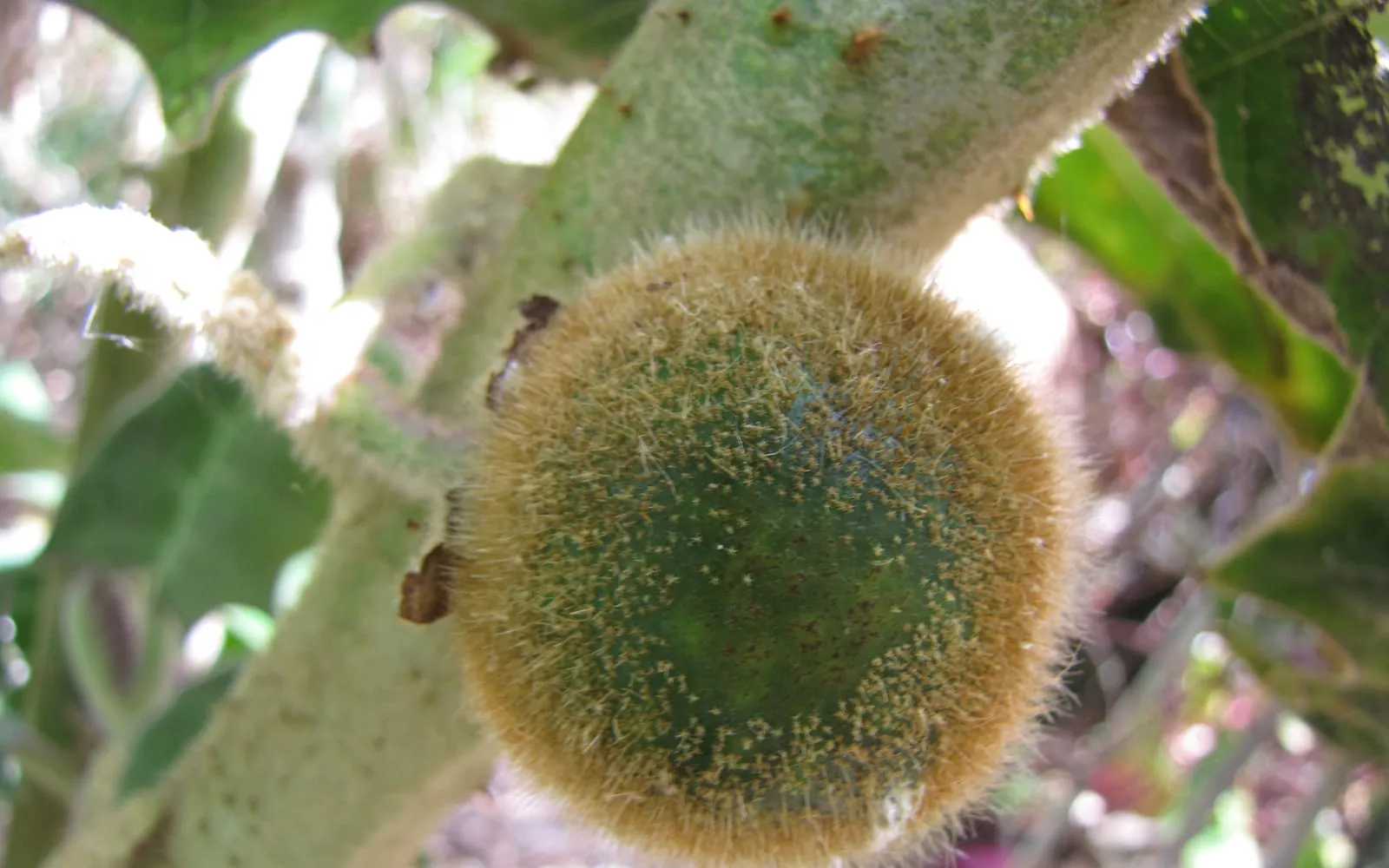
Fruit is round, 4 to 6 cm, ripening from green through orange, and covered when young in short brittle brown hairs that rub off as it matures.
Flesh is bright green, translucent and juicy, divided into four segments by membranes, and full of small flat pale seeds.
Flavour is sharp and complex, of pineapple, rhubarb and lime at once.
Where it is from
Naranjilla is native to the Andean cloud forest of Ecuador and southern Colombia, at 1,200 to 2,000 m, where days are mild and nights are cool.
Its Spanish name means little orange, from the fruit’s appearance, and the Colombian name lulo comes from the Quechua.
Ecuador and Colombia grow nearly all of it. Lulo juice and lulada are everyday drinks in both countries and the fruit is a market staple.
Attempts to grow it at lower altitudes have generally failed on heat and on nematodes, which is why it has never become an export crop of any scale.
Central America, Peru and parts of the Caribbean grow it in a small way at altitude.
Temperate markets see frozen lulo pulp in Latin American food shops and never the fresh fruit, which bruises and does not travel.
How it grows
Sow seed from a ripe fruit. It germinates at 20 to 25 deg C in two to four weeks and keeps for several months.
Ferment the pulp off the seed for a couple of days as you would a tomato, which improves germination.
Grow in rich moisture-retentive free-draining compost, slightly acid.
Give part shade. This is a cloud forest plant and full sun through glass scorches the large soft leaves.
Keep it at 17 to 23 deg C. Above 30 deg C growth stops and flowers drop, which is the opposite of nearly everything else here.
Keep humidity high.
Water twice a week and never let it dry out.
Feed fortnightly from April to September.
Use fresh compost each time and avoid ground where tomatoes or potatoes have grown, since the species is very prone to nematodes and to the wilts that affect the family.
Expect fruit in the first or second year and expect the plant to be worn out after three or four.
Through the seasons
Winter is a cool rest above 10 deg C, watered moderately and unfed.
Spring brings vigorous growth. Repot and start feeding.
Early summer is flowering, which continues over a long period.
Midsummer is fruit swell, and a hot spell will stop the plant setting.
Late summer to autumn is harvest, which runs over several weeks.
Autumn is when to stop feeding and reduce watering.
A plant of three or four years should be replaced from seed.
Care difficulty
Difficult, and difficult in an unusual direction.
Heat is the problem rather than cold. Naranjilla wants 17 to 23 deg C and stops growing and drops its flowers above about 30 deg C, so a heated greenhouse in a heatwave is worse for it than a cool spring.
Part shade is needed, since full sun through glass scorches the large soft leaves.
High humidity is needed.
Nematodes and wilts are the commercial obstacle and matter in a pot too. Use fresh compost and avoid anything that has grown tomatoes or potatoes.
The plant is short-lived and needs replacing every three or four years.
Fruit comes in the first or second year, which is quick, and that is the compensation.
Watering
Water twice a week in growth, keeping the compost consistently damp.
Never let it dry out. The large soft leaves wilt fast.
Reduce in winter without letting the compost dry.
Drain fully.
Keep humidity high with grouping, damping down or a damp gravel tray.
Use rainwater where the supply is very hard.
Water more in warm weather, since the leaf area transpires heavily.
Warning signs, diseases and pests
Flowers dropping in a hot spell is the plant reacting to heat above 30 deg C. Shade and ventilate it.
Scorched patches on the leaves mean direct sun through glass.
Wilting of one side of the plant, with brown staining inside a cut stem, is verticillium or fusarium wilt. There is no cure. Destroy the plant and do not reuse the compost.
Knobbly swellings on the roots when repotting are root knot nematodes.
Clouds of small white insects are whitefly.
Fine webbing on the leaves is red spider mite.
Aphids cluster on the soft growing tips.
An itch after handling the fruit or leaves is the brittle hairs. Wash the fruit and wear gloves.
A plant that declines in its fourth year has reached the end of its life.
Growing environment
A cool greenhouse, a shaded conservatory or a sheltered outdoor spot for the summer.
Minimum 10 deg C, ideally 17 to 23 deg C, and shaded or ventilated above 30 deg C.
Part shade.
High humidity.
Rich moisture-retentive free-draining compost, slightly acid.
pH from 5.5 to 6.5.
Fresh compost each time, and no ground that has grown tomatoes or potatoes.
A pot of 35 to 45 cm, and room for the very large leaves.
Feeding
Feed fortnightly from April to September with a balanced liquid feed.
Switch to a high-potash feed such as tomato food as flowering starts.
Stop feeding at the end of September.
Give nothing through winter.
Repot into fresh compost each spring rather than reusing old, because of the nematode risk.
Add magnesium if older leaves yellow between the veins.
Keep feeding steady, since the plant carries a large leaf area and a long fruiting season.
Troubleshooting
Why is the pulp green when the skin is orange? That is the fruit. Naranjilla has an orange skin over a bright green translucent pulp, and the contrast is the first thing anyone notices.
Does it want a hot greenhouse? No, and this is what makes it awkward. It comes from Andean cloud forest, wants 17 to 23 deg C, and stops growing and drops its flowers above about 30 deg C. Shade and ventilate it in a heatwave.
The fruit made my hands itch. Short brittle hairs on the young skin. They rub off as the fruit matures and growers remove them before sale. Wash the fruit and wear gloves with the leaves.
Can I eat the leaves? No. Naranjilla is a Solanum and the leaves and stems contain the same class of alkaloids that make potato foliage toxic. The ASPCA lists the genus as toxic to cats and dogs.
Half the plant wilted. Verticillium or fusarium wilt, to which this species is very prone. There is no cure. Destroy the plant and do not reuse the compost.
What is lulada? A Colombian drink made by crushing the pulp with ice, lime and sugar. Lulo juice is the everyday version.
How long will the plant live? Three or four years. It is short-lived and should be replaced from seed.
How soon will it fruit? In the first or second year from seed, which is the quickest in this collection alongside the sweet granadilla.
Naranjilla problem guides
Not sure what is wrong? See the common vegetable pests guide.