
Edible
Carrot
Daucus carota subsp. sativus
Also known as Garden carrot
How to grow carrots, Daucus carota subsp. sativus. Stone-free soil, why you must not thin them in daylight, beating carrot fly, and sowing for a Christmas crop.
At a glance
- Difficulty
- Easy
- Water
- Steadily, roughly once a week in dry weather
- Light
- Full sun to very light shade
- Temperature
- 16-21 deg C. Hardy enough to stand in the ground over winter
- Hardiness
- USDA 3-10, RHS H5, hardy to -10 C
- Type
- Biennial grown as an annual
- Height
- 30-60 cm of foliage
- Native to
- Central Asia, and Afghanistan in particular
- Best month
- April in the Northern Hemisphere, October in the Southern Hemisphere
Soil needs to reach about 7 deg C before carrot will germinate, and it is slow even then, so early sowings sit and rot in a cold wet spring. The plant is a biennial and a cold check after germination makes it bolt. Roots stand hard frost in the ground and keep better there than in store.
Hardiness zones describe winter cold alone. Summer heat, humidity, rainfall and the length of the growing season decide as much, so treat the range as the outer limit rather than as a recommendation.
Every month named in this guide is for the temperate Northern Hemisphere. If you garden in the Southern Hemisphere, shift each one by six months, so April becomes October. Closer to the equator the wet and dry seasons matter more than the calendar, and the shift stops being a useful guide.
Not known to be toxic
Non-toxic. The ASPCA lists the carrot as safe for cats, dogs and horses, and the root is a common treat for all three. The foliage is edible too, and it makes a serviceable pesto, though a small number of people develop a rash from handling the leaves in bright sunlight because carrot belongs to the Apiaceae and its foliage contains furanocoumarins. That reaction is mild in carrot and nothing like the burns that giant hogweed causes. The genuine danger with this plant concerns identification rather than cultivation. Wild carrot grows across Britain and has close relatives in the same family that are among the most poisonous plants in the country, including hemlock and hemlock water-dropwort. Never eat a wild umbellifer on the strength of a carrot-like smell.
Sources: ASPCA (Carrot, Daucus carota), RHS potentially harmful garden plants
About
Carrots ask for one thing and refuse to compromise on it. The root grows down into whatever it finds, so the soil decides the crop before you have sown a seed. Deep, light and stone-free gives long straight roots, and heavy or stony ground gives short forked ones.
Carrot fly is the other problem, and a stranger one. The fly finds the crop by smell, and crushing a leaf releases enough scent to draw females from several hundred metres. Thinning seedlings on a still evening, and taking the thinnings away with you, prevents more damage than any barrier.
Sow from March to July and you can pull carrots from June until the following February.
Appearance and character
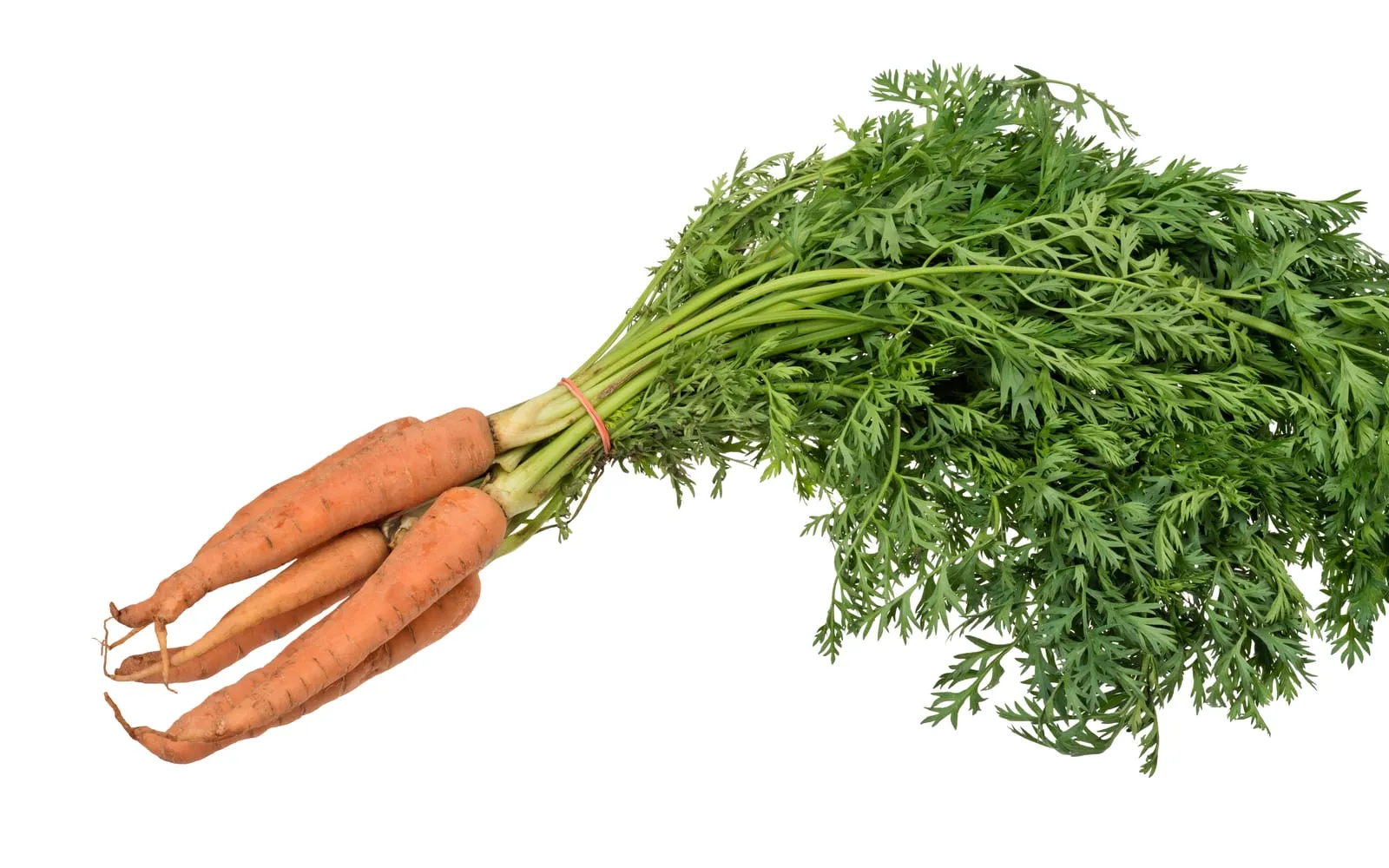
Finely divided ferny foliage on grooved stalks, bright green and upright, smelling strongly of carrot when bruised.
The root is a single swollen taproot, orange in most modern varieties and also sold in purple, yellow, white and near-black. Purple was the original cultivated colour, and the orange carrot is a comparatively recent selection.
Shape divides the types. Nantes are cylindrical and blunt-ended, Chantenay are short and conical and cope with heavier soil, Amsterdam are slim and quick for early sowings, and Autumn King are large and store well.
Left in the ground a second year the plant bolts, sending up a flowering stem a metre tall topped with a flat white umbel that darkens to a cupped seed head.
The root goes woody as soon as flowering begins, which is why a bolted carrot is no longer worth eating.
Where it is from
Central Asia, with Afghanistan as the centre of diversity, where purple and yellow carrots were cultivated by the tenth century.
The wild ancestor grows across Europe and Britain as wild carrot, a roadside and chalk-grassland plant with a thin, pale, tough root. Domestication selected for a swollen storage root and against the bitterness and the tendency to flower in the first year.
Orange carrots were developed in the Netherlands in the sixteenth and seventeenth centuries. The story that Dutch growers bred them to honour the House of Orange is repeated everywhere and rests on no contemporary evidence.
The plant is a biennial. It builds a food store in year one and spends it on flowering in year two, and the crop is that store harvested before the plant can use it.
Its wild habitat is open, sunny and sharply drained, which is exactly the site it wants in a garden.
How it grows
Sow direct where the plants are to grow. Carrots have a taproot and resent disturbance, so transplanting produces forked and stunted roots.
Seed is slow, taking two to three weeks to germinate, and it needs the surface kept damp through that period. Sow thinly at about 1 cm deep in rows 15 cm apart.
Thin in stages to 5 to 8 cm apart, and do it in the evening. Water the row afterwards to settle the soil and damp down the scent, and remove the thinnings from the plot rather than dropping them between the rows.
Roots swell from around eight weeks. Early varieties are ready in ten to twelve weeks, maincrops in sixteen to twenty.
A sowing in early June misses the first generation of carrot fly, and a sowing in July gives roots that can stay in the ground under straw until midwinter.
Through the seasons
Early spring starts the season. Sow early varieties under cloches or fleece from March, on ground prepared the previous autumn and not manured since.
Late spring is the main sowing window for maincrops, from April into May. Cover the row with fleece or fine mesh at sowing rather than after the seedlings appear.
Summer is thinning, weeding and steady watering. Sow a final batch in early July for autumn and winter roots, one of several sowings spread through the season for young roots over a long stretch.
Autumn and winter are for lifting and storing. Pull maincrops in October and store them in boxes of damp sand in a cool shed, or leave them where they grew under a thick straw mulch and dig them as needed until February.
Care difficulty
Easy on the right soil and frustrating on the wrong one, and the difference is almost entirely down to ground preparation.
Stones, clods and fresh manure all cause forking. A root that meets an obstacle splits and grows around it, which is why a well-fed vegetable bed produces comical carrots and a poor sandy one produces perfect ones.
Carrot fly is the other hurdle and it is solvable. A 60 cm barrier of fine mesh around the bed works because the flies fly low, and covering the row with insect-proof mesh from sowing works better still. Onions grown among the carrots to mask the smell the fly homes in on are the traditional companion planting answer, but they protect far less reliably than mesh.
Germination is the third stumbling block. The seed is slow and small and it fails if the surface dries out, so water the drill before sowing rather than after.
Watering
Water steadily rather than often. A thorough soak once a week in dry weather suits them better than a daily sprinkle, which keeps the moisture in the top few centimetres and discourages the root from going down.
Keep the seedbed damp until germination. This is the one period where daily attention pays, and a covering of fleece slows the drying.
Splitting is caused by a heavy watering after a dry spell. The root swells faster than the skin can stretch. Even watering prevents it.
Mulch between the rows once the plants are established to steady the moisture.
Carrots in containers dry out quickly and need checking every day or two in summer.
Warning signs, diseases and pests
Carrot fly is the pest that matters. The adult lays at the base of the plant and the larvae tunnel through the root, leaving rusty brown channels just under the skin and often a plant with reddish, wilting foliage. There is no treatment once the larvae are inside. Prevention works, and the practical measures are a fine mesh cover from the day of sowing, a 60 cm vertical barrier around the bed, thinning in the evening with the thinnings removed, and sowing in early June to miss the first generation. Resistant varieties such as ‘Resistafly’ and ‘Flyaway’ reduce damage without eliminating it.
Forked and stunted roots mean stones, compaction or recently manured ground. Grow a short stump-rooted variety such as a Chantenay type in soil you cannot improve, or use a deep container of sieved compost.
Green shoulders on the root are sunlight reaching the crown. Draw a little soil over the tops as they swell. The green is harmless.
Splitting follows irregular watering.
Aphids cluster on the foliage and are usually dealt with by ladybirds and hoverflies.
Violet root rot shows as a purple felty growth over the root on wet heavy soil, so rotate the crop and improve drainage.
Growing environment
Full sun, though carrots tolerate a little shade better than most root crops.
Light, deep, stone-free soil is the requirement. Sandy loam is ideal. On clay, grow short-rooted varieties, or build a raised bed 30 cm deep and fill it with sieved topsoil and sand.
Never manure the bed before carrots. Fresh organic matter causes forking and hairy roots. Follow a crop that was manured the year before instead.
Rake the surface to a fine tilth before sowing. The seed is tiny and needs contact with fine soil.
Containers work well. Use a deep pot of at least 30 cm, filled with a mix of multipurpose compost and sharp sand, and stand it clear of the ground to help against carrot fly.
Rotate on a three or four-year cycle to limit carrot fly and root diseases.
Feeding
Carrots need very little. On soil in reasonable heart they need nothing at all.
Avoid nitrogen. It produces a large ferny top over a small forked root, and it is the commonest cause of disappointing carrots on an otherwise good plot.
A dressing of sulphate of potash before sowing helps on poor ground.
Never apply fresh manure. Where the bed needs organic matter, add well-rotted compost a full season ahead and sow carrots into the ground the following year.
Container-grown carrots in fresh compost need no feed for the twelve to sixteen weeks they occupy the pot.
Troubleshooting
Rusty brown tunnels just under the skin. Carrot fly larvae. Cut the damaged parts away and eat the rest. Cover next year’s row with fine mesh from the day of sowing.
The roots are short and forked. Stones, compacted ground or fresh manure. Grow a Chantenay type, or build a deep bed of sieved soil.
Hardly anything germinated. The seedbed dried out, or the seed was sown too deep. Water the drill before sowing, cover with 1 cm of fine soil, and keep the surface damp for three weeks.
Green tops on the roots. Sunlight on the crown. Harmless. Earth up lightly.
Splitting. A heavy watering after a dry spell. Water evenly.
Masses of foliage, small roots. Too much nitrogen, or the plants were never thinned.
The plants have flowered. Bolting, usually after a cold spell early on or a drought. The root turns woody, so pull and compost them and sow again.
Can I grow carrots in a pot? Yes, and it is the best answer on stony or heavy ground. Use a container at least 30 cm deep and a short-rooted variety.
Carrot problem guides
Not sure what is wrong? See the common vegetable pests guide.