
Edible
Watermelon
Citrullus lanatus
Also known as Water melon, Icebox melon
How to grow watermelons, Citrullus lanatus. Why they need a greenhouse in a cool summer, choosing a small icebox cultivar, hand pollination, and the ripeness tests that work.
At a glance
- Difficulty
- Difficult
- Water
- Every two days, cut back sharply as the fruit ripens
- Light
- Full sun under glass or in a polytunnel
- Temperature
- 25-32 deg C. Growth stops below 18 deg C
- Hardiness
- USDA 10-11, RHS H1b, hardy to 5 C
- Type
- Tender annual
- Height
- 30 cm tall, trailing 3-4 m
- Native to
- North-eastern Africa
- Best month
- April in the Northern Hemisphere, October in the Southern Hemisphere
It wants more heat than any other cucurbit here, with 80 to 100 days above 25 deg C, and it takes drought once rooted because the taproot goes deep. Cool nights stall it. Seedless triploid cultivars set nothing on their own and need a diploid pollinator planted alongside.
Hardiness zones describe winter cold alone. Summer heat, humidity, rainfall and the length of the growing season decide as much, so treat the range as the outer limit rather than as a recommendation.
Every month named in this guide is for the temperate Northern Hemisphere. If you garden in the Southern Hemisphere, shift each one by six months, so April becomes October. Closer to the equator the wet and dry seasons matter more than the calendar, and the shift stops being a useful guide.
Not known to be toxic
- Safe to eat
- The ripe flesh, the rind pickled, and the seeds roasted
Watermelon is a food crop and carries no toxicity concern. The RHS does not list Citrullus lanatus as a potentially harmful garden plant and the ASPCA lists watermelon as non-toxic to cats, dogs and horses. The cucurbit caution applies here as it does across the family. Cucurbitacins are intensely bitter compounds that cause violent vomiting and diarrhoea, and they have been bred out of edible watermelons but persist in the wild bitter relatives from which the crop descends. Seed saved from a plant that has crossed with an ornamental or wild gourd can produce a bitter fruit, so taste a small piece before eating a whole one and discard it if it is bitter. Bought seed carries no such risk. Cut watermelon is a documented vehicle for salmonella and listeria, because the rind carries soil organisms into the flesh on the knife, so wash the outside before cutting and refrigerate it afterwards. The rind is edible pickled and the seeds are eaten roasted across Africa and the Middle East.
Sources: ASPCA toxic and non-toxic plants, RHS potentially harmful garden plants
About
Watermelons need more heat for longer than anything else in this collection, and in a cool summer that means a greenhouse or a polytunnel with the season started in April. Outdoors in such a climate it does not work reliably.
Where cool-climate growers succeed, they succeed with the small icebox cultivars. ‘Sugar Baby’, ‘Blacktail Mountain’ and ‘Golden Midget’ produce fruit of 2 to 4 kg in around eighty days, and a 15 kg supermarket watermelon needs conditions no cool-climate greenhouse provides.
Limiting the plant is the other half of it. Two or three fruits per plant under glass is what will ripen. Any more and none of them sweetens.
Appearance and character
A long trailing vine, 3 to 4 m, with slender hairy stems and forked tendrils.
Leaves are deeply cut into rounded lobes, greyish-green and softly hairy, quite distinct from the broad leaves of a melon or a squash.
Flowers are small, pale yellow and considerably less showy than a squash flower, with separate males and females on the same plant.
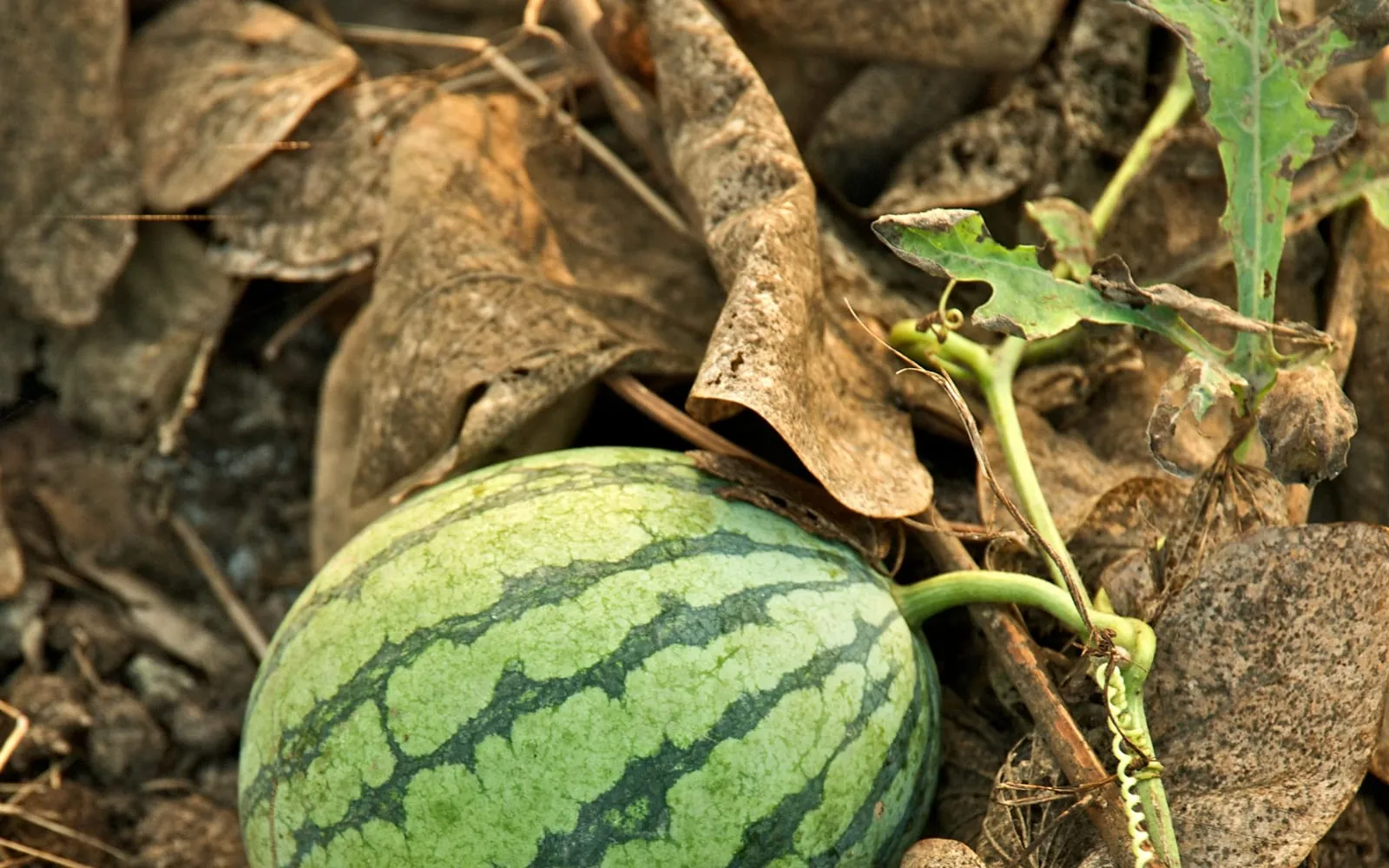
Fruit in the icebox varieties is round, 20 to 25 cm across, with a dark green skin that is sometimes striped or mottled.
Flesh is deep pink to red in most varieties, and yellow in ‘Golden Midget’ and ‘Yellow Doll’, crisp and watery with dark seeds. Seedless varieties are triploid hybrids and are harder to germinate and harder to grow.
Where it is from
Watermelon descends from a wild ancestor in north-eastern Africa, and recent genetic work points to the Kordofan melon of Sudan as the closest wild relative.
Egyptian tomb paintings from around 4,000 years ago show watermelons, and seeds have been found in Tutankhamun’s tomb. Early forms were grown as a portable water source more than as a sweet fruit, and the flesh was pale and bland.
Selection for red sweet flesh happened over millennia. The red colour and the sugar are genetically linked, which is why the two arrived together.
Mediterranean cultivation spread through the Roman period, and the Moors brought it into Spain by the tenth century.
Northern Europe has grown it under glass since the eighteenth century as a hothouse curiosity, alongside pineapples and grapes, and it has never been anything else there.
How it grows
Sow indoors from mid-April at 25 deg C, two seeds to a 9 cm pot on their edge, thinning to the stronger. Watermelon seed needs more warmth to germinate than any other crop in this wave.
Germination takes five to ten days at 25 deg C and fails below 20.
Plant into a greenhouse border or a large container in late May, at 90 cm apart, on a mound with the stem base proud of the compost.
Warm the soil beforehand with black plastic, which is worth doing even under glass.
Pinch out the main shoot at five leaves to force side shoots.
Hand-pollinate. Take a male flower, remove the petals, and dab pollen onto the stigma of a female flower on a sunny morning. Pollinate two or three females within a few days of each other.
Remove all further flowers once two or three fruits have set, and pinch each fruiting shoot two leaves beyond the fruit.
Support the fruit on a tile or a straw pad. Slings are needed only if the plant is trained vertically, and most watermelons are better left trailing.
Through the seasons
Mid-spring is sowing, from mid-April at 25 deg C in a propagator.
Late spring grows the plants on at 20 deg C or more and plants them into the greenhouse border in late May. Do not let them get potbound.
Early summer is training and hand pollination. Pinch out at five leaves and pollinate two or three female flowers.
Summer swells the fruit. Water every two days, feed weekly with high potash, and damp down every morning against red spider mite.
Late summer and early autumn ripen the crop, from late August. Cut watering right back for the last three weeks. Pick when the tendril nearest the fruit has dried and the underside patch has turned from white to buttery yellow.
Care difficulty
Difficult, and the hardest crop in this wave alongside melon.
Heat is the limiting requirement. Watermelon needs 25 to 32 deg C and stops below 18. Under glass in a good summer this is achievable and outdoors it is not.
Variety choice comes second. Icebox types of 2 to 4 kg ripen here. Large varieties do not.
Hand pollination is necessary under cover.
Limiting to two or three fruits is what makes them sweet.
Judging ripeness is hard, since a watermelon gives no smell and does not soften. Three signs together are the reliable test.
Collar rot kills plants watered carelessly at the base.
Watering
Water generously every two days while the plant is growing and the fruit is swelling.
Water around the plant rather than at the stem base, and plant on a mound. Collar rot is the commonest sudden death.
Damp the greenhouse floor daily in hot weather to raise humidity and suppress red spider mite.
Cut watering right back for the last three weeks before picking. This is more important in watermelon than in any other crop here, since the fruit is mostly water and a wet finish gives a bland, split melon.
Mulch the border after planting.
Container growing needs at least 45 litres per plant and is harder to keep even than a border.
Warning signs, diseases and pests
Red spider mite bronzes and speckles the leaves and webs the growing tips in dry glasshouse heat. Damp down every morning and introduce Phytoseiulus predators before webbing appears.
Powdery mildew coats the leaves from midsummer. Ventilate and water at the base. Late mildew matters little.
Collar rot browns the stem at compost level and the plant wilts and dies within days. Plant on a mound and keep the stem base dry.
Poor fruit set means no pollination. Hand-pollinate.
Aphids spread mosaic virus, which mottles and distorts the leaves and stunts the plant. There is no cure, so remove affected plants.
Fruit that never sweetens means too many fruits, too little heat, or watering right up to picking.
Splitting follows heavy watering after a dry spell.
Cucumber beetle, small and either striped or spotted yellow, feeds on watermelon across North and South America and matters less here than on cucumber or melon, since watermelon resists the bacterial wilt the beetle often carries. Row cover over young plants still limits leaf damage. It has never established outside the Americas.
Growing environment
Full sun under glass or in a polytunnel. Outdoors in a cool summer is not a realistic proposition.
Rich, deep, free-draining sandy soil. Dig a bucket of well-rotted manure into each station.
Neutral to slightly acid, pH 6 to 7.
Temperatures of 25 to 32 deg C by day and above 18 at night.
Space at 90 cm. The vines trail 3 to 4 m and the fruit is better left on the ground on a tile or a straw pad.
Rotate with melons, cucumbers and squash, or use fresh compost each year.
Feeding
Dig well-rotted manure into each planting station.
Feed with a balanced liquid feed until fruit set, then switch to a high-potash tomato feed weekly.
Avoid nitrogen after fruit set, which gives vine rather than fruit.
Stop feeding three weeks before picking, at the same time you cut back the watering.
Container plants need feeding from six weeks after planting.
Troubleshooting
No fruit set at all. No pollination under cover. Hand-pollinate two or three female flowers on a sunny morning with pollen from a male flower.
The fruits stayed small and never ripened. Too many fruits, too little heat, or a large-fruited variety. Grow an icebox type and limit to two or three fruits.
The plant collapsed at the base. Collar rot. Plant on a mound and water around the plant rather than at the stem.
The flesh is pale and bland. Watering continued right up to picking, or too many fruits. Cut watering right back for the last three weeks.
Fine webbing and bronzed leaves. Red spider mite. Damp the greenhouse floor every morning and introduce Phytoseiulus predators.
It split on the plant. A heavy watering after a dry spell. Reduce watering gradually rather than suddenly.
How do I tell when it is ripe? Use three signs together. The tendril nearest the fruit has dried and browned, the patch where the fruit sits on the ground has turned from white to buttery yellow, and the fruit sounds hollow when tapped. Smell and softness tell you nothing in a watermelon.
Can I grow them outdoors? Not reliably where summers stay below 25 deg C. That makes it a greenhouse or polytunnel crop across most of northern Europe.
Watermelon problem guides
Not sure what is wrong? See the common vegetable pests guide.