
Edible
Passion fruit
Passiflora edulis
Also known as Purple granadilla, Maracuja, Purple passionfruit
How to grow passion fruit, Passiflora edulis. A tender vine for a greenhouse or conservatory, and why the hardy blue passionflower is not a substitute.
At a glance
- Difficulty
- Difficult
- Water
- Twice weekly in summer, sparingly in winter
- Light
- Full sun under glass
- Temperature
- Needs a minimum of 10 deg C, and is killed by frost
- Hardiness
- USDA 9-11, RHS H1c, hardy to 0 C
- Type
- Evergreen woody climber, productive for about five years
- Height
- 4-6 m under glass
- Native to
- Brazil, Paraguay, Northern Argentina
- Best month
- September, October and November in the Northern Hemisphere, March, April and May in the Southern Hemisphere
Subtropical southern Brazil. It flowers on new growth and fruits within three months, so it crops in its first year, and a light frost cuts it to the ground and it regrows. Purple forms take more cold than yellow ones.
Hardiness zones describe winter cold alone. Summer heat, humidity, rainfall and the length of the growing season decide as much, so treat the range as the outer limit rather than as a recommendation.
Every month named in this guide is for the temperate Northern Hemisphere. If you garden in the Southern Hemisphere, shift each one by six months, so September becomes March. Closer to the equator the wet and dry seasons matter more than the calendar, and the shift stops being a useful guide.
Edible, with limits
- Safe to eat
- The ripe pulp and seeds
- Do not eat
- Unripe fruit, leaves and stems
- Harm from
- Eating it
- Affects
- People, cats and dogs
The ripe pulp is food. Unripe fruit, leaves and stems contain cyanogenic glycosides, which is why green passion fruit should be left to ripen fully and why the foliage is not eaten. Levels fall sharply as the fruit ripens and wrinkles, and ripe fruit carries no meaningful risk. The ASPCA lists Passiflora as toxic to cats, dogs and horses on the strength of the unripe fruit and foliage rather than the ripe pulp. The related hardy Passiflora caerulea carries the same caution more strongly, since its orange fruit often fails to ripen properly in a cool summer and is better left uneaten.
Sources: RHS potentially harmful garden plants, ASPCA toxic and non-toxic plants
About
The fruit worth growing comes from Passiflora edulis, a tender Brazilian vine that needs a frost-free winter. The hardy climber sold in every garden centre is Passiflora caerulea, which survives outdoors in USDA 7 and produces orange fruit that is watery, seedy and not worth eating.
Given a greenhouse or a conservatory kept above 10 deg C, P. edulis is productive and fast. It will fruit in its second year and carry heavily for four or five before declining.
Flowers are the other reason to grow it. The elaborate structure of filaments, stamens and styles was read by sixteenth-century missionaries as a diagram of the Crucifixion, which is where the name comes from.
Under glass you will need to pollinate by hand, since the flowers are built for carpenter bees that do not visit conservatories outside the tropics.
Appearance and character
A vigorous evergreen climber attaching by coiling tendrils that grip wires and netting.
Stems are slender and green when young, becoming woody at the base.
Leaves are glossy dark green, 8 to 15 cm, deeply divided into three pointed lobes with finely toothed edges.
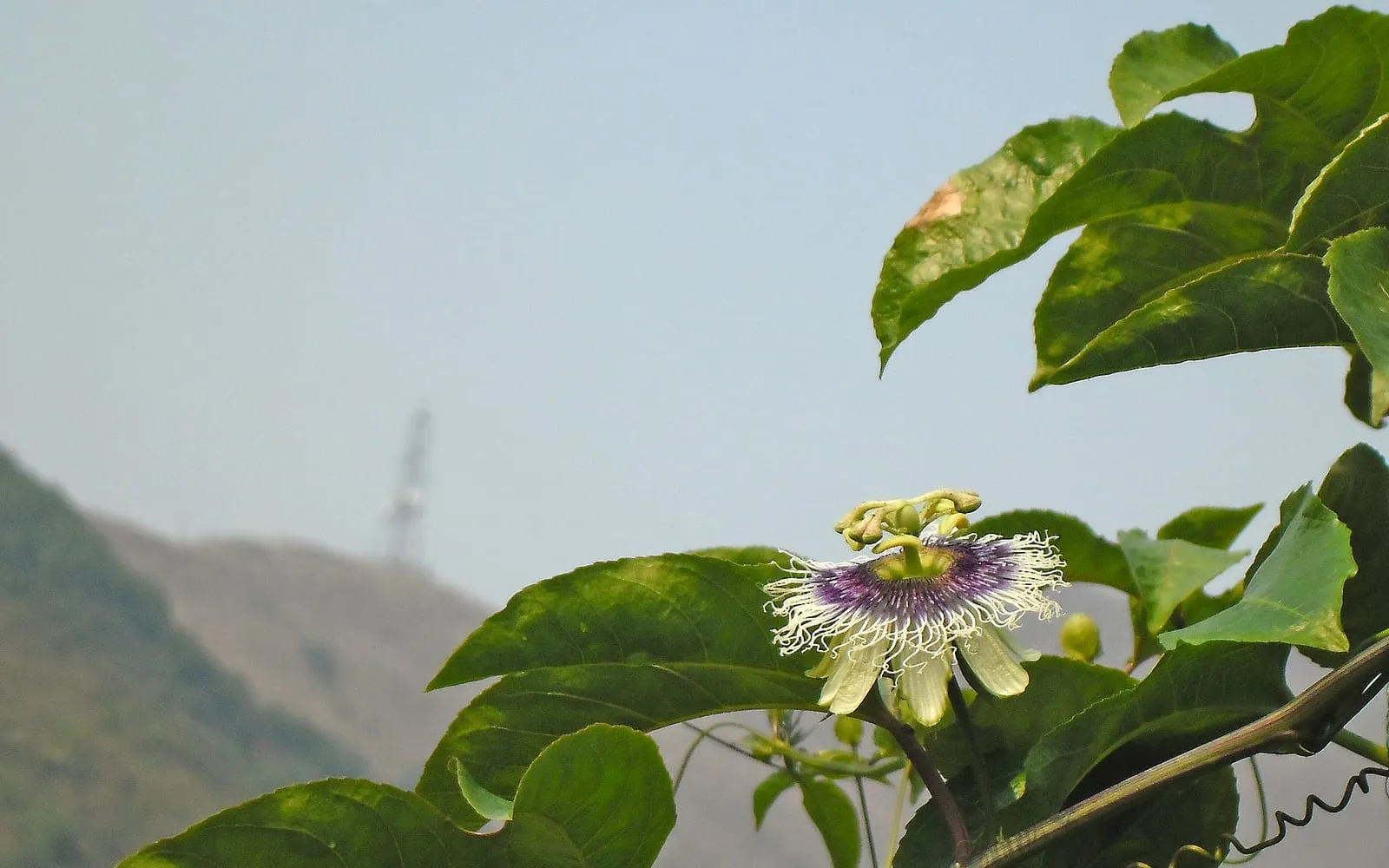
Flowers are 5 to 8 cm across, with five white petals and five sepals beneath a prominent corona of purple and white banded filaments. Above that sit five stamens and three styles on a raised stalk.
Fruit is round to oval, 4 to 7 cm, deep purple when ripe, with a hard smooth shell that wrinkles as it matures. Inside, orange pulp surrounds many crunchy black seeds.
Where it is from
Passiflora edulis is native to southern Brazil, Paraguay and northern Argentina, growing in subtropical forest.
The genus is overwhelmingly American, with several hundred species across the tropics of South and Central America.
Spanish missionaries in South America used the flower’s structure as a teaching device, reading the corona as the crown of thorns, the five stamens as the wounds and the three styles as the nails.
Commercial growing is centred on Brazil, Colombia, Ecuador, Kenya and Australia, and the yellow form, Passiflora edulis f. flavicarpa, is the one grown in the hotter tropics.
Britain has grown it under glass since the nineteenth century, when heated glasshouses on large estates produced a range of subtropical fruit.
How it grows
Grow it under glass. A greenhouse or conservatory with a winter minimum of 10 deg C is the requirement, and the plant dies at the first frost.
Plant into a border or a large container of at least 45 cm, in free-draining fertile compost.
Provide wires or netting for the tendrils to grip. The vine climbs quickly and needs something to hold.
Train a main stem up to the roof and let side shoots run along horizontal wires, since fruit forms on the current season’s growth.
Hand-pollinate. Transfer pollen between flowers with a soft brush in the middle of the day, ideally between two different plants, since some forms set poorly with their own pollen.
Replace the plant every four or five years, as cropping falls away sharply with age.
Through the seasons
Growth restarts in spring as light and temperature increase, and is rapid from April onwards.
Flowering begins in June and continues into September, with each flower lasting a single day.
Hand-pollinate through the flowering period, checking daily since a flower opens and closes within the day.
Fruit develops over ten to twelve weeks and ripens from September into November.
Harvest when the fruit turns fully purple and begins to wrinkle. Ripe fruit drops, and windfalls are ready to eat.
Reduce water and stop feeding through winter, keeping the plant just moist and above 10 deg C.
Care difficulty
Difficult outside the tropics, entirely because of the heat requirement.
There is no way to grow this species outdoors here. It needs a heated structure through winter, which is a cost and a commitment.
Under glass the growing itself is straightforward, with fast growth, quick fruiting and few complications beyond pests.
Hand-pollination is unfamiliar work and has to be done daily during flowering.
Glasshouse pests are the other burden. Red spider mite, whitefly and mealybug all thrive in the conditions this plant needs.
Watering
Water twice weekly through summer, moistening the whole root zone.
Reduce sharply from October, and keep the plant only just moist through winter.
Overwatering in cold conditions rots the roots and is the commonest way to lose a plant over winter.
Mist the foliage in hot weather to raise humidity, which also suppresses red spider mite.
Free drainage is essential. Add grit to container compost and never leave a pot standing in water.
Warning signs, diseases and pests
Plant collapsing after a cold night. Frost. This species has no tolerance at all, and the loss is total.
Fine pale speckling on leaves with webbing. Red spider mite, which thrives in dry conservatory air. Raise humidity and introduce a biological control.
Clouds of small white flies rising from the foliage. Whitefly. Use sticky traps and a parasitic wasp control.
White waxy fluff in the leaf joints. Mealybug. Dab with horticultural soap or use a predator.
Flowers opening and dropping without setting. No pollination. Hand-pollinate daily with a brush during flowering.
Yellow leaves and soft stems in winter. Overwatering in cold conditions. Keep the compost barely moist until spring.
Fruit collapsing into a rotten, maggot-filled mass within days of looking sound. Queensland fruit fly, an outdoor risk across eastern Australia. Net the vine and never move home-grown fruit out of a quarantine area.
Growing environment
Full sun under glass, with a winter minimum of 10 deg C.
A greenhouse, conservatory or heated lean-to is the only practical setting outside the subtropics.
Free-draining fertile compost at pH 6 to 7, in a border or a large container.
Ventilation in summer keeps temperatures manageable and reduces pest pressure, and the plant tolerates high heat well provided there is air movement.
Allow 3 to 4 m of wire. The vine is vigorous and will fill a small greenhouse quickly.
Feeding
Feed fortnightly with a high-potash liquid feed, such as a tomato feed, from May to September.
High potash supports flowering and fruiting, where a high-nitrogen feed produces foliage and few flowers.
Stop feeding from October and resume in spring as growth restarts.
Top-dress container plants each spring with fresh compost.
A plant in a border needs less feeding than one in a pot, though both crop better with regular potash through the season.
Troubleshooting
Vigorous vine, no flowers. Too much nitrogen, or too little light. Switch to a high-potash feed and increase the light.
Flowers but no fruit. No pollination under glass. Use a soft brush daily, and between two plants where possible.
Fruit small and dry. Underwatering, or the plant is past its productive years. Replace it after four or five seasons.
Plant dying over winter. Cold, or wet compost, or both. Keep above 10 deg C and barely moist.
Hardy passionflower producing inedible fruit. That is Passiflora caerulea rather than P. edulis. The two are different plants and only one is worth eating.
Fruit wrinkled on the vine. Ripe. Wrinkling is the sign to pick rather than a problem.
Passion fruit problem guides
Not sure what is wrong? See the common vegetable pests guide.