
Edible
Winged Bean
Psophocarpus tetragonolobus
Also known as Goa bean, Four-angled bean, Asparagus pea, Princess bean, Dragon bean
How to grow winged beans, Psophocarpus tetragonolobus. Heat, humidity, day length and edible pods, leaves, flowers, roots and seeds.
At a glance
- Difficulty
- Difficult
- Water
- Regular. It wants steady moisture through the season
- Light
- Full sun
- Temperature
- 25-32 deg C, with high humidity, and frost kills it
- Humidity
- High. It is a wet tropical plant
- Hardiness
- USDA 11-12, RHS H1a, hardy to 10 C
- Type
- Perennial vine with tuberous roots, grown as a tender annual where frost comes
- Height
- 200-400 cm
- Native to
- Papua New Guinea, south east Asia
Flowering is strongly short-day in most cultivars, so a plant grown outside the tropics climbs vigorously and never flowers, which is the usual reason a crop fails rather than any lack of warmth. It wants 25 to 32 deg C with high humidity. Day-neutral lines exist and are worth seeking out.
Hardiness zones describe winter cold alone. Summer heat, humidity, rainfall and the length of the growing season decide as much, so treat the range as the outer limit rather than as a recommendation.
Edible, with limits
- Safe to eat
- The young pods, leaves, flowers, shoots, tubers and mature seed, all cooked
- Do not eat
- Raw mature seed
- Harm from
- Eating it
- Affects
- People
Winged bean is safe cooked, and it is unusual in that every part of the plant is eaten somewhere. The mature dry seed carries the trypsin inhibitors and lectins common to pulses at levels comparable with soya, so it needs soaking and thorough boiling rather than light cooking, and raw mature seed causes digestive upset. Young pods, leaves, flowers and tubers are cooked briefly and present no such problem. The plant is not one of the 14 named allergens in Britain, and its protein profile is close enough to soya that anyone with a soya allergy should treat it with caution. Seed should be kept away from young children for the same reason it should be cooked.
Sources: Food Standards Agency on the 14 named allergens, Food Standards Agency on food allergy and intolerance
About
Winged bean is the crop agricultural scientists keep rediscovering. Every part of it is edible. The young pods are a vegetable and the leaves a spinach, the flowers go into salads and the shoots are eaten as a green, the seeds are a pulse with protein and oil comparable to soya, and the roots are a starchy tuber carrying far more protein than a potato. A 1975 report from the United States National Academy of Sciences made it briefly famous as a solution to tropical malnutrition.
It has never quite worked at scale. The plant is strongly short-day, so it flowers only where and when nights are long enough, which restricts it to the tropics and makes breeding for other latitudes slow. Yields are variable, the dry seed needs long cooking, and the tubers take months.
Papua New Guinea grows it more seriously than anywhere else, and it is a garden crop across south east Asia, Sri Lanka and southern India. Outside the tropics it is a greenhouse curiosity, and a rewarding one if you have the heat.
Appearance and character
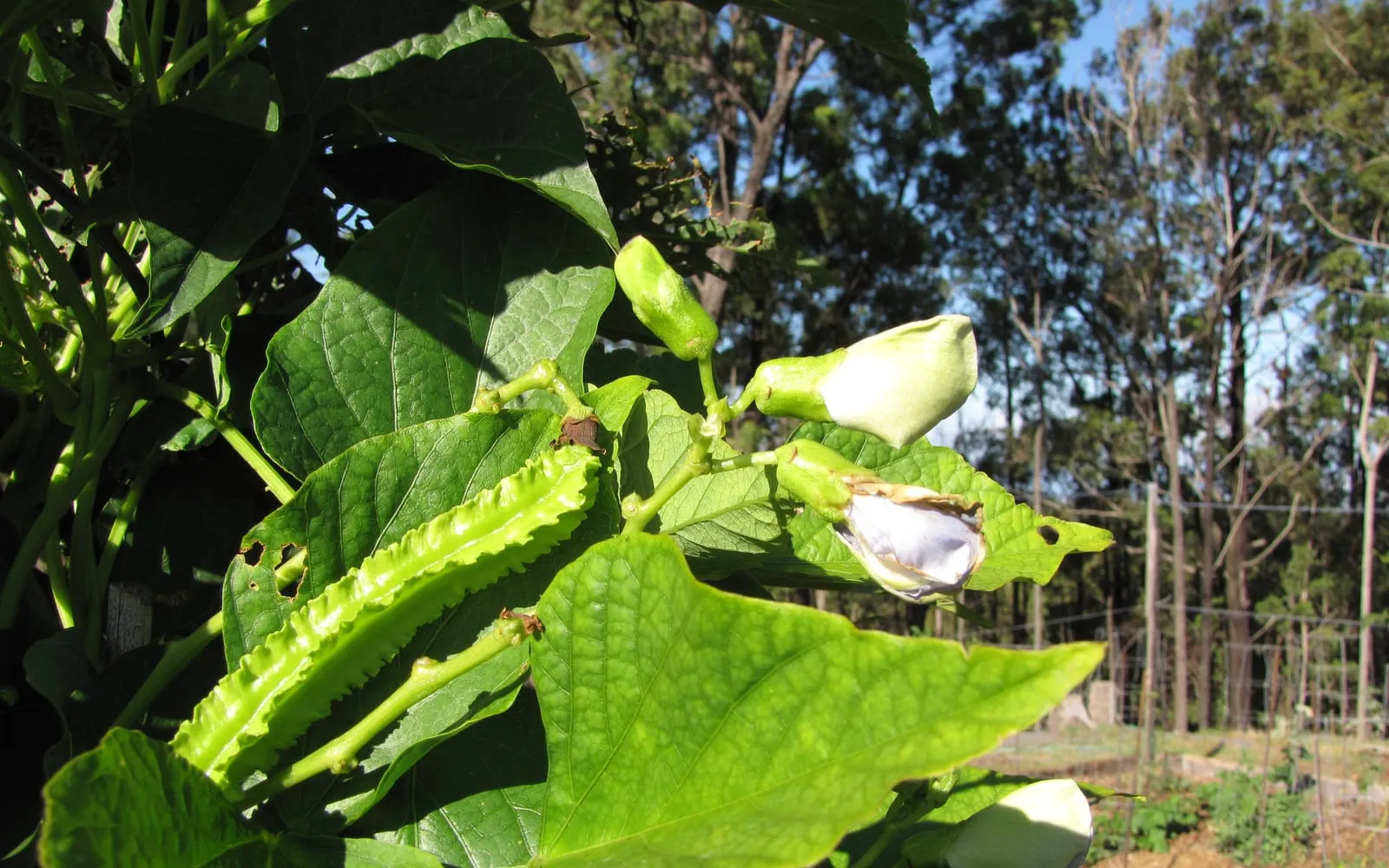
The pod is the identification and nothing else looks like it. It is square in cross section with four longitudinal frilled wings running the length of it, 5 to 40 cm long depending on variety, usually green and sometimes purple or red. Sliced across, it produces a four-pointed star.
The vine twines vigorously, carrying trifoliate leaves with broad triangular leaflets. It looks like a robust runner bean until the pods appear.
The flowers are large pea flowers, usually pale blue or purple, occasionally white, carried on short stalks from the leaf joints. Below ground the plant forms tuberous roots, pale-fleshed and up to 8 cm across in a long season, which are a significant food in Papua New Guinea and Burma.
Where it is from
The origin is argued over. Papua New Guinea holds the greatest diversity of cultivated forms and is the most likely centre of domestication, though the closest wild relatives are African, which has led some authors to place the species’ origin there and its domestication in New Guinea.
Cultivation is old in New Guinea and long established across south east Asia, Indonesia, the Philippines, Sri Lanka and southern India, always as a garden and smallholder crop rather than a field one.
Interest from outside the tropics dates from the 1970s, when the plant was promoted as a protein crop for humid tropical regions where soya does poorly. The enthusiasm has not translated into large-scale production anywhere, and the crop remains a garden staple in the places that have always grown it.
How it grows
Winged bean germinates slowly, and the seed coat is hard enough that scarifying it with sandpaper or soaking it overnight improves germination markedly.
The vine grows steadily once warm, twining up any support and branching freely. It nodulates heavily, with nodules that are unusually large, and it fixes a substantial amount of nitrogen.
Flowering depends on day length. Most varieties need nights of about twelve hours before they will flower, which at high latitude does not arrive until late September, by which point there is no heat left to fill a pod. A few day-neutral lines exist and are hard to buy.
Tubers form late, over four to six months, which is longer than a short season provides even under glass.
Through the seasons
Sow indoors in March or April at 25 deg C, after soaking or scarifying the seed. Pot on into a large container and grow under glass with a support.
The vine grows through the summer, wanting warmth and humidity throughout. Ventilate on hot days and damp the floor rather than letting the air dry, since red spider mite is the main problem under glass.
Flowering, if it comes, is in September. Pick young pods at 15 to 20 cm, when they snap cleanly, and keep picking to encourage more. Frost ends the plant, and a cool-climate grower is generally harvesting pods rather than seed or tubers.
Care difficulty
This is the hardest crop in the wave to bring to anything outside the tropics, because it needs the right combination of heat, humidity and day length.
Heat and humidity can be supplied by a heated greenhouse. Day length cannot be supplied at all without blacking out the plant for part of each day, which is what commercial growers of short-day crops do and which is more effort than most gardeners will contemplate.
Grow it for the plant and the pods rather than the seed or the tubers. A vine under glass with a few star-shaped pods in September is a reasonable outcome, and a dry seed harvest is not.
Watering
Water regularly and generously. This is a wet tropical plant and it does not tolerate drying out, unlike most of the pulses in this collection.
Under glass, water thoroughly two or three times a week in summer, more in a heatwave, and damp down the floor to keep humidity up.
Standing water still rots the roots, and it will destroy the tubers if the plant has begun to form them.
Warning signs, diseases and pests
Red spider mite is the pest that ruins winged bean under glass. Dry warm air suits it perfectly, and the first sign is a fine pale speckling on the upper leaf surface, followed by webbing at the growing tips. Keeping the humidity up is the best defence.
Whitefly clouds up from the leaves when disturbed and leaves sticky honeydew and sooty mould behind. Aphids gather on the growing tips.
Powdery mildew appears in still air as a white coating on the leaves, and it follows poor ventilation rather than dryness at the root.
Failure to flower is the commonest disappointment and it is not a disease. Short-day cultivars wait for nights that arrive too late in the year at high latitude.
Growing environment
Full sun, 25 to 32 deg C, and high humidity. This is a humid tropical crop and it declines in the dry heat that suits a tomato.
A heated greenhouse or a warm conservatory is the practical setting outside the tropics. Outdoors, even in a hot summer, the plant will grow slowly and flower too late.
Soil should be free-draining and slightly acid, from pH 5.5 to 6.8, and moderately fertile. Give it a large deep container if it is under glass, since the root system is substantial and the plant may attempt tubers.
Feeding
Feed nothing in the ground. Winged bean nodulates heavily and fixes a large amount of nitrogen, and fertiliser suppresses that and produces a leafy vine with no flowers.
In a container a high-potash feed every fortnight from flowering helps, since a pot restricts what the roots can find.
Phosphate supports nodulation, so a container mix with a reasonable phosphate content gives better nodules than a high-nitrogen compost would.
Troubleshooting
Is every part edible? Pods, leaves, flowers, shoots, seeds and tuberous roots are all eaten somewhere, which is unusual and is the basis of the plant’s reputation. All of them are cooked, and the mature dry seed needs long boiling.
Why did my plant not flower? Day length. Most cultivars need nights of about twelve hours, which at high latitude arrive in late September when there is no heat left to fill a pod. Day-neutral lines exist and are hard to find.
Can I grow it outdoors in a cool climate? The vine will grow in a hot summer against a sheltered wall and it will not crop. A heated greenhouse is the only realistic setting.
Is it the same as asparagus pea? No, though the names overlap in European seed catalogues. Asparagus pea is Lotus tetragonolobus, a small hardy plant with red flowers and short winged pods. Winged bean is a tropical vine.
Why is the seed slow to germinate? A hard seed coat. Soak it overnight or rub one edge with sandpaper before sowing, and germinate it at 25 deg C.
What do the tubers taste like? Nutty and firm, closer to a water chestnut than to a potato, with far more protein. They take four to six months to form, which is longer than a short season allows.
How do I cook the pods? Pick them young at 15 to 20 cm while they snap cleanly, then steam, stir-fry or boil briefly. Older pods become fibrous and tough, and the wings turn stringy.
Winged Bean problem guides
Not sure what is wrong? See the common vegetable pests guide.