
Edible
Finger lime
Microcitrus australasica
Also known as Australian finger lime, Caviar lime, Citrus caviar
How to grow finger lime, Microcitrus australasica. An Australian rainforest citrus whose fruit is filled with juice vesicles that burst like caviar.
At a glance
- Difficulty
- Difficult
- Water
- When the top few centimetres dry, so twice weekly in summer and monthly in winter
- Light
- Bright light with some shade from the fiercest midday sun
- Temperature
- Minimum 5-7 deg C, and it tolerates a light touch of frost
- Humidity
- Moderate to high, reflecting its rainforest origin
- Hardiness
- USDA 9-11, RHS H1c, hardy to -3 C
- Type
- Evergreen shrub or small tree, slow-growing and long-lived
- Height
- 1.5-2.5 m in a container
- Native to
- Eastern Australia
- Best month
- September, October and November in the Northern Hemisphere, March, April and May in the Southern Hemisphere
The rainforest understorey of northern New South Wales and southern Queensland. It wants dappled shade rather than the full sun other citrus demand, and the vesicles separate into the caviar-like beads it is grown for.
Hardiness zones describe winter cold alone. Summer heat, humidity, rainfall and the length of the growing season decide as much, so treat the range as the outer limit rather than as a recommendation.
Every month named in this guide is for the temperate Northern Hemisphere. If you garden in the Southern Hemisphere, shift each one by six months, so September becomes March. Closer to the equator the wet and dry seasons matter more than the calendar, and the shift stops being a useful guide.
Skin irritant
- Safe to eat
- The juice vesicles and the zest
- Do not eat
- Peel oils and leaves, for pets
- Harm from
- Eating it and handling it
- Affects
- Cats, dogs and horses
The fruit is food. The entry that matters is the veterinary one. The ASPCA lists citrus as toxic to cats, dogs and horses, on the strength of the essential oils and psoralens concentrated in the peel, the pith and the leaves rather than anything in the flesh. A pet that chews peel or foliage may vomit or develop a skin reaction, and citrus oil products marketed as pet deterrents have caused poisoning at concentrated doses. Sap and leaves can also irritate human skin, and the psoralens they carry are phototoxic, so a scratch from a thorn followed by strong sunlight sometimes produces a burn out of proportion to the wound. Wear sleeves when pruning a thorny plant on a bright day.
Sources: RHS potentially harmful garden plants, ASPCA toxic and non-toxic plants
About
Cut a finger lime across and hundreds of tiny juice-filled spheres tumble out, each one bursting separately in the mouth with a sharp lime flavour. Chefs pay a great deal for that texture, and the fruit sells under the name citrus caviar.
The plant is an Australian rainforest understorey shrub rather than a Mediterranean orchard tree, and that changes how it is grown. It tolerates and even prefers some shade, and it wants higher humidity than other citrus.
It is slow. A grafted plant takes three to four years to fruit and grows at a fraction of the rate of a lemon, which is part of why the fruit is expensive.
Thorns are severe. The stems are armed along their whole length with sharp spines, and picking is a careful business.
Appearance and character
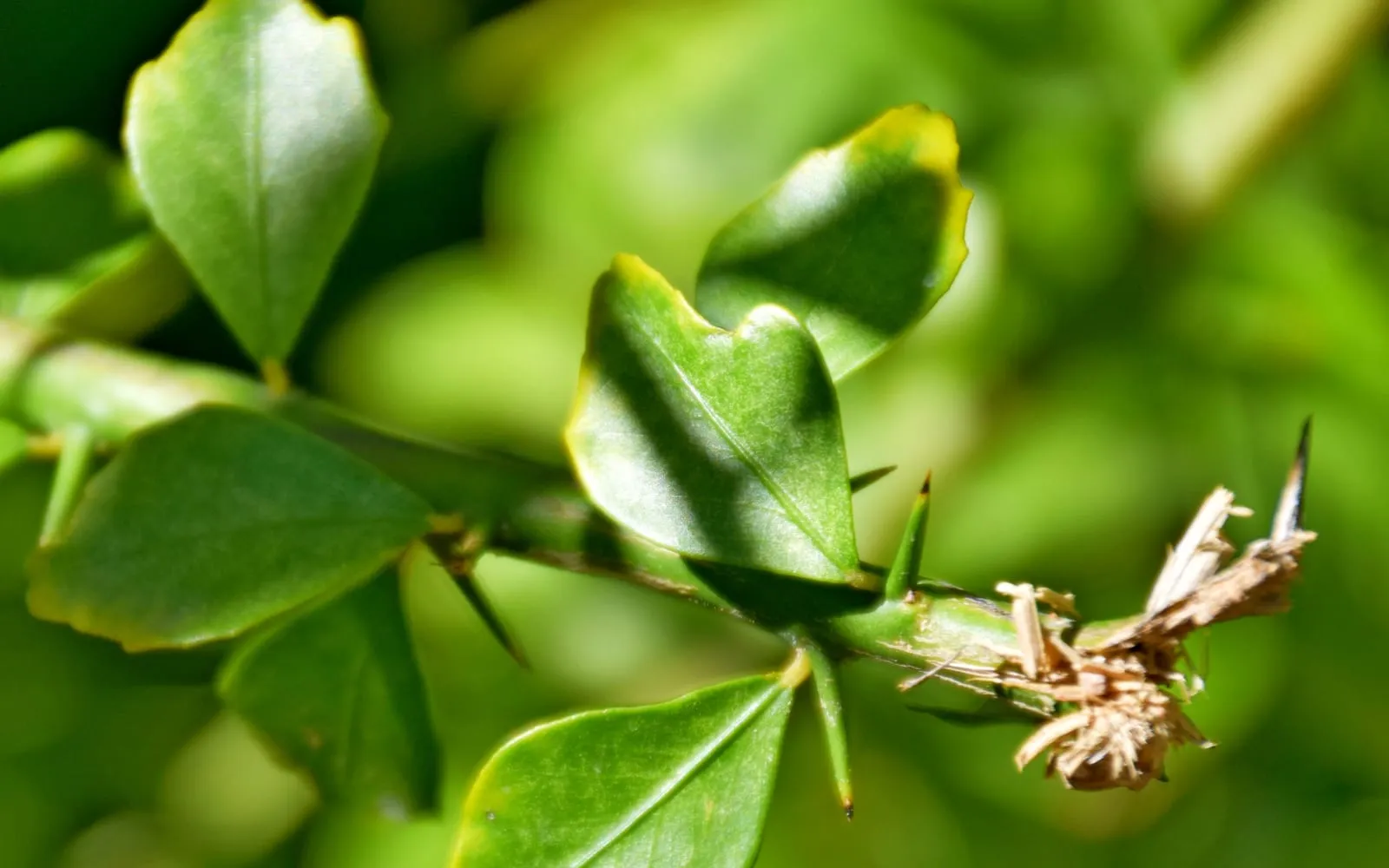
A dense twiggy evergreen shrub with fine upright growth and sharp thorns along the stems.
Leaves are very small, 1 to 3 cm, which is unlike any other citrus and gives the plant a fine textured appearance closer to a box shrub.
New growth often flushes bronze or purple before turning green.
Flowers are small, 1 to 1.5 cm, white or pale pink, opening from late spring into summer, lightly scented.
Fruit is cylindrical and finger-shaped, 4 to 12 cm long and 2 to 3 cm thick, in colours from green through pink and red to near black depending on the selection. Inside, the flesh is made of separate spherical vesicles rather than the usual segments of juice sacs.
Where it is from
Microcitrus australasica grows wild in the subtropical rainforest of south-east Queensland and northern New South Wales.
It is an understorey plant, growing beneath a canopy rather than in open sun, which explains its tolerance of shade and its appetite for humidity.
Aboriginal peoples of the region used the fruit as food long before European settlement, and it is one of the better-known Australian bush foods.
Commercial cultivation began only in the 1990s, when chefs discovered the texture, and named selections such as ‘Rainforest Pearl’ and ‘Durham’s Emerald’ date from that period.
Botanists now generally place it in Citrus as Citrus australasica, though the older name Microcitrus remains in wide use in the trade.
How it grows
Buy a grafted plant. Seedlings take five to fifteen years to fruit, where a grafted plant fruits in three or four.
Pot into free-draining citrus compost, slightly more acid than for other citrus, at pH 5.5 to 6.5.
Give it bright light with shade from the fiercest midday sun, which suits its understorey origin better than the full exposure other citrus want.
Keep the winter minimum at 5 to 7 deg C. It tolerates a brief light frost, which is more than a lime will take, though it is happier frost-free.
Water thoroughly and let the compost dry down, and keep humidity higher than for other citrus.
Prune lightly in spring with gauntlets, since the thorns are severe.
Through the seasons
Growth starts slowly in spring, and the plant is never fast.
Flowering runs from late spring into summer, with small pale flowers scattered through the twiggy growth.
Fruit develops over four to five months through summer and autumn.
Move the plant outside in summer to a sheltered position with dappled light rather than full exposure.
Fruit ripens from September into November. It is ready when it comes away from the stalk with a light pull and the skin has developed its full colour.
Bring the plant under cover in October and keep it bright, barely moist and above 5 deg C through winter.
Care difficulty
Difficult, mainly because of the slow growth and the different conditions it wants.
Anyone treating it as an ordinary citrus and giving it full blazing sun and dry air will get a plant that sulks.
The rainforest requirements of dappled light and higher humidity are easy to supply once understood.
Slowness tests patience. Three to four years to the first fruit from a grafted plant is normal, and the plant never bulks up quickly.
Thorns make every operation slower and require proper gloves.
Watering
Water thoroughly and let the top few centimetres dry before watering again.
The plant wants more consistent moisture than a Mediterranean citrus, reflecting its rainforest origin, though it still will not tolerate waterlogging.
Reduce watering in winter as growth slows.
Mist regularly or stand the pot on a humidity tray, since dry air causes leaf drop and mite problems.
Use rainwater where possible, since the plant prefers slightly acid conditions and hard water pushes the pH the wrong way.
Warning signs, diseases and pests
Leaves scorching and bleaching in full summer sun. Too much direct light for an understorey species. Provide dappled shade at midday.
Fine speckling with webbing under the leaves. Red spider mite in dry air. Raise humidity and mist.
Brown bumps along the thorny stems. Scale insects. Scrub off carefully with a soft brush.
White waxy fluff in leaf joints. Mealybug. Dab with horticultural soap.
Leaf drop in winter. Cold, dry air, or overwatering. Check the compost and the humidity together.
No fruit after three years. Often normal for a young grafted plant, and expected for a seedling.
Growing environment
Bright light with shade from strong midday sun, which is the main difference from other citrus.
A winter minimum of 5 to 7 deg C, tolerating a brief light frost.
Free-draining citrus compost at pH 5.5 to 6.5, slightly more acid than other citrus want.
Moderate to high humidity, matching its rainforest origin.
A pot of 30 to 40 cm suits a mature plant, since the species stays compact and grows slowly.
Feeding
Feed fortnightly with summer citrus feed from March to October, at slightly reduced strength given the slow growth.
Switch to winter citrus feed monthly through the colder months.
Avoid overfeeding, which a slow-growing plant cannot use and which builds up salts in the compost.
Sequestered iron corrects yellowing between the veins.
Top-dress with fresh compost each spring, and repot every three years rather than every two.
Troubleshooting
Plant growing very slowly. Normal for the species, which is slow by nature.
Leaves bleaching in summer. Too much direct sun. It is an understorey plant and wants dappled light.
No fruit from a seedling after five years. Expected. Seedlings can take fifteen years, which is why grafted plants are worth the extra cost.
Vesicles dry rather than juicy. Underwatering during fruit development, or fruit picked past its best.
Fruit dropping before ripening. Water stress or a sudden temperature change.
Thorns making picking impossible. Use gauntlets and pick with secateurs, cutting the stalk rather than pulling.
Finger lime problem guides
Not sure what is wrong? See the common vegetable pests guide.