
Edible
Black raspberry
Rubus occidentalis
Also known as Blackcap, Black cap raspberry, Thimbleberry
How to grow black raspberry, Rubus occidentalis. Arching purple canes that root at the tips, intense dark fruit, and the one plant you must keep it away from.
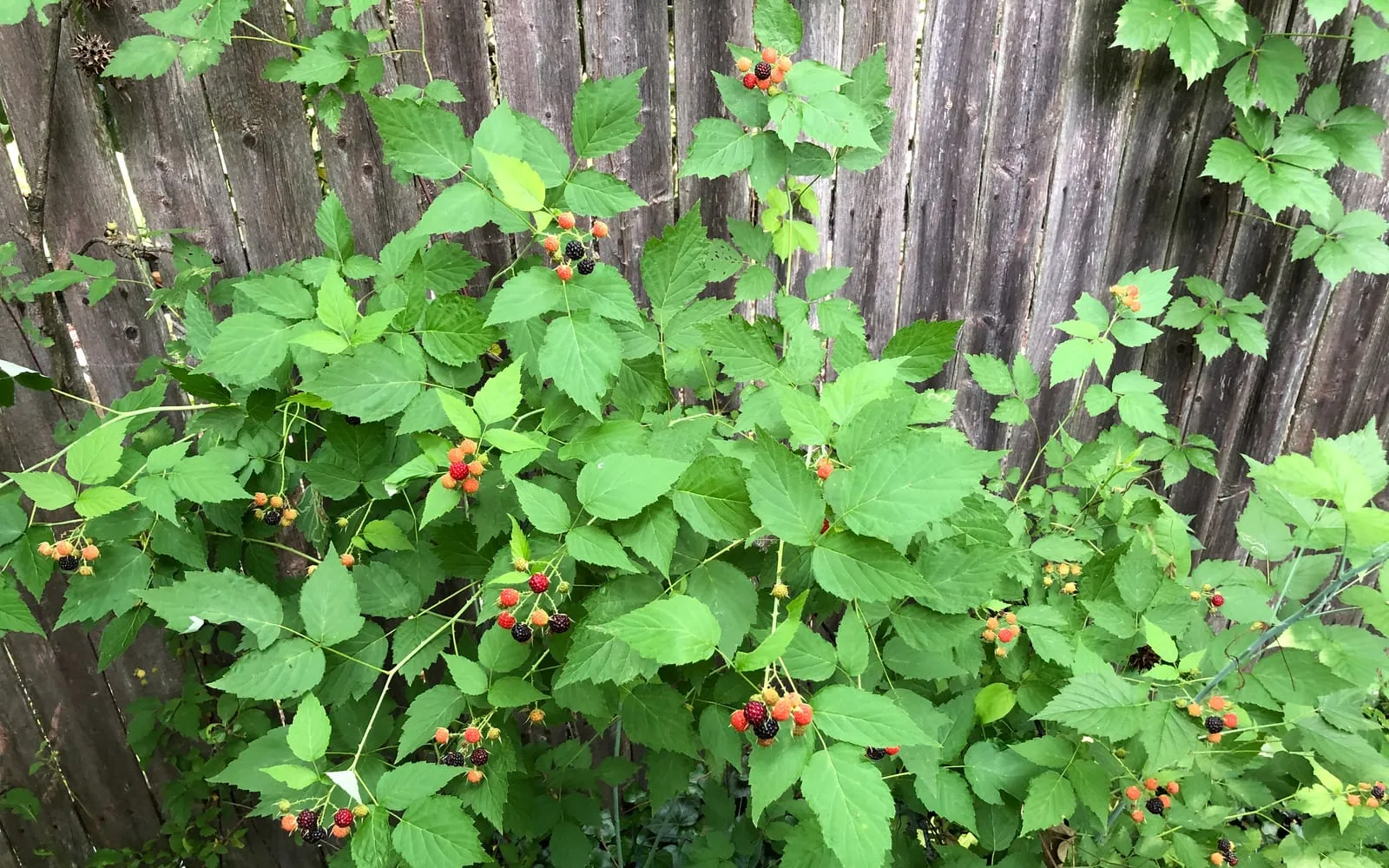
At a glance
- Difficulty
- Moderate
- Water
- Weekly in dry spells
- Light
- Full sun
- Temperature
- Fully hardy to -25 deg C
- Hardiness
- USDA 4-8, RHS H6, hardy to -30 C
- Type
- Deciduous perennial with biennial canes
- Height
- 1.5-2.5 m, arching wider than tall
- Native to
- Eastern North America
- Best month
- July and August in the Northern Hemisphere, January and February in the Southern Hemisphere
Cold suits it and heat does not, and it fails in summers where the soil stays above about 30 deg C. The greater constraint is disease. Black raspberry collapses to viruses carried from red raspberries by aphids, so the two want separating by 200 m or more, and a planting is usually spent within eight years.
Hardiness zones describe winter cold alone. Summer heat, humidity, rainfall and the length of the growing season decide as much, so treat the range as the outer limit rather than as a recommendation.
Every month named in this guide is for the temperate Northern Hemisphere. If you garden in the Southern Hemisphere, shift each one by six months, so July becomes January. Closer to the equator the wet and dry seasons matter more than the calendar, and the shift stops being a useful guide.
Not known to be toxic
- Safe to eat
- The ripe fruit
The fruit is food and the plant carries no toxicity concern. Neither the RHS nor the ASPCA lists Rubus as harmful, and the ASPCA does not record the genus as toxic to cats or dogs. Leaves have a long history as a herbal tea and present no hazard. The practical risks are physical rather than chemical. Prickles and bristles scratch, and a scratch from a cane that has been lying in soil is worth washing properly. Fruit picked at knee height beside a path or a field edge may carry contamination from animals, which is a foraging caution rather than a garden one.
Sources: RHS potentially harmful garden plants, ASPCA toxic and non-toxic plants
About
A black raspberry is not a blackberry. Pick one and it comes away hollow, leaving the white core behind on the plant, which is the raspberry signature. A blackberry takes its core with it.
The flavour is deeper and more winey than a red raspberry, with a distinct note that American bakers build whole pies around. It is the fruit behind the black raspberry ice cream that has no equivalent outside North America.
The canes look different from any other cane fruit, arching in a strong curve, coated in a blue-white bloom over purple, and armed with hooked prickles.
One rule governs where you plant it. Black raspberries are severely vulnerable to viruses that red raspberries carry without symptoms, and aphids move those viruses between the two. Keep them well apart.
Appearance and character
A cane fruit with biennial canes, growing one season and fruiting the next.
Canes arch strongly rather than standing upright, reaching the ground and rooting where the tip touches, which is how the plant spreads in the wild.
Stems are purple with a heavy blue-white waxy bloom that rubs off on your hands, and carry stiff hooked prickles.
Leaves are in threes or fives, green above and white-felted beneath.
Flowers are small and white in May and June, in tight clusters at the cane tips and side shoots.
Fruit is a firm dome 1 to 1.5 cm across, deep purple-black with a slight bloom, hollow when picked.
Where it is from
Rubus occidentalis is native to eastern and central North America, from Quebec down to Georgia and west to the Dakotas.
It grows on woodland edge, clearings, old fields and roadsides, favouring disturbed ground with plenty of light.
Cultivation began in the mid-nineteenth century, and Ohio became the centre of a substantial industry, much of the crop going into juice and food colouring rather than fresh fruit.
‘Bristol’, ‘Jewel’ and ‘Munger’ are the long-standing varieties, and ‘Jewel’ is the one most often offered outside North America.
It has never caught on in Europe the way it did in America, partly because European gardens have red raspberries in them, which makes the virus problem hard to avoid.
How it grows
Buy certified virus-free plants from a fruit nursery. This matters more for black raspberry than for any other cane fruit.
Site it as far from red raspberries as your garden allows, and further if you can. Commercial guidance is 100 m or more, which few gardens can offer, so aim for the opposite end of the plot at minimum.
Plant in autumn or early spring in full sun, 60 to 90 cm apart, in well-drained fertile soil.
Pinch out the tips of new canes when they reach about 90 cm in early summer. This forces side shoots, keeps the plant compact and greatly increases the crop.
Shorten those side shoots to about 30 cm in late winter.
Cut fruited canes to the ground straight after harvest. Do not let tips root unless you want more plants.
Through the seasons
New canes emerge in spring and grow strongly through May and June.
Tip-pinch in June when the canes reach 90 cm, which is the single most useful job of the year for this plant.
Last year’s canes flower in May and June and fruit through July into August.
Pick every day or two while cropping. Ripe fruit is dull black rather than shiny and comes away with no pull.
Cut the fruited canes out immediately after harvest and burn or bin them, since they harbour cane blight.
Late winter is for shortening the side shoots and tying the canes in.
Care difficulty
Moderate. The growing is straightforward and the siting is the hard part.
Virus is the defining problem. Red raspberries nearby will infect a black raspberry planting within a few years, and there is no cure once it happens.
The plant is otherwise vigorous and hardy, and the tip-pinching routine is easy once learnt.
Expect to replace the planting after eight to ten years even in good conditions, which is shorter than a red raspberry row lasts.
Hooked prickles and arching canes make it a scratchier plant to work with than a wineberry.
Watering
Water weekly during dry spells, 15 litres per plant, applied at the base.
July is the month that matters, when the fruit is sizing and ripening.
Keep water off the foliage and fruit, since wet berries mould quickly.
Mulch in spring with compost or well-rotted manure, kept clear of the cane bases.
Good drainage is as important as moisture. Black raspberry roots will not tolerate sitting wet through winter.
Warning signs, diseases and pests
Leaves mottled yellow-green, canes stunted, crops falling away. Virus, almost certainly from red raspberries nearby. Dig the plants out and start again elsewhere with certified stock.
Colonies of aphids on shoot tips. The virus vector. Controlling them helps, but distance from red raspberries helps far more.
Canes dying back with dark patches and split bark. Cane blight or spur blight, entering through wounds. Cut out affected canes to ground level and burn them.
Grey mould on ripening fruit. Wet weather and crowded canes. Thin, pick often and remove affected fruit.
White powdery coating on leaves. Powdery mildew in a dry season. Mulch and water.
Fruit disappearing. Birds, which take black raspberries readily. Net the row.
Growing environment
Full sun. This species fruits poorly in shade.
Well-drained fertile soil at pH 5.5 to 6.8. It is less tolerant of heavy wet ground than a red raspberry.
Air movement helps against mould and blight, so avoid a still enclosed corner.
Distance from red raspberries is the environmental factor that decides whether the planting survives, and it outweighs everything else.
Allow 90 cm between plants and 1.8 m between rows, with wires at 60 cm and 1.2 m to tie the arching canes to.
Feeding
Feed once in early spring with a balanced fertiliser, or mulch with well-rotted manure.
Avoid heavy nitrogen, which produces soft canes prone to blight and delays ripening.
Sulphate of potash in late winter improves fruit where cane growth is strong but the crop is light.
Do not feed after June, so the canes harden before winter.
Mulch annually, which matters on the free-draining soil this plant prefers.
Troubleshooting
Plants declining after three or four years. Virus from nearby red raspberries. The only fix is distance and fresh certified stock.
Long unbranched canes with fruit only at the tips. Tip-pinching was missed. Pinch at 90 cm next June.
Small seedy fruit. Drought in July, or an ageing planting. Water through ripening and plan to replace after eight years.
New plants appearing at the cane tips. Natural tip-rooting. Sever and lift them in autumn, or prevent it by shortening the canes.
Canes dying back over winter. Cane blight through wounds, or soft late growth from feeding too late in the season.
Fruit sour. Picked too early. Ripe black raspberries lose their shine and detach with no resistance.
Black raspberry problem guides
Not sure what is wrong? See the common vegetable pests guide.